
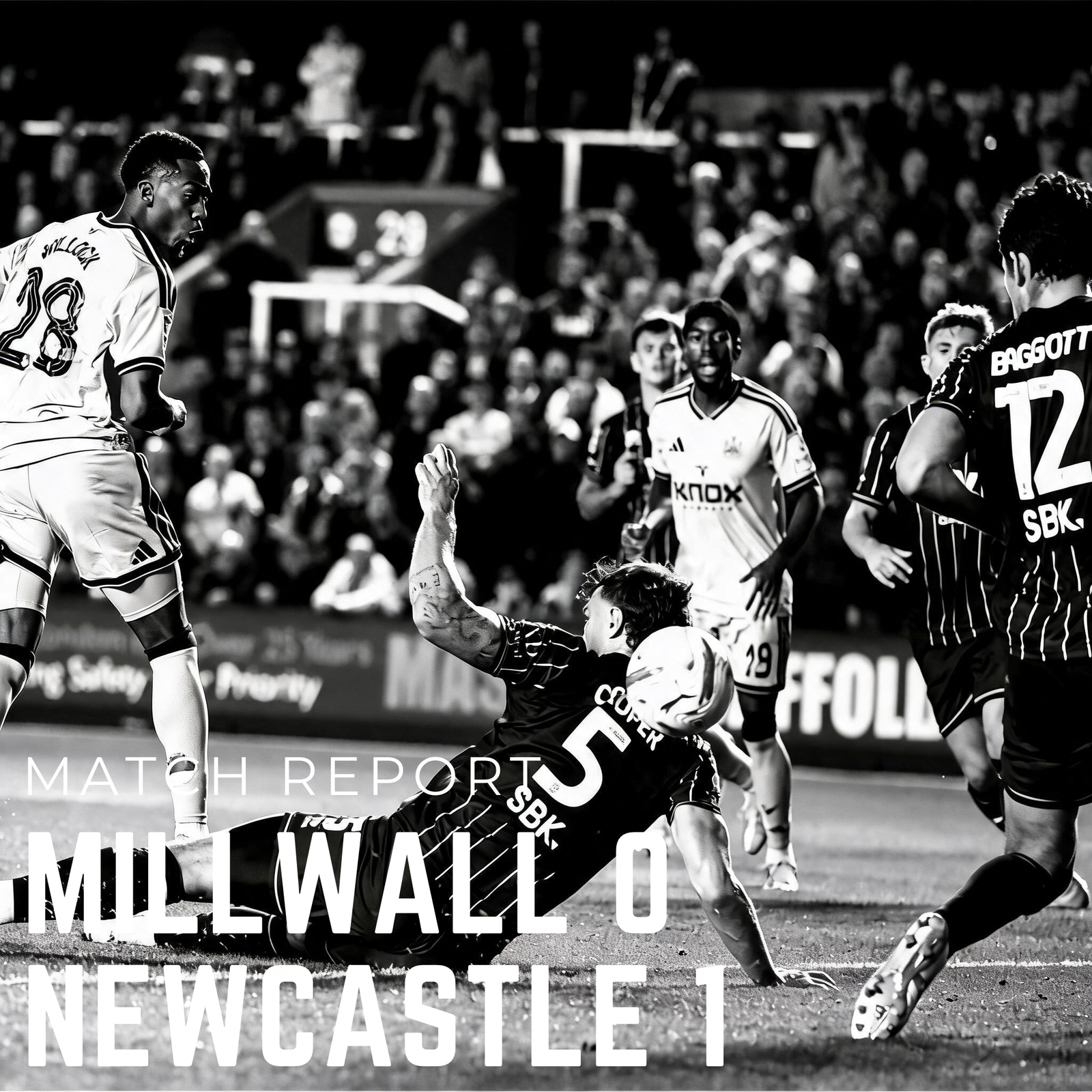
The teamsheet dropped at The Den forty minutes before kick-off and settled an argument before a ball had been struck: three changes, not the wholesale clearout that had seemed the safer bet for a Tuesday night in Bermondsey against Championship opposition. Sven Botman, Lewis Hall, Joe Willock, Harvey Barnes, Yoane Wissa and Amar Dedić all kept their places from Saturday’s draw with Bournemouth. Only Malick Thiaw, Lewis Miley and Anthony Elanga made way, for Fabián Schär, Jacob Ramsey and Jacob Murphy. For a manager five matches into the job, at a ground with a genuine history of humbling bigger clubs, that is a team sheet with intent written through it.
The reasoning isn’t hard to trace. Newcastle arrived at The Den as past winners of this competition and semi-finalists last season, and a young head coach fielding a second-string XI in round three away to a side sitting handily in the Championship risked exactly the kind of night this competition has previously punished sides for taking lightly. Millwall had won 4-0 three days earlier, had lost only one of three home league matches, and had never once hosted Newcastle at the current stadium in the thirty-three years since it opened — the sides hadn’t met at all, anywhere, since 1993. Alex Neil’s side had every reason to fancy their night, and Jaissle’s team selection reads as a direct answer to that threat rather than a nod to the calendar. With Leeds not arriving until Monday, there was no fixture-congestion argument forcing his hand toward heavy changes in the first place — the six-day gap gave him the freedom to rotate hard if he’d wanted to, and he chose largely not to take it.
Look closer at who did sit out, too, and it reads less like a rotation policy than individual maintenance: Thiaw, Miley and Elanga rested on their own specific terms rather than as representatives of a fringe cohort given a run-out. That distinction matters. A coach still bedding in a high-press structure that depends on players reading one another’s triggers has good reason to protect continuity over giving minutes away — wholesale changes cost cohesion faster than they save legs this early into a new system, and Jaissle appears to have judged that trade-off wasn’t worth making against a Millwall side sitting deep and compact.
Which is what makes the eighty minutes that followed so instructive. This was, by most reasonable definitions, close to full strength — and it still took until the 81st minute to break Millwall down. Newcastle finished with 25 shots to Millwall’s nine, 15 corners to one, and an expected-goals reading of 1.77 against 0.50, yet spent long stretches of the first half unable to turn territory into anything alarming for Filip Marschall, handed his Millwall debut after a spell on loan at Gateshead. Of Newcastle’s 25 attempts, only one was rated a genuine big chance by the data — and they took it. Fourteen efforts before the break produced one shot on target, Willock’s low strike parried into the six-yard box rather than finished by the lurking Wissa. Murphy dragged an early sighter over. Jake Cooper and Caleb Taylor gave nothing away cheaply in the Millwall backline, and for a team picked specifically to win rather than to rest, the profligacy carried more weight than it would have against a weekend reserve XI — there was no fatigue or unfamiliarity to point to as mitigation.
Millwall nearly made Newcastle pay for it. Nine minutes before the winner, substitute Tairyk Arconte turned Tino Livramento — only recently back from a long injury lay-off — and dragged a shot back off the near post with Lukas Horníček well beaten. Had that gone in, a near-full-strength Newcastle side would have been staring at a genuine upset rather than a mid-round formality, and the story of the selection would have written itself very differently. Instead, Jaissle’s bench did what his starters hadn’t: Elanga and deadline-day arrival Matías Fernández-Pardo had been on since the 66th minute to force the issue, and fifteen minutes later Hall’s low ball across the six-yard box found Willock at the back post for the finish that separated the sides.

If one player made that selection look assured rather than merely bold, it was Hall. Tuesday continued a run of form that’s hard to argue with: an 8.6 in the win at Tottenham, a 7.8 with the assist in the Bournemouth draw, and now an 8.8 — his best of the three — built on the low ball across the six-yard box that Willock turned in. The pattern in the numbers matches the pattern on the pitch: solid without much incident defensively for an hour, then increasingly the outlet Newcastle turned to as Millwall’s low block held firm everywhere else, finishing with four chances created and more touches of the ball, 85, than anyone else on the pitch in either shirt. Speaking to Sky Sports afterwards, Hall credited the change in mood at the club since Jaissle’s arrival, saying the new coaching staff have “been top” and that the way they’re playing is one the whole squad is enjoying. On this evidence the feeling is mutual: he played every one of the ninety minutes on offer.
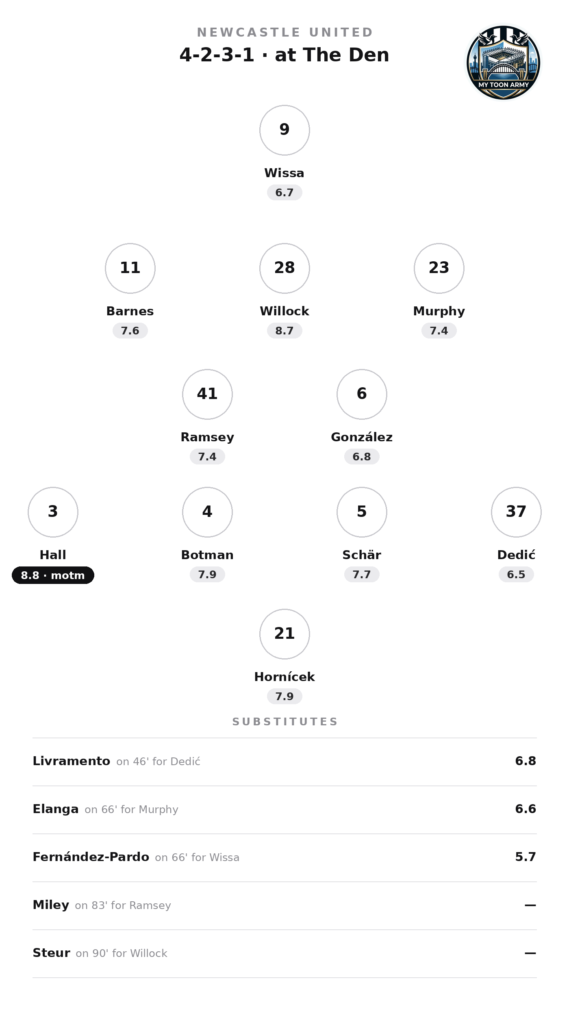
Willock is harder to write about cleanly, because the version of him that shows up changes depending on which ninety minutes are on. Nobody covered more ground trying to get into a scoring position than he did on Tuesday — ten duels won, more than any other player on the pitch, five shots, three of them on target, both the most of anyone in a Newcastle shirt — and it was that same appetite for the eighteen-yard box that put him on the end of Hall’s ball nine minutes from time, a finish rated a mere 0.28 expected goals that still finished with an on-target probability of 0.93 once it left his boot: not a gift, a finish. But the instinct that gets him into those positions so reliably is the same one that, watched over a longer run of matches, just as often produces the rushed shot or the wrong final pass when a simpler option is on: Newcastle’s profligacy in the first eighty minutes at The Den wasn’t confined to Murphy’s off night on the other flank. It’s what makes Willock simultaneously one of the easier players in this squad to get frustrated with and one of the hardest to leave out — a midfielder capable of long stretches of anonymity in the final third who has also, down the years, popped up with matchwinners. Tuesday’s ledger settled in his favour, emphatically. It won’t always.
Read the selection and the performance together, and a picture emerges of a manager unwilling to gamble with a competition his club takes seriously, backed by a group that took nearly the full ninety to justify his faith in them. Newcastle move into the Carabao Cup fourth round with the intended trophy challenge intact and the spine of the side rested only where it needed to be — but the manner of it, an expected-goals gulf that size taking until nine minutes from time to show up on the scoreboard, is worth remembering the next time a Championship low block stands between this squad and where it wants to go.
Newcastle return to league business on Monday at Elland Road, sitting seventh after four matches without defeat, against a Leeds side with its own survival plan to protect. Whether Tuesday’s finishing edge travels with the group Jaissle trusted to find it, or whether Bermondsey’s near-miss was the more honest guide to where this Newcastle side currently stands under pressure, gets another real test inside a week.
Do you think it was a scrappy win? The sort of results that we need to be able to grind out if we’re going to have a good season ahead? Join the conversation on X @mytoonarmy #NUFC
Response
[…] watched him train through pre-season, and decided he wasn’t for sale. Willock stayed. Three weeks later he was flicking home a matchwinner off a Lewis Hall cross away at Millwall — his second goal of a campaign that was never supposed to happen on […]