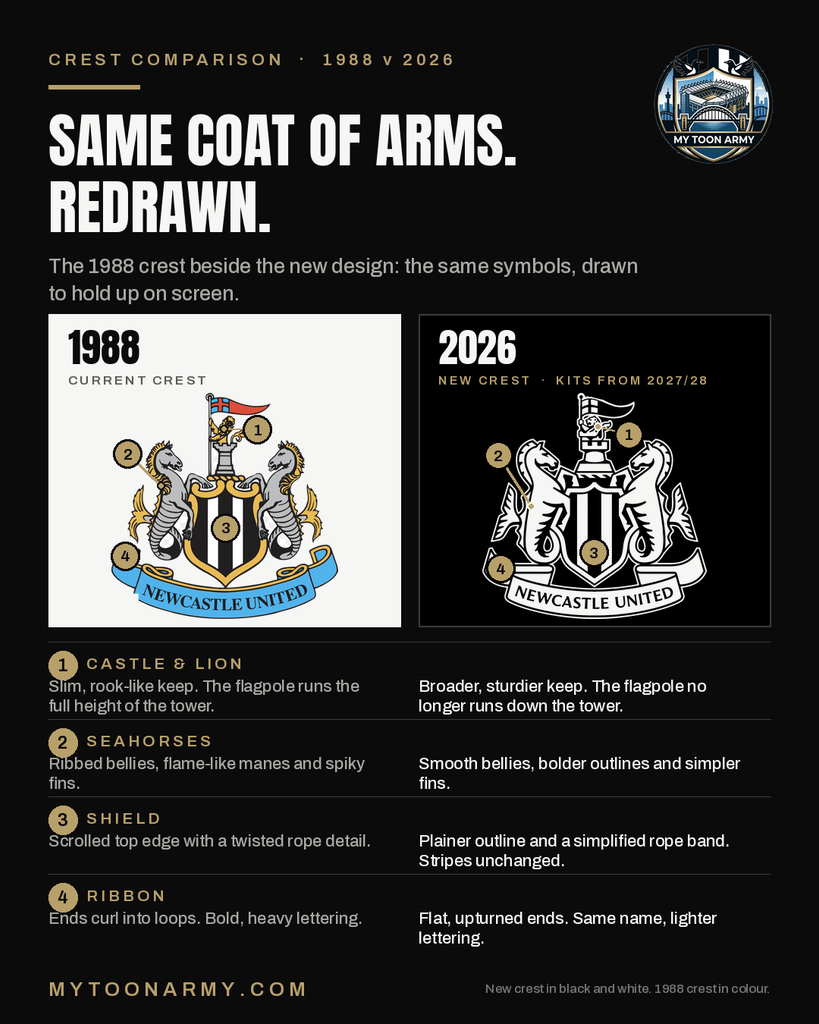
The club has redrawn its badge for the first time since 1988. The symbols are the same. The drawing is not. Here is why it happened, and what it means for the club now and in the future.
Newcastle United have a new crest, and at first glance you might not notice.
The castle is still there. So are the lion, the two seahorses and the black-and-white stripes. The ribbon still carries the club’s name. Nothing has been swapped out and nothing new has been added.
That is exactly what supporters asked for.
Why change it?
The old crest was drawn in 1988. It is 38 years old, and it was made for a different time.
Back then, a badge lived on a shirt, a programme and a ticket. Today it also has to look right on a phone screen, in a television graphic and in stitched thread. The club says the fine detail and uneven lines of the old design do not hold up in those places. Shapes blur and details disappear.
So the problem was not that supporters disliked the badge. They loved it. The problem was that it did not reproduce cleanly.
The club announced the plan in 2025 and called its approach “refine and revive”. The idea was to keep the crest and tidy it up, not to start again.
What the fans said
Newcastle spent more than two years asking supporters what they wanted. They ran focus groups, workshops and surveys.
The answer was clear. In the first round of surveys, 84 per cent of fans wanted key elements of the current crest kept. A circular badge was ruled out straight away, according to NUFC Blog’s account of the feedback. And the castle was named as the most important element of all.
That gave the designers a short brief. Keep everything and fix the drawing.
The vote
In August, supporters were given a poll with three options. All three were small changes to the existing crest.
More than 64 per cent of the 27,348 eligible season-ticket holders and members chose the third option. That is the crest the club has now unveiled.
What has changed
The castle has had the most work. The club says it has been fortified, made sharper and made more distinctive. The keep is now broader and sturdier than the slim tower on the 1988 crest.
The rest has been redrawn as well. The seahorses are smoother, with fewer lines on their bodies. The ribbon’s ends now sweep upwards. The stripes are unchanged.
The infographic above shows the two crests side by side.
A fair question
Not everyone was happy with the process early on. Newcastle United Supporters Trust said the first survey did not show whether most fans wanted any change at all. It pointed to an FA rule that says a club must be able to prove that most of its supporters back a material change to a crest.
The club went on to hold workshops and the August poll. A 64 per cent pick from three options shows which design fans preferred. It does not show how many fans wanted a change in the first place.
Even so, the changes are small, the process was long and fans had a say in the final choice.
What it means now
Nothing changes on the shirts this season. The old crest stays on the kit for 2026-27.
Everywhere else, the new crest starts to appear straight away. The club will introduce it over the coming months across signage, digital platforms and television graphics.
What it means for the future
The first shirt with the new crest will be the 2027/28 kit.
That makes this a long-term decision. The 1988 crest lasted 38 years, and clubs do not change their badge often. The new one is likely to be the crest that Newcastle fans, and the next generation of fans, grow up with.
It also fits a bigger picture. The club says the crest review is part of a wider look at every part of Newcastle United as it builds for sustainable success. Newcastle have been under the ownership of the Saudi Arabian sovereign wealth fund PIF since 2021, and the crest is the part of that wider work that supporters can see and wear.
The club has not said the change is about money. Its stated reason is clarity. But a badge that reproduces cleanly is easier to use on a shirt, a screen or a broadcast graphic, and those are the places where the club is seen.
Newcastle have changed the drawing, not the badge.
Until next season, the old crest stays on the shirt. The new one is already on the screen.
What do you think about the new crest? Love it? Hate it? Join the conversation on X @mytoonarmy #NUFC
Two owners, thirteen years apart, made almost exactly the same promise.
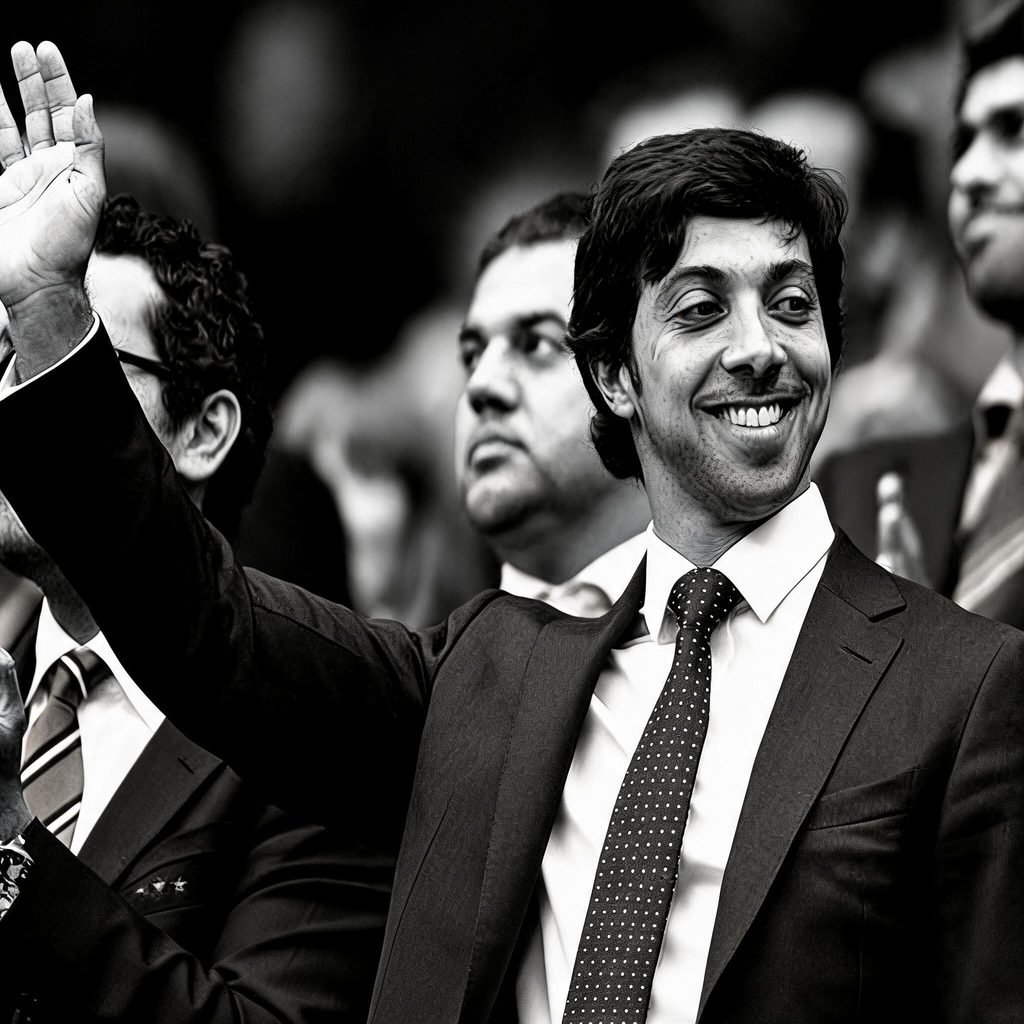
Sheikh Mansour
The first came in an open letter to City supporters as Sheikh Mansour’s takeover was completed in September 2008. The new owner said he was ambitious for the club, “but not unreasonably so”, and that building a team able to hold a top-four place and win in Europe would take time.
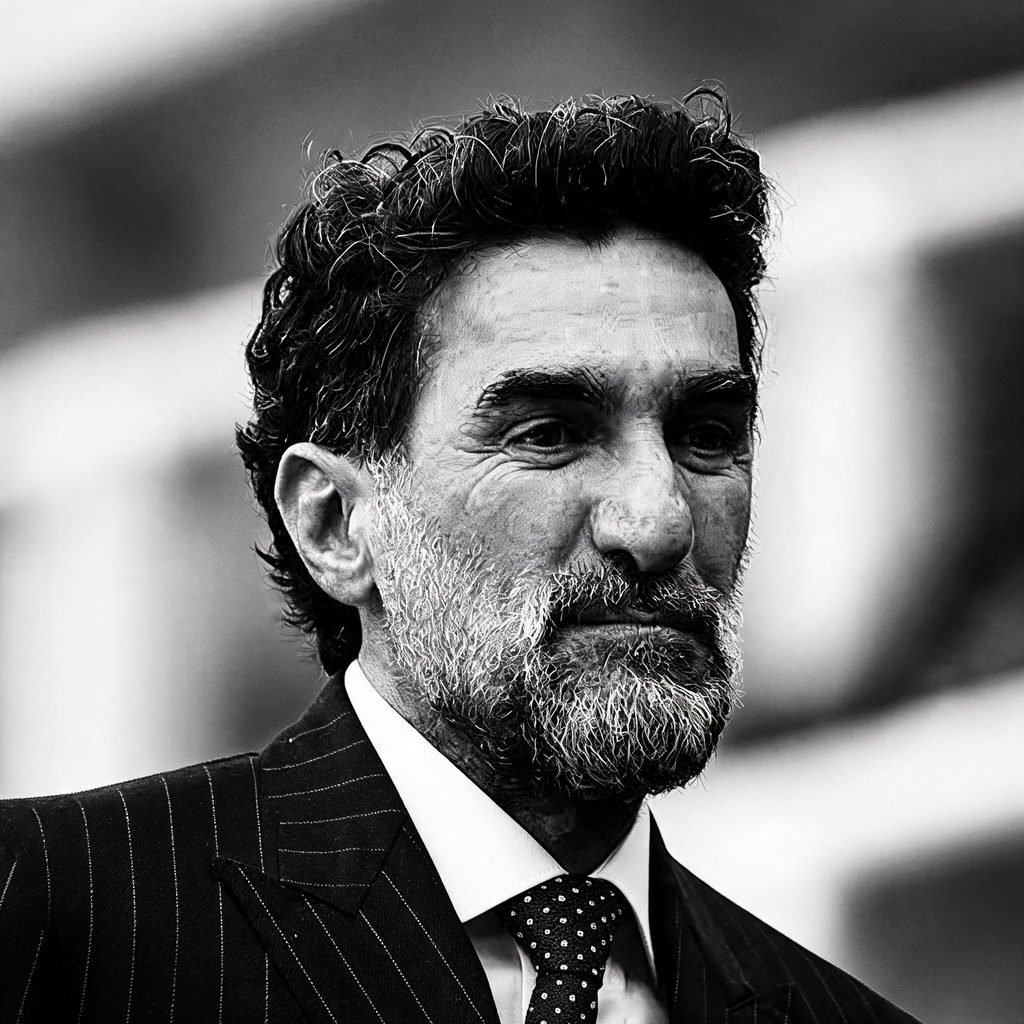
Yasir Al-Rumayyan
The second is what Yasir Al-Rumayyan, governor of Saudi Arabia’s Public Investment Fund (PIF) and Newcastle’s chairman, has said in various forms since the October 2021 takeover, most recently at the FII Priority Summit in Rome: PIF is “a long-term patient investor.”
Patient. Reasonable. Long-term. Both owners said it in public. Only one has kept to it.
Newcastle’s story runs the other way. Nearly five years into PIF’s ownership, the trophy cabinet holds one League Cup, won in March 2025 and the club’s first major trophy in 56 years, alongside a return to the Champions League. That is not a revolution. It is what a patient timetable looks like, and nobody has accused the club of hiding anything to get there.
City’s defence: there was no other way in
In August 2021, days after City broke the British transfer record to sign Jack Grealish, Pep Guardiola made City’s case in its plainest form. Manchester United and Arsenal, he argued, had won titles years earlier because they outspent everyone else, and City could only compete once they had owners who, in his words, “want to be in this world, they want to buy into football. What is the problem?”
Call it the Red Cartel argument. The old red clubs, United, Liverpool and Arsenal, had decades of history and revenue stacked in their favour, and the only way to break in quickly was to outspend them. In the same breath, Guardiola added a line that has aged badly: “If we are wrong then OK, convict us.” Five years on, a commission has.
Why the excuse doesn’t hold
The trouble with the argument is the timeline. In City’s early years, outspending the old order broke no rule, because there were no spending rules to break. UEFA approved Financial Fair Play in 2009 and only began monitoring clubs in 2011-12. The Premier League’s Profit and Sustainability Rules (PSR), which cap how much a club can lose, arrived in 2013.
City, meanwhile, moved fast. The takeover was agreed on 1 September 2008, the same day Robinho signed for £32.5 million. The spending that built the team, Robinho, then Tévez, Adebayor and Barry, then Silva, Yaya Touré and Balotelli, then Agüero, ran from 2008 to 2011. The first title came in May 2012. City broke into the elite almost entirely before any spending limit existed.
So City didn’t need to cheat to get in. On the commission’s findings, they did anyway. The charge sheet starts in 2009-10, with rules on accurate accounts and on disclosing players’ and managers’ pay that already applied, and carries on through the Financial Fair Play and PSR breaches once the spending limits arrived. UEFA sanctioned City under Financial Fair Play in 2014. On the commission’s findings, the breaches ran on for another four seasons.
Newcastle never had that head start. PSR was eight years old when PIF arrived, and within three years the League had docked Everton and Nottingham Forest points under it. New rules on deals with companies linked to a club’s owners, widely seen as a response to Newcastle’s takeover, followed within about two months. There was no unregulated window for Newcastle to exploit, even had it wanted one.
What patience costs
In the last days of June 2024, Newcastle sold academy graduate Elliot Anderson to Nottingham Forest and winger Yankuba Minteh to Brighton, for around £65 million combined, to stay inside PSR before the 30 June accounting deadline. Anderson was a boyhood Newcastle supporter Eddie Howe rated highly. Minteh had been signed for about £7 million a year earlier and had just had a breakout season on loan at Feyenoord. Reporting at the time described the club as reluctant to sell either. It sold anyway. As Part Three noted, those sales left Newcastle narrowly clear of a possible sanction.
That is the difference in a single transfer window. Under financial pressure, City, on the commission’s findings, made their accounts say something untrue. Newcastle sold two players it wanted to keep.
Nor does the patient route require a state-backed owner. According to one analysis, Liverpool’s net transfer spend from 2014 to 2024 under Fenway Sports Group was £304 million, seventeenth-highest in world football. That is spending minus sales, and the sales were the point. Philippe Coutinho arrived from Inter for £8.5 million and left for Barcelona for a reported £142 million, in the same window Liverpool paid £75 million for Virgil van Dijk. Buy well, sell at a premium, reinvest. In that decade Liverpool won the Premier League, the Champions League and six other trophies. Brighton run the same model on a smaller scale: Moisés Caicedo cost them a small fraction of the £115 million Chelsea later paid for him, and the money went back into a recruitment operation that keeps finding the next one. Patience isn’t a consolation prize for clubs that can’t afford to cheat. It’s a proven route to the top.
Cheaters never prosper, even when they get there first
City got there first. In the nine seasons under scrutiny they won eight trophies: three Premier League titles, an FA Cup, three League Cups and a Community Shield. On the commission’s findings, the accounts behind those years did not tell the truth, and reports say the panel found City acted in bad faith. Newcastle waited until their fourth season under PIF for one League Cup, and nothing guarantees more silverware soon.
But winning something and being able to stand behind it are different things. While the verdict stands, City’s trophies from those years carry an asterisk. Newcastle’s League Cup carries none. It took 56 years and a summer of selling players the club wanted to keep, and every part of it is theirs. Doing it right takes longer. It’s also the one version of success that never has to fear the day someone checks the books.
This concludes the four-part My Toon Army series on Manchester City’s 115 charges. Thank you for reading.
This is Part One of a four-part My Toon Army series on Manchester City’s Premier League charges and what the whole saga means for Newcastle United’s own position under Saudi ownership.
On Thursday, in a Premier League shareholders’ meeting, the division’s clubs were told the outcome of the biggest disciplinary case English football has ever heard — and then made to sign non-disclosure agreements. The silence held for barely a day. On Friday, David Ornstein of The Athletic reported what those executives had been told: an independent commission had found Manchester City guilty on 114 of the 115 charges brought against them.
Say it plainly. For nine consecutive seasons, the commission found, Manchester City’s accounts did not tell the truth. And when the Premier League came asking questions, City spent the best part of four years refusing to help it find the answers. This was not a clerical slip or a misread rulebook. It was a system, and it ran for a decade.
No sanction has yet been decided, City are expected to appeal, and the League itself has published nothing, citing a confidential process. But City’s response told its own story. According to ESPN, the club refused to deny the reports when approached, and its statement insisted it had respected due process for eight years on the basis that the League would act as a fair-minded regulator “free from partisan influence.” Even with 114 findings against them, City were still questioning the referee.
Meanwhile, the club found guilty of building its empire on false accounts sits top of the Premier League, five wins from five under Enzo Maresca. The dividends of those nine seasons are still being paid out every weekend.
The detail was specific enough to follow the money. City’s Etihad deal was said to be worth £67.5 million a year, but according to an internal email from the club’s chief financial officer, Jorge Chumillas, £59.9 million of it was channelled back through the owner’s holding company, the Abu Dhabi United Group. Another email reportedly flagged a £9.9 million Financial Fair Play shortfall after Roberto Mancini’s sacking in 2013, and proposed plugging it with extra Abu Dhabi sponsorship. City, the Associated Press noted at the time, did not dispute the authenticity of any of the emails.
The first escape
UEFA moved first. In February 2020 it banned City from the Champions League for two seasons and fined them €30 million. City took the case to the Court of Arbitration for Sport, and that July the ban was overturned. CAS ruled that most of UEFA’s allegations were either not established on the evidence before it or time-barred under UEFA’s five-year limit.
City called it vindication. Read the ruling, though, and the picture is less flattering. CAS still fined the club €10 million, citing City’s disregard for the duty to cooperate and its “obstruction of the investigations.” Remember that word. It comes back.
Nor was 2020 City’s first brush with European regulators. In 2014, UEFA had already sanctioned them for FFP breaches, with a €60 million fine, a spending cap and a trimmed Champions League squad. By the time the Premier League case began, City had been punished once for breaking Europe’s spending rules and once for obstructing the people enforcing them.
The Premier League’s rules carry no five-year limit, and this time there was no clock to run down. The League opened its investigation in December 2018, and after more than four years of forensic accounting work, City were charged in February 2023 over a pattern stretching across nine seasons, from 2009-10 to 2017-18. That window covers the entire arc of City’s transformation from mid-table also-rans into the dominant force in English football.
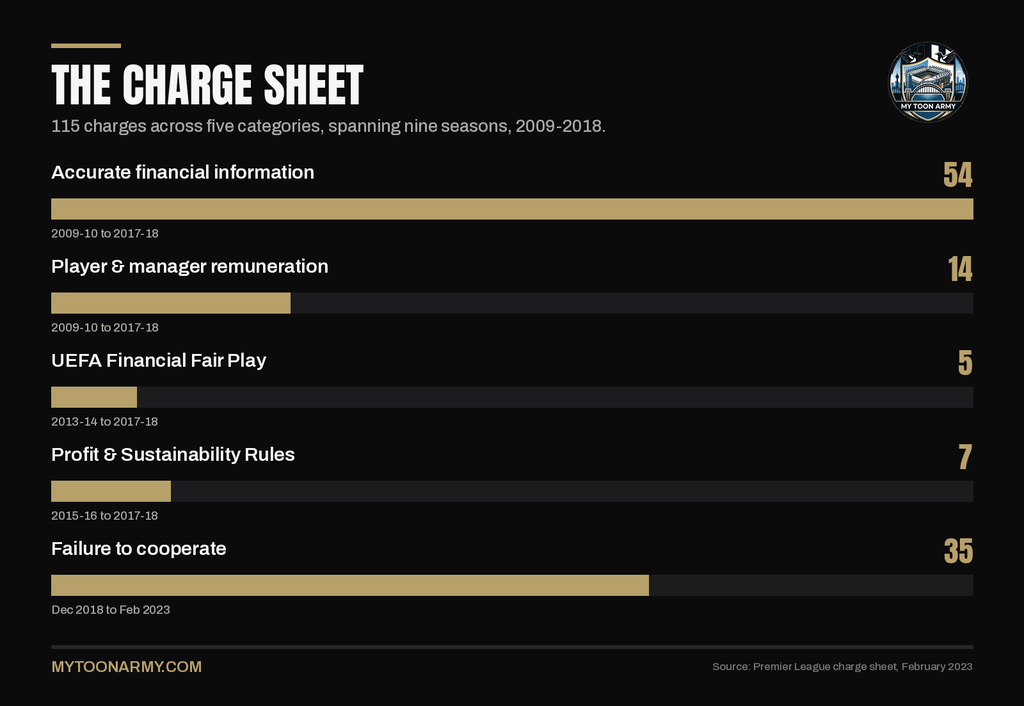
The charge sheet breaks into five categories, and the anatomy of it is easier to take in at a glance than in a paragraph of numbers:
Look at the last bar. Thirty-five charges, close to a third of the case, have nothing to do with what City’s accounts said. They concern how the club behaved once it knew investigators were looking, from December 2018 onwards. While CAS was fining City for obstructing UEFA, the Premier League says the same conduct was happening on home soil, and it carried on for years afterwards. That is not a club caught out by complexity. It is a club that decided, again and again, that the regulators should not see what was in the books.
The trial and the wait
The hearing finally opened in September 2024, before a three-person independent commission, and ran for roughly twelve weeks until December. Back in February 2023, the club had promised the commission a “comprehensive body of irrefutable evidence.” Of 115 charges, it has seemingly persuaded the panel on one.
Then came the wait. Early forecasts pointed to a verdict in the first months of 2025. It slipped to the summer, then past the start of 2025-26 altogether. Twenty-one months passed between closing arguments and Friday’s report.
Delay in a case like this is never neutral, and it only ever benefits one side. Since being charged in February 2023, City have added two more league titles and a Champions League to their honours, signed fresh sponsorship deals, and sold their success around the world, all under a status the commission has now found was built on rule-breaking.
What the commission can actually do
Here the story becomes less satisfying, not more. There is no published formula linking a number of upheld charges to a set punishment. Under Rule W.51, the commission can impose an unlimited fine, deduct points, and recommend that City be expelled. The operative word is “recommend.” The commission cannot throw City out on its own authority.
Expulsion runs through Rule B6 of the Premier League Handbook, which requires a Special Resolution, with 15 of the 20 clubs voting in favour. No club has ever been expelled from the Premier League. For it to happen here, three-quarters of the division would have to vote to remove one of its biggest broadcast draws. The clubs City cheated out of titles and prize money would, in effect, be asked to damage their own product to punish the club that wronged them. It would be brave to bet on that.
One exit is sealed this time. Unlike 2020, there is no route to the Court of Arbitration for Sport. This is a domestic Premier League arbitration, and an appeal board’s decision is effectively final, open to challenge in the ordinary courts only on narrow procedural grounds rather than on the merits. City cannot escape on a technicality in Lausanne a second time.
How long the appeal will take is the honest unknown, and the usual comparisons undersell the difference. Everton’s 10-point deduction, handed down on 17 November 2023, was cut to six on appeal on 26 February 2024 — a little over three months. Nottingham Forest’s four-point deduction was appealed and dismissed inside about seven weeks. Both moved fast for the same reason: both clubs admitted their breach and appealed only the size of the punishment. There was no dispute left to relitigate, only a number to argue over.
City have never conceded a single one of the 115 charges, and nothing in Friday’s reporting suggests that’s about to change. An appeal that only argues sanction is a different exercise, and a much shorter one, than an appeal that continues to deny the underlying findings themselves. Richard Masters, the Premier League’s own chief executive, told a parliamentary committee that City’s case was being heard in what he called “a completely different environment” to Everton’s and Forest’s, precisely because of the volume and character of the charges. Add City’s case spanning 114 upheld charges, five categories of rules and nine seasons of evidence, and scaling Everton’s three months up to something of this size is guesswork, not arithmetic. A final answer before the second half of the season looks optimistic, and every week of waiting is another week City play on at the top of the table.
That is the part that must not get lost beneath the procedure and the legal chess. The titles, the cups, and the climb from a club that played in English football’s third tier as recently as 1998-99 to the most commercially powerful institution in the country did not happen in spite of what the commission says went on between 2009 and 2018. On the panel’s own findings, a meaningful part of it happened because of it.
Eight trophies, nine seasons, one guilty verdict. Every medal from that decade now carries a question City’s lawyers cannot make disappear, however long the appeal takes.
Part Two follows the receipts: the seasons, the signings, the results, and the clubs now counting what those nine years cost them. It follows tomorrow.
A tweet on X, a five-game sample, and the maths behind a start that’s running well ahead of the performances underneath it — time the rebuild shouldn’t waste.
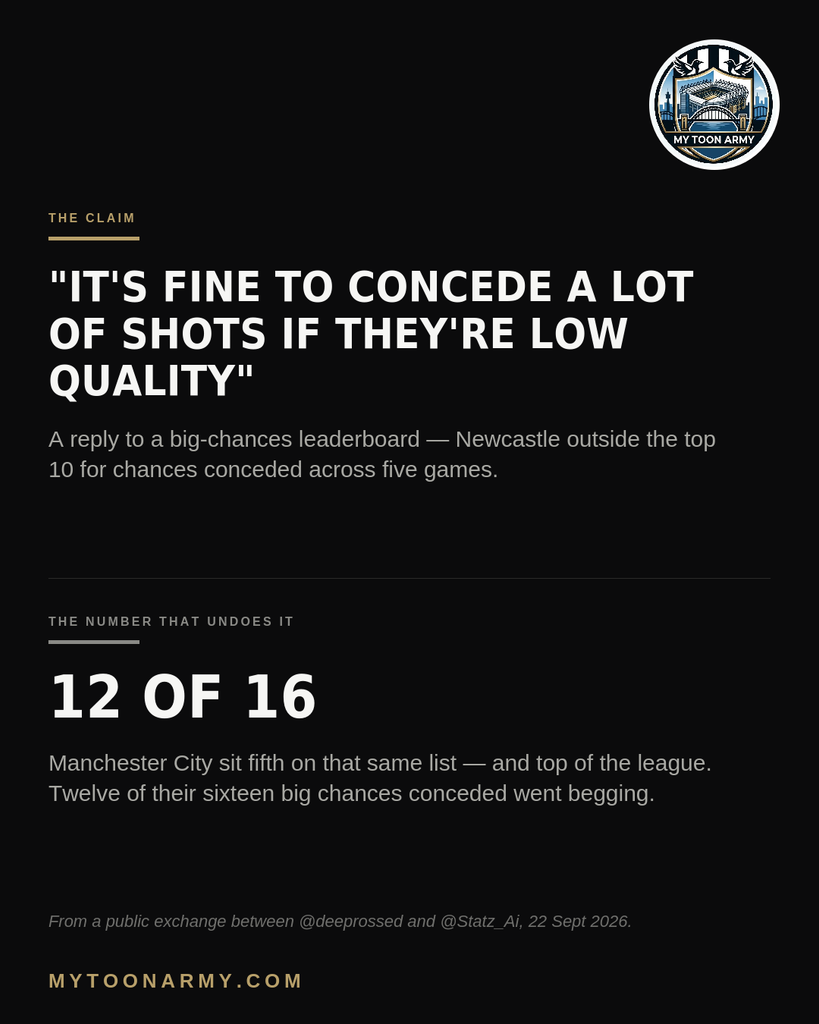
Twelve of sixteen. That’s how many “big chances” Manchester City’s opponents have missed against them this season — the club sitting top of the Premier League, conceding chances at a rate that would alarm most defensive coordinators, saved from the numbers by finishing so wasteful it borders on charitable. It’s a useful place to start, because the exact same mechanism is sitting underneath the numbers at Newcastle right now — just working in the other direction. That’s not a reason to panic. It’s a reason to be honest about what the next few months are actually buying the club, and what needs to happen while the buying lasts.
The claim
On Monday night, Ross (@deeprossed) replied to a thread from the analytics account Statz (@Statz_Ai) that had ranked Premier League sides by big chances conceded across their first five matches. Newcastle didn’t crack the top ten. Ross’s conclusion: the volume of shots Newcastle are conceding doesn’t matter, because the shots aren’t good ones, and a defence facing low-quality efforts is a defence that’s fine.
It’s a reasonable-sounding instinct — the sort of thing that gets nodded along to by ten thousand people before anyone runs a number on it. It’s also wrong, in a way that’s provable rather than debatable, and it’s worth taking apart properly rather than dismissing with a shrug. Ross clearly cares about the numbers enough to go looking for them, which is more than can be said for most of Twitter. He’s just reached for the wrong one.
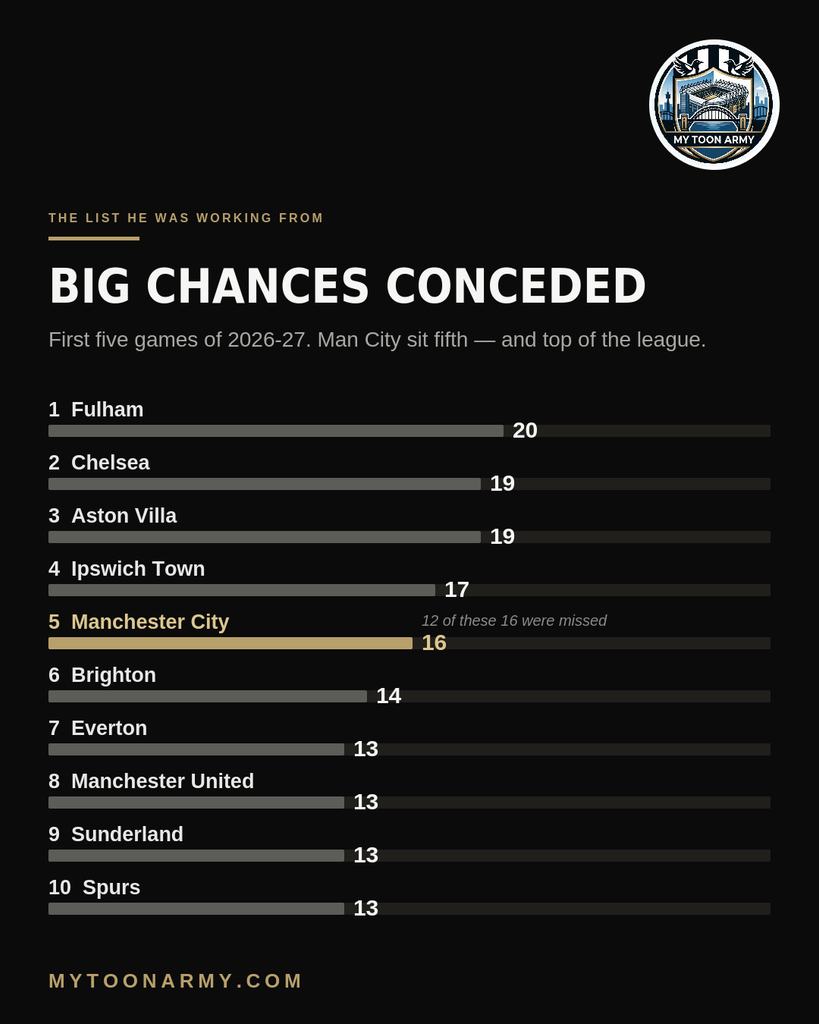
Here’s the leaderboard he was working from:
Two things jump out immediately, and Statz himself flagged the second one in the very next line of his own thread: Manchester City — top of the league, unbeaten, five straight wins — sit fifth on this list, and twelve of the sixteen big chances they’ve conceded have been missed. That’s a 25 per cent conversion rate against opponents in the highest-quality bracket of shot, roughly half what you’d expect a competent Premier League forward line to manage from situations Opta’s own analysts have judged good enough to be expected to score from. City aren’t controlling that outcome. They’re benefiting from it.
Which means the stat Ross is leaning on for reassurance is the same stat currently explaining why the best team in the country isn’t getting punished the way its underlying defending suggests it should be. If it can flatter Manchester City by twelve wayward finishes, it can just as easily flatter anyone sitting further down that list — including a side that isn’t on it at all.
Where “big chance” breaks down
Start with what the category actually measures. A big chance, in Opta’s framework, is a shot from a position where a player would reasonably be expected to score — broadly, the far right tail of shot quality, roughly the efforts carrying something north of a 30–40 per cent chance of going in. It’s a deliberately narrow bucket, built to flag the sitters and the one-on-ones. It was never built to describe the totality of a team’s defensive exposure, and using it that way is the first error in Ross’s reasoning.
Expected goals exists precisely because a binary “big chance or not” filter throws away almost everything that actually happens in a football match. Every shot faced carries some probability of becoming a goal — a cut-back turned first-time from the edge of the box, a corner that falls kindly for a half-hit volley, a defensive header that only half-clears — and none of those routinely qualify as big chances, while each of them carries a real, non-trivial chance of finding the net. A defence can concede zero big chances by Opta’s definition and still be bleeding an expected-goals total north of two a match, purely by accumulating enough of that middle tier. Counting only the tail and drawing conclusions about the whole distribution is the mistake sitting underneath the tweet.
The maths nobody tweets
Treat each shot faced as an independent trial with some probability of success, p, and the probability of conceding at least once across n shots follows: P(at least one goal) = 1 − (1 − p)ⁿ. Shots that fall outside the big-chance bracket still convert at something in the region of one in twelve to one in fourteen — nowhere near zero. Run fifteen of those through the formula at p = 0.07 and the probability of conceding climbs past 65 per cent. Push it to twenty shots and it clears 75 per cent. None of those shots needs to be a big chance for that outcome to arrive. The danger was never sitting in any single effort — it’s compounding across the volume, the same way a casino’s edge does across enough hands, regardless of how unthreatening any individual one looks.
Goals themselves don’t arrive smoothly, either — they arrive as counts, which is where a Poisson model earns its keep. The tool takes its name from Siméon Denis Poisson, the French mathematician who introduced it in an 1837 study of criminal and civil jury verdicts, working out how to predict the number of rare, independent events that would occur within a fixed stretch — given nothing more than their average rate — from a starting point in probability theory rather than sport. It’s since become the standard way to model exactly that kind of count in football: not how likely any single shot is to score, but how many goals a team is likely to concede across ninety minutes given its overall rate of chances allowed. Treat goals conceded in a match as Poisson-distributed with mean λ equal to cumulative expected goals faced, and the relationship between shot volume and disaster is convex, not linear: nudging λ from 1.0 to 2.0 doesn’t just double the expected goals conceded, it disproportionately inflates the probability sitting in the two-and-three-goal outcomes — the collapses, not the routine defeats.
And there’s a reason a five-game count of big chances conceded is such an unreliable guide in the first place. Rare-event counts behave like Poisson processes, and their relative variance — the coefficient of variation — scales with 1 ÷ √λ. A stat averaging one or two events a game wobbles enormously over five matches; a stat averaging twelve to fifteen events a game, like total shots faced, doesn’t. Put a number on it: a defence with a genuine long-run rate of 1.5 big chances conceded per game would, over five matches, have a Poisson mean of 7.5 and a standard deviation of roughly 2.7 — meaning a perfectly average defence could produce anywhere from two to thirteen in this exact sample purely by chance, before a single tactical or personnel factor gets involved. The leaderboard Ross quoted, running from 20 down to single figures inside five fixtures, is a metric demonstrating its own unreliability in real time.
This is also the terrain of PDO — a name that looks like an acronym but isn’t one; it comes from the online handle of a commenter on an old Edmonton Oilers hockey blog who first noticed the pattern it now describes. The stat itself is simple: a team’s save percentage plus its shooting percentage, added together and used as a rough proxy for how much of a team’s results are being carried by finishing variance rather than repeatable process. PDO across a division tends to sit close to a league-average baseline over a full season and drift back toward it wherever it’s strayed. City sitting on a big-chances-conceded record that would normally trouble a mid-table side, while their opponents miss three-quarters of their clearest sights of goal, is a PDO story. Newcastle’s own numbers, below, show exactly where that same dynamic currently sits for them.
Newcastle, by the numbers
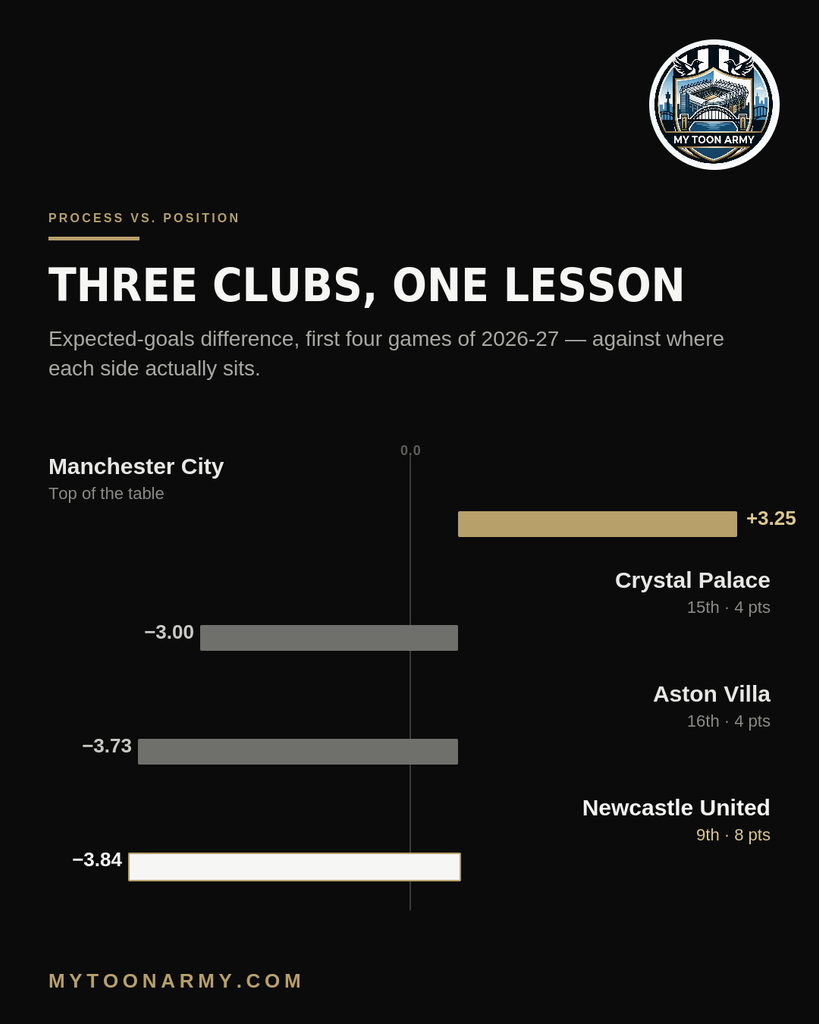
Here’s where the theory stops being abstract. Through the first four gameweeks of 2026-27 — the last point at which Opta’s underlying data has been fully reconciled into the season totals — Newcastle have created 3.54 expected goals. That’s the second-lowest tally of created chances in the entire Premier League, ahead of only Aston Villa. At the other end, they’ve conceded 7.38 — the second-highest in the division, behind only Crystal Palace. Put those together and the expected-goals difference is −3.84. Not bottom-half. Not relegation-form. The single worst expected-goals difference of any club in the Premier League, marginally worse even than bottom-placed Aston Villa’s −3.73.
None of that should land as a surprise dressed up as one. This is a squad four months into a genuine rebuild — Bruno Guimarães, Sandro Tonali and Anthony Gordon all sold across the last two windows, a reshaped spine still learning each other, and Matthias Jaissle only a handful of matches into installing a way of playing that was never going to arrive fully formed by September. A dip in the underlying numbers during a squad and identity change is normal. It’s what the numbers below actually mean that matters.
Run those same four gameweeks through Squawka’s rounded xG model — converting each match’s underlying numbers into the scoreline they actually deserved rather than the one that went on the board — and Newcastle sit 19th, with a record of nought wins, two draws and two defeats. Seven places worse than where they actually stood in the real table at that exact moment. There is no bigger gap between deserved position and actual position anywhere in the division.
The finishing explains the whole of it. Newcastle have scored seven goals from that 3.54 xG — an overperformance of +3.46, the third-highest in the Premier League, behind only Brighton and Chelsea. It’s carrying the entire points tally. And it’s worth being precise about where the gap actually sits, because the instinctive read — a defence riding its luck — isn’t quite what the numbers show. Newcastle’s expected goals against through four games works out to 1.85 a match. Their actual goals conceded, across five completed fixtures as of 20 September, sit at nine — 1.8 a match. The defence isn’t overperforming its process at all. It’s delivering almost exactly what a genuinely leaky process predicts, goal for goal. The only thing standing between Newcastle and a considerably tougher league table is finishing form at the other end of the pitch, and finishing form is, by some distance, the least repeatable metric in the sport — the first thing to regress once a sample grows.
One result already hints at what happens when the wrapping comes off. At Elland Road, Newcastle’s underlying play merited something close to a 2-1 defeat — Leeds’ 1.79 xG against Newcastle’s 0.68 rounds cleanly to that scoreline. The actual result was 4-1. The process was already bad enough to lose comfortably on its own merits; on the day, it lost considerably worse than that.
The very next match, still outside this reconciled four-game window but worth naming on its own terms, put the other half of the argument on the pitch. Hull City had 21 shots at St James’ Park on 19 September — nearly double Newcastle’s own tally of 12, eighteen of them arriving in a second-half siege that had the hosts men behind the ball for long spells. None of that volume amounted to a big chance by Opta’s count; Newcastle actually finished with the better expected-goals total on the day, 1.41 to 1.24, which means Hull’s 21 attempts averaged out to barely a tenth of a goal apiece in quality. Run twenty-one shots at that kind of average probability through the binomial formula above and conceding at least once was odds-on regardless — and Newcastle did, in the 67th minute. What kept the afternoon from unravelling further was two clinical finishes inside the first seven minutes at the other end, and a goalkeeper who made the saves that were there to be made. It’s the whole piece in miniature, inside ninety minutes: a defensive picture that’s genuinely stretched, an attack currently bailing it out, and a final scoreline that gave no hint of either.
FotMob’s own model, running independently of Opta’s and refreshed through that Hull match, tells much the same story from a different angle: an expected-goals-against total of 9.1 across five games — barely different from the nine goals Newcastle have actually conceded — with only two sides in the entire division rated worse defensively. Different provider, same verdict, one gameweek further on.
Three clubs, one lesson
Newcastle aren’t operating in isolation here, and looking at where they sit against two other clubs makes the pattern harder to wave away.
Manchester City’s process matches their position — elite underlying numbers, elite results, with a layer of finishing luck against them sitting on top of genuine quality rather than substituting for it. Crystal Palace and Aston Villa’s processes also match their positions — poor underlying numbers, poor results, the table doing exactly what you’d expect it to do. Newcastle are the anomaly in this set. Their process is worse than Palace’s. It is marginally worse than Villa’s. And yet they sit fifth in this four-club comparison on points while owning the worst underlying number of the lot — which is exactly why the next block of fixtures matters more than the points column currently suggests, and why the work is worth starting now rather than once the table catches up and says so for them.
Tyneside has been here before
None of this is hypothetical for this football club specifically, and it’s worth naming honestly rather than skating past it. In 2011-12, Alan Pardew’s Newcastle finished fifth — an eight-year contract handed out on the strength of it. Buried inside that campaign was a defence recording the worst shots-against totals of Pardew’s tenure, carried by the best save percentage and the kindest finishing luck he ever had at his disposal. None of it repeated. Newcastle spent most of 2012-13 in a real relegation fight, escaping on the second-to-last weekend in 16th.
The lesson from that season isn’t that the collapse was inevitable — it’s that the window bought by good fortune went unused. Pardew’s Newcastle didn’t reinforce the areas the underlying numbers were flagging; a hot finishing spell got mistaken for the finished article, and the rebuild that should have happened during the grace period simply didn’t. That’s the part worth this side getting right instead, and there’s real reason to think the club is better placed to do it: considerably more resource behind the project than Pardew ever had, a sporting director’s office running recruitment with a plan rather than reacting to results, and a manager who is early enough in his own tenure that these numbers are a diagnosis rather than a verdict. History rhyming isn’t the same as history repeating. What happens next depends on what gets done with the time currently being bought — and that part hasn’t been decided yet.
The short version
Facing a lot of shots is dangerous even when hardly any of them are clear-cut, because the risk adds up across the many moderate chances a defence concedes, not just the handful of obvious ones a stats account counts by hand. A ranking built on just five matches of a rare event like “big chances conceded” is too small a sample to trust — it swings wildly by chance alone, which is exactly why Manchester City can sit mid-table on that particular list while topping the real one. Right now, Newcastle’s actual underlying numbers — chances created and chances conceded combined — are the worst in the Premier League, and the only thing keeping the league table from reflecting that is a finishing return in front of goal that ranks among the best in the division — and shooting form is, on the weight of everything football’s underlying numbers show about how it behaves, the least repeatable output in the sport, which makes the current rate far likelier to fall away than to hold.
None of that is cause for alarm, and it shouldn’t be read as one. It’s a side four months into a genuine rebuild, playing for a manager who is still installing his own way of doing things, currently being carried by a finishing spell that’s buying real, usable time. That’s not a small thing — points banked now are points a harder patch later won’t have to find from scratch. The job in front of Jaissle and his staff is simple to state even if it isn’t easy to do: tighten the process producing the shots faced, keep building the chance creation that’s currently running short, and treat the table’s current generosity as working capital rather than proof the job’s already done. Newcastle have lived a version of this story before, under Pardew in 2011-12, and what went wrong wasn’t the lucky start — it was that the club spent the following year finding that out the hard way instead of getting ahead of it while there was still time. That’s the difference that actually matters here, and unlike the stats above, it’s the one still open to being written the right way.
What do you think of our start to the season? Will Jaissle be able to tighten things at the back? Join the conversation on X @mytoonarmy #NUFC
Andoni Iraola spent three seasons building the side he faced at the Vitality Stadium on Sunday, and in the 57th minute Alexander Isak turned in Cody Gakpo’s cross, which had clipped Florian Wirtz on its way through. Liverpool won 1-0. Iraola was Bournemouth’s manager until this summer, and on Sunday he beat them as Liverpool’s. Marco Rose, who replaced him, has three points from five league games.
It was one of nine stories like it. Nine Premier League clubs began 2026-27 under a new manager, the most in an English top-flight season since 1946-47, and change on that scale forces one question: who got it right? Every appointment is judged twice, against the man who left and against the eight who arrived alongside him.
The early answers are already loud. Enzo Maresca has won seven from seven at Manchester City, across the league, Europe and the Carabao Cup. Iraola is the first Liverpool manager unbeaten through his opening five league games since Joe Fagan in 1983. At the City Ground, Oliver Glasner’s side has yet to score at home in the league, and he said on Saturday that he had felt the weight of last season for the first time. Five of the nine have won fewer than half of their games in all competitions.
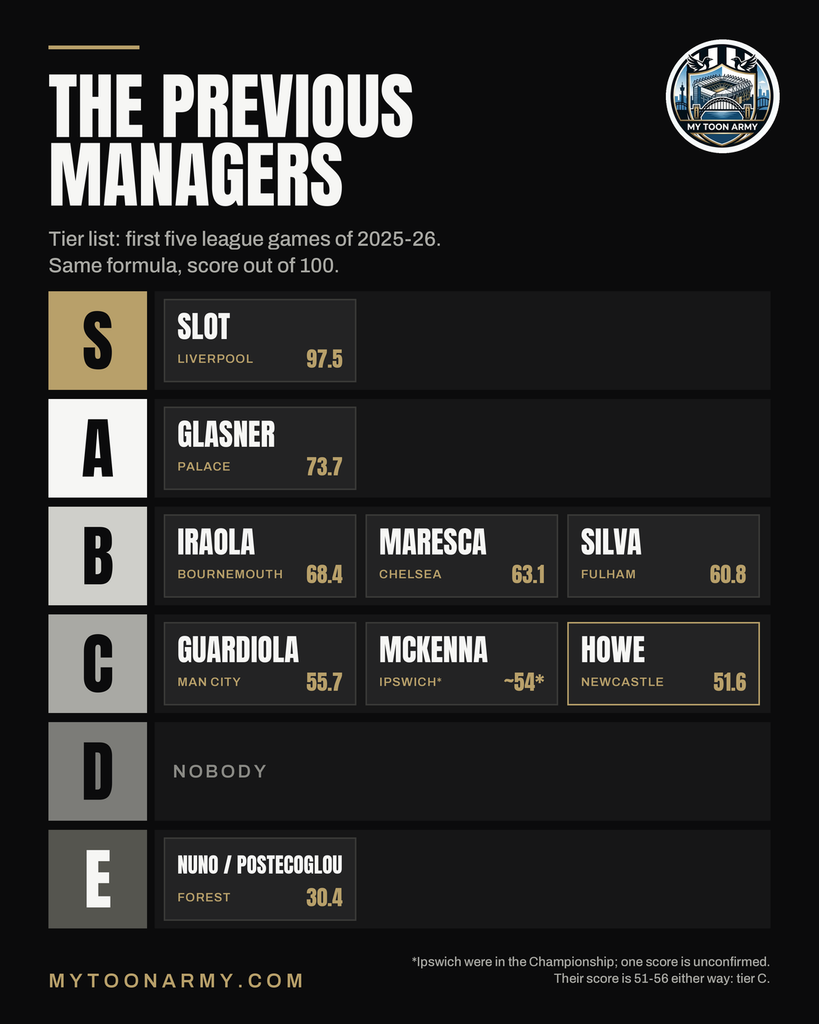
Loud is not the same as measured. So here is the yardstick, then the nine, then the same test run on last September’s managers.
How the tiers were scored
The rules were fixed before any manager was scored, and they use only results.
The window runs from each manager’s first competitive match to Sunday 20 September. It covers the Premier League, the Carabao Cup and the Champions League or Europa League where a club plays in them. The Community Shield and friendlies are excluded, and the FA Cup has not started. Every match counts the same, and the result is the one after 90 minutes; no tie has needed a shoot-out.
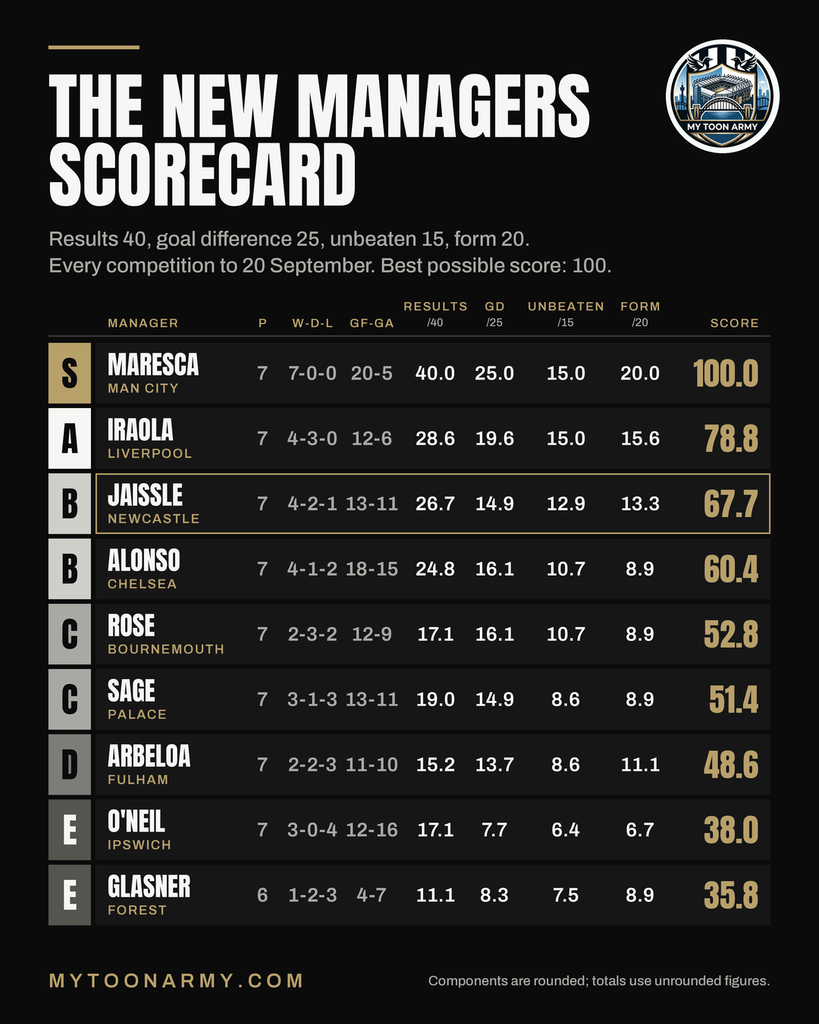
Four measures make a score out of 100:
Results (40 points): points per game across all competitions. Three per game earns the full 40.
Goal difference (25 points): goal difference per game, scaled so that +1.5 or better earns 25 and −1.5 or worse earns nothing.
Resilience (15 points): the share of matches not lost.
Form (20 points): points per game across the last three matches, scored like results.
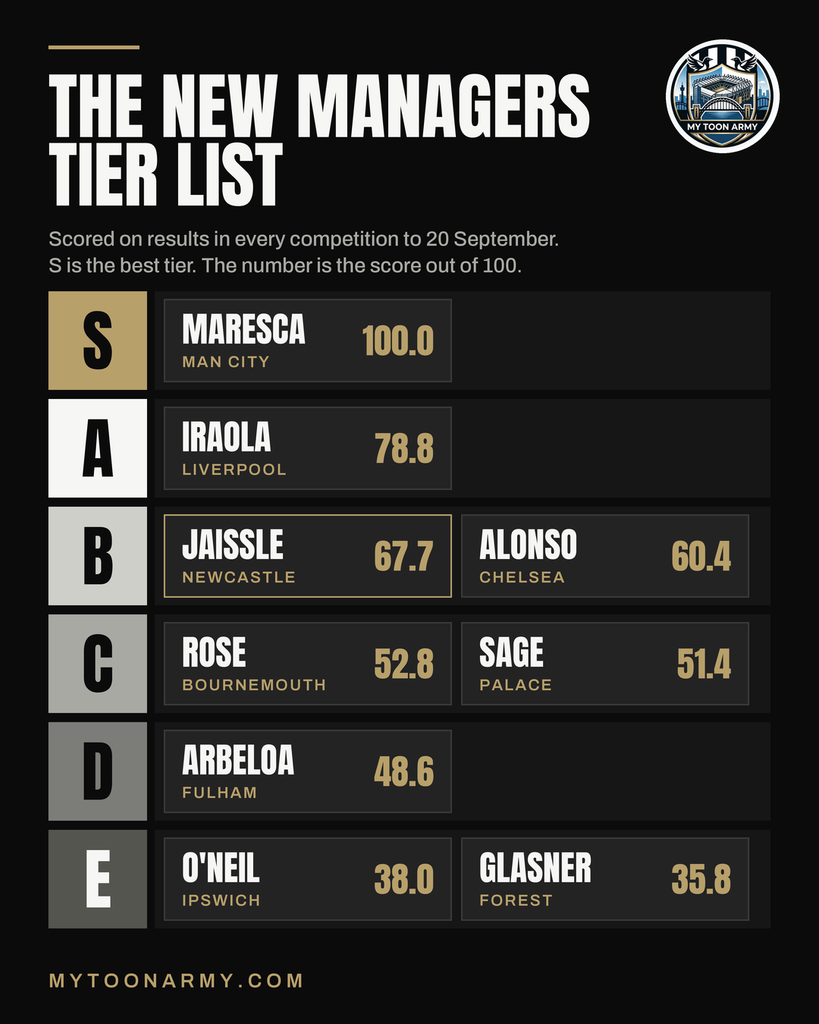
Bands are S from 80, A from 70, B from 60, C from 50, D from 40, E from 30 and F below that.
Given the weights, nobody’s opinion touches the arithmetic. The weights themselves are a judgement, so we tested them, and three limits apply:
Six or seven games is a small sample.
A Carabao Cup tie against a League One side counts the same as a league match.
Nothing adjusts for opposition or uses expected goals.
We also tested the weights. Give the four measures equal weight and seven of the nine managers stay in the same tier; Liverpool (78.8) moves up to S and Fulham (48.6) up to C, each just short of a tier line. Count league games only and the bottom of the table reshuffles: Ipswich (1.2 points a game) and Forest (1.0) would rank fifth and sixth, above Palace, Bournemouth and Fulham. They sit at the bottom of the all-competition table because Palace, Bournemouth and Fulham have won all their cup and European games so far, while Ipswich and Forest went out of the Carabao Cup.
S: Enzo Maresca, Manchester City (100.0)
Seven wins have arrived in every shape. At Old Trafford, City played from the 23rd minute with ten men after Phil Foden was sent off, and still won 1-0 through Erling Haaland’s goal just before the hour. In Porto, Haaland scored twice, City’s expected goals came to 2.31 against the hosts’ 0.22, and Porto failed to register a shot on target. Against Norwich in the Carabao Cup, Maresca made ten changes and still won 5-0, with 17-year-old Floyd Samba scoring twice on his debut. Sunderland’s three goals on Sunday are the only crack so far.
SWOT.Strengths: a squad that survives rotation, and a striker who scored both goals in Porto. Weaknesses: the back line was stretched for the first time against Sunderland. Opportunities: a top-eight finish in the Champions League league phase gives an easier route. Threats: the calendar asks the hard questions early, with Liverpool away on 11 October, Aston Villa away on 24 October and Arsenal away on 28 November.
A: Andoni Iraola, Liverpool (78.8)
Iraola is unbeaten in seven, though only some of it has been comfortable. The league record is two wins and three draws, alongside a 2-1 Champions League win over Atlético Madrid and a 3-1 Carabao Cup win over Tottenham. Opta notes he is the first Liverpool manager unbeaten in his first five league games since Joe Fagan in 1983. Alexander Isak already has four league goals, more than in all of last season. The 1-0 at Bournemouth was scrappy: Jamie Carragher criticised the first half, and Liverpool gave the ball away too often in midfield.
SWOT.Strengths: three consecutive league clean sheets, and Jeremy Jacquet looking like a serious prospect beside Virgil van Dijk. Weaknesses: the attack has struggled for influence, and three of five league games were draws. Opportunities: a young defence that is still improving. Threats: Liverpool are sixth on nine points, with City at Anfield on 11 October.
B: Matthias Jaissle, Newcastle (67.7)
Newcastle’s start has had two faces. A 2-2 draw with Liverpool, a 2-0 win at Tottenham and a 2-2 draw with Bournemouth sat alongside a 3-2 Carabao Cup win over West Brom and a 1-0 win at Millwall. Then Leeds won 4-1 at Elland Road on a Monday night, a defeat Jaissle put down to a lack of intensity in duels and second balls. Saturday’s 2-1 win over Hull came with eight senior players absent, including Tino Livramento, and an 18-year-old, Sean Steur, in midfield. Joe Willock and Lewis Hall scored inside the first seven minutes, Yoane Wissa’s penalty was saved, and a late switch to a back three let Hull back in.
SWOT.Strengths: 13 goals in seven matches, and the direct, incisive football that Football365 saw in the Hull goals. Weaknesses: physical duels and second balls, in Jaissle’s own diagnosis. Opportunities: Newcastle are not in Europe, so they have clear midweeks to work with. Threats: Coventry away on Monday 12 October, Aston Villa at home on 17 October and Palace away on 25 October.
B: Xabi Alonso, Chelsea (60.4)
Chelsea began as entertainers: the first four league games produced 19 goals. They won 3-2 at Fulham and 4-3 against Brighton, lost 2-1 at Arsenal and drew 2-2 with Hull, with a 6-3 Carabao Cup win over Leeds and a 2-0 win over Luton in between. Then Brentford won 3-0. Chelsea have now conceded at least two goals in five straight league games under Alonso, conceded from set-pieces again and looked short of competitive mentality once behind. They have taken one point from their last three league games.
SWOT.Strengths: 18 goals in seven matches, with Cole Palmer and Morgan Rogers at the centre of it. Weaknesses: set-pieces, and shape once they concede. Opportunities: Moisés Caicedo’s return should add solidity in midfield. Threats: João Pedro’s knee injury, then Bournemouth at home on 10 October and Everton away on 17 October.
C: Marco Rose, Bournemouth (52.8)
Bournemouth’s league table and their season tell different stories. They have not won in five league games (three draws, two defeats), the ninth time in the club’s history they have failed to win any of their first five, and sit 17th. Yet they beat Lincoln 4-0 in the Carabao Cup and won 2-1 at Real Sociedad in their first European match, with Justin Kluivert scoring the club’s first European goal. Iraola’s return on Sunday ended in a 1-0 defeat, in a game between Iraola’s new side and Rose’s evolution of what Iraola built.
SWOT.Strengths: Bournemouth won plenty of second balls at Liverpool. Weaknesses: six goals in five league games, with two 2-2 draws among them. Opportunities: a Europa League campaign that has started with an away win. Threats: they are out of the bottom three only on tiebreakers, with Chelsea away on 10 October.
C: Pierre Sage, Crystal Palace (51.4)
Palace’s league form and Europe are a study in contrasts. They conceded 11 goals in their first four league games, four of them at home to City and three to Ipswich. Then they held Leeds 0-0 at Elland Road, and Tyrick Mitchell’s goal was ruled out for offside. In Europe Yéremy Pino, Chris Richards, Jørgen Strand Larsen from the penalty spot and Eddie Nketiah scored in a 4-0 Europa League win over Lech Poznań, and they won 3-0 against Middlesbrough in the Carabao Cup.
SWOT.Strengths: Adam Wharton driving the midfield, and depth up front with Mateta, Strand Larsen and Nketiah. Weaknesses: before the weekend, the worst defensive record in the league. Opportunities: the first clean sheet as a foundation, and Forest at home on 11 October. Threats: Palace are one point clear of the relegation zone.
D: Álvaro Arbeloa, Fulham (48.6)
Fulham have not won a league game, and only Tottenham are below them on goal difference. They lost 3-2 to Chelsea, 1-0 at Sunderland and 3-2 to Palace, then drew 0-0 at Liverpool and 1-1 with Manchester United. Against United the expected goals were 1.57 to 1.59. The cups have been kinder: a 3-0 win over AFC Wimbledon after ten changes was his first competitive win, followed by a 3-2 win at West Ham.
SWOT.Strengths: a young, revamped side that is scrapping hard, with back-to-back draws against Liverpool and United. Weaknesses: eight goals conceded in five league games. Opportunities: Ipswich on 10 October, then Hull and Coventry. Threats: only Tottenham are below them on goal difference.
E: Gary O’Neil, Ipswich (38.0)
Ipswich won their opener 2-1 against Sunderland, won 3-2 at Palace and beat Leicester 3-1 in the Carabao Cup. But they conceded five at Old Trafford, lost 4-2 to Arsenal in the Carabao Cup, where 16-year-old Max Dowman scored twice, and lost 1-0 at Everton, where they finished with ten men. Ipswich have gone 24 Premier League games without a clean sheet, their worst run in the top flight, and O’Neil has now lost 50 of his 93 Premier League games as a manager.
SWOT.Strengths: goals on the road, including three at Palace. Weaknesses: defending, without a clean sheet in 24 top-flight games. Opportunities: Fulham at home on 10 October, a match the pre-match model rates as close to even. Threats: Manchester City away on 17 October, then Forest at home on 23 October, a meeting of the two E-tier sides.
E: Oliver Glasner, Nottingham Forest (35.8)
Forest have played six and won one. Leeds beat them twice in four days, 1-0 in the league and 2-0 in the Carabao Cup. Draws with Liverpool (2-2) and Tottenham (0-0) followed, then a 2-1 win at Villa. On Saturday Coventry won 1-0 at the City Ground, their first Premier League win in 25 years, after VAR ruled out a late equaliser by Igor Jesus. Forest have not scored in any of three home league games. Glasner’s own diagnosis was psychological, not tactical.
SWOT.Strengths: points against Liverpool and Tottenham, and a win at Villa. Weaknesses: home scoring, and the loss of Elliot Anderson. Opportunities: Liam Delap, who arrived from Chelsea, and Palace away on 11 October. Threats: the club’s fifth manager in 12 months, with Arsenal at the City Ground on 18 October.
Then and now: are the clubs better off?
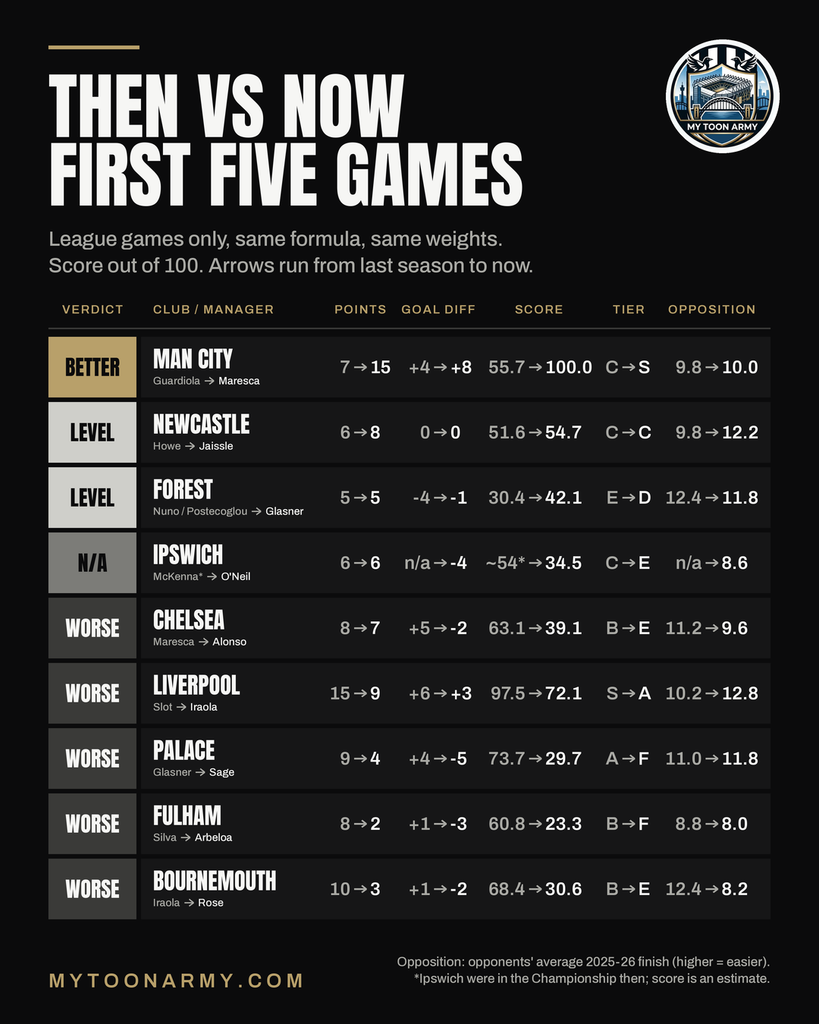
Put last September beside this one and the change looks less like renewal than a bill. Across the eight clubs that were also in the Premier League a year ago, the first five league games returned 68 points under the managers who left and 53 under the men who replaced them. Only two of the eight are ahead on points, and one of those is ahead by two.
To keep the comparison as close to like-for-like as the data allows, everything is held constant. Each club gets the same window, its first five league games, and the same four-part formula with the same weights. Cup and European matches are left out on both sides, so the tiers below will not match the all-competition tiers earlier in this piece: Palace and Bournemouth, whose Europa League and Carabao Cup wins no longer count, fall several places. “Then” means the man actually in the dugout for those five games last season: Guardiola at City, Slot at Liverpool, Howe at Newcastle, Maresca at Chelsea, Iraola at Bournemouth, Glasner at Palace and Silva at Fulham, and at Forest Nuno for three matches and Postecoglou for two. Ipswich were in the Championship, so their row carries a warning: it is a different division, and the score of one of their five matches is missing from our record. Their tier is C for any defeat of up to four goals.
Fixtures are the obvious objection, so we tested them. Ranking every opponent by where it finished in 2025-26, with newly promoted clubs counted as 19th, the average opponent this September was easier than last year’s for Liverpool (12.8 against 10.2) and for Newcastle (12.2 against 9.8). It was harder for Bournemouth (8.2 against 12.4), whose five games included Manchester City, Liverpool and Newcastle, and for Chelsea (9.6 against 11.2). For the other four clubs the swing is less than a single place.
Manchester City are the only clear improvement. Points are up from seven to fifteen and goal difference from +4 to +8, against opposition of almost identical difficulty. Guardiola’s side lost at home to Tottenham and at Brighton within nine days; Maresca’s has beaten every opponent, including a 1-0 win at Old Trafford played with ten men. His own record is the sharper comparison: eight points from Chelsea’s first five games last season, fifteen from City’s now.
Newcastle are level, with the fixtures helping. Six points became eight, but goal difference is zero in both years and the opposition was two and a half places easier this time. Howe’s five contained three goalless draws and a 3-2 home defeat to Liverpool; Jaissle’s contain a 4-1 defeat at Leeds and wins at Tottenham and against Hull. Newcastle scored and conceded three goals then and nine now. On equal weights the score barely moves, from 56.4 to 56.9: a club in the same place, with more goals at both ends.
Forest have moved sideways. Five points then and five now, with goal difference improved from −4 to −1 against a marginally harder run. Nuno’s side lost 3-0 at home to West Ham and Postecoglou’s lost 3-0 at Arsenal; Glasner’s has drawn at Liverpool, drawn with Tottenham and won at Villa. The trouble is at home, where the league goals have not come.
Five clubs are worse. Liverpool fell from fifteen points to nine despite the easier schedule, though an unbeaten start of two wins and three draws is a better place than the fall suggests. Chelsea’s points barely moved, eight to seven, but goal difference went from +5 to −2 against a harder run, and they have conceded at least twice in each of their five league games. Bournemouth’s drop is the biggest in points, ten to three, and the fixture list explains part of it. Palace (nine points to four) and Fulham (eight to two) faced almost the same difficulty as a year ago, and neither has that defence.
The men, not only the badges. Follow the managers instead of the clubs and the picture is mixed. Maresca went from eight points to fifteen, Iraola from ten to nine, Glasner from nine to five. That suggests squads and starting points matter at least as much as the man in charge, though three managers is a thin sample.
The verdict. One club is clearly better, two are level, one cannot be compared and five are worse, on the same five games and the same formula. The direction holds when the weights are equalised: all eight comparable clubs move the way they did before, and only Newcastle by less than a point. It mostly holds when fixtures are considered; the exceptions are Newcastle, whose small gain leans on an easier run, and Bournemouth, whose fall is partly the fixture list. Two cautions apply. Five games is a snapshot, not a forecast: Liverpool won their first five last season and led the table until 4 October, then finished fifth. And none of this says the appointments were mistakes. It says the change has not yet bought improvement at seven of the eight comparable clubs.
What it means for Newcastle. The results above cover the soft part of the fixture list. Newcastle’s first five league opponents averaged 12.2 on the same yardstick, and the next five, Coventry, Aston Villa, Palace, Everton and Fulham, average 12.4, so by 7 November they will have played ten games against opposition easier than the league average. Then come four league games in a fortnight against Arsenal, Brighton, Manchester United and Sunderland, all of whom finished in last season’s top eight. On the current dates, that run from 21 November to 5 December is where a start that reads as level becomes better or worse.
What the international break decides
The scorecard reopens quickly. Ipswich host Fulham and Chelsea host Bournemouth on 10 October. Palace host Forest and Liverpool host City on 11 October, then Newcastle visit Coventry on Monday 12 October. Forest’s trip to Selhurst Park has the sharpest edge: Oliver Glasner returns to the club he left, to face Pierre Sage, the man who replaced him.
How has your team performed so far with the new manager? Newcastle fans, are you satisfied with Jaissle’s return of points in the first stanza of the season just concluded? Join the conversation on X @mytoonarmy #NUFC
Results are to Sunday 20 September 2026. Match results come from Sportradar data and broadcaster match reports; context and statistics are drawn from Sky Sports, ESPN, Opta Analyst, UEFA.com, Football365, BBC Sport and AFP.