
Five defeats in seven, a restless St James’ Park and a timeline full of verdicts. On what the noise around Matthias Jaissle does to those of us listening.
Five defeats in seven matches, thirteenth in the table, and a St James’ Park that vented its anger at half-time on Monday night and again at the final whistle. Everton had already won in the Carabao Cup, away from home. Now they had won again on Tyneside, in the league, and the frustration came down off the stands in waves.
Then the match on the pitch ended and a second one began, the argument over what it all meant, fought out online.
The second match is played on phones. Its pitch is a timeline, a Reddit thread, a WhatsApp group that has been silent since the weekend and suddenly lights up with twelve messages in a minute. It has no referee and no final whistle. After the Aston Villa defeat earlier this season, supporters of Al-Ahli, the Saudi club Jaissle managed before he came to Newcastle, had a hashtag demanding his sacking running within minutes. People with no season ticket and no stake in where Newcastle finish joined the chorus, and nobody scrolling past could tell which voices belonged to the Gallowgate and which belonged to somewhere else entirely.
I have no verdict to add on Jaissle here. I’ll leave that argument to others for now. What interests me is what the volume does to the rest of us while we listen.
The pull
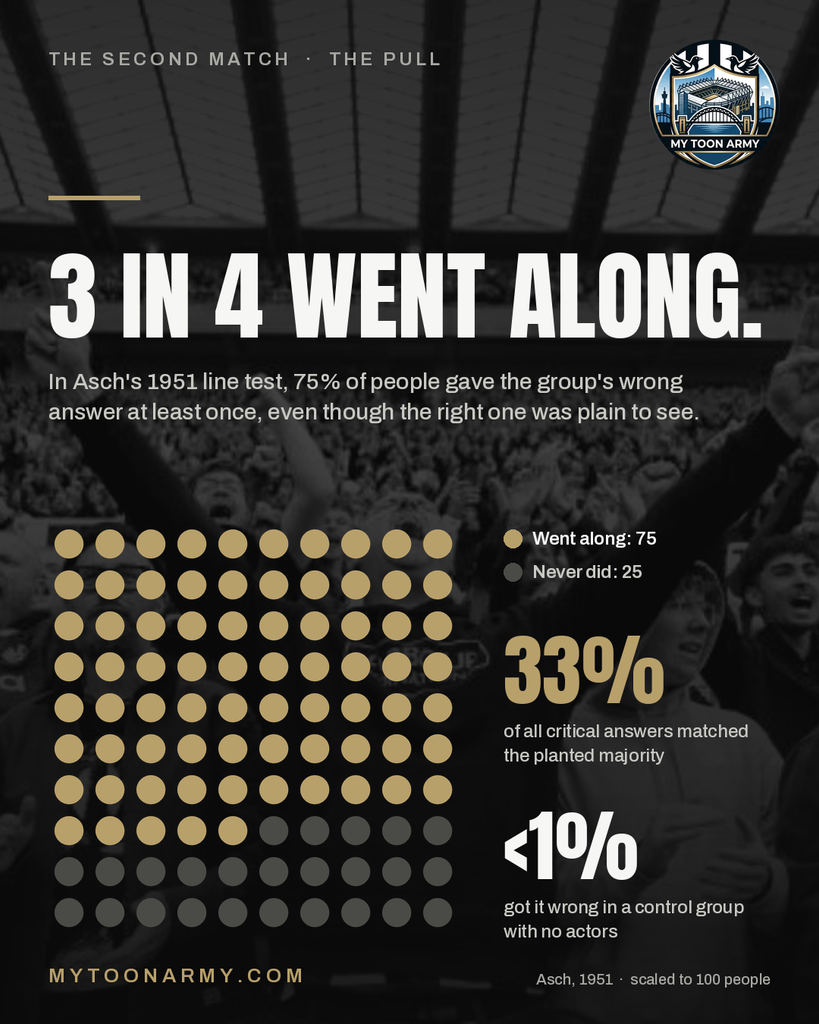
In 1951, Solomon Asch put a young man in a room at Swarthmore College with seven other people and a card showing a line. The task was to say which of three other lines matched it. The answer was obvious. The other seven, all of them actors, had been told to give the same wrong answer on twelve of the eighteen rounds.
About a third of the answers on those critical rounds matched the planted majority. Three-quarters of the participants went along with the room at least once. In a control group with no actors, fewer than one per cent of people got it wrong.
Asch also found the thread that unravels the whole thing. When a single actor broke ranks and gave the right answer, conformity dropped sharply. One dissenting voice made the other seven far easier to resist.
Asch’s lines had a correct answer printed on the back of the card. Football offers nothing of the kind. Is Matias Fernandez-Pardo ready to start? Does a particular system suit this particular squad? Is a manager two months into the job showing flaws or still finding his feet? Those questions have no card with the answer on the back, which makes the room even more persuasive.
I’ll put my hand up. When I see a wall of people asking for something, whether it’s a manager sacked or a £51m forward in the starting eleven, it builds a sense of expectation. Often I catch myself agreeing because I want to belong to the right group. If the masses say it, part of me wants to be among the masses. When the subject is something I care about this much, the pressure is intense.
It works the same way with politics and religion. Football just happens to be a small, niche, constantly observable laboratory for it, and Newcastle, with its fifty-two thousand voices and its permanent state of heightened feeling, is a very good place to watch it happen.
A price is not a fact
Bankers know this pattern in another costume.
In 1983, Douglas Diamond and Philip Dybvig published a model of a bank run. Their point was uncomfortable. A perfectly solvent bank can fail if enough depositors believe other depositors are about to withdraw. Each individual’s decision is rational given what they expect everyone else to do. Nobody needs to have read the balance sheet. The belief about other people’s belief does the damage.
A campaign to sack a manager, Jaissle now or anyone else in future, has the same architecture. The more people who say it, the more it seems that others must have seen something, and the more reasonable it feels to say it too. A share price works this way as well. It records what the market is willing to pay today, and whether the company is worth that is a separate question that someone has to answer by doing the work.
The temperature of a timeline is a price. It tells you what the crowd is willing to say right now, which is useful information about the crowd.
Who is actually talking
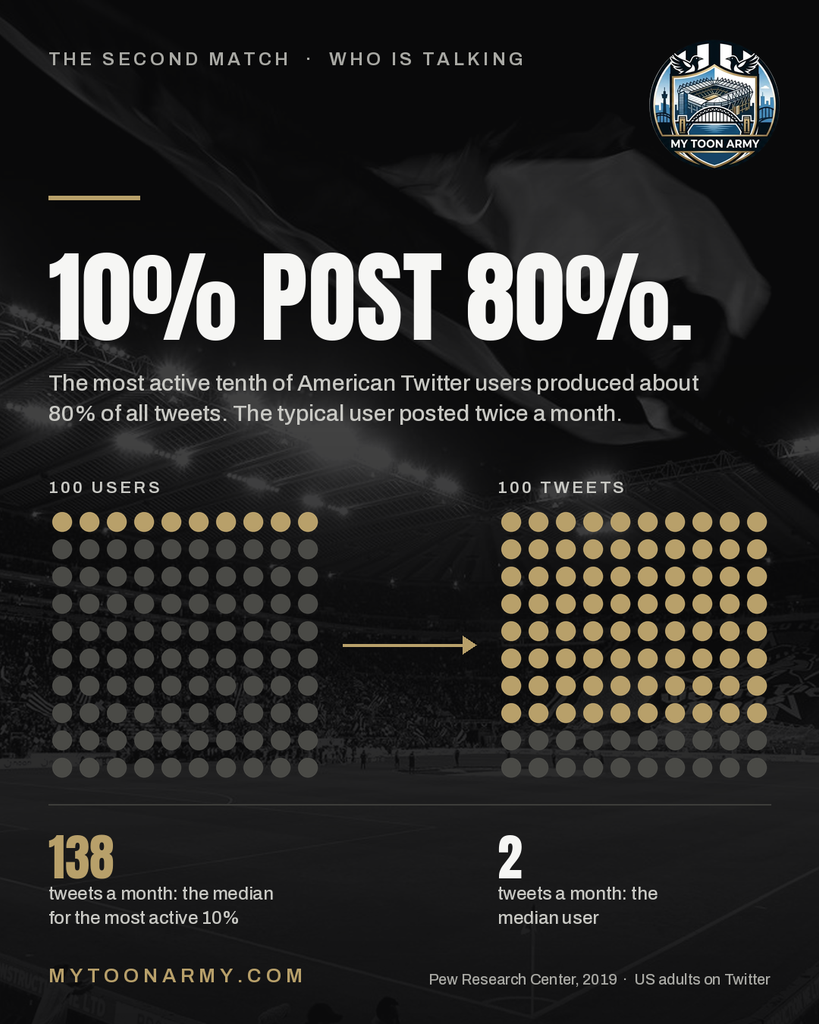
A Pew Research Center study of American adults on Twitter, published in 2019, found that the most active ten per cent of users produced about eighty per cent of the tweets. The median user posted twice a month. Nothing in that study was about football, the platform has changed since, and the data is American. It still describes how a timeline gets its shape: a small, prolific minority generating most of the words, and a much larger audience that reads and says nothing.
From where I sit, loud and numerous look identical. A thousand angry posts in an hour feel like a thousand angry supporters. Some of them are one supporter posting eleven times.
Framing adds another layer. Several outlets this week ran headlines built around the word “sack”. Read beneath them and the reports describe a club with no plans to move, a board said to be standing by its man. I can’t see inside the building and those are reports, not facts, but the gap between the headline and the copy tells you something about how a story gets its temperature. The word that goes into the headline is the word that goes into the group chat.
The best outcome and the likeliest one
Thinking independently takes deliberate effort. It needs quiet time, away from the notifications, to sit with an issue and let it settle. Then comes a second job that I find harder: separating what would be the best outcome from what is the most likely one. They are sometimes mutually exclusive.
A change in the dugout might be the best thing for the club and also the least likely to happen. A change might be the likeliest outcome and also a poor idea. A signing might deserve a start on merit and still sit on the bench for reasons nobody outside the training ground can see. The crowd tends to fuse these questions into a single demand, because a demand is easier to type than a probability.
Inside a bank’s credit committee, nobody asks which outcome the room would like. They ask which outcome the file supports, and how confident anyone should be. It feels cold at first. It is also the only way I know to keep wishing and forecasting apart.
The phrasing matters
This is one of the things I think hardest about when I write for this blog. “Under pressure” and “failing” are different sentences. “Calls for” and “demands” are different sentences. A choice of verb can carry a conclusion into a reader’s head before the evidence has arrived, and I would rather the reader reach their own conclusion on the way. If I do my job properly, you finish a post of mine knowing what happened, why it might have happened, and where I am uncertain, with room left to disagree with me.
Newcastle travel to Craven Cottage on Saturday to face Fulham. Before a ball is kicked, someone in the group chat will already have decided what the result is going to mean, win or lose. I’d like to watch the match first and make up my own mind afterwards.
Leave a Reply