
Andoni Iraola spent three seasons building the side he faced at the Vitality Stadium on Sunday, and in the 57th minute Alexander Isak turned in Cody Gakpo’s cross, which had clipped Florian Wirtz on its way through. Liverpool won 1-0. Iraola was Bournemouth’s manager until this summer, and on Sunday he beat them as Liverpool’s. Marco Rose, who replaced him, has three points from five league games.
It was one of nine stories like it. Nine Premier League clubs began 2026-27 under a new manager, the most in an English top-flight season since 1946-47, and change on that scale forces one question: who got it right? Every appointment is judged twice, against the man who left and against the eight who arrived alongside him.
The early answers are already loud. Enzo Maresca has won seven from seven at Manchester City, across the league, Europe and the Carabao Cup. Iraola is the first Liverpool manager unbeaten through his opening five league games since Joe Fagan in 1983. At the City Ground, Oliver Glasner’s side has yet to score at home in the league, and he said on Saturday that he had felt the weight of last season for the first time. Five of the nine have won fewer than half of their games in all competitions.
Loud is not the same as measured. So here is the yardstick, then the nine, then the same test run on last September’s managers.
How the tiers were scored
The rules were fixed before any manager was scored, and they use only results.
The window runs from each manager’s first competitive match to Sunday 20 September. It covers the Premier League, the Carabao Cup and the Champions League or Europa League where a club plays in them. The Community Shield and friendlies are excluded, and the FA Cup has not started. Every match counts the same, and the result is the one after 90 minutes; no tie has needed a shoot-out.
Four measures make a score out of 100:
- Results (40 points): points per game across all competitions. Three per game earns the full 40.
- Goal difference (25 points): goal difference per game, scaled so that +1.5 or better earns 25 and −1.5 or worse earns nothing.
- Resilience (15 points): the share of matches not lost.
- Form (20 points): points per game across the last three matches, scored like results.
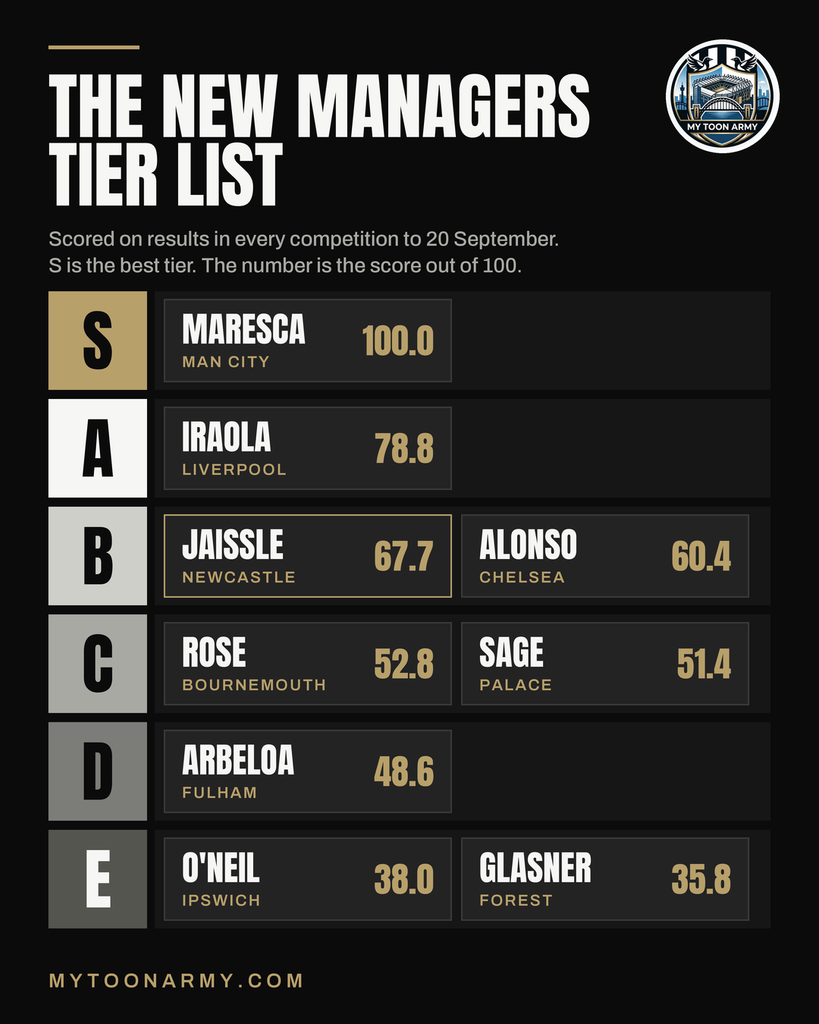
Bands are S from 80, A from 70, B from 60, C from 50, D from 40, E from 30 and F below that.
Given the weights, nobody’s opinion touches the arithmetic. The weights themselves are a judgement, so we tested them, and three limits apply:
- Six or seven games is a small sample.
- A Carabao Cup tie against a League One side counts the same as a league match.
- Nothing adjusts for opposition or uses expected goals.
We also tested the weights. Give the four measures equal weight and seven of the nine managers stay in the same tier; Liverpool (78.8) moves up to S and Fulham (48.6) up to C, each just short of a tier line. Count league games only and the bottom of the table reshuffles: Ipswich (1.2 points a game) and Forest (1.0) would rank fifth and sixth, above Palace, Bournemouth and Fulham. They sit at the bottom of the all-competition table because Palace, Bournemouth and Fulham have won all their cup and European games so far, while Ipswich and Forest went out of the Carabao Cup.
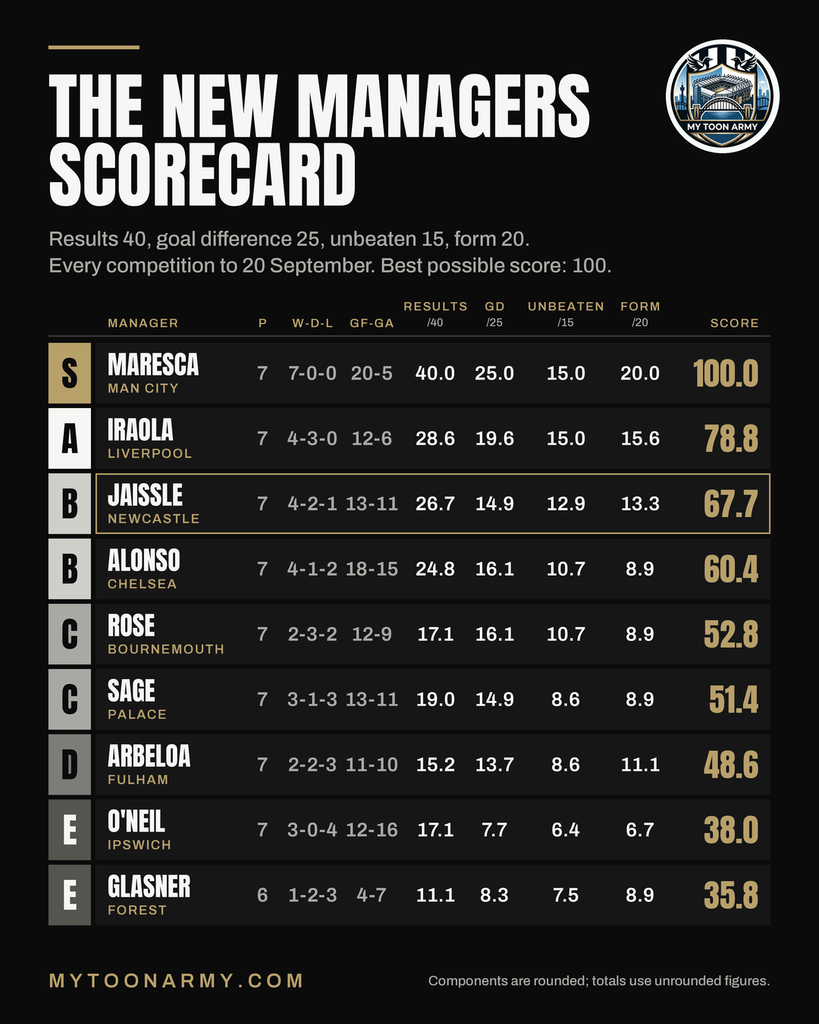
S: Enzo Maresca, Manchester City (100.0)
Seven wins have arrived in every shape. At Old Trafford, City played from the 23rd minute with ten men after Phil Foden was sent off, and still won 1-0 through Erling Haaland’s goal just before the hour. In Porto, Haaland scored twice, City’s expected goals came to 2.31 against the hosts’ 0.22, and Porto failed to register a shot on target. Against Norwich in the Carabao Cup, Maresca made ten changes and still won 5-0, with 17-year-old Floyd Samba scoring twice on his debut. Sunderland’s three goals on Sunday are the only crack so far.
SWOT. Strengths: a squad that survives rotation, and a striker who scored both goals in Porto. Weaknesses: the back line was stretched for the first time against Sunderland. Opportunities: a top-eight finish in the Champions League league phase gives an easier route. Threats: the calendar asks the hard questions early, with Liverpool away on 11 October, Aston Villa away on 24 October and Arsenal away on 28 November.
A: Andoni Iraola, Liverpool (78.8)
Iraola is unbeaten in seven, though only some of it has been comfortable. The league record is two wins and three draws, alongside a 2-1 Champions League win over Atlético Madrid and a 3-1 Carabao Cup win over Tottenham. Opta notes he is the first Liverpool manager unbeaten in his first five league games since Joe Fagan in 1983. Alexander Isak already has four league goals, more than in all of last season. The 1-0 at Bournemouth was scrappy: Jamie Carragher criticised the first half, and Liverpool gave the ball away too often in midfield.
SWOT. Strengths: three consecutive league clean sheets, and Jeremy Jacquet looking like a serious prospect beside Virgil van Dijk. Weaknesses: the attack has struggled for influence, and three of five league games were draws. Opportunities: a young defence that is still improving. Threats: Liverpool are sixth on nine points, with City at Anfield on 11 October.
B: Matthias Jaissle, Newcastle (67.7)
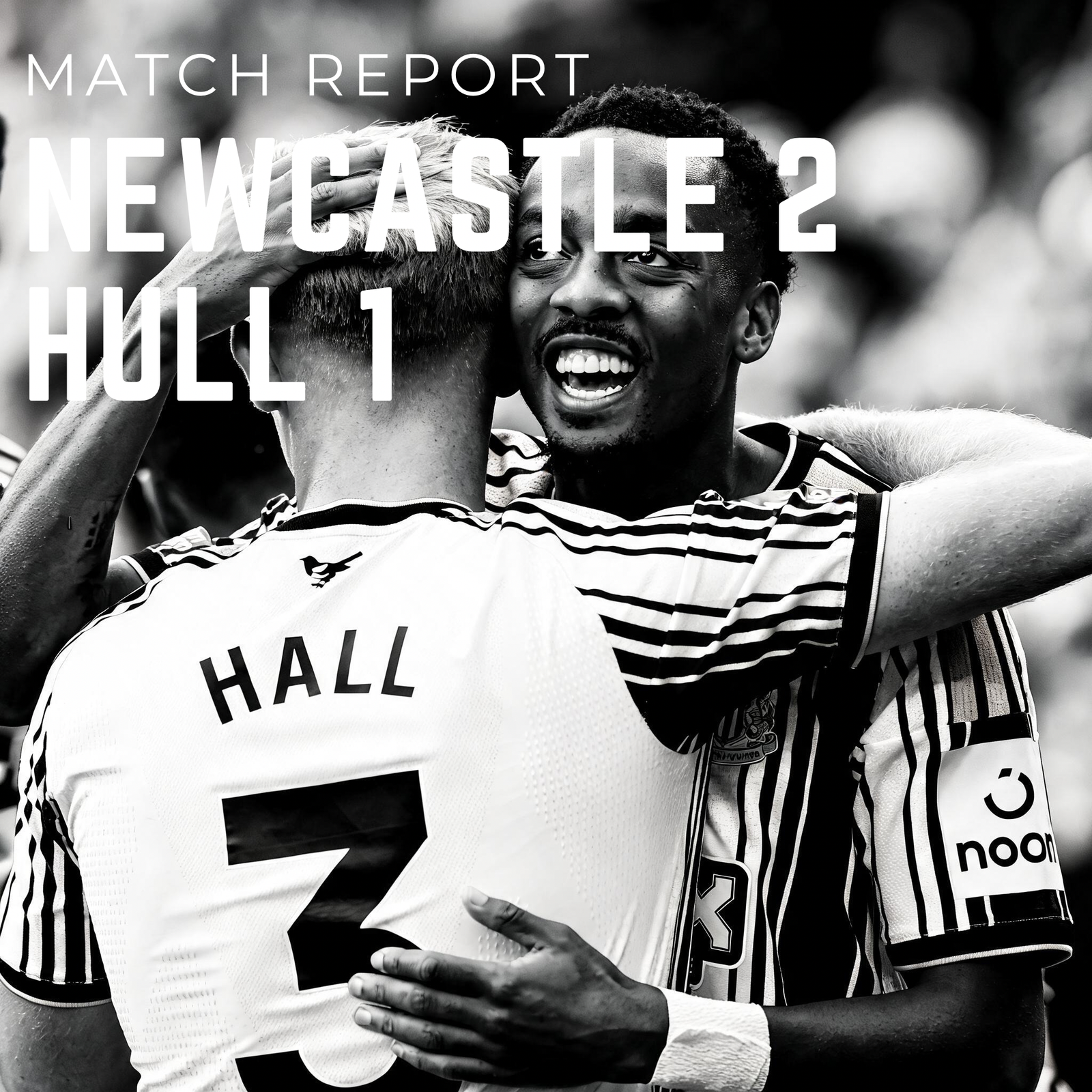
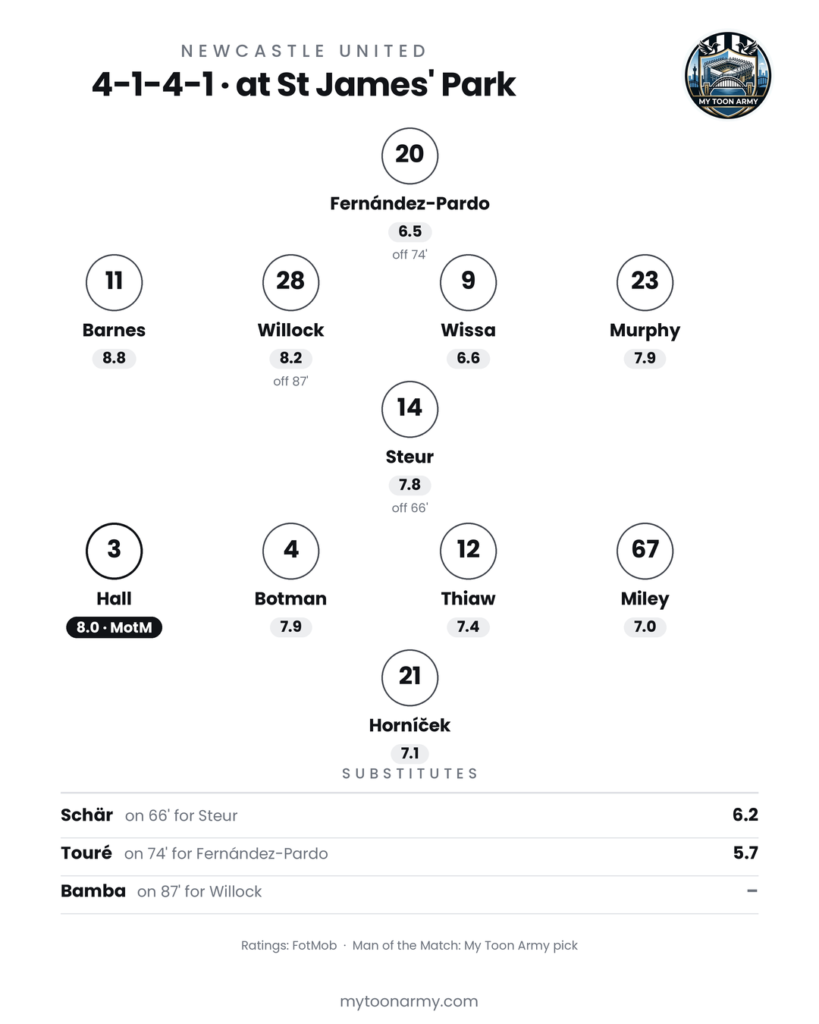
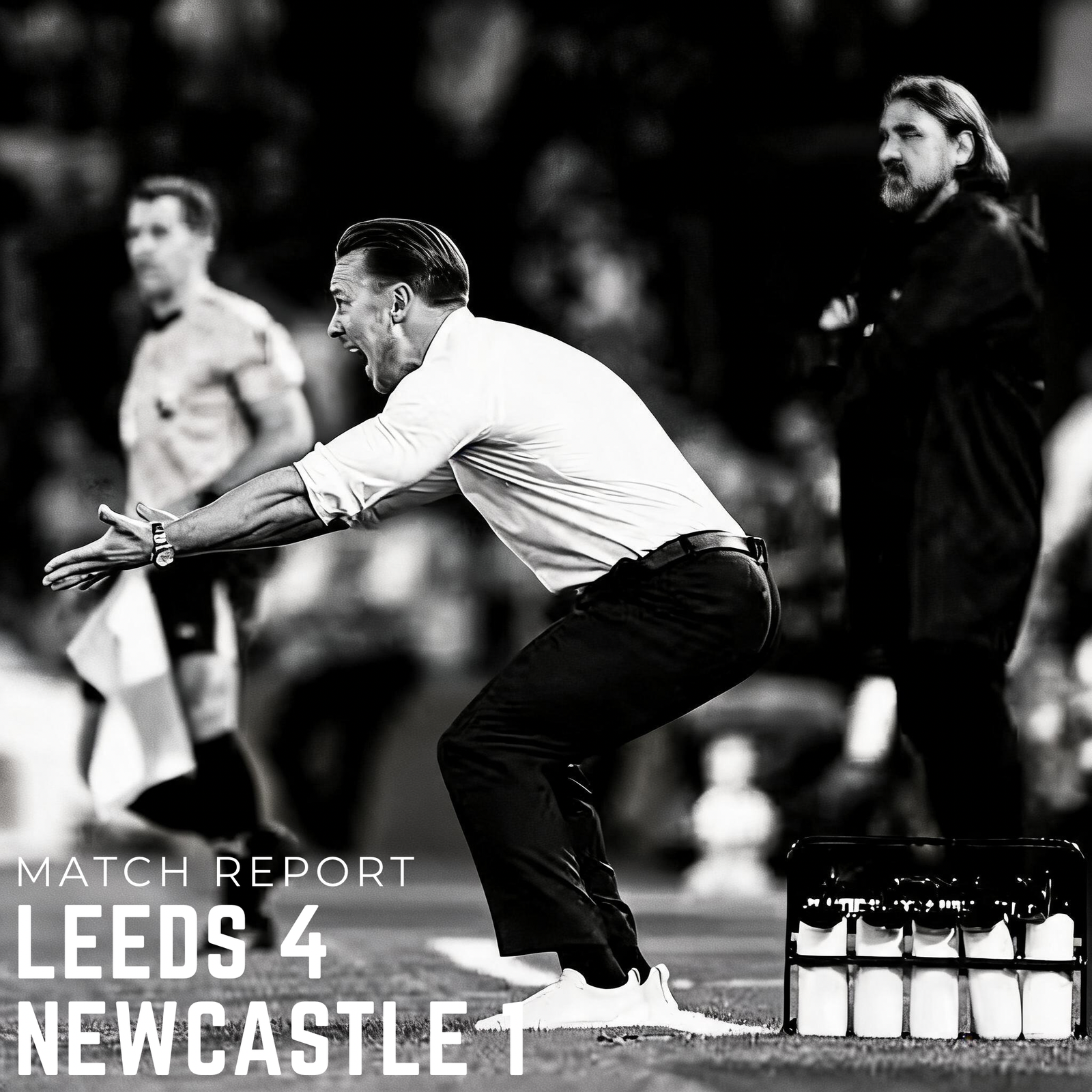
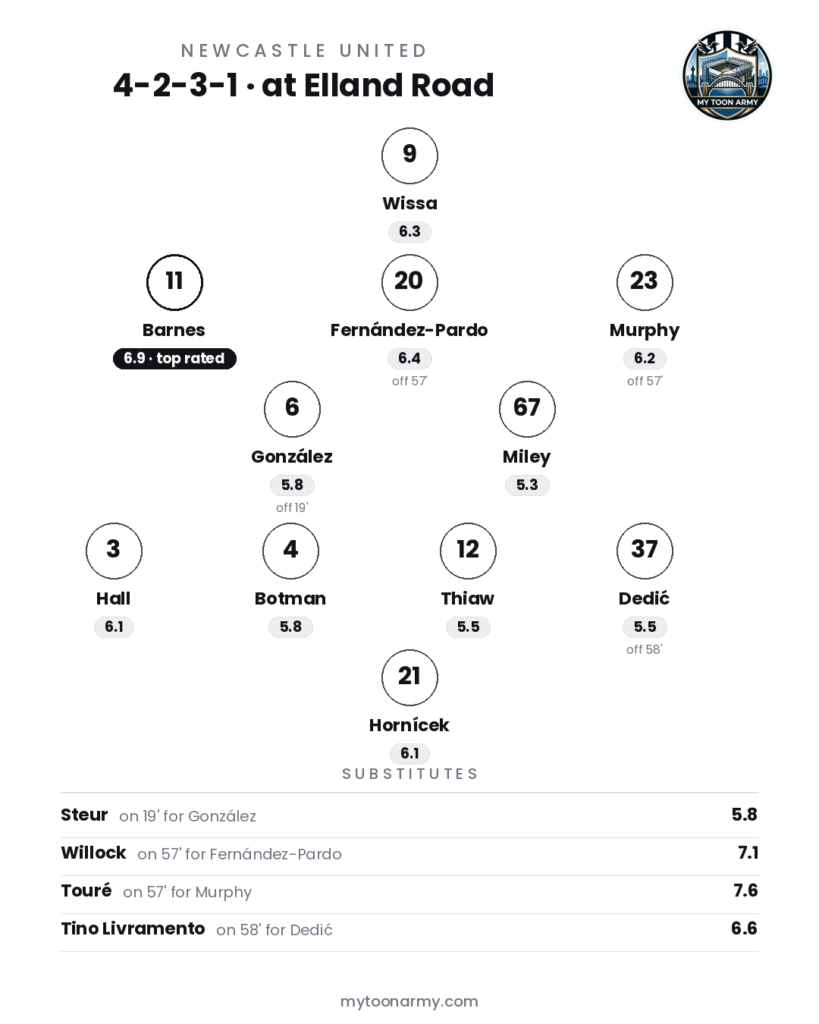
Newcastle’s start has had two faces. A 2-2 draw with Liverpool, a 2-0 win at Tottenham and a 2-2 draw with Bournemouth sat alongside a 3-2 Carabao Cup win over West Brom and a 1-0 win at Millwall. Then Leeds won 4-1 at Elland Road on a Monday night, a defeat Jaissle put down to a lack of intensity in duels and second balls. Saturday’s 2-1 win over Hull came with eight senior players absent, including Tino Livramento, and an 18-year-old, Sean Steur, in midfield. Joe Willock and Lewis Hall scored inside the first seven minutes, Yoane Wissa’s penalty was saved, and a late switch to a back three let Hull back in.
SWOT. Strengths: 13 goals in seven matches, and the direct, incisive football that Football365 saw in the Hull goals. Weaknesses: physical duels and second balls, in Jaissle’s own diagnosis. Opportunities: Newcastle are not in Europe, so they have clear midweeks to work with. Threats: Coventry away on Monday 12 October, Aston Villa at home on 17 October and Palace away on 25 October.
B: Xabi Alonso, Chelsea (60.4)
Chelsea began as entertainers: the first four league games produced 19 goals. They won 3-2 at Fulham and 4-3 against Brighton, lost 2-1 at Arsenal and drew 2-2 with Hull, with a 6-3 Carabao Cup win over Leeds and a 2-0 win over Luton in between. Then Brentford won 3-0. Chelsea have now conceded at least two goals in five straight league games under Alonso, conceded from set-pieces again and looked short of competitive mentality once behind. They have taken one point from their last three league games.
SWOT. Strengths: 18 goals in seven matches, with Cole Palmer and Morgan Rogers at the centre of it. Weaknesses: set-pieces, and shape once they concede. Opportunities: Moisés Caicedo’s return should add solidity in midfield. Threats: João Pedro’s knee injury, then Bournemouth at home on 10 October and Everton away on 17 October.
C: Marco Rose, Bournemouth (52.8)
Bournemouth’s league table and their season tell different stories. They have not won in five league games (three draws, two defeats), the ninth time in the club’s history they have failed to win any of their first five, and sit 17th. Yet they beat Lincoln 4-0 in the Carabao Cup and won 2-1 at Real Sociedad in their first European match, with Justin Kluivert scoring the club’s first European goal. Iraola’s return on Sunday ended in a 1-0 defeat, in a game between Iraola’s new side and Rose’s evolution of what Iraola built.
SWOT. Strengths: Bournemouth won plenty of second balls at Liverpool. Weaknesses: six goals in five league games, with two 2-2 draws among them. Opportunities: a Europa League campaign that has started with an away win. Threats: they are out of the bottom three only on tiebreakers, with Chelsea away on 10 October.
C: Pierre Sage, Crystal Palace (51.4)
Palace’s league form and Europe are a study in contrasts. They conceded 11 goals in their first four league games, four of them at home to City and three to Ipswich. Then they held Leeds 0-0 at Elland Road, and Tyrick Mitchell’s goal was ruled out for offside. In Europe Yéremy Pino, Chris Richards, Jørgen Strand Larsen from the penalty spot and Eddie Nketiah scored in a 4-0 Europa League win over Lech Poznań, and they won 3-0 against Middlesbrough in the Carabao Cup.
SWOT. Strengths: Adam Wharton driving the midfield, and depth up front with Mateta, Strand Larsen and Nketiah. Weaknesses: before the weekend, the worst defensive record in the league. Opportunities: the first clean sheet as a foundation, and Forest at home on 11 October. Threats: Palace are one point clear of the relegation zone.
D: Álvaro Arbeloa, Fulham (48.6)
Fulham have not won a league game, and only Tottenham are below them on goal difference. They lost 3-2 to Chelsea, 1-0 at Sunderland and 3-2 to Palace, then drew 0-0 at Liverpool and 1-1 with Manchester United. Against United the expected goals were 1.57 to 1.59. The cups have been kinder: a 3-0 win over AFC Wimbledon after ten changes was his first competitive win, followed by a 3-2 win at West Ham.
SWOT. Strengths: a young, revamped side that is scrapping hard, with back-to-back draws against Liverpool and United. Weaknesses: eight goals conceded in five league games. Opportunities: Ipswich on 10 October, then Hull and Coventry. Threats: only Tottenham are below them on goal difference.
E: Gary O’Neil, Ipswich (38.0)
Ipswich won their opener 2-1 against Sunderland, won 3-2 at Palace and beat Leicester 3-1 in the Carabao Cup. But they conceded five at Old Trafford, lost 4-2 to Arsenal in the Carabao Cup, where 16-year-old Max Dowman scored twice, and lost 1-0 at Everton, where they finished with ten men. Ipswich have gone 24 Premier League games without a clean sheet, their worst run in the top flight, and O’Neil has now lost 50 of his 93 Premier League games as a manager.
SWOT. Strengths: goals on the road, including three at Palace. Weaknesses: defending, without a clean sheet in 24 top-flight games. Opportunities: Fulham at home on 10 October, a match the pre-match model rates as close to even. Threats: Manchester City away on 17 October, then Forest at home on 23 October, a meeting of the two E-tier sides.
E: Oliver Glasner, Nottingham Forest (35.8)
Forest have played six and won one. Leeds beat them twice in four days, 1-0 in the league and 2-0 in the Carabao Cup. Draws with Liverpool (2-2) and Tottenham (0-0) followed, then a 2-1 win at Villa. On Saturday Coventry won 1-0 at the City Ground, their first Premier League win in 25 years, after VAR ruled out a late equaliser by Igor Jesus. Forest have not scored in any of three home league games. Glasner’s own diagnosis was psychological, not tactical.
SWOT. Strengths: points against Liverpool and Tottenham, and a win at Villa. Weaknesses: home scoring, and the loss of Elliot Anderson. Opportunities: Liam Delap, who arrived from Chelsea, and Palace away on 11 October. Threats: the club’s fifth manager in 12 months, with Arsenal at the City Ground on 18 October.
Then and now: are the clubs better off?
Put last September beside this one and the change looks less like renewal than a bill. Across the eight clubs that were also in the Premier League a year ago, the first five league games returned 68 points under the managers who left and 53 under the men who replaced them. Only two of the eight are ahead on points, and one of those is ahead by two.
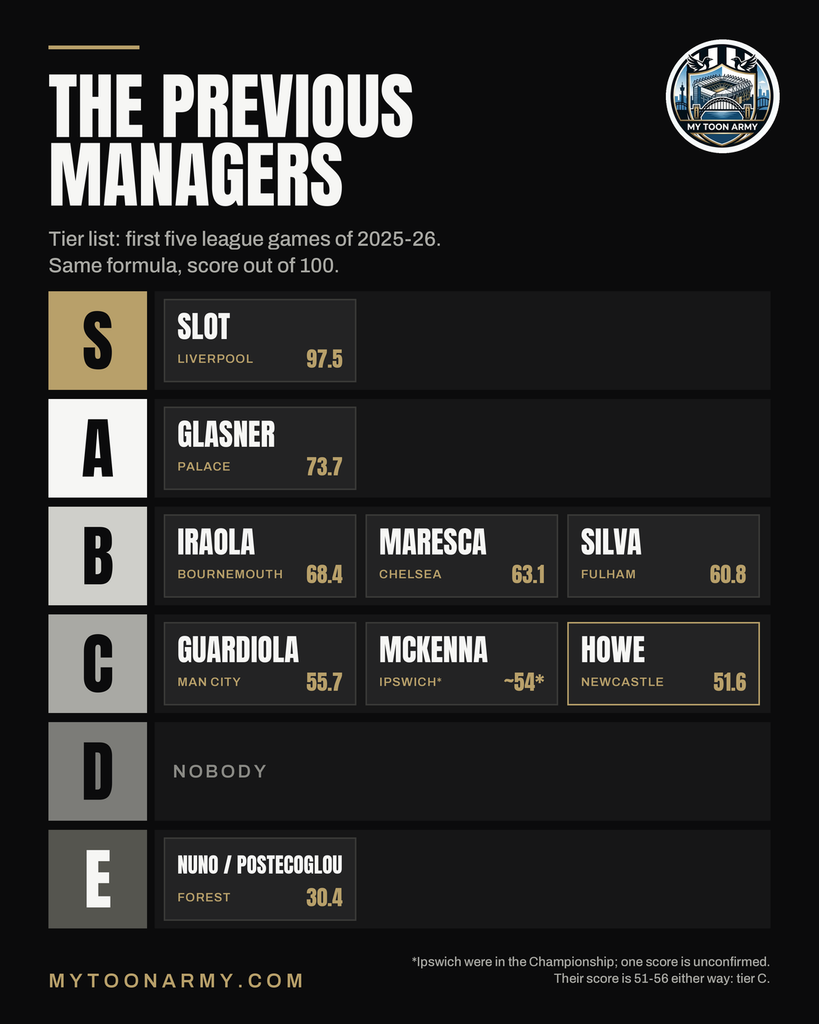
To keep the comparison as close to like-for-like as the data allows, everything is held constant. Each club gets the same window, its first five league games, and the same four-part formula with the same weights. Cup and European matches are left out on both sides, so the tiers below will not match the all-competition tiers earlier in this piece: Palace and Bournemouth, whose Europa League and Carabao Cup wins no longer count, fall several places. “Then” means the man actually in the dugout for those five games last season: Guardiola at City, Slot at Liverpool, Howe at Newcastle, Maresca at Chelsea, Iraola at Bournemouth, Glasner at Palace and Silva at Fulham, and at Forest Nuno for three matches and Postecoglou for two. Ipswich were in the Championship, so their row carries a warning: it is a different division, and the score of one of their five matches is missing from our record. Their tier is C for any defeat of up to four goals.
Fixtures are the obvious objection, so we tested them. Ranking every opponent by where it finished in 2025-26, with newly promoted clubs counted as 19th, the average opponent this September was easier than last year’s for Liverpool (12.8 against 10.2) and for Newcastle (12.2 against 9.8). It was harder for Bournemouth (8.2 against 12.4), whose five games included Manchester City, Liverpool and Newcastle, and for Chelsea (9.6 against 11.2). For the other four clubs the swing is less than a single place.
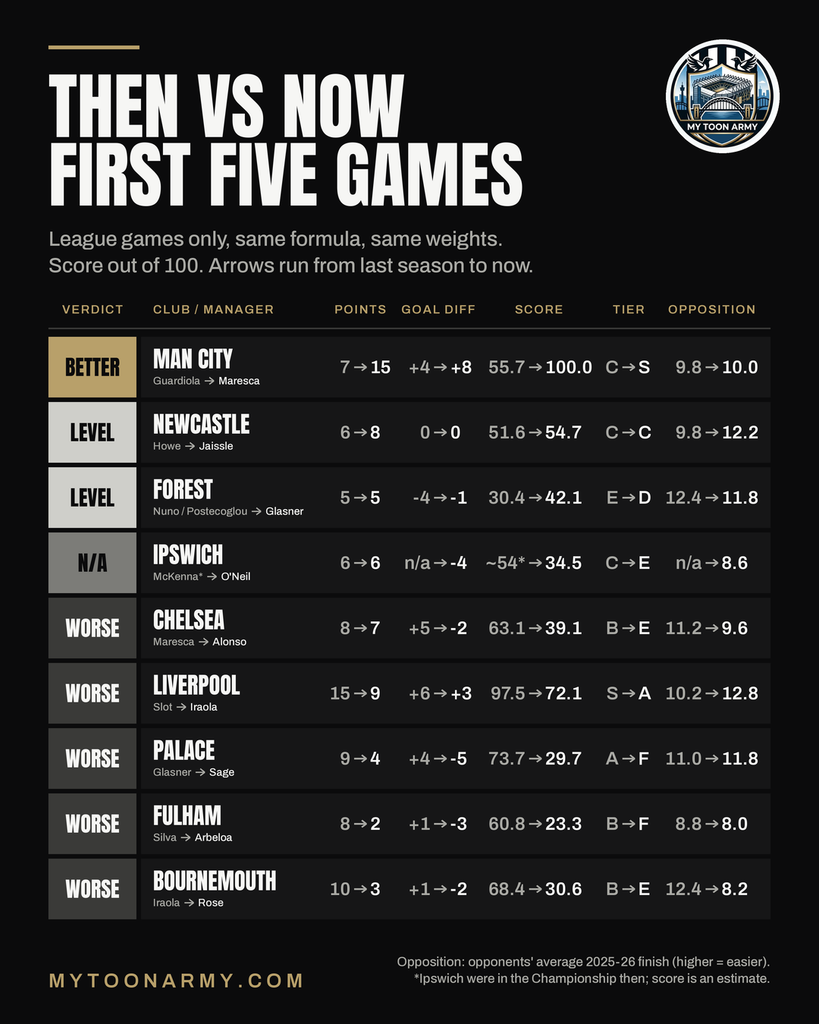
Manchester City are the only clear improvement. Points are up from seven to fifteen and goal difference from +4 to +8, against opposition of almost identical difficulty. Guardiola’s side lost at home to Tottenham and at Brighton within nine days; Maresca’s has beaten every opponent, including a 1-0 win at Old Trafford played with ten men. His own record is the sharper comparison: eight points from Chelsea’s first five games last season, fifteen from City’s now.
Newcastle are level, with the fixtures helping. Six points became eight, but goal difference is zero in both years and the opposition was two and a half places easier this time. Howe’s five contained three goalless draws and a 3-2 home defeat to Liverpool; Jaissle’s contain a 4-1 defeat at Leeds and wins at Tottenham and against Hull. Newcastle scored and conceded three goals then and nine now. On equal weights the score barely moves, from 56.4 to 56.9: a club in the same place, with more goals at both ends.
Forest have moved sideways. Five points then and five now, with goal difference improved from −4 to −1 against a marginally harder run. Nuno’s side lost 3-0 at home to West Ham and Postecoglou’s lost 3-0 at Arsenal; Glasner’s has drawn at Liverpool, drawn with Tottenham and won at Villa. The trouble is at home, where the league goals have not come.
Five clubs are worse. Liverpool fell from fifteen points to nine despite the easier schedule, though an unbeaten start of two wins and three draws is a better place than the fall suggests. Chelsea’s points barely moved, eight to seven, but goal difference went from +5 to −2 against a harder run, and they have conceded at least twice in each of their five league games. Bournemouth’s drop is the biggest in points, ten to three, and the fixture list explains part of it. Palace (nine points to four) and Fulham (eight to two) faced almost the same difficulty as a year ago, and neither has that defence.
The men, not only the badges. Follow the managers instead of the clubs and the picture is mixed. Maresca went from eight points to fifteen, Iraola from ten to nine, Glasner from nine to five. That suggests squads and starting points matter at least as much as the man in charge, though three managers is a thin sample.
The verdict. One club is clearly better, two are level, one cannot be compared and five are worse, on the same five games and the same formula. The direction holds when the weights are equalised: all eight comparable clubs move the way they did before, and only Newcastle by less than a point. It mostly holds when fixtures are considered; the exceptions are Newcastle, whose small gain leans on an easier run, and Bournemouth, whose fall is partly the fixture list. Two cautions apply. Five games is a snapshot, not a forecast: Liverpool won their first five last season and led the table until 4 October, then finished fifth. And none of this says the appointments were mistakes. It says the change has not yet bought improvement at seven of the eight comparable clubs.
What it means for Newcastle. The results above cover the soft part of the fixture list. Newcastle’s first five league opponents averaged 12.2 on the same yardstick, and the next five, Coventry, Aston Villa, Palace, Everton and Fulham, average 12.4, so by 7 November they will have played ten games against opposition easier than the league average. Then come four league games in a fortnight against Arsenal, Brighton, Manchester United and Sunderland, all of whom finished in last season’s top eight. On the current dates, that run from 21 November to 5 December is where a start that reads as level becomes better or worse.
What the international break decides
The scorecard reopens quickly. Ipswich host Fulham and Chelsea host Bournemouth on 10 October. Palace host Forest and Liverpool host City on 11 October, then Newcastle visit Coventry on Monday 12 October. Forest’s trip to Selhurst Park has the sharpest edge: Oliver Glasner returns to the club he left, to face Pierre Sage, the man who replaced him.
How has your team performed so far with the new manager? Newcastle fans, are you satisfied with Jaissle’s return of points in the first stanza of the season just concluded? Join the conversation on X @mytoonarmy #NUFC
Results are to Sunday 20 September 2026. Match results come from Sportradar data and broadcaster match reports; context and statistics are drawn from Sky Sports, ESPN, Opta Analyst, UEFA.com, Football365, BBC Sport and AFP.