This is Part Three of a four-part My Toon Army series on Manchester City’s Premier League charges and what the whole saga means for Newcastle United’s own position under Saudi ownership. Part One covered the verdict and the appeal to come; Part Two traced the seasons, the signings and the clubs now counting the cost.
According to a Guardian report picked up widely after the verdict, the independent commission did not simply find Manchester City guilty of 114 breaches. It found the club had acted in bad faith. Two words, and they matter more than they look. Bad faith is not a filing error or an honest dispute over accounting standards. It is a panel of three people, after working through what is reported to be roughly half a million pages of evidence, concluding that Manchester City knew exactly what it was doing.
And yet, days after that finding became public, nobody, including the people paid to know, can tell you what happens to City now. Not the size of the fine, not the number of points, not even the shape of the punishment. Part One explained why the appeal could drag deep into this season. This piece is about something else: even if the appeal were settled tomorrow, there may be no punishment on the shelf that actually fits what the commission found.
The toolkit
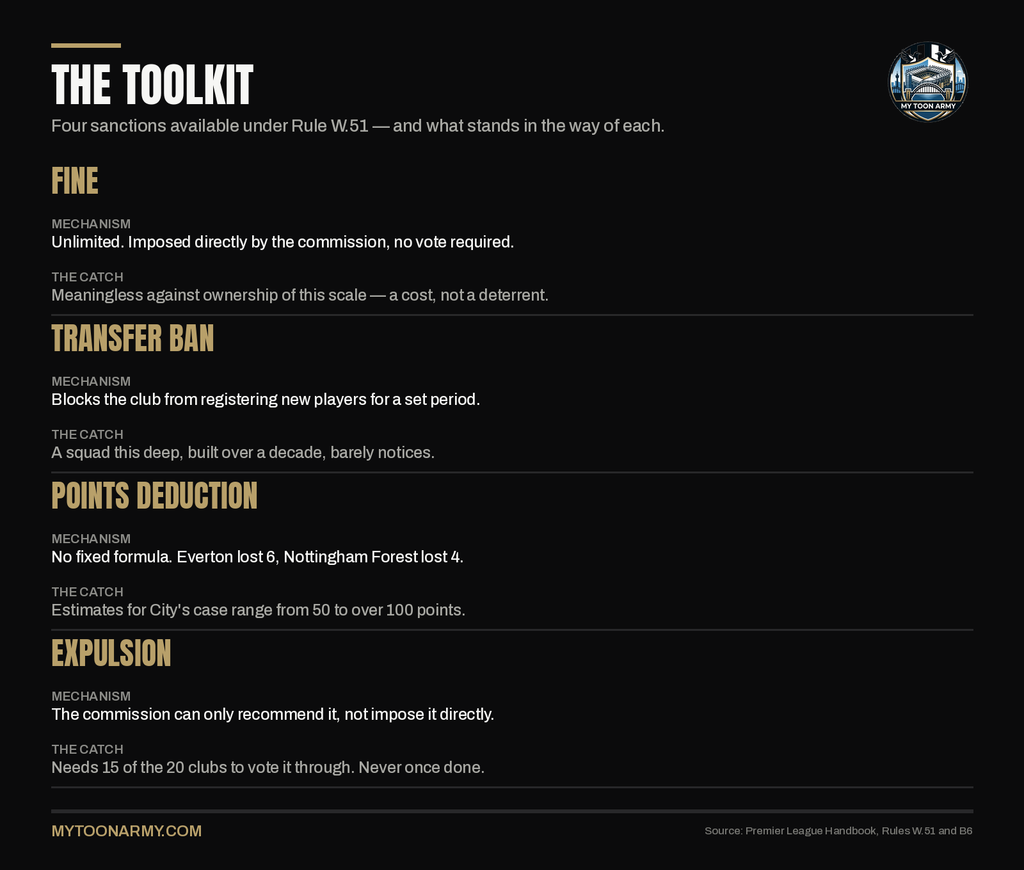
The commission’s powers come from Rule W.51, the part of the Premier League Handbook that deals with disciplinary sanctions. It can impose an unlimited fine, deduct points, and recommend that a club be expelled. Ian Hargreaves, a partner at the disputes firm Quillon Law, summed up the range for Al Jazeera: a transfer ban at the moderate end of the spectrum, expulsion at the most severe. Fines and points deductions sit in between, and none of these options excludes the others. As sports barrister Yasin Patel has pointed out, a single ruling could combine a major fine, a points deduction and other sporting measures.
What the rulebook does not contain is a tariff: no sentencing guideline, no points-per-charge formula. That absence is deliberate. Clubs chose not to set fixed penalties for financial breaches, fearing that a published price list would let a wealthy club simply budget for the punishment and treat it as a cost of doing business. Chief executive Richard Masters said in February 2025 that the League was exploring a “Sanctions Grid” of agreed penalties. It has not arrived in time for the biggest case in the competition’s history. Every option below is, to some degree, a guess dressed up as a precedent.
Money means nothing here
Start with the fine, because it can be dismissed fastest. City are owned by the Abu Dhabi United Group, the investment vehicle of Sheikh Mansour bin Zayed Al Nahyan, vice-president of the United Arab Emirates and a senior member of Abu Dhabi’s ruling family. Against wealth on that scale, any fine the Premier League could realistically impose is a rounding error rather than a deterrent. The only financial route with real teeth is the set of civil compensation claims being assembled by Arsenal, Liverpool, Manchester United and Tottenham, covered in Part Two, and even those would compensate specific wronged clubs rather than act as a punishment from the League itself.
The points deduction nobody can actually calculate
This is where the real disagreement lives. The benchmark cases are Everton and Nottingham Forest, both punished for breaching the Profit and Sustainability Rules (PSR), which cap how much a club can lose over a rolling three-year period. Everton’s first penalty was ten points, cut to six on appeal; Forest lost four. Each case covered a single three-year assessment period. City’s covers nine seasons and five categories of rules. Football finance expert Kieran Maguire’s phrase for scaling up is blunt: “you have to add a zero.”
Since the verdict, the estimates have hardened. Maguire and fellow analyst Stefan Borson have floated deductions of 60 to 100 points, enough to relegate City almost regardless of how they play. Former Everton chief executive Keith Wyness told Football Insider he expects a 50-point deduction “to ensure relegation in some way”, arguing that with guilt found across virtually every area of the case, “it will be very hard to appeal on facts.”
Others are more cautious. Dan Plumley, a sports finance academic, told Goal that a points deduction plus a fine is the most likely outcome, with relegation and title-stripping “the extreme, but unlikely, scenarios”. From a modest deduction to a table-bottom collapse, the spread of informed opinion shows how little precedent exists for a case of this size.
There is one real data point at the lenient end. After Chelsea’s 2022 takeover, the new owners self-reported undisclosed payments made between 2011 and 2018 under Roman Abramovich. In March this year, Chelsea were fined £10.75 million and handed a suspended transfer ban, one that only takes effect if the club reoffends, with no points deduction at all. The fine was halved from £20 million, and the League explicitly credited Chelsea’s “proactive self-reporting” and “exceptional co-operation.” It also noted that Chelsea’s breaches, even if declared properly, would not have taken the club over its spending limits. City’s charge sheet includes 35 counts of doing the opposite of cooperating, over four years. If the system rewards clubs that come clean and punishes those that fight, City’s decision to contest everything may prove to be the costliest choice of the entire saga.
Transfer bans: moderate on paper, toothless in practice
A transfer ban, which stops a club registering new players for a set period, sounds severe but would cost City remarkably little. The squad was built over more than a decade of the spending the commission has now found breached the rules, it is young, with an average age of around 25, and it is deep enough to lose several players to rival clubs without collapsing. Behind it sit a productive academy and the scouting network of City Football Group’s sister clubs around the world. A transfer ban hurts a club that needs to rebuild. City’s squad was built long ago.
Expulsion: the button nobody can actually press
For many supporters of other clubs, expulsion is the only proportionate response to rule-breaking on this scale. It is also the option furthest from happening. The commission can only recommend it. Actually removing a club requires a Special Resolution under Rule B6 of the Handbook: 15 of the 20 Premier League clubs must vote in favour. No club has ever been expelled, and this time three-quarters of the division would have to vote to remove one of the competition’s biggest commercial draws.
Opinion among the clubs was already split before the verdict. According to Goal, some were prepared to push for an outright expulsion, while others worried the delay was causing “undue damage to the Premier League” and wanted a resolution that let everyone move on. Relying on 15 clubs to set aside their own commercial interests is, at best, a coin flip.
Even if the vote passed, there is a second problem: nobody knows where City would go. The English Football League (EFL), which runs the three professional divisions below the Premier League, would be under no obligation to accept an expelled City, according to The Telegraph. The EFL is also capped at 72 clubs, with no spare place for a 73rd. And because entry to the FA Cup and League Cup is tied to league membership, City could in theory lose those too.
The doomsday scenario. Over the weekend, the picture darkened further. Journalist Ben Jacobs reported that if City are expelled, the EFL is not merely entitled to refuse them but is reportedly prepared to, standing in solidarity with the Premier League and keeping City out of the Championship, League One and League Two alike. Follow that to its end and one of the most expensively assembled squads in world football would have nowhere left to go but non-league football, outside the top four tiers of the English game.
Nobody seriously expects that to play out as written. Enzo Maresca and a squad of full internationals do not report for pre-season in the National League. The realistic outcome is an immediate exodus of players and staff, leaving the owners with a stadium, a badge and very little else.
The scenario also revives a question football thought it had closed. The European Super League, relaunched as the “Unify League,” was finally abandoned in February 2026, when Real Madrid, its last backer, reached an agreement with UEFA. But the legal ground beneath it has not moved. In December 2023, the European Court of Justice ruled that UEFA and FIFA had abused a dominant position in blocking rival competitions, though UEFA insists its rules have since been brought into line. A City locked out of English football would have a motive no founding Super League club ever had. Real Madrid wanted a richer competition alongside a healthy domestic league. A leagueless City would need somewhere, anywhere, to play, with Abu Dhabi money behind it. It is not hard to imagine its owners concluding that bankrolling a breakaway competition beats a National League fixture list.
That is precisely why the more measured voices treat the doomsday scenario as a reason expulsion won’t happen, not evidence that it might. Former City midfielder Dietmar Hamann argues the Premier League has no interest in engineering the collapse of one of its biggest draws, because a competition needs more than three or four clubs capable of winning it. Clubs voting to expel City would not just be removing a rival. They would be gambling with the value of their own product, with no guarantee the wreckage lands anywhere useful.
Where the real teeth are
None of that makes a severe outcome impossible. It simply moves the teeth elsewhere. A points deduction large enough to leave City bottom of the table avoids both of expulsion’s problems. The commission can impose it alone, without a single club’s vote. And relegation, once it happens, is automatic. A standing “tripartite agreement” between the Premier League, the EFL and the Football Association guarantees that the bottom three Premier League clubs go down and the top three Championship clubs come up every season. When the Premier League floated suspending relegation during the pandemic, EFL chairman Rick Parry warned that doing so would breach that agreement and get “very messy”. City would drop into the Championship like any other relegated club, complete with the “parachute payments” the League pays relegated clubs to soften the financial fall.
The most effective sanction, then, is not the most dramatic one. It is the one the commission can impose entirely on its own, with a guaranteed place for City to land.
What history says happens next
Play that forward: City relegated by a points deduction. What happens to a financially untouched giant dropped down a division is not the clean morality tale either side assumes.
The closest precedent is Juventus. Calciopoli, the Italian referee-rigging scandal that broke in 2006 (its name is wordplay on “calcio,” Italian for football), saw Juventus stripped of two Serie A titles and relegated to Serie B, Italy’s second tier, for the first time in their history, starting the season with a nine-point deduction. Their wealth and ownership were untouched, and they won Serie B comfortably, returning to Serie A after a single season. But the football did not snap back with the finances. Ibrahimović, Vieira, Thuram and Cannavaro all left once relegation was confirmed, and Juventus spent the next few years cycling through coaches, finishing as low as seventh. Real dominance returned only with Antonio Conte in 2011-12, the start of nine consecutive titles. The money survived the drop. The football took half a decade to catch up.
The counter-precedents are bleaker. Rangers’ 2012 liquidation sent them to Scotland’s fourth tier. That was genuine financial collapse rather than a punishment on top of intact wealth, but it took them four years to reach the top flight again and nine to win another title, while Celtic won nine in a row. Leeds United, Champions League semi-finalists in 2001, took sixteen years, three of them in the third tier, to return to the Premier League. Retained money does not guarantee a quick recovery. Lost money can keep a club out for a generation.
The trophy question
Calciopoli offers one more contrast. Italy’s federation had, and used, the power to strip Juventus of titles and hand one to Inter Milan. The Premier League’s rules set out no equivalent. Some reporting has raised the possibility that sanctions could reach back to City’s trophies, but nothing has been decided, and title-stripping is not an automatic consequence of a guilty verdict under the League’s published framework. The most emotionally satisfying punishment on anyone’s list, taking the eight trophies detailed in Part Two and handing them to the runners-up, may not be a lever the commission has been given.
A proposal of our own
Every option above treats City’s offence as a single event deserving a single sanction. It wasn’t. It ran for nine years, and a proportionate punishment would reflect that: a points deduction now, severe enough to guarantee relegation this season, followed by a pre-set penalty of around 30 points and a ban from cup competitions in each of City’s first two or three seasons back in the Premier League, closing any route into Europe for the length of the sentence. It is the only idea in this piece that matches the duration of the offence, rather than compressing nine years of rule-breaking into a single afternoon’s verdict.
It is also almost certainly unworkable as things stand. The rules do not allow a commission to pre-sentence seasons that haven’t happened yet, against a squad and management that will have changed by the time the penalty bites. That hands City’s lawyers a ready-made argument that the sanction is disproportionate. It would need a rule change rather than a ruling, and rule changes need a two-thirds majority of the same self-interested clubs, voting to weaken their own competition for years at a stretch. It is more honest about the scale of the offence than anything on the table. For now, the rulebook has no room for it.
The problem no punishment solves
Line the options up and the pattern is clear. A fine means nothing to an owner of this wealth. A transfer ban barely dents a squad this deep. Expulsion needs 15 self-interested votes and may have nowhere to send City even if it gets them. The one sanction that avoids both problems, a relegation-sized points deduction, drops the same financial machine, largely intact, into a division of clubs who would then have to survive it. Title-stripping may not be available at all.
These are not failures of imagination. They are what happens when a regulatory system built for ordinary financial misconduct is pointed, for the first time, at an owner with the resources of a state. The inequality between clubs was the water English football swam in long before City were found to have exploited it further. Caroline Dinenage, chair of Parliament’s Culture, Media and Sport Committee, said as much after the verdict, warning that the affair raises fresh questions about financial fairness across the football pyramid. No sanction handed down by a three-person panel can make the last nine years fair. It can only choose which unfairness comes next, and who bears it.
That question is not academic for every club watching. Tucked into the same Al Jazeera report was a line about another club entirely: Newcastle United “narrowly avoided potential sanctions” after selling players before a June 2024 reporting deadline to stay within the spending rules. The rulebook that has just caught Manchester City has already brushed against the next state-backed ownership in the competition.
Part Four turns to exactly that: what this verdict, and the regulatory machinery built partly because of it, means for Newcastle United under Saudi ownership. It follows tomorrow.
Leave a Reply