
Matias Fernandez-Pardo touched down at Newcastle Airport on deadline day eve with a medical to complete and a nation’s transfer trackers refreshing every ninety seconds. By the time St James’ Park’s summer business was done, the Belgian winger’s £51m arrival from Lille had pushed Newcastle’s outlay past £275m for the window — fourth-highest in the Premier League, behind only Manchester City, Chelsea and Tottenham. Multiply that scramble by twenty clubs, add in a World Cup year’s worth of urgency, and you arrive at the number now rippling through boardrooms from Tyneside to the City of London: Premier League clubs spent somewhere between £3.2bn and £3.48bn this summer, depending on which data house you trust, comfortably eclipsing last year’s record and confirming what anyone watching deadline day already suspected. English football’s transfer market no longer has a ceiling — only a series of records waiting to be broken by the following September.
A decade of compounding numbers
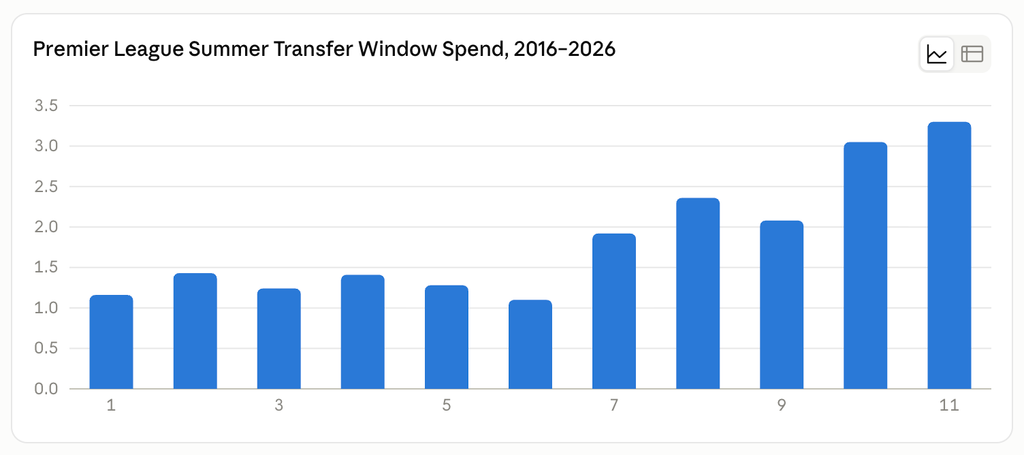
Ten years ago, the entire Premier League spent £1.16bn across a single summer window — a figure that felt seismic at the time, driven by the first instalment of a new £5.1bn domestic broadcast deal. Today, that sum wouldn’t cover Manchester City’s spending alone this window; the champions committed £440.3m on their own, more than the whole division managed in 2016. Sky Sports’ own analysis puts this summer’s outlay at “almost three times the amount clubs spent a decade ago” — and the shape of that growth curve tells its own story.
The climb wasn’t smooth. Summer 2017 pushed the record to £1.43bn on the back of another broadcast uplift. The pandemic years flattened the curve — as recently as 2021, the all-time single-window record stood at a comparatively modest £1.4bn. Then came the snap-back: £1.92bn in 2022, a leap to £2.36bn in 2023, a brief dip to £2.08bn in 2024 as clubs caught their breath under Profit and Sustainability Rules scrutiny, before the market detonated. Summer 2025 smashed through £3bn for the first time, propelled by Alexander Isak’s British-record £125m move from Newcastle to Liverpool. This summer did it again, breaking £3bn for a second consecutive year and, by some trackers, setting a fresh all-time high.
The steepness sits in the acceleration, not the average. Analysis from the football finance newsletter Swiss Ramble calculated that the Premier League spent more than £9.6bn across its four most recent transfer windows — nearly double the £5.1bn spent in the preceding four-year stretch. Put another way: it took the division roughly fourteen years, from the current transfer system’s introduction in 2003, to first crack £1bn in a single window. It has taken barely half that time to triple it.
Why the market keeps climbing
Three forces are compounding at once, and none of them show signs of easing.
The first is simple: broadcast and commercial revenue keeps growing, and clubs spend against what they expect to earn, not what they’ve already banked. Every uplift in the Premier League’s domestic and overseas rights packages since that original 2016 windfall has fed directly into transfer budgets, because clubs know rivals will spend theirs regardless.
The second is accounting mechanics. Under both the outgoing Profit and Sustainability Rules and the incoming Squad Cost Ratio system — replacing PSR from this season, 2026/27, after Premier League clubs voted through the change — transfer fees aren’t booked as one lump sum. They’re amortised, spread evenly across the life of a contract. A £100m signing on a five-year deal shows up as £20m a year on the books, which makes eye-watering headline fees far more palatable against annual revenue than the number itself suggests. Clubs have responded by lengthening contracts to soften the annual hit, which in turn makes bigger fees easier to justify upfront.
The third is regulatory transition itself. This is the first transfer window conducted with SCR on the horizon rather than PSR’s rolling three-year loss cap. SCR ties permitted spending on wages, transfers and agent fees to a fixed share of revenue — 85% for clubs playing only domestically, dropping to 70% for anyone in Europe. Crucially, that’s a percentage of turnover, which means a club’s spending ceiling rises automatically as its revenue does, with no equivalent brake on the biggest six clubs whose commercial and European income dwarfs the rest of the division. Unused allowance can even roll over between seasons, giving well-run clubs further incentive to spend up to the line rather than bank a surplus.
Layer on top of that what one football finance academic, Professor Rob Wilson of UCFB, described to City AM as a genuine fear of missing out — the calculation, increasingly explicit in boardrooms, that standing still while direct rivals strengthen costs far more in relegation risk or missed European qualification than overpaying by £10m or £20m on a targeted signing. And layer on sovereign and state-backed ownership models, of which Newcastle’s PIF-controlled structure is the most obvious Tyneside example, which have injected a different risk appetite into a market where cash-rich challengers can absorb short-term losses that traditional family or plc ownership structures could not.
Sustainable, or simply recycled?
Here the picture gets more interesting than the headline figure suggests, and Newcastle’s own summer is the clearest illustration of it. This was not simply PIF money flowing outward. St James’ Park sold its spine to fund the rebuild: Sandro Tonali to Tottenham for £92.5m, Bruno Guimarães to Arsenal for £75m, Anthony Gordon to Barcelona for £68m — roughly £236m recouped from three of the dressing room’s most important players, reinvested largely in players under twenty-four. That is not the behaviour of a club with an open chequebook and no constraints; it is the behaviour of a club navigating PSR discipline right up until the rules change beneath it, forced to sell its best players to buy its next ones. Even state-backed ownership, in other words, still has to balance the books under the current framework — sustainability, for Newcastle at least, has meant painful player trading as much as reckless spending.

That’s the case for optimism. The harder question is what the market looks like from outside the top of the table. Manchester City’s £440m gross outlay this summer, or Chelsea’s £342m, sits alongside Premier League new-boys and mid-table sides working with a fraction of that firepower and a £39m three-year PSR loss cap rather than the established clubs’ £105m ceiling. Crystal Palace co-owner John Textor put the underlying grievance bluntly at the Financial Times Business of Football summit earlier this year, arguing the financial rules are built to protect clubs that already generate significant revenue from being caught by those that don’t. SCR doesn’t resolve that tension so much as formalise it: tying spending power to existing revenue essentially locks in the current hierarchy, because the clubs already earning the most from global broadcast deals, Champions League football and commercial partnerships get to spend the most, while newly promoted or historically smaller clubs are permitted to compete only up to a ceiling defined by revenue they don’t yet have.
The macro risk for the division is one of its own making. The Premier League’s global commercial value rests on its billing as English football’s greatest asset — the most unpredictable top flight in world football, where mid-table sides can beat champions and a top-half finish is never guaranteed. A transfer market compounding at close to 20% a year, concentrated overwhelmingly among six or seven clubs with the deepest revenue bases, risks calcifying precisely the competitive uncertainty that makes the league worth £3bn a summer to broadcast in the first place. For a club like Newcastle — big enough in ambition and ownership to compete at the spending table, but still building toward the revenue base of the traditional elite — the coming SCR era will test whether Tyneside can keep trading its way up the table, or whether the accounting now simply confirms who was always going to stay at the top.
What it costs the fan on the Gallowgate
None of the £3.3bn moves through a supporter’s wallet directly. Transfer fees are financed by broadcast contracts, Champions League prize money and commercial deals struck in boardrooms far from Barrack Road, not by the price of a matchday pie. But ask a fan queuing at the turnstiles whether the arms race feels distant, and the honest answer is no.
Newcastle’s own season ticket price rose 5% for 2026/27, the fourth successive year of increases, drawing criticism alongside Manchester United even as the club spent £275m rebuilding the squad that same summer. Across the division, 13 of the 20 clubs raised prices again this season, and 115 supporter organisations and Fan Advisory Boards backed the Football Supporters’ Association’s “Stop Exploiting Loyalty” campaign for a two-year freeze — rejected almost everywhere, bar a handful of clubs including Manchester City, Nottingham Forest and Tottenham, who chose restraint rather than necessity. The average Premier League season ticket now sits at a record £535. None of that is transfer spending landing in a supporter’s bank statement as a line item, but it is the same clubs, flush with the same broadcast windfall, asking fans to absorb rising costs in the same window they spend nine figures on a winger barely out of his teens.
The subtler cost is emotional rather than financial. At £50m-£90m a head, a signing is rarely allowed to develop quietly — expectation arrives with the fee attached, and patience for a player finding his feet shrinks in proportion to what he cost. Newcastle said goodbye to Sandro Tonali, Bruno Guimarães and Anthony Gordon inside nine weeks this summer, three players supporters had watched grow into folk heroes since 2022, and absorbed that loss the way this era increasingly demands: quickly, and in service of a rebuild rather than treated as a betrayal. Attachment to a matchday XI now competes with the accounting reality that almost every player is, eventually, an asset waiting to be monetised.
Set against that is the football itself, which by most measures has never been better to watch. Four of the eleven most expensive transfers in history happened this summer alone, three of them Premier League deals, and the calibre arriving at St James’ Park — Woltemade, Elanga, Fernandez-Pardo — would have been unthinkable for a mid-table English club a decade ago. That is the trade a supporter is actually being asked to make: a faster, more disposable relationship with the players wearing the shirt, in exchange for a standard of football no previous generation of Geordies got to watch, even if the price of getting through the gate keeps climbing alongside it. Whether that trade feels worth it has less to do with the spreadsheet than with what a fan actually goes to St James’ Park for in the first place.
Do you think the massive spending has made the Premier League “better”? How much higher can it go? Join the conversation on X @mytoonarmy #NUFC