
£3.48bn. That’s the number Sky Sports totted up when the window shut on the first of September, a new Premier League record, nine per cent clear of the £3.19bn spent twelve months earlier. Somewhere inside that figure, Chelsea banked £125m from Manchester City for Enzo Fernández, matching the joint-highest fee ever paid for a British transfer. Elsewhere, on the same weekend, Nottingham Forest agreed a deal worth up to £22m for a 30-year-old right-back most supporters outside Selhurst Park wouldn’t pick out of a lineup.
One of those two deals will return more football per pound this season than the other. It isn’t the £125m one.
That’s the premise of this piece. Not who cost the most, or who arrived with the loudest fanfare, but who delivered the most output for the fee actually paid — goalkeeper, centre-back, full-back, midfielder and forward, plus one wildcard nobody outside the recruitment departments had heard of before August. Newcastle’s own business this summer sits somewhere in the mix too, for what it’s worth, though the brief here was never to go looking for a black-and-white shirt to justify.
How We Scored It
Cost tells you what a club was willing to pay. It tells you almost nothing about what they actually bought. So the ranking here starts from output, not outlay, and works backwards to ask whether the fee was fair.
Recent form does most of the heavy lifting — the season just gone carries the most weight in every case — but a single hot run doesn’t make the cut on its own. Two prior seasons sit underneath as a stabiliser, so a player who strung together one purple patch in April isn’t mistaken for one who’s sustained it. Minutes matter for the same reason: anyone judged here cleared a reasonable bar of game time in the sample season, because three substitute cameos and a hat-trick tell you less than they feel like they do.
The yardsticks change by position, because they should. A centre-back earns his keep in duels won and passes played out from the back under pressure, not in goal involvements. A full-back is judged on the same defensive discipline plus what he adds going forward. A midfielder needs some blend of ball-winning and progression, depending on his job description. A forward lives and dies by shot quality and volume — non-penalty expected goals, chances created, conversion. A goalkeeper is judged on shots stopped that a model expects most keepers to concede.
Two adjustments sit on top of all that. First, a league-of-origin discount: numbers racked up in the Eredivisie, the Belgian Pro League or the Championship don’t travel at face value into a division where centre-backs are faster and midfields are tighter, so raw output from outside the traditional big five gets marked down before it’s compared to Premier League produce. Second, a positional benchmark: what did this specific role cost elsewhere in the market this window? Centre-backs and defensive midfielders have been inflating for years, so a “bargain” needs to be judged against what the position typically commands right now, not against some flat notion of a cheap transfer.
One more thing worth flagging before the list starts: transfer fees reported by trackers such as Squawka and Sky Sports routinely include potential add-ons, and rarely isolate the guaranteed base a club is actually on the hook for. Every figure below should be read as an upper-bound package unless a cleaner structure was reported at the time — which, in a couple of cases, it was.
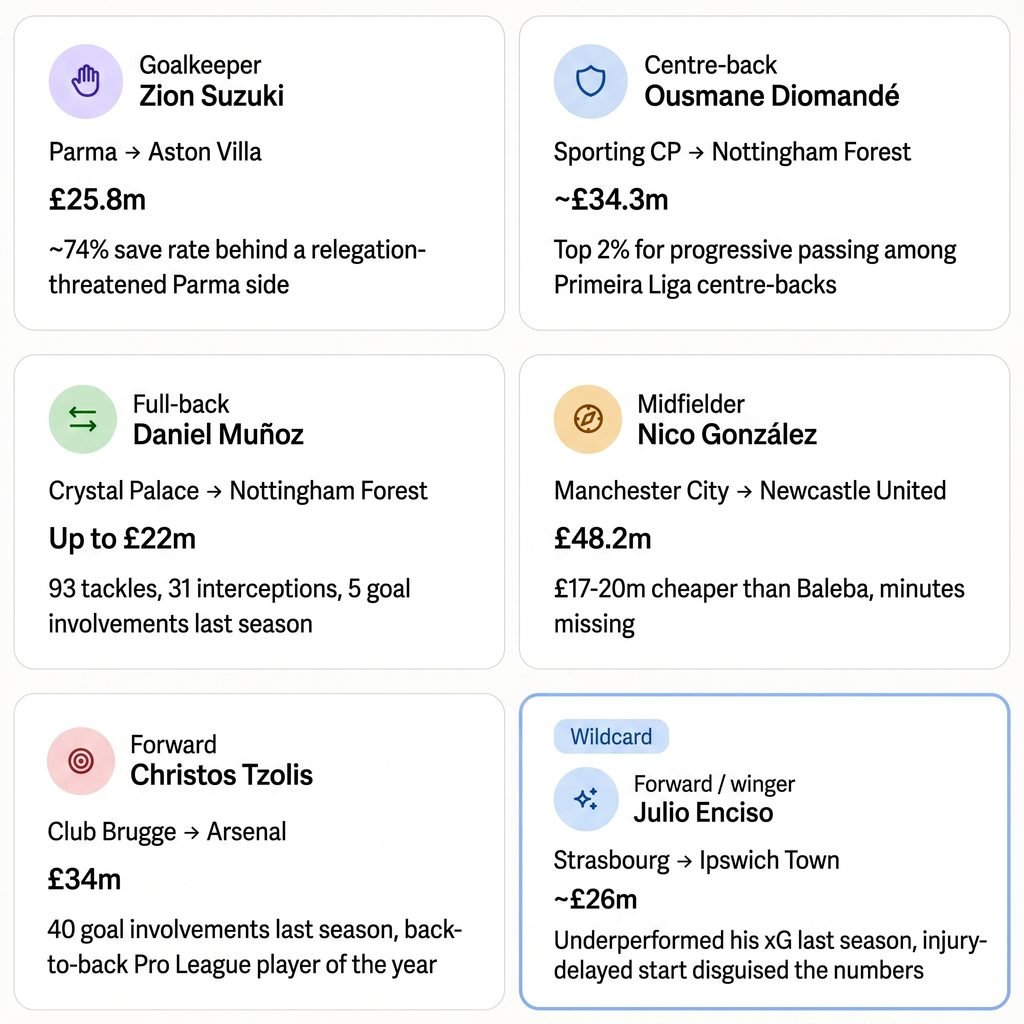

Goalkeeper: Zion Suzuki
Parma’s season was miserable enough that Suzuki spent large stretches of it playing behind a defence offering no protection whatsoever, and still the numbers hold up: roughly a 70 per cent save percentage across the campaign, five clean sheets salvaged from a relegation-threatened side, and an FBref sample built on 990 minutes that put his shot-stopping value at a genuine 74 per cent conversion rate against expectation. He missed three months with a finger injury, which thins the sample and is worth remembering before anyone crowns him — but Aston Villa picked up a 23-year-old Japan international with elite reflex instincts for £25.8m.
Set that against James Trafford, now the most expensive British goalkeeper in history at £40.2m, whose entire 2025/26 sample at Manchester City amounted to roughly 360 minutes of cup and back-up duty. His last real body of work — a Championship title-winning season at Burnley, 84.5 per cent save percentage, close to twelve goals prevented above expectation — was excellent, but it came a full tier below where Leeds now need it repeated, at almost double the fee. Trafford might be the better goalkeeper in three years’ time. Suzuki was the better deal this summer.
Centre-back: Ousmane Diomandé
Sporting’s academy graduate left Lisbon on a fixed four-year fee of around £34.3m, and what Forest bought was a defender whose ball-playing numbers ranked among the very best in Portuguese football last season — 98th percentile among centre-backs for progressive passes, 97th for progressive carries, with eight clean sheets from seventeen league games and a physical profile George Syrianos at Sporting described as commanding well beyond his 22 years.
The honest caveat is that Primeira Liga football isn’t Premier League football, and a striker who terrorised Sporting’s back four in August might find life harder against a Newcastle or an Arsenal front line. But even discounting for that gap, the maths is generous to Forest. Aston Villa, Arsenal and Chelsea each paid around £51–52m this summer for a Premier League-proven centre-back in van Hecke, Konsa and Lacroix. Diomandé arrived for roughly two-thirds of that outlay, with eight years of resale runway attached that none of the older three carry.

Full-back: Daniel Muñoz
This is the best piece of business in the entire window, and it isn’t especially close.
Forest paid Crystal Palace a fee worth up to £22m for a 30-year-old they already knew intimately, reuniting Muñoz with Oliver Glasner, who’d coached him at Selhurst Park. Palace themselves had bought him for £6.9m from Genk barely two years earlier. What Forest actually acquired for that money was one of the most productive wing-backs in the country: 93 tackles and 31 interceptions last season alongside three goals and two assists, twenty chances created and five rated as big chances, all from a genuinely two-way role that most attacking full-backs simply don’t defend hard enough to match.
Compare that against what full-back production cost elsewhere this summer — £35.1m for Diouf at Brentford, over £30m apiece for Dedic and Bamba at Newcastle — and Forest bought comparable or superior output at a discount most of the market didn’t get near. The one honest mark against it is age: Muñoz turns 30 this year, so there’s little resale value baked into the deal, and Forest are buying two or three prime seasons rather than a long-term asset. On pure output-per-pound, though, nothing else this window touches it.

Midfield: Nico González, not Carlos Baleba
This is the one worth arguing about properly, because the obvious name here isn’t the right one.
Carlos Baleba’s move from Brighton to Manchester United is being talked about as the marquee midfield deal of the summer, and the underlying case for him as a player is real: in 2024/25 he ranked sixth among all Premier League midfielders for combined tackles and interceptions and fourth for progressive carries per ninety, a genuinely rare ball-winning-and-carrying profile at 21. United paid £65m guaranteed plus £5m in add-ons for that ceiling. The problem is the season they’re actually buying against. 2025/26 was disrupted for Baleba from pre-season onward — a knee issue followed by recurring muscle trouble — and his output dipped accordingly. United have paid the highest fee of any midfielder in this entire sample for a player coming off the worst season of his young career. That’s not a value signing. That’s a bet on reversion, priced as though the reversion had already happened.
Nico González tells a cleaner story. He cost Newcastle £48.2m — some £17–20m less than Baleba — for a La Masia-schooled deep-lying playmaker whose passing range and aerial presence were never really in doubt; the reason his 2025/26 numbers look modest is that he started just fifteen games in a treble-chasing Manchester City midfield stacked three and four deep in his position. That’s a player capped by opportunity, not ability, arriving at a club that has just waved goodbye to both Bruno Guimarães and Sandro Tonali and needs exactly his profile to run the middle of the pitch from week one. Paying a discount for a proven talent who was simply blocked, and who now walks into guaranteed minutes, is a materially better value case than paying a premium for a talent coming off an injury-hit down year. Newcastle didn’t just get the cheaper midfielder this summer. On the numbers, they got the better deal.

Forward: Christos Tzolis
£34m is a record fee for the Belgian Pro League, and Arsenal’s sporting director Andrea Berta didn’t undersell what it bought, calling Tzolis an excellent finisher with both feet who thrives in tight spaces. The production backs the description up: seventeen goals and twenty-three assists in thirty-six league games last season, roughly forty goal involvements in all, back-to-back Pro League Player of the Season awards, and an expected-goals profile that put him in the 96th percentile for finishing quality among his league’s forwards.
The league-quality discount has to apply here more than anywhere else on this list — Belgian football is several notches below the Premier League, and Tzolis’s Champions League form was quiet by comparison, two goals from 723 minutes against continental opposition. But even marked down hard, £34m for that volume of output looks like extraordinary business next to what Manchester City paid for comparable or lesser production elsewhere: £60.2m for Iliman Ndiaye, whose underlying numbers were solid rather than spectacular, and £75.4m for Savio. Arsenal bought the ceiling at less than half the going rate for the floor.
The Wildcard: Julio Enciso
Every year the transfer window produces a name that means nothing to most supporters in August and everything to them by Christmas. This year, that’s Julio Enciso.
The 22-year-old Paraguayan spent last season out on loan at Strasbourg in Ligue 1, not at parent club Brighton, and the underlying numbers are the kind that scouts circle rather than headline writers: three goals and six assists from 27 appearances, but an expected-goals tally of 5.22 against a non-penalty expected figure closer to six, the sort of gap that usually points to better finishing luck arriving soon rather than talent draining away. Ninety-three completed dribbles and persistent movement into the box round out a profile built for exactly the kind of creative, high-carry role a newly promoted Ipswich side will lean on heavily. A knee injury delayed the start of his season by four months, which is precisely why the numbers above didn’t get the attention they deserved, and he capped the campaign by scoring against Germany at the World Cup this summer. At around £26m, for a player few outside Paraguay and east France had strong opinions on in July, this is the name to remember come the spring.
Where That Leaves Us
Six deals, six different arguments, and one thread running through all of them: none of the transfer committees that got this right were chasing the biggest name available. They were pricing output against opportunity and finding the gap between the two. Forest found it twice, at both centre-back and full-back, which says something about the humility of their recruitment model even as their record signing sails past £100m elsewhere on the books. Newcastle found it in a City reserve who simply needed the pitch time St James’ Park was always going to give him.
Whether the ledger agrees with the eye by May is the only part of this that can’t be settled in September. Football has a habit of making fools of spreadsheets. But if history is any guide, the clubs who bought output rather than reputation this summer will be the ones still smiling when the accounts are drawn up next June.
Who is your top summer transfer? Are you happy with your club’s transfer business? Join the conversation on X @mytoonarmy #NUFC