
Data Driven Insights. Fearless Opinions.

Transfers

  • Manchester United’s record year lost £43m. Newcastle should read the small print

    What Can We Learn From MU

    United’s books for 2025/26 look like a triumph until you break them down. What can Newcastle learn from it.

    Manchester United finished third, earned a record £677.6 million and lost £43 million doing it.

    The loss came out on Wednesday, inside a results release that led with the record. Chief executive Omar Berrada said the numbers showed a club “on the right trajectory”, and on the operating lines he had a point. Adjusted EBITDA reached £216.4 million, up 18.4 per cent. The club made an operating profit of £22.6 million, against a loss of £18.4 million the year before.

    The story lies inside the headline.

    The bill for yesterday

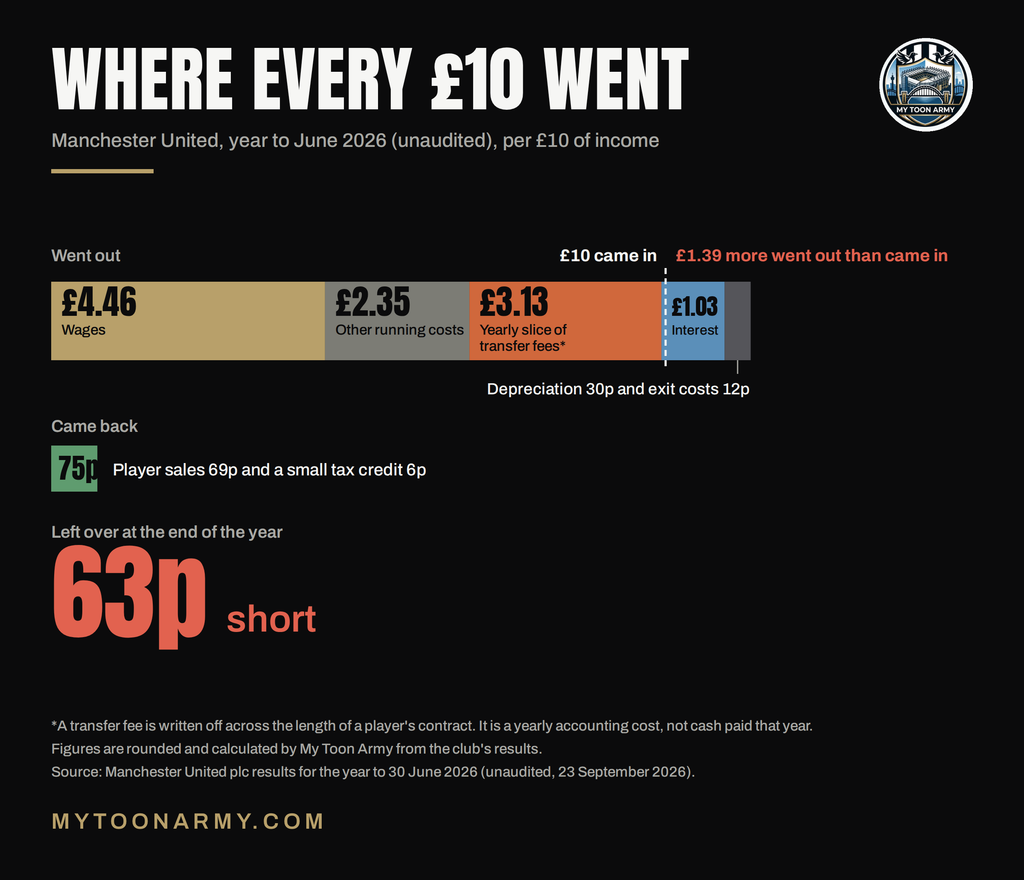
    Take a fan’s view of it. Put £10 of United’s income in a drawer and watch where it goes.

    £6.81 leaves at once to run the club, £4.46 of it in wages. That leaves £3.19.

    Then the past arrives. £3.13 goes on players already in the squad. It isn’t cash out of the door this year. It is the yearly slice of their transfer fees, spread across the length of their contracts, and it lands on the books whether or not a penny changes hands. Just over £1 goes to lenders: £69.6 million in net finance costs across the year, more than the £63.5 million the club spent buying land for a new stadium. Thirty pence covers depreciation on buildings and equipment. Player sales hand back 69p. The last of the restructuring bills take 12p, and a small tax credit gives back 6p.

    The drawer ends 63p short.
    Some of that interest bill is currency. £10 million was an unrealised loss on dollar-denominated debt, against a gain of nearly £23 million the year before. Strip that out and the underlying interest cost is still higher, by roughly £18 million. In June United also replaced some of its bonds, the notes it sold to investors, with a larger issue that added $125 million to its dollar borrowings.

    So the club got better at the parts a fan can see. Third place, Champions League football, a bigger television cheque for finishing twelve places higher. And the same £10 still arrives with claims on it before the head coach sees a penny.

    The ceiling

    Every supporter has asked why a club doesn’t simply spend more. Moreso when your owner is the richest in the world, like the PIF.

    A squad budget is not set by how rich the owner is. It is set by how much the club earns. The Premier League’s squad-cost rules tie what a club can commit to its players, meaning wages, agents’ fees and those yearly slices of transfer fees, to what comes in at the other end. Raise the income and the ceiling rises. Trim the other bills and there is more room beneath it.

    United did both this year, in a season without a single European night.

    Commercial income came to £317.3 million, and the release announces a training-kit partner in Betway and a sleeve partner in SumUp on top of adidas on the shirt and Snapdragon across the front. The club is selling every square inch of the kit.

    The climb from fifteenth to third lifted broadcasting income by £33.9 million, even after the European money vanished. Matchday income held at £153.5 million from just 20 home games, ten fewer than the year before, which the club credits to “strong demand for our general admission and hospitality offerings”. That works out at roughly £7.7 million a home game. Old Trafford holds 74,244 people, and United make them count.

    On the other side of the ledger, wages fell 3.6 per cent to £302.0 million, after two years of headcount cuts. The bill for getting there was £36.6 million and then £8.2 million in restructuring, head-coach exits and a pension top-up.

    Now the warning label. United expect £740 million to £760 million of revenue next season and £205 million to £225 million of adjusted EBITDA. Subtract one from the other and both ends of the range imply about £535 million of running costs, roughly £74 million more than this year. In the fourth quarter alone, wages already ran at 52.3 per cent of revenue, up from 48.3.

    The Champions League money hasn’t arrived, and it has been spent.

    What Newcastle should take from it

    Every club in the Premier League works under the same arithmetic. So the useful question isn’t what United got wrong. It is which of their moves a club in a different position can copy, and which of their habits it should avoid.

    Four things worth copying

    Treat league position as income. The climb from fifteenth to third added £33.9 million to United’s broadcasting revenue, and that is after losing their European money. A place in the table needs no new partner and no new stand. For Newcastle, every decision that protects league position, from the depth of the squad to the stability around it, is a financial decision as well as a sporting one.

    Sell every surface. United’s commercial income was £317.3 million, 46.8 per cent of their revenue, in a year with no European football and after losing a training-kit sponsor. The club has since filled that space with Betway and added a sleeve partner in SumUp. The lesson is that inventory is a choice: the shirt, the sleeve and the training kit are three sales, not one. For Newcastle the lesson is breadth. The more of the club’s commercial income comes from partners with no link to the owner, the less of it ever faces a fair-market-value question.

    Make every seat earn more. The release credits strong demand for hospitality and general admission with holding matchday income up while the number of home games fell by a third. That is yield, not capacity. Old Trafford’s 74,244 seats are about 22,000 more than St James’ Park’s 52,264, so the gap in seats is real. But pricing and hospitality are levers a club can pull before it pours a foundation.

    Build in the right order. United finished the Carrington training-ground rebuild in August 2025 and then bought the land for a new stadium. The cheaper, quicker project went first. It is a sequence any club weighing a stadium can borrow.

    Five things to fear

    Spending money before it lands. United’s guidance shows how fast a Champions League uplift is absorbed by wages. The safer way to treat European income is as a bonus. Where a contract pays more for a European season, the extra should be triggered only when the money arrives.

    Interest. More than £1 of every £10 at United goes to lenders, and none of it puts a player on the pitch. When a stadium needs financing, the question for Newcastle is how to keep that cost out of the football budget altogether.

    The transfer credit card. Amortisation rose £15.4 million to £211.8 million, and £452.3 million of unamortised fees still sits on the balance sheet. United’s net cash spend on players fell to £143.7 million from £230.0 million, partly by selling future transfer receivables, which brings cash forward and takes it from later years. At June 2025 they owed other clubs £447.1 million in fees. The better measure of a signing is its yearly write-down, not the fee on the headline.

    Currency. A £10.0 million loss on dollar debt, after a £22.9 million gain the year before, turned a manageable year into a bigger loss. A club should borrow in the currency it earns.

    Slow stadium decisions and churn. United have bought the land for a new ground and the release discloses no cost or funding plan for it. Meanwhile the £44.8 million spent over two years on restructuring and exits shows what changing course costs. For Newcastle, in transition under Matthias Jaissle, the lesson is to settle the big structural questions early, the stadium route above all, and to keep the structure around the team steady while it does.

    What happens next

    Newcastle’s latest accounts, when they arrive by March year, are the place to test these lessons: are we still on the right path. Until then the ceiling is the fixed point around which every club plans.

    The finances of a Big 6 team is quite different from Newcastle’s – how are we charting our own path? Join the conversation on X @mytoonarmy #NUFC

  • Catching Them From Behind: Newcastle’s Plan to Out-Earn Its Way Up the Table

    Catching Them From Behind

    Fifty per cent. That’s how much David Hopkinson wants Newcastle United’s revenues to grow between now and 2030. He reckons the Premier League’s old aristocracy — the clubs Newcastle is chasing — will manage four, compounded, over the same stretch. It’s a wide gap to close, and under the division’s new financial rules, revenue isn’t just a boardroom concern any more. It’s the whole game. Newcastle’s plan, in Hopkinson’s own words, is to “catch them from behind.”

    Why revenue is the whole game now

    The Premier League swapped its old Profit and Sustainability Rules for a new system this season: Squad Cost Ratio, which caps what a club can spend on wages, transfers and agents’ fees at a fixed share of the revenue it generates — 85 per cent domestically, a tighter 70 per cent for anyone in Europe. It passed by the narrowest possible margin last November, fourteen votes to six, the exact minimum required. Newcastle was one of the fourteen.

    Hopkinson, a year removed from Madison Square Garden Sports — the Knicks, the Rangers, leagues built on hard salary caps where every club fishes from “about the same size bag of money” — finds the contrast instructive. Under SCR, the correlation between wage bill and league position is, in his words, “incredibly tight,” almost one to one. And the size of the envelope a club can spend is “directly correlated to the revenues you generate.” The consequence is structural: clubs already earning more get bigger envelopes to earn even more from, while anyone starting behind inherits a gap that widens on its own. “It’s frustrating when it rains,” he said of a system his own club voted through — an admission that the rules he backed are also the rules now working against him.

    It also explains why Public Investment Fund ownership doesn’t simply solve the problem. PIF capital can still build things outright — a new £190 million training complex is going up at Woolsington, near Newcastle Airport, funded as equity rather than revenue. What it cannot do, under SCR, is buy squad-cost headroom the way a benefactor once might have. What Newcastle is allowed to spend on players is a function of what Newcastle itself earns. Nothing else counts.

    The self-help ledger

    Hopkinson calls the response “self-help,” and some of it is already on the books. The training ground’s naming-rights partner, Knox Hydration, and the club’s newer training-kit sponsor, SumUp, between them now generate around £11 million a year in commercial income that didn’t exist twelve months ago — a figure Hopkinson cited himself and one independently reported elsewhere. Knox’s separate front-of-shirt agreement, worth roughly £60 million through to the end of the 2028-29 season, has replaced the outgoing Sela deal entirely. The next lever he’s pulling is retail: a “monobrand” operation in which Newcastle becomes both manufacturer and vendor of its own product, rather than licensing that margin away to a kit supplier.

    The Europe feedback loop

    The mechanism cuts both ways, and Newcastle already knows the downside. Finishing twelfth last season shrank this year’s SCR envelope directly — missing Champions League football costs revenue, and revenue is now the only currency that buys squad spending. The bill arrived quickly: Victor Muñoz chose Liverpool’s Champions League football over a Newcastle side with no European football at all this season, and Johan Manzambi picked Aston Villa’s £59.5 million bid over Newcastle’s own £49 million offer, for the same reason. Missing Europe doesn’t just cost prestige. Under SCR, it costs the money that buys the players who might get you back into it.

    Growing outward, not upward

    Crucially, Hopkinson doesn’t see existing supporters as where that fifty per cent has to come from. Asked directly about ticket prices, he was unambiguous that he isn’t looking there, citing near-daily contact with the Fan Advisory Board and the Newcastle United Supporters Trust as evidence the club knows exactly how sensitive that ground is. Instead, the growth target points outward: global retail, VIP hospitality, and revenue from supporters who live outside this market entirely. Eventually, stadium capacity becomes the biggest lever of all — more seats simply mean more revenue — though whether that means renovating St James’ Park or building new remains, in his telling, genuinely undecided. What he’s ruled out is any shortcut: an AI-generated stadium render, he said, “is not really a transactable option.”

    David Hopkinson, interview 4 Sept

    None of this arrives quickly. Hopkinson is explicit that 2030 is the checkpoint, not this season, and that the plan requires Newcastle to out-earn its way up a table it can no longer simply outspend its way up. But for a club whose finances have usually been discussed in terms of what the owners might inject, hearing the chief executive talk instead about training-kit sponsors and retail margins, in the same breath as fourteen-to-six regulatory votes, is itself the clearest sign of where Newcastle’s actual advantage is now expected to come from.

    Does it sound like the club’s plan to increase revenues and catch the bigger teams work? What will it take for us to achieve success? Join the conversation on X @mytoonarmy #NUFC

  • Premier League: Summer 2026’s Six Best-Value Signings

    £3.48bn. That’s the number Sky Sports totted up when the window shut on the first of September, a new Premier League record, nine per cent clear of the £3.19bn spent twelve months earlier. Somewhere inside that figure, Chelsea banked £125m from Manchester City for Enzo Fernández, matching the joint-highest fee ever paid for a British transfer. Elsewhere, on the same weekend, Nottingham Forest agreed a deal worth up to £22m for a 30-year-old right-back most supporters outside Selhurst Park wouldn’t pick out of a lineup.

    One of those two deals will return more football per pound this season than the other. It isn’t the £125m one.

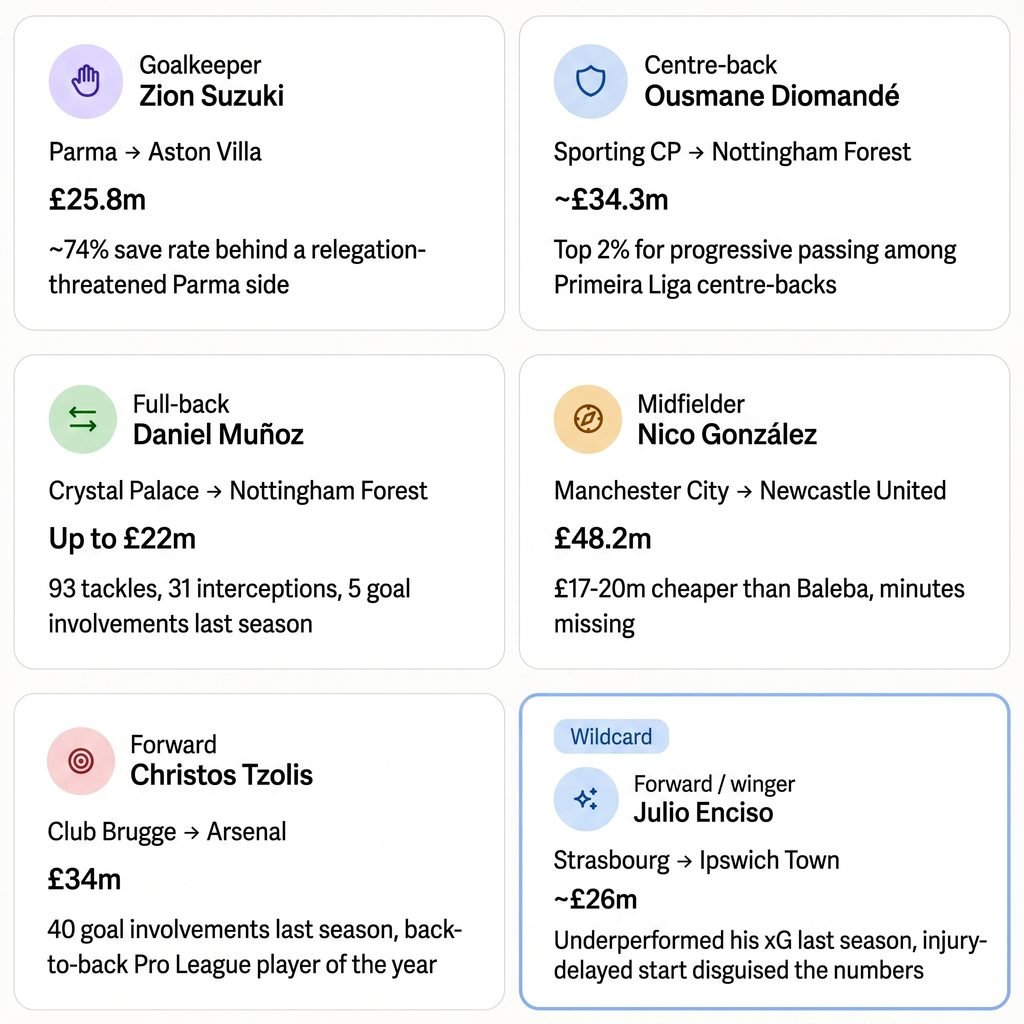
    That’s the premise of this piece. Not who cost the most, or who arrived with the loudest fanfare, but who delivered the most output for the fee actually paid — goalkeeper, centre-back, full-back, midfielder and forward, plus one wildcard nobody outside the recruitment departments had heard of before August. Newcastle’s own business this summer sits somewhere in the mix too, for what it’s worth, though the brief here was never to go looking for a black-and-white shirt to justify.

    How We Scored It

    Cost tells you what a club was willing to pay. It tells you almost nothing about what they actually bought. So the ranking here starts from output, not outlay, and works backwards to ask whether the fee was fair.

    Recent form does most of the heavy lifting — the season just gone carries the most weight in every case — but a single hot run doesn’t make the cut on its own. Two prior seasons sit underneath as a stabiliser, so a player who strung together one purple patch in April isn’t mistaken for one who’s sustained it. Minutes matter for the same reason: anyone judged here cleared a reasonable bar of game time in the sample season, because three substitute cameos and a hat-trick tell you less than they feel like they do.

    The yardsticks change by position, because they should. A centre-back earns his keep in duels won and passes played out from the back under pressure, not in goal involvements. A full-back is judged on the same defensive discipline plus what he adds going forward. A midfielder needs some blend of ball-winning and progression, depending on his job description. A forward lives and dies by shot quality and volume — non-penalty expected goals, chances created, conversion. A goalkeeper is judged on shots stopped that a model expects most keepers to concede.

    Two adjustments sit on top of all that. First, a league-of-origin discount: numbers racked up in the Eredivisie, the Belgian Pro League or the Championship don’t travel at face value into a division where centre-backs are faster and midfields are tighter, so raw output from outside the traditional big five gets marked down before it’s compared to Premier League produce. Second, a positional benchmark: what did this specific role cost elsewhere in the market this window? Centre-backs and defensive midfielders have been inflating for years, so a “bargain” needs to be judged against what the position typically commands right now, not against some flat notion of a cheap transfer.

    One more thing worth flagging before the list starts: transfer fees reported by trackers such as Squawka and Sky Sports routinely include potential add-ons, and rarely isolate the guaranteed base a club is actually on the hook for. Every figure below should be read as an upper-bound package unless a cleaner structure was reported at the time — which, in a couple of cases, it was.

    Goalkeeper: Zion Suzuki

    Parma’s season was miserable enough that Suzuki spent large stretches of it playing behind a defence offering no protection whatsoever, and still the numbers hold up: roughly a 70 per cent save percentage across the campaign, five clean sheets salvaged from a relegation-threatened side, and an FBref sample built on 990 minutes that put his shot-stopping value at a genuine 74 per cent conversion rate against expectation. He missed three months with a finger injury, which thins the sample and is worth remembering before anyone crowns him — but Aston Villa picked up a 23-year-old Japan international with elite reflex instincts for £25.8m.

    Set that against James Trafford, now the most expensive British goalkeeper in history at £40.2m, whose entire 2025/26 sample at Manchester City amounted to roughly 360 minutes of cup and back-up duty. His last real body of work — a Championship title-winning season at Burnley, 84.5 per cent save percentage, close to twelve goals prevented above expectation — was excellent, but it came a full tier below where Leeds now need it repeated, at almost double the fee. Trafford might be the better goalkeeper in three years’ time. Suzuki was the better deal this summer.

    Centre-back: Ousmane Diomandé

    Sporting’s academy graduate left Lisbon on a fixed four-year fee of around £34.3m, and what Forest bought was a defender whose ball-playing numbers ranked among the very best in Portuguese football last season — 98th percentile among centre-backs for progressive passes, 97th for progressive carries, with eight clean sheets from seventeen league games and a physical profile George Syrianos at Sporting described as commanding well beyond his 22 years.

    The honest caveat is that Primeira Liga football isn’t Premier League football, and a striker who terrorised Sporting’s back four in August might find life harder against a Newcastle or an Arsenal front line. But even discounting for that gap, the maths is generous to Forest. Aston Villa, Arsenal and Chelsea each paid around £51–52m this summer for a Premier League-proven centre-back in van Hecke, Konsa and Lacroix. Diomandé arrived for roughly two-thirds of that outlay, with eight years of resale runway attached that none of the older three carry.

    Full-back: Daniel Muñoz

    This is the best piece of business in the entire window, and it isn’t especially close.

    Forest paid Crystal Palace a fee worth up to £22m for a 30-year-old they already knew intimately, reuniting Muñoz with Oliver Glasner, who’d coached him at Selhurst Park. Palace themselves had bought him for £6.9m from Genk barely two years earlier. What Forest actually acquired for that money was one of the most productive wing-backs in the country: 93 tackles and 31 interceptions last season alongside three goals and two assists, twenty chances created and five rated as big chances, all from a genuinely two-way role that most attacking full-backs simply don’t defend hard enough to match.

    Compare that against what full-back production cost elsewhere this summer — £35.1m for Diouf at Brentford, over £30m apiece for Dedic and Bamba at Newcastle — and Forest bought comparable or superior output at a discount most of the market didn’t get near. The one honest mark against it is age: Muñoz turns 30 this year, so there’s little resale value baked into the deal, and Forest are buying two or three prime seasons rather than a long-term asset. On pure output-per-pound, though, nothing else this window touches it.

    Midfield: Nico González, not Carlos Baleba

    This is the one worth arguing about properly, because the obvious name here isn’t the right one.

    Carlos Baleba’s move from Brighton to Manchester United is being talked about as the marquee midfield deal of the summer, and the underlying case for him as a player is real: in 2024/25 he ranked sixth among all Premier League midfielders for combined tackles and interceptions and fourth for progressive carries per ninety, a genuinely rare ball-winning-and-carrying profile at 21. United paid £65m guaranteed plus £5m in add-ons for that ceiling. The problem is the season they’re actually buying against. 2025/26 was disrupted for Baleba from pre-season onward — a knee issue followed by recurring muscle trouble — and his output dipped accordingly. United have paid the highest fee of any midfielder in this entire sample for a player coming off the worst season of his young career. That’s not a value signing. That’s a bet on reversion, priced as though the reversion had already happened.

    Nico González tells a cleaner story. He cost Newcastle £48.2m — some £17–20m less than Baleba — for a La Masia-schooled deep-lying playmaker whose passing range and aerial presence were never really in doubt; the reason his 2025/26 numbers look modest is that he started just fifteen games in a treble-chasing Manchester City midfield stacked three and four deep in his position. That’s a player capped by opportunity, not ability, arriving at a club that has just waved goodbye to both Bruno Guimarães and Sandro Tonali and needs exactly his profile to run the middle of the pitch from week one. Paying a discount for a proven talent who was simply blocked, and who now walks into guaranteed minutes, is a materially better value case than paying a premium for a talent coming off an injury-hit down year. Newcastle didn’t just get the cheaper midfielder this summer. On the numbers, they got the better deal.

    Forward: Christos Tzolis

    £34m is a record fee for the Belgian Pro League, and Arsenal’s sporting director Andrea Berta didn’t undersell what it bought, calling Tzolis an excellent finisher with both feet who thrives in tight spaces. The production backs the description up: seventeen goals and twenty-three assists in thirty-six league games last season, roughly forty goal involvements in all, back-to-back Pro League Player of the Season awards, and an expected-goals profile that put him in the 96th percentile for finishing quality among his league’s forwards.

    The league-quality discount has to apply here more than anywhere else on this list — Belgian football is several notches below the Premier League, and Tzolis’s Champions League form was quiet by comparison, two goals from 723 minutes against continental opposition. But even marked down hard, £34m for that volume of output looks like extraordinary business next to what Manchester City paid for comparable or lesser production elsewhere: £60.2m for Iliman Ndiaye, whose underlying numbers were solid rather than spectacular, and £75.4m for Savio. Arsenal bought the ceiling at less than half the going rate for the floor.

    The Wildcard: Julio Enciso

    Every year the transfer window produces a name that means nothing to most supporters in August and everything to them by Christmas. This year, that’s Julio Enciso.

    The 22-year-old Paraguayan spent last season out on loan at Strasbourg in Ligue 1, not at parent club Brighton, and the underlying numbers are the kind that scouts circle rather than headline writers: three goals and six assists from 27 appearances, but an expected-goals tally of 5.22 against a non-penalty expected figure closer to six, the sort of gap that usually points to better finishing luck arriving soon rather than talent draining away. Ninety-three completed dribbles and persistent movement into the box round out a profile built for exactly the kind of creative, high-carry role a newly promoted Ipswich side will lean on heavily. A knee injury delayed the start of his season by four months, which is precisely why the numbers above didn’t get the attention they deserved, and he capped the campaign by scoring against Germany at the World Cup this summer. At around £26m, for a player few outside Paraguay and east France had strong opinions on in July, this is the name to remember come the spring.

    Where That Leaves Us

    Six deals, six different arguments, and one thread running through all of them: none of the transfer committees that got this right were chasing the biggest name available. They were pricing output against opportunity and finding the gap between the two. Forest found it twice, at both centre-back and full-back, which says something about the humility of their recruitment model even as their record signing sails past £100m elsewhere on the books. Newcastle found it in a City reserve who simply needed the pitch time St James’ Park was always going to give him.

    Whether the ledger agrees with the eye by May is the only part of this that can’t be settled in September. Football has a habit of making fools of spreadsheets. But if history is any guide, the clubs who bought output rather than reputation this summer will be the ones still smiling when the accounts are drawn up next June.

    Who is your top summer transfer? Are you happy with your club’s transfer business? Join the conversation on X @mytoonarmy #NUFC

  • The £3.3bn Question: Inside Football’s Most Expensive Arms Race

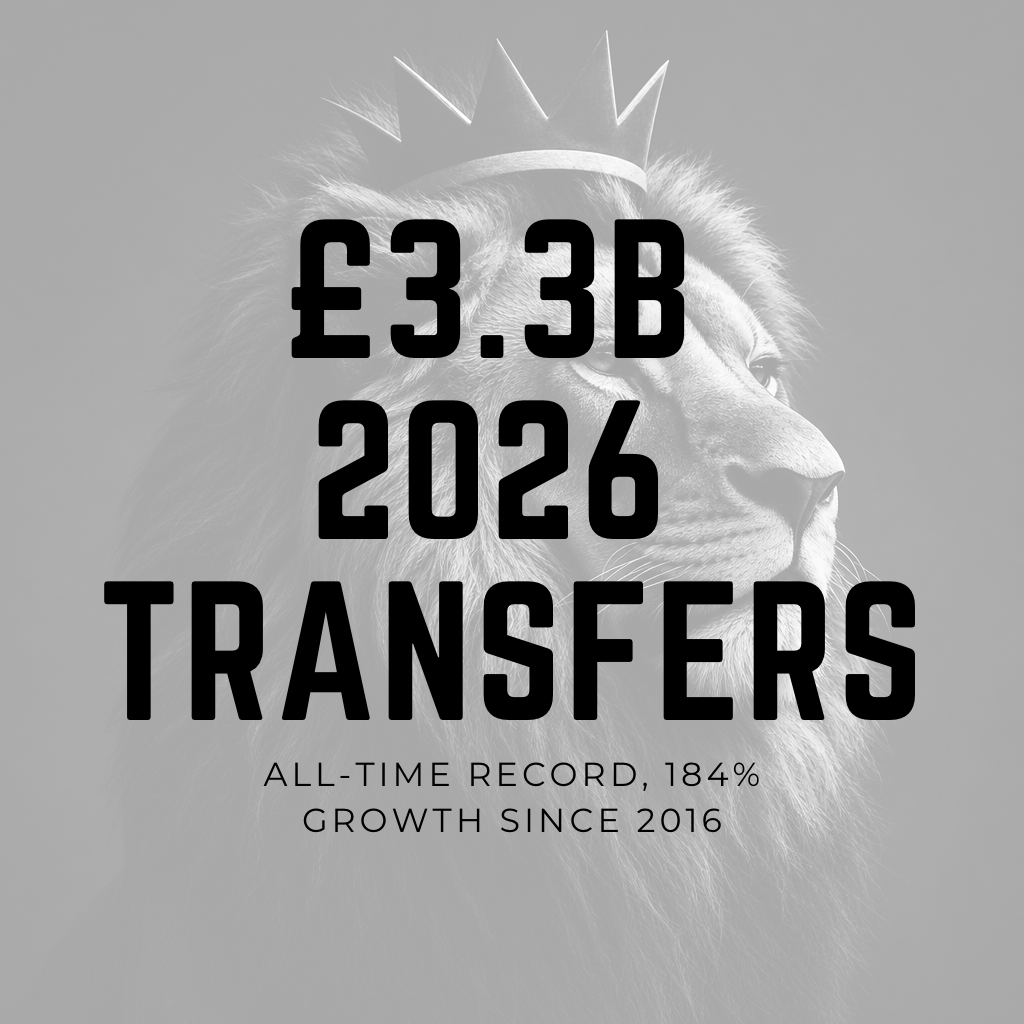
    3.3B, Premier League Transfer Spend 2026

    Matias Fernandez-Pardo touched down at Newcastle Airport on deadline day eve with a medical to complete and a nation’s transfer trackers refreshing every ninety seconds. By the time St James’ Park’s summer business was done, the Belgian winger’s £51m arrival from Lille had pushed Newcastle’s outlay past £275m for the window — fourth-highest in the Premier League, behind only Manchester City, Chelsea and Tottenham. Multiply that scramble by twenty clubs, add in a World Cup year’s worth of urgency, and you arrive at the number now rippling through boardrooms from Tyneside to the City of London: Premier League clubs spent somewhere between £3.2bn and £3.48bn this summer, depending on which data house you trust, comfortably eclipsing last year’s record and confirming what anyone watching deadline day already suspected. English football’s transfer market no longer has a ceiling — only a series of records waiting to be broken by the following September.

    A decade of compounding numbers

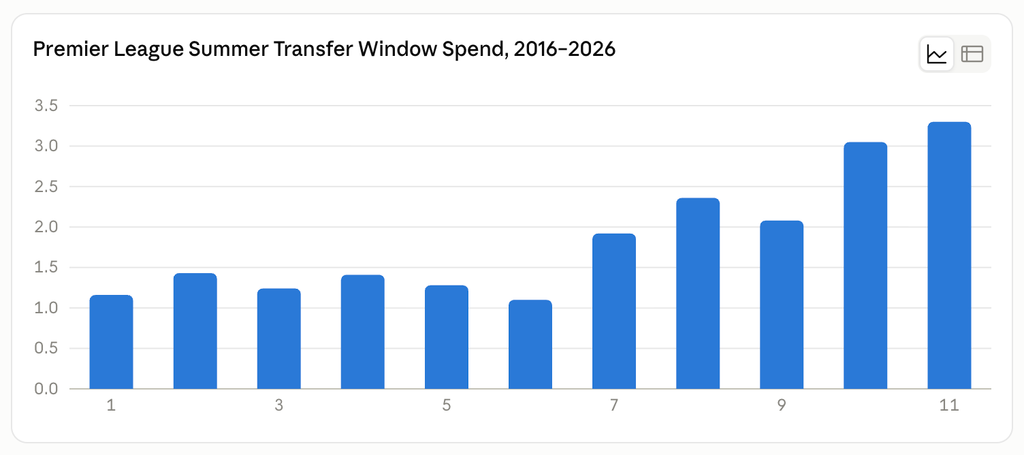
    Ten years ago, the entire Premier League spent £1.16bn across a single summer window — a figure that felt seismic at the time, driven by the first instalment of a new £5.1bn domestic broadcast deal. Today, that sum wouldn’t cover Manchester City’s spending alone this window; the champions committed £440.3m on their own, more than the whole division managed in 2016. Sky Sports’ own analysis puts this summer’s outlay at “almost three times the amount clubs spent a decade ago” — and the shape of that growth curve tells its own story.

    The climb wasn’t smooth. Summer 2017 pushed the record to £1.43bn on the back of another broadcast uplift. The pandemic years flattened the curve — as recently as 2021, the all-time single-window record stood at a comparatively modest £1.4bn. Then came the snap-back: £1.92bn in 2022, a leap to £2.36bn in 2023, a brief dip to £2.08bn in 2024 as clubs caught their breath under Profit and Sustainability Rules scrutiny, before the market detonated. Summer 2025 smashed through £3bn for the first time, propelled by Alexander Isak’s British-record £125m move from Newcastle to Liverpool. This summer did it again, breaking £3bn for a second consecutive year and, by some trackers, setting a fresh all-time high.

    The steepness sits in the acceleration, not the average. Analysis from the football finance newsletter Swiss Ramble calculated that the Premier League spent more than £9.6bn across its four most recent transfer windows — nearly double the £5.1bn spent in the preceding four-year stretch. Put another way: it took the division roughly fourteen years, from the current transfer system’s introduction in 2003, to first crack £1bn in a single window. It has taken barely half that time to triple it.

    Why the market keeps climbing

    Three forces are compounding at once, and none of them show signs of easing.

    The first is simple: broadcast and commercial revenue keeps growing, and clubs spend against what they expect to earn, not what they’ve already banked. Every uplift in the Premier League’s domestic and overseas rights packages since that original 2016 windfall has fed directly into transfer budgets, because clubs know rivals will spend theirs regardless.

    The second is accounting mechanics. Under both the outgoing Profit and Sustainability Rules and the incoming Squad Cost Ratio system — replacing PSR from this season, 2026/27, after Premier League clubs voted through the change — transfer fees aren’t booked as one lump sum. They’re amortised, spread evenly across the life of a contract. A £100m signing on a five-year deal shows up as £20m a year on the books, which makes eye-watering headline fees far more palatable against annual revenue than the number itself suggests. Clubs have responded by lengthening contracts to soften the annual hit, which in turn makes bigger fees easier to justify upfront.

    The third is regulatory transition itself. This is the first transfer window conducted with SCR on the horizon rather than PSR’s rolling three-year loss cap. SCR ties permitted spending on wages, transfers and agent fees to a fixed share of revenue — 85% for clubs playing only domestically, dropping to 70% for anyone in Europe. Crucially, that’s a percentage of turnover, which means a club’s spending ceiling rises automatically as its revenue does, with no equivalent brake on the biggest six clubs whose commercial and European income dwarfs the rest of the division. Unused allowance can even roll over between seasons, giving well-run clubs further incentive to spend up to the line rather than bank a surplus.

    Layer on top of that what one football finance academic, Professor Rob Wilson of UCFB, described to City AM as a genuine fear of missing out — the calculation, increasingly explicit in boardrooms, that standing still while direct rivals strengthen costs far more in relegation risk or missed European qualification than overpaying by £10m or £20m on a targeted signing. And layer on sovereign and state-backed ownership models, of which Newcastle’s PIF-controlled structure is the most obvious Tyneside example, which have injected a different risk appetite into a market where cash-rich challengers can absorb short-term losses that traditional family or plc ownership structures could not.

    Sustainable, or simply recycled?

    Here the picture gets more interesting than the headline figure suggests, and Newcastle’s own summer is the clearest illustration of it. This was not simply PIF money flowing outward. St James’ Park sold its spine to fund the rebuild: Sandro Tonali to Tottenham for £92.5m, Bruno Guimarães to Arsenal for £75m, Anthony Gordon to Barcelona for £68m — roughly £236m recouped from three of the dressing room’s most important players, reinvested largely in players under twenty-four. That is not the behaviour of a club with an open chequebook and no constraints; it is the behaviour of a club navigating PSR discipline right up until the rules change beneath it, forced to sell its best players to buy its next ones. Even state-backed ownership, in other words, still has to balance the books under the current framework — sustainability, for Newcastle at least, has meant painful player trading as much as reckless spending.

    That’s the case for optimism. The harder question is what the market looks like from outside the top of the table. Manchester City’s £440m gross outlay this summer, or Chelsea’s £342m, sits alongside Premier League new-boys and mid-table sides working with a fraction of that firepower and a £39m three-year PSR loss cap rather than the established clubs’ £105m ceiling. Crystal Palace co-owner John Textor put the underlying grievance bluntly at the Financial Times Business of Football summit earlier this year, arguing the financial rules are built to protect clubs that already generate significant revenue from being caught by those that don’t. SCR doesn’t resolve that tension so much as formalise it: tying spending power to existing revenue essentially locks in the current hierarchy, because the clubs already earning the most from global broadcast deals, Champions League football and commercial partnerships get to spend the most, while newly promoted or historically smaller clubs are permitted to compete only up to a ceiling defined by revenue they don’t yet have.

    The macro risk for the division is one of its own making. The Premier League’s global commercial value rests on its billing as English football’s greatest asset — the most unpredictable top flight in world football, where mid-table sides can beat champions and a top-half finish is never guaranteed. A transfer market compounding at close to 20% a year, concentrated overwhelmingly among six or seven clubs with the deepest revenue bases, risks calcifying precisely the competitive uncertainty that makes the league worth £3bn a summer to broadcast in the first place. For a club like Newcastle — big enough in ambition and ownership to compete at the spending table, but still building toward the revenue base of the traditional elite — the coming SCR era will test whether Tyneside can keep trading its way up the table, or whether the accounting now simply confirms who was always going to stay at the top.

    What it costs the fan on the Gallowgate

    None of the £3.3bn moves through a supporter’s wallet directly. Transfer fees are financed by broadcast contracts, Champions League prize money and commercial deals struck in boardrooms far from Barrack Road, not by the price of a matchday pie. But ask a fan queuing at the turnstiles whether the arms race feels distant, and the honest answer is no.

    Newcastle’s own season ticket price rose 5% for 2026/27, the fourth successive year of increases, drawing criticism alongside Manchester United even as the club spent £275m rebuilding the squad that same summer. Across the division, 13 of the 20 clubs raised prices again this season, and 115 supporter organisations and Fan Advisory Boards backed the Football Supporters’ Association’s “Stop Exploiting Loyalty” campaign for a two-year freeze — rejected almost everywhere, bar a handful of clubs including Manchester City, Nottingham Forest and Tottenham, who chose restraint rather than necessity. The average Premier League season ticket now sits at a record £535. None of that is transfer spending landing in a supporter’s bank statement as a line item, but it is the same clubs, flush with the same broadcast windfall, asking fans to absorb rising costs in the same window they spend nine figures on a winger barely out of his teens.

    The subtler cost is emotional rather than financial. At £50m-£90m a head, a signing is rarely allowed to develop quietly — expectation arrives with the fee attached, and patience for a player finding his feet shrinks in proportion to what he cost. Newcastle said goodbye to Sandro Tonali, Bruno Guimarães and Anthony Gordon inside nine weeks this summer, three players supporters had watched grow into folk heroes since 2022, and absorbed that loss the way this era increasingly demands: quickly, and in service of a rebuild rather than treated as a betrayal. Attachment to a matchday XI now competes with the accounting reality that almost every player is, eventually, an asset waiting to be monetised.

    Set against that is the football itself, which by most measures has never been better to watch. Four of the eleven most expensive transfers in history happened this summer alone, three of them Premier League deals, and the calibre arriving at St James’ Park — Woltemade, Elanga, Fernandez-Pardo — would have been unthinkable for a mid-table English club a decade ago. That is the trade a supporter is actually being asked to make: a faster, more disposable relationship with the players wearing the shirt, in exchange for a standard of football no previous generation of Geordies got to watch, even if the price of getting through the gate keeps climbing alongside it. Whether that trade feels worth it has less to do with the spreadsheet than with what a fan actually goes to St James’ Park for in the first place.

    Do you think the massive spending has made the Premier League “better”? How much higher can it go? Join the conversation on X @mytoonarmy #NUFC

  • The Sporting Director’s Window: Ross Wilson and the £266m Reset Nobody Saw Coming

    The Wizard of Toon

    Ross Wilson, take a bow.

    Eleven o’clock on Tuesday night, and the ledger finally closes: £266.4m spent, £236m banked, three full internationals sold inside nine weeks. By any measure that is one of the more violent squad turnovers English football has seen in a single window. That it happened without the finances buckling, without a manager-less panic, and without a single deal that reads as desperate on Wednesday morning, tells you rather more about Ross Wilson than any individual signing does.

    Start with the conditions he was working under, because they matter more than the transfer graphics ever will.

    The inheritance

    Paul Mitchell walked out of the sporting director’s office in June 2025, eleven months after arriving to succeed Dan Ashworth. Newcastle went into last summer’s window — the one that delivered Woltemade at a club-record fee and saw Anthony Gordon fill in as an emergency centre-forward — without anyone formally holding that brief. Wilson didn’t arrive from Nottingham Forest until 11 October, by which point the season was already drifting toward the mid-table finish that eventually arrived: twelfth, five points off Europe, undone at Camp Nou by a Barcelona side that put seven past them in the second leg of a last-sixteen tie. Sunderland finished seventh. The optics were not kind.

    So Wilson had less than eleven months in the building — most of it spent doing due diligence on a squad he hadn’t built — before he was asked to sell three of its best players, replace a head coach who resigned on 31 July with three weeks to the season opener, and execute the heaviest rebuild of the PIF era, all while a new Squad Cost Ratio and Sustainability and Systemic Resilience framework replaced the old Profit and Sustainability Rules and started tethering wages and amortisation directly to football revenue. A Scot who cut his teeth at Huddersfield and Southampton before winning Rangers their first league title in a decade doesn’t scare easily, by all accounts. He needed not to.

    What went out the door

    Sandro Tonali left for Tottenham at £92.5m, a fee that made him Spurs’ record signing on arrival. Bruno Guimarães — the armband, the goals, the player who kissed the badge on the way out — followed to Arsenal for £75m. Anthony Gordon, fresh off a World Cup with England, went to Barcelona for £68m. Kieran Trippier left for Wolves on a free transfer; Matt Targett and Emil Krafth were released outright. Add it up and roughly £236m came in across the summer, three of the dressing room’s most senior voices gone inside a fortnight in June and July.

    For a fanbase that had spent four years being asked to trust a process, watching the removal van reverse up to St James’ Park stung. It was meant to. Selling three peak-value, fully amortised assets in the same window a club-record striker was already struggling for form is not a sequence any sporting director enjoys explaining to supporters. What it is, in the coldest accounting terms, is textbook: crystallise the profit on mature registrations before it depreciates, and do it while three separate buyers were prepared to pay top of market for proven Premier League and Champions League output. Newcastle’s FY25 accounts show intangible assets — the book value of the squad — falling from £350.0m to £281.2m across the year to 30 June 2025, even as net assets climbed from £248.3m to £333.0m and retained losses narrowed from £221.1m to £186.4m. That is a club that had already begun trading down its playing assets before this window opened. The summer just finished the sentence.

    What came back in

    Roughly £215m went straight back out across seven signings before deadline day, and the profile discipline is the tell. Nico González arrived from Manchester City for £48m as the one ready-made starter of the intake, an experienced midfield anchor who was, by most accounts, the best player on the pitch in the 2-0 win at Tottenham. Around him: Bazoumana Touré from Hoffenheim (£43m), Amar Dedić from Benfica (£30m) — a full-back who played under incoming head coach Matthias Jaissle at Red Bull Salzburg — Aladji Bamba from Monaco (£30m), goalkeeper Lukáš Horníček from Braga (£26m), Sean Steur from Ajax (£20m) and a second young goalkeeper, Ewen Jaouen, from Reims (£18m). Bamba and Jaouen are twenty. Steur is eighteen.

    Then, on deadline day itself, the domino that made sense of everything else fell: Matias Fernandez-Pardo, twenty-one, from Lille for £51.4m on a five-year deal, taking the summer’s total spend to £266.4m. This was not a panic buy dressed up as ambition. Lille had frozen him out of training for the better part of a week rather than risk their asset before a deal closed; Newcastle’s opening bid near €40m in early August was returned unopened, and it took a final offer around €60m plus add-ons — with the player’s own resolve softening on his earlier insistence on Champions League football — to get it over the line. A Belgian international who plays off either flank or through the middle, comfortable receiving and carrying into the box, he is the closest thing this squad has to Gordon’s departed creativity, bought a full year younger and on a fee that will amortise gently across five seasons rather than sit as a single painful line in next year’s accounts.

    Net spend across the whole window: a little over £30m. Compare that with the £141m net cost of transfers Newcastle contracted for in the twelve months to last summer, against £20m the year before that, and the shape of Wilson’s discipline becomes obvious. This was the heaviest squad overhaul of the PIF era, and it was very nearly self-funding.

    The deadline-day edges

    The signing explains only half of a good window; what a sporting director declines to do explains the other half. Nottingham Forest had a £10m bid for Jacob Murphy rejected over the weekend, returned with £15m on deadline day, and were rejected again — twice, in the space of a day, for a thirty-one-year-old entering the final year of his contract. Social media did not love the decision. But Jaissle had already spoken of a leadership “vacuum” in a dressing room that lost Bruno, Trippier and Tonali inside one summer, and Murphy is the club’s longest-serving player, 267 appearances deep since arriving from Norwich in 2017. Selling your most experienced pro for late-window cash, with no replacement lined up and a right-hand side already carrying Livramento and Dedić as each other’s only cover, is the kind of “good business” that reads well in a spreadsheet and terribly in a February relegation six-pointer. Wilson and Jaissle judged the football risk correctly, even if it leaves a contract question to resolve before next summer.

    Nick Woltemade’s exit tells the same story from the other direction. Newcastle’s club-record signing a year ago at an initial £65m, he had fallen behind Osula, Wissa and Willock in the pecking order under the new head coach and was heading for a loan for weeks — but the move was made contingent on Fernandez-Pardo’s arrival first. Nobody leaves until somebody arrives, was the internal line, and it held: the Belgian’s signature cleared the way for Woltemade to fly to Turin hours later, joining Luciano Spalletti’s Juventus on a season-long loan worth £3.5m to Newcastle, with no obligation to buy. That is asset preservation, not a fire sale — Newcastle get a struggling striker’s wages off the books for a season and retain full control of his valuation heading into next summer, rather than accepting a discounted permanent fee under deadline pressure. Sean Neave, nineteen, was also cleared to find senior football elsewhere on loan, the kind of minor squad-tidying that barely registers against nine-figure fees but matters to a development pathway.

    The balance sheet underneath it all

    None of this happened in isolation from the boardroom. The club refinanced in July 2025 into a £50m term loan and a £50m revolving credit facility at SONIA plus 2.15 and 2.1 per cent respectively, secured against Premier League central funds and St James’ Park ticket revenue, running to 2028. A further £106.5m of equity funding arrived from PZ Newco in September 2025, on top of £50m raised through the share premium account during the financial year. Record commercial revenue — up 44 per cent to £120.1m, contributing to £335.3m in total turnover — is beginning to look like the off-field engine this ownership always promised rather than a line in an ambition deck. Put simply: Wilson wasn’t just managing a football rebuild this summer. He was managing it inside a financing structure that had just been rebuilt underneath him, against a regulatory framework that changed its rules on the same afternoon the season kicked off, for a chairman’s boardroom that is separately trying to work out how to fund a stadium project north of £1bn.

    That he delivered a coherent, positionally sensible, five-years-younger squad within all of that — average age twenty-one among the new intake, a goalkeeping succession plan quietly assembled behind Nick Pope’s thirty-four-year-old frame, a genuine like-for-like creative replacement for Gordon bought at a discount to Lille’s opening valuation — is the kind of execution that doesn’t often get the credit it deserves, because it shows up as an absence of chaos rather than a highlight reel.

    What still creaks

    Credit isn’t the same as immunity from scrutiny, and a fair review owes the reader the cracks as well as the ceiling. The back four is the oldest part of an otherwise adolescent squad — Botman and Thiaw are asked to carry a season between them, with Schär and Burn both thirty-four behind them. Central midfield, rebuilt more aggressively than anywhere else, now leans on a twenty-year-old, an eighteen-year-old and a twenty-year-old alongside González, Ramsey and an ageing Joelinton with a recent surgical history. A squad cost ratio does not care about a five-year plan when three of your midfielders are teenagers in a February relegation scrap. And the Murphy contract situation — rejecting £15m for a player who could yet walk for nothing next summer — will need resolving with a new deal or a January sale, not left to drift.

    The verdict

    Three unbeaten league and cup performances to open the season — a battling 2-2 with Liverpool, a fightback past West Brom in the Carabao Cup, a proper away win at Tottenham — is a small sample, but it is not nothing for a head coach a month into the job with half his midfield still learning English pitches. The pieces Wilson assembled are, on the balance of the evidence so far, coherent rather than merely expensive.

    Judge this window against what it actually was — not a transfer window in isolation, but a sporting director eleven months into the job, replacing a head coach mid-preparation, selling three internationals into a market that wanted them badly, buying eight replacements at a discipline of youth the club has rarely shown, and doing it all for a net outlay smaller than what Newcastle spent on Bruno Guimarães alone back in 2022 — and it stops looking like a chaotic summer. It looks like the first window since October 2021 in which the football department, the finance department and the head coach’s office were all reading from the same page. That it happened during the most turbulent hundred days this ownership has overseen is not a coincidence worth glossing over. It is, on the evidence in front of us, rather the point.

    What do you think of the job Ross Wilson has done this summer? Are you satisfied with the recruits who have joined the cause? Join the conversation on X @mytoonarmy #NUFC