
Newcastle have lost three of their first seven league games, and the boos have already started. Panic now would cost the club more than the defeats have.
In the 36th minute against Aston Villa on 17 October, João Gomes, Villa’s Brazilian midfielder, finds space on the right and crosses. Johan Manzambi, the 20-year-old Swiss attacking midfielder Newcastle had agreed a £49m fee for in July before Villa went higher, heads it past Lukáš Horníček.
Watch it back and every Newcastle player near the ball has a job. Harvey Barnes, on the left, keeps his eye on Matty Cash, Villa’s right-back, overlapping behind the play. Lewis Hall stays tight to a runner cutting inside. Closing down Gomes falls to the midfield, and Nico González gets there late. After 35 minutes of chasing the ball high up the pitch he looks like a man who has run out of air.
It was not a one-off. In the third game of the season, Bournemouth had 13 first-half shots at St James’ Park and one match report spoke of a team running out of steam. Jaissle said much the same after beating Hull: the legs went late, with nine players missing. At Coventry, Newcastle had 67% of the ball and 19 shots to nine and conceded four. ‘We controlled many phases but it’s not enough,’ Jaissle told the BBC.
The plan is clear. González, signed from Manchester City for a reported £50m, told NUFC TV that Jaissle ‘wants direct football, intense’, with the ball won back high the moment it is lost. The midfielders who could have run all day for that, Bruno Guimarães and Sandro Tonali, left in the summer. González is a passer, and a good one: on his debut at Tottenham he lifted a long ball inside the first minute that led to a clear chance. Analysts who charted the early games noted that he drops between his centre-backs in build-up, so he starts attacks from deep and is then expected to sprint out and shut down the winger when they break down. At Villa he was late doing the second job.
That adds up to a job half done, and the people meant to finish it need the time to do it.
I have watched this happen at work whenever a new boss arrives with a new strategy. The people were hired for the old plan, and the new plan doesn’t alter what they are good at. Nobody sensible expects them to change in a few weeks. González won’t become an elite presser in two months, and no amount of booing will speed it up. The sensible route is to build the game around what the squad does well today and plan the move towards Jaissle’s ideal over a longer period. Some players switch quickly. Joelinton arrived at Newcastle as a striker and became one of the best midfielders in the league. Most take far longer.
Newcastle supporters need no lecture on this, because we lived it. Eddie Howe took over a club that was 19th in November 2021 and spent most of that season in the bottom three. We finished 11th, and the year after we were in the Champions League. The same story runs through the league. Pep Guardiola ended his first year at Manchester City third and without a trophy, then won the title with 100 points. Jürgen Klopp’s Liverpool finished eighth in his first season and were champions four years later. Clubs that waited were rewarded for it.
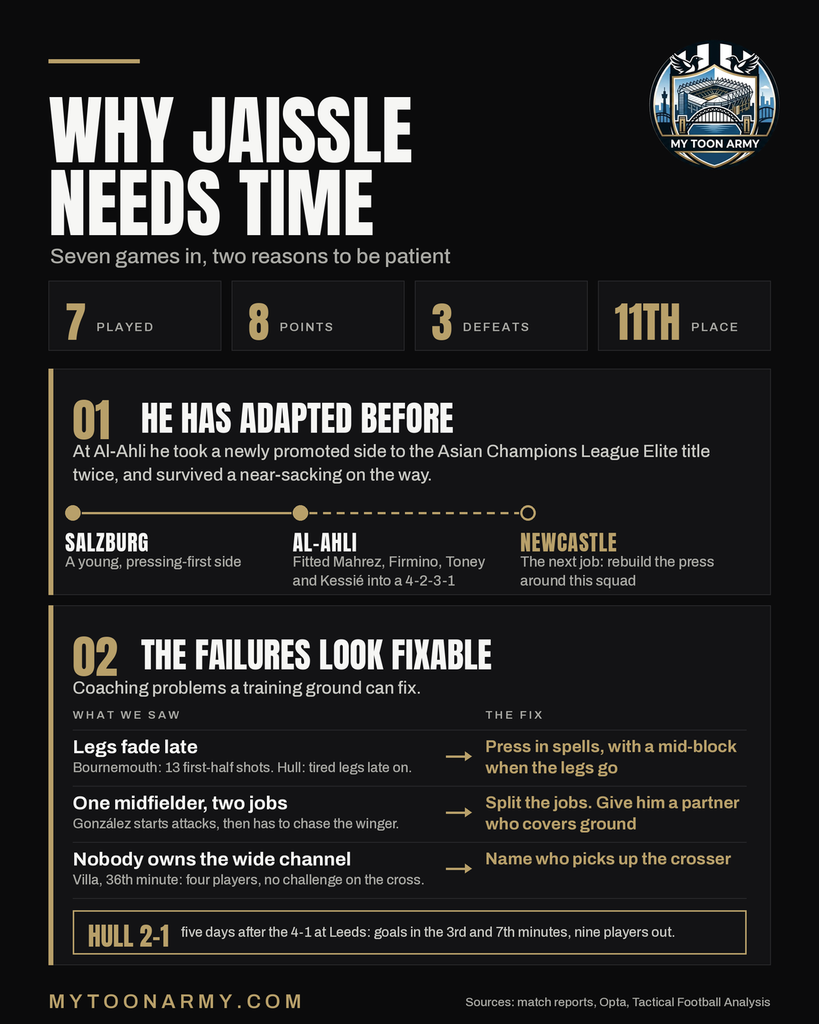
Why should Newcastle give him this time? Start with what he did at Al-Ahli. He took over a side that had only just been promoted and came close to being sacked early in the 2024-25 season. The club’s board resisted a knee-jerk reaction and backed him to turn it around, and Al-Ahli’s fans reportedly protested when the club weighed replacing him with Massimiliano Allegri that January. He survived, finished that campaign as champion of Asia, and won it again the year after. Along the way he rebuilt his own football. At Salzburg he ran a young, pressing-first side. At Al-Ahli he had to fit Riyad Mahrez, Roberto Firmino, Ivan Toney and Franck Kessié into a 4-2-3-1, with more weight on defensive organisation and quick counter-attacks down the flanks. A data review of his Saudi years found that Al-Ahli became less possession-heavy and less busy without the ball, and defended better anyway, because the press became more efficient. He kept his principles and changed the workload. That is the skill Newcastle need from him now, and he has already shown it under heavier pressure than a poor October. After Coventry he said the formation was not the issue. If he is right, the thing that has to flex is what he asks of the players inside it.
The second reason is what the failures look like. Legs fading late, one midfielder carrying two jobs and nobody named to pick up the crosser are coaching problems, and coaching problems get fixed on a training ground. They don’t suggest a dressing room that has stopped listening. Five days after the 4-1 defeat at Leeds, Newcastle beat Hull 2-1 with goals in the third and seventh minutes, with nine players missing. At Coventry they had most of the ball and 19 shots. That is a squad that wants to do what it is told and is finding the limits of what it can do, which gives a good coach something to work with.
I’d start with the press. A side that cannot sustain it for 90 minutes can still press well for 20, with spells in a mid-block when the legs go and the whole team resetting its shape together. It costs a little ambition and it protects the legs of a midfield that has not yet been built for the full 90.
Then I’d give the wide channel an owner. When the full-backs push up in build-up, someone has to be named to pick up the crosser if the ball is lost, and the rule has to be drilled until nobody needs to think about it.
González’s own job comes next. He does one of his two tasks far better than the other, and it is the one Jaissle bought him for. A midfield partner who covers ground would let him remain a passer.
The last adjustment is about listening. Ted Lasso is a fictional American football coach who is suddenly hired, in the television series of the same name, to manage a Premier League club. He was an outsider learning an unfamiliar league in a hurry, and the useful part of that story was how he asked the people who already knew the place. Jaissle’s dressing room has players who have spent years in this league, Joelinton and Dan Burn among them. They can tell him where the Premier League punishes a high line or a vacated channel, and a head coach who takes that advice early will adapt faster than one who has to learn it on Saturdays.
Patience should still come with conditions. Here is what I would hold him to over the next few games. Does Newcastle’s press come in spells, with calmer periods in between? And is it clear who picks up the crosser when the full-backs are high? If both improve, Jaissle is adapting, even if the results take longer to follow. Crystal Palace away on Saturday 24 October, Everton at home a week later and Arsenal on 21 November give him three tests of it.
So I’d ask supporters to hold their nerve. After two 4-1 defeats and a home loss, they booed the team in frustration, and nobody can say they had no reason. But the boos fix nothing. The squad is fixed until January, so the only thing that can improve over the next few weeks is how Jaissle and the players work together, and that needs training days and match minutes. Turning on the head coach now would restart the same learning with someone else, who would inherit the same midfield, the same legs and the same absences. Managers who have become great were each given time to reshape a squad, and none of them could have done it in a month.
Newcastle sit eleventh on eight points. Back the team at Selhurst Park on Saturday, and judge Jaissle on whether it looks like a side that is learning.
Leave a Reply