

This is Part Two of a four-part My Toon Army series on Manchester City’s Premier League charges and what the whole saga means for Newcastle United’s own position under Saudi ownership. Part One covered the verdict itself and the appeal to come.
On 27 April 2014, Steven Gerrard’s studs went from under him on the Anfield turf, Demba Ba ran clear to score, and a Liverpool title challenge that had carried the whole city began to come apart. A fortnight later, Manchester City were champions by two points. On the findings of the independent commission that has just ruled on City’s Premier League charges, that title race, like two others inside the same nine seasons, was not run on equal terms.
A verdict on paper cannot capture that part. These were nine seasons that actually happened, watched by millions and decided by real goals and real slips, and an independent panel has now found they were played out inside a financial system built on 114 upheld breaches. This is about what those accounts bought.
The empire, season by season
City finished 10th in the season the Abu Dhabi United Group’s takeover went through, having spent £32.5 million on Robinho on the very day the deal closed. That signing set the pattern for the next decade: money first, results following close behind. They climbed to fifth the next season after bringing in Carlos Tévez, Emmanuel Adebayor and Gareth Barry, and swapped Mark Hughes for Roberto Mancini that December. By 2010-11 David Silva, Yaya Touré and Mario Balotelli were in the building, City finished third, and they won the FA Cup, their first trophy in 35 years.
Then came the acceleration. Sergio Agüero arrived in 2011, and 93 minutes and 20 seconds into the final day of 2011-12 he scored the goal that won City their first Premier League title, level on points with Manchester United and ahead only on goal difference. Fernandinho and Álvaro Negredo followed in 2013, and Manuel Pellegrini’s side won the league and League Cup double. Kevin De Bruyne and Raheem Sterling arrived in 2015, bringing another League Cup and a first Champions League semi-final. Pep Guardiola took over in 2016, and by 2017-18, with Ederson, Bernardo Silva, Kyle Walker and Benjamin Mendy freshly signed, City became the first side in English top-flight history to reach 100 points, winning the league and League Cup once more.
Here is the full climb, set against what arrived each summer:
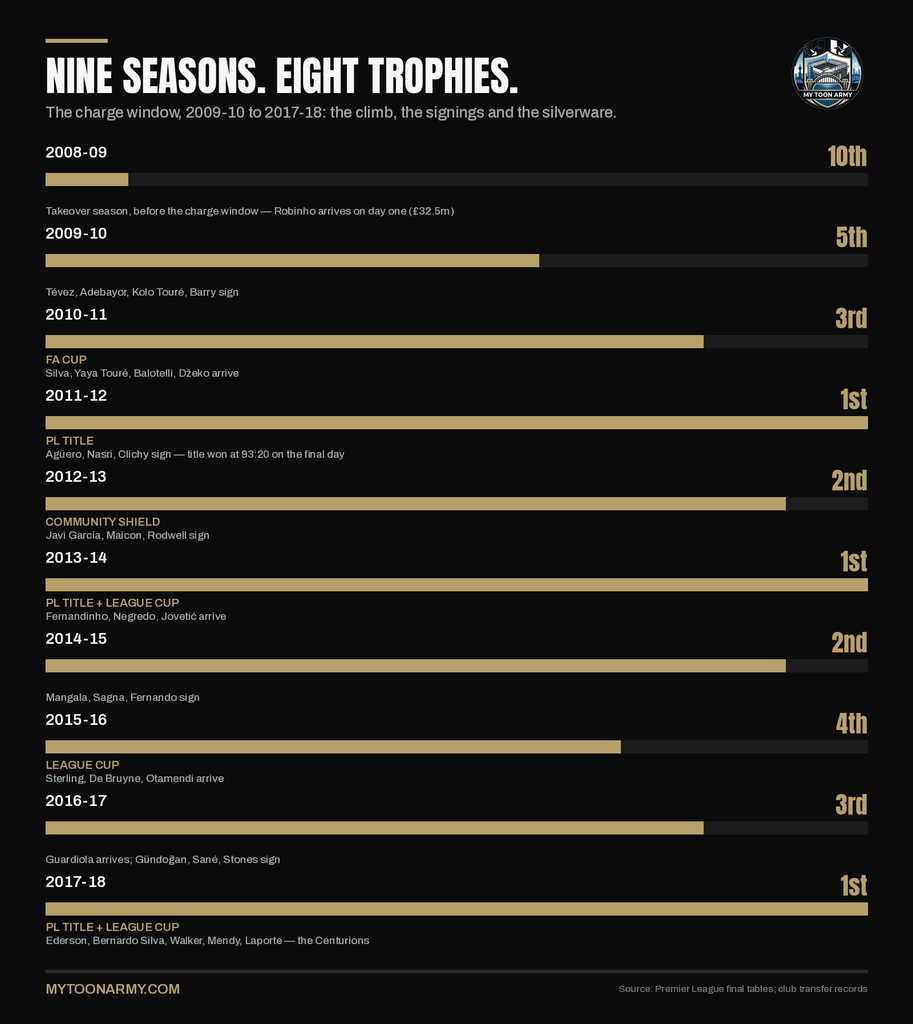
Eight trophies from nine seasons: three Premier League titles, an FA Cup, three League Cups and a Community Shield. On the commission’s findings, every one of them was won while the club’s accounts were not telling the truth about where its money came from.
Who actually lost
Every trophy City lifted had a runner-up. In the three title races, Manchester United finished second twice, beaten on goal difference in 2011-12 and by 19 points in 2017-18, and Liverpool once, two points short in 2013-14. Stoke City lost the 2011 FA Cup final 1-0. Sunderland, Liverpool and Arsenal lost League Cup finals to City in 2014, 2016 and 2018, and Chelsea lost the 2012 Community Shield.
None of that is trivia. Under the Premier League’s merit payment system, each place in the final table was worth around £2.8 million in 2023-24, and that is before Champions League qualification, which adds tens of millions more in prize money, broadcast exposure and matchday revenue. Losing a title race to a club found to have broken the rules for nine straight years is not only a wound to pride. It is a financial injury that can be measured, and the clubs on the wrong end of it have started measuring.
To be clear about what that does and does not mean: nobody can prove that a specific pound of disguised sponsorship bought a specific goal. There is no way to replay 2013-14 with City’s books clean and show Liverpool lifting the trophy instead, and no single moment across those nine seasons can be pinned to a line in a balance sheet. What the economics of the game show is blunter, and in some ways more damning. The long-running research of Stefan Szymanski and Simon Kuper found that relative wage spending explains around 90 per cent of the variation in English league position over time. Money does not buy a particular result. It shifts the odds of an entire era. For nine seasons City operated with financial firepower the commission says was inflated by rule-breaking, in a league where firepower is already the best predictor of who finishes where. The charge was never that fraud won any one match. It is that fraud tilted the table beneath all of them.
The bill being drawn up
The clubs worked this out long before the verdict. By November 2024, almost two years before Friday’s news, Arsenal, Manchester United, Liverpool and Tottenham had all lodged legal notices reserving the right to claim compensation from City, with Arsenal reportedly the first to move. The timing was not sentimental. Their lawyers feared the six-year limitation period might run from November 2018, when Der Spiegel’s reporting first triggered the investigation, and expire long before any verdict arrived. Waiting for justice risked forfeiting the right to be compensated for its absence.
Since Friday, that groundwork has started to move. According to The Athletic, several clubs have instructed leading lawyers to assess their damages, with talks reportedly under way on a coordinated approach. Sources quoted by The Independent suggest a successful claim could be worth more than £200 million to some individual clubs, while Liverpool’s claim, built on lost income from lower finishes and the knock-on effect on Champions League qualification, has been put at around £100 million.
Those figures are not fantasy, because the route has already been tested. Burnley, relegated in 2021-22, sued Everton over the PSR breach from that same season, arguing that had Everton’s six-point penalty been applied at the time, Burnley would have stayed up instead. In June, a Premier League commission agreed, and ordered Everton to pay £26 million plus interest, a bill that could approach £40 million. Everton have appealed, calling the ruling a dangerous precedent.
The Burnley case matters for a reason that goes beyond the money. The commission did not have to prove that Everton’s overspending produced a particular goal. It accepted a simpler counterfactual: apply the sanction to the table in the season it belonged to, and see who ends up where. That is precisely the argument City’s rivals will make. It will still be a far harder fight at this scale, with nine seasons, several title races and a club that will contest every step, and nothing can begin until City’s appeal has run its course.
None of this softens what Part One established. It sharpens it. This was not nine seasons of City being brilliant while everyone else was merely good. On the commission’s findings, it was nine seasons in which the margins, whether a point here, a slip there or a Champions League place worth tens of millions, were decided on a pitch that was not level – City’s spending beyond the rules distorted the competition. The clubs who lost by those margins are now adding up exactly what it cost them.
Part Three turns to the punishment nobody can agree on — why fines, points deductions and even expulsion all struggle to fit a case this size, and why the underlying problem might not be fixable at all. It follows tomorrow.
Leave a Reply