Data Driven Insights. Fearless Opinions.

Club

  • Jaissle Walks Into Craven Cottage With the Boos Still Ringing

    Fulham v Newcastle Match Poster

    Four defeats in five, a restless home crowd and a first meeting with Álvaro Arbeloa’s Fulham: Newcastle’s head coach has 90 minutes in west London to change the mood before the international break.

    Fulham captain Tom Cairney’s left foot found the top corner at Craven Cottage in the 80th minute of last season’s final day, and two managers with uncertain futures watched it go in. Marco Silva beat Eddie Howe 2-0 that afternoon, Fulham taking 21 shots to Newcastle’s seven. By the summer both men had gone.

    Their successors meet at 3pm tomorrow, at a ground tucked between the Thames and Bishop’s Park, and so far as I can establish they have never faced each other before. Matthias Jaissle, 38, arrives 13th in the table with the sound of Monday night’s boos still in his ears. Álvaro Arbeloa, 43, came to Fulham after five months in the Real Madrid dugout, went six league games without a win and heard the sack talk before three unbeaten matches steadied the room. Both need the points. The break that follows will either settle a dressing room or hand the doubters a fortnight.

    The night it came apart

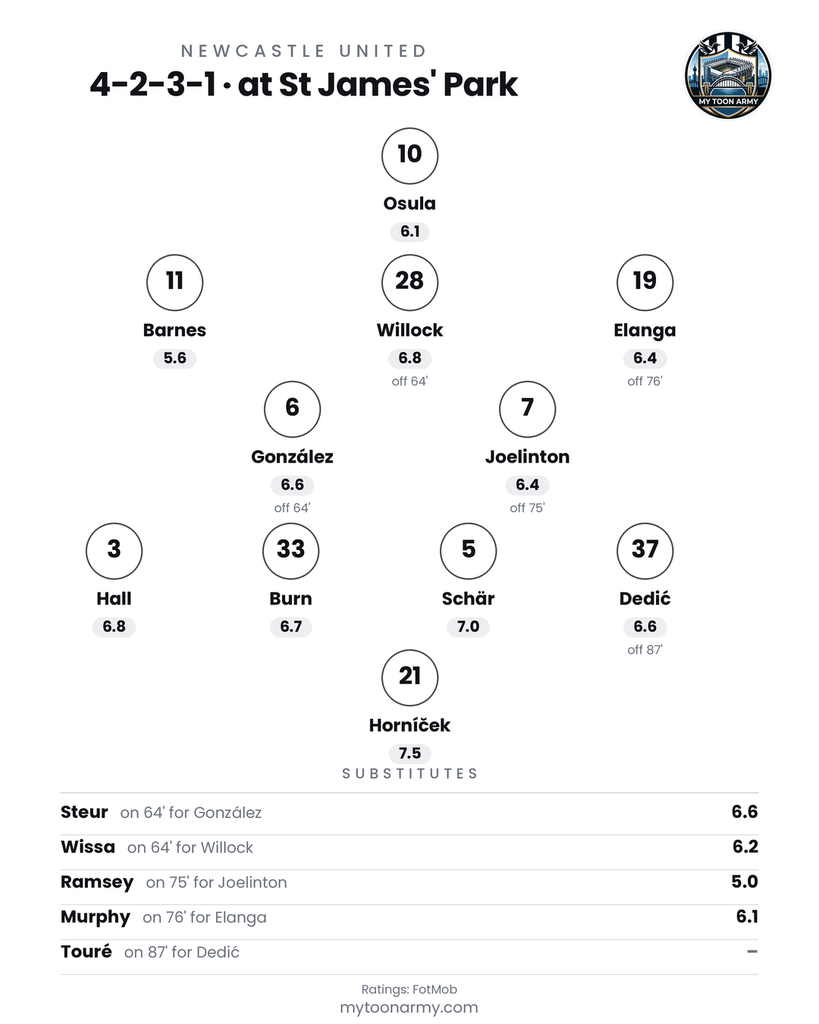
    Four minutes after half-time on Monday, Everton’s Tyrique George struck a shot that reached Lukáš Horníček at a comfortable height. It squirmed under the goalkeeper’s body and striker Thierno Barry tapped into an empty net. St James’ Park, already booing at the interval, did not need the replay. Newcastle’s first shot on target, from Yoane Wissa, arrived in the 86th minute. Jacob Ramsey, on as a late substitute, collected two bookings inside a minute and a half and walked.

    Jaissle told the supporters to blame him. His reign had opened with an unbeaten run of 2-2 against Liverpool, 2-0 at Tottenham and 2-2 at Bournemouth. Then came Elland Road, where Leeds striker Dominic Calvert-Lewin ran the evening, a 4-1 hammering at Coventry and a 1-0 loss to Aston Villa. A 2-0 win at Crystal Palace was followed by a 3-1 Carabao Cup defeat at Everton, and then Monday.

    TeamTalk has reported that players are struggling to adjust to his methods, and newspapers are already running lists of available replacements. Jaissle says his job is not on his mind.

    His squad also did not exist in July. Tonali (£100m to Tottenham), Guimarães (£75m to Arsenal) and Gordon (£69.3m to Barcelona) left for more than £240m between them, while eight first-team signings worth roughly £265m arrived between mid-June and deadline day. Those fees buy a great deal of talent and very little familiarity, and a midfield assembled that way has had to learn itself in public.

    What has to change

    Jaissle says he adjusts his principles to the opposition. Tomorrow tests that, and my view is that the No.10 has to go. He has leaned on a 4-2-3-1 with no specialist in the role, and Everton walked through the middle of it. Only Palace have faced more shots than Newcastle’s 154.

    I would move to a 4-3-3 with Nico González, the £47m arrival from Manchester City, at the base and Sean Steur and Joe Willock ahead of him, with Lewis Miley in if his knock has cleared. Harvey Barnes and Anthony Elanga are tireless on the flanks, Lewis Hall gives the left side a settled base, and a team that forces opponents wide defends better. That was the logic of Howe’s 4-3-3, though it leaned on Bruno Guimarães, Sandro Tonali and Joelinton. Bruno and Sandro have left, and this gives their replacements a chance to prove themselves.

    The right flank is the awkward part. Tino Livramento is out long term, which leaves Amar Dedić as the only fit senior right-back. The BBC gave him a 4 on Monday, and his poor clearance began Everton’s first goal in the cup. He needs protection from the eight in front of him.

    Further back I would drop Fabian Schär, 34 and short of the recovery pace Everton’s counters demanded, and bring in Malick Thiaw. Dan Burn stays. At 201cm he and the 194cm Thiaw suit a Fulham side that has won 56 corners, second only to Tottenham. Horníček also stays. He was man of the match at Palace a week before Monday, and dropping him after one error would tell a nervous dressing room that nobody is safe. Most predicted line-ups keep Horníček, Schär and Burn, so the outside world expects Jaissle to stand firm.

    The hosts

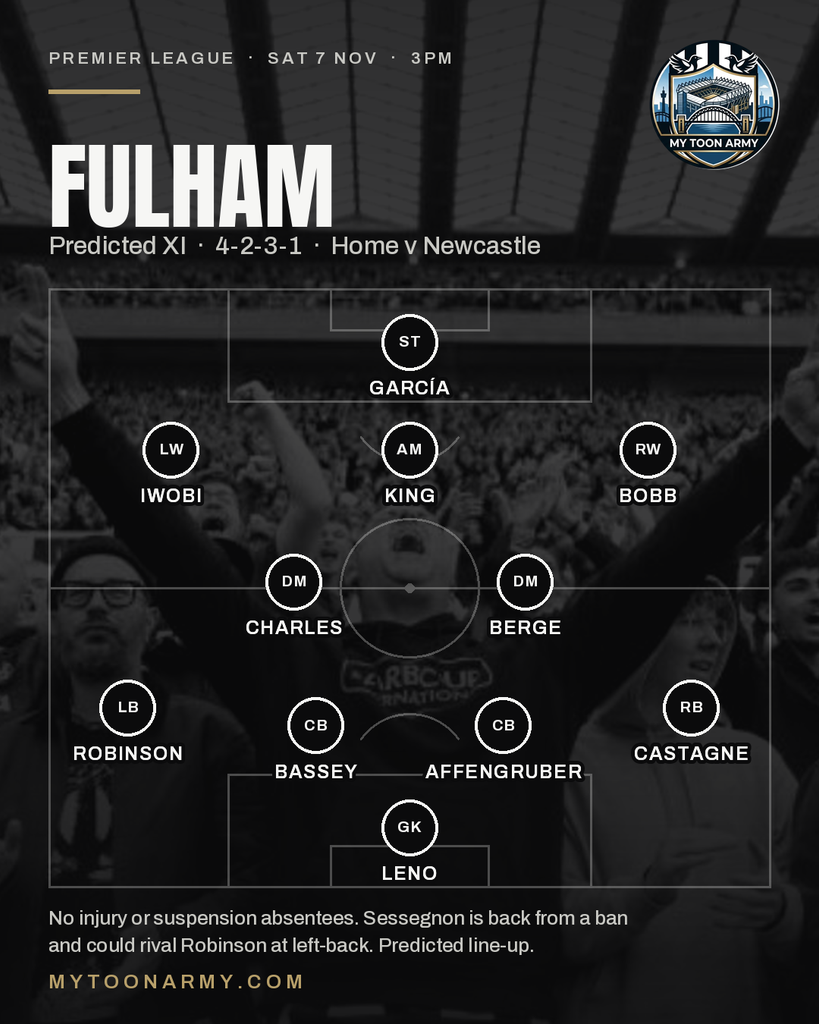
    Arbeloa’s Fulham score sparingly. Their nine goals are fewer than all but Nottingham Forest and Sunderland, and they have scored exactly once in each of their last five league games. They have conceded one in the last three. Goalkeeper Bernd Leno sits behind a back four built around centre-halves Calvin Bassey and David Affengruber, with midfielders Sander Berge and Shea Charles screening them and Joshua King in the No.10 slot. Striker Gonzalo Garcia, who arrived from Real Madrid, has gone eight league starts without a goal, and Ryan Sessegnon, the left-sided defender, is back from a three-match ban for a red card against Hull.
    The history favours them. Fulham have won three of the last four league meetings, the latest through Cairney’s strike and a header from centre-half Issa Diop. The exception came last October, when Guimarães took a loose ball and scored at the Gallowgate End in the 90th minute for a 2-1 win. He now plays for Arsenal, who visit St James’ Park after the break. None of the 18 league meetings between these clubs in London has ended in a draw. Perhaps now is the best time for one. Neither team will want a draw, which probably makes it the best result, and it steadies the Newcastle ship somewhat after a series of disappointments in recent weeks.

    Pressing to impress

    Steur is 18, cost £19.6m from Ajax and has a growing band of supporters demanding he start. Will Osula, 23, the Danish striker, combined with Barnes at Palace and leads the line. Joelinton and Ramsey are out. Matias Fernandez-Pardo, the £51m forward from Lille, is training again after more than two weeks with a virus and should be on the bench.
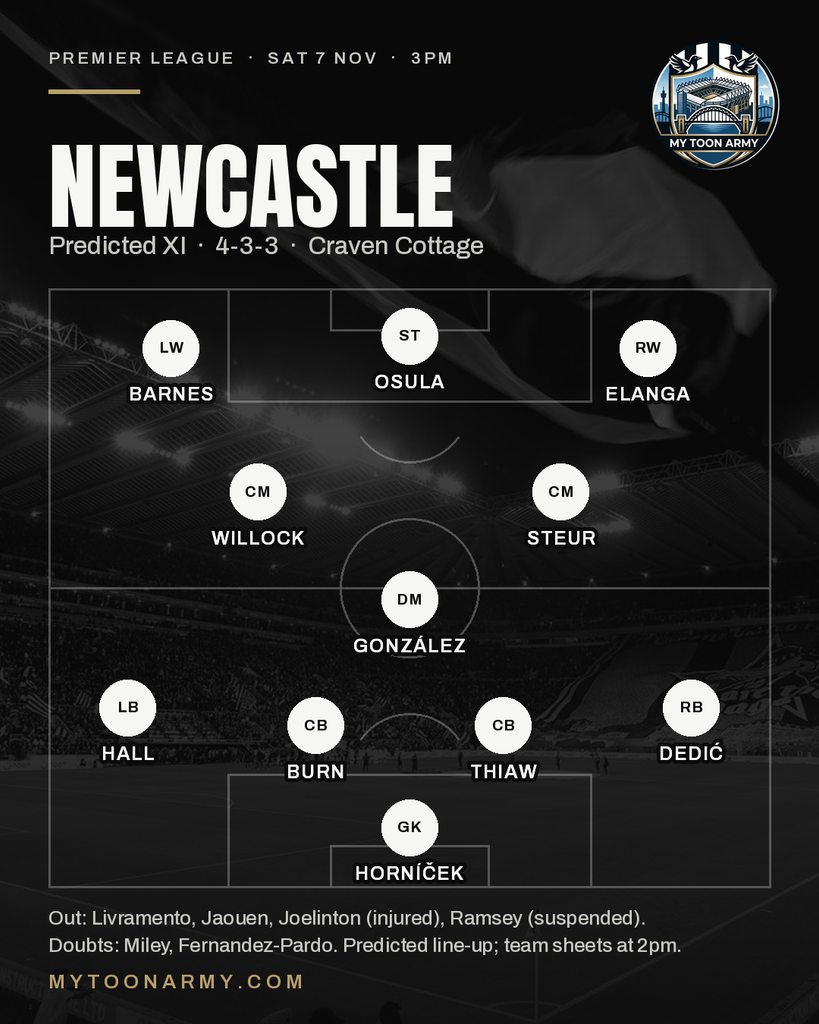
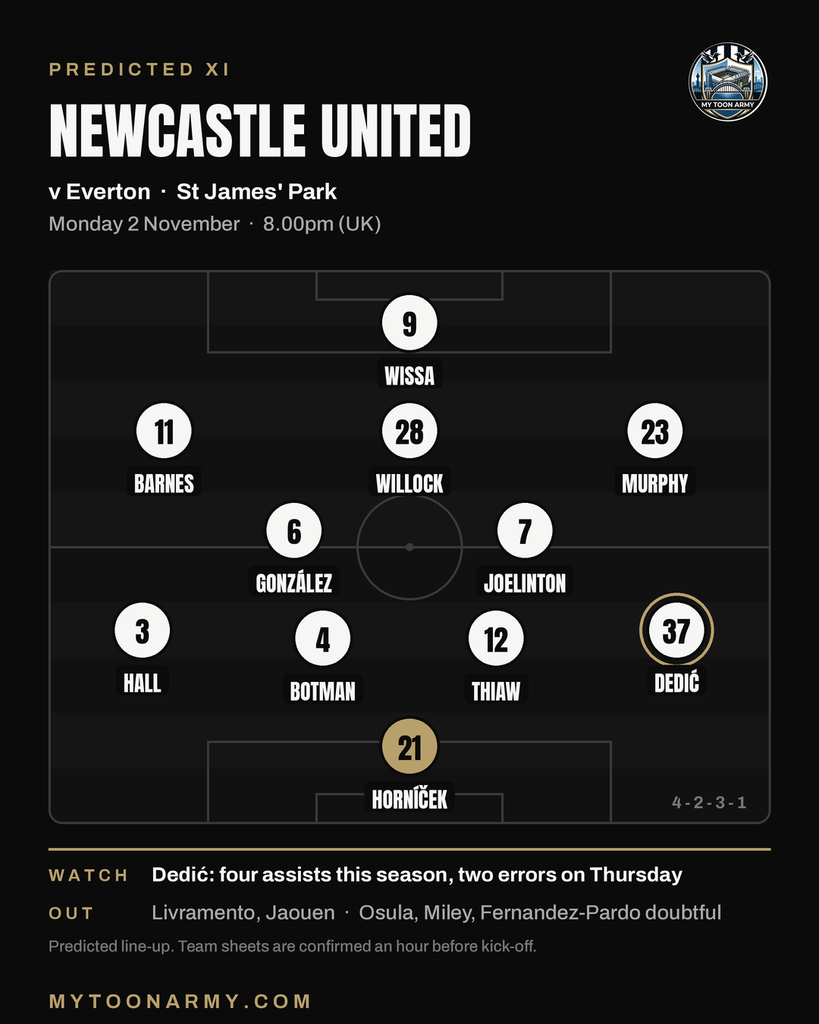
    Predicted XI (4-3-3): Horníček; Dedić, Thiaw, Burn, Hall; González, Steur, Willock; Barnes, Osula, Elanga.

    Prediction

    Fulham 1-1 Newcastle. Fulham have been scoring one at a time, and Newcastle took 17 shots at Everton and had nothing to show for them. The record says someone wins in London, and I am picking the draw anyway.

    A point sends Jaissle into the break with a fortnight to find a plan before Arsenal arrive at St James’ Park. A win would send him there to cheers.

  • The Second Match

    Five defeats in seven, a restless St James’ Park and a timeline full of verdicts. On what the noise around Matthias Jaissle does to those of us listening.

    Five defeats in seven matches, thirteenth in the table, and a St James’ Park that vented its anger at half-time on Monday night and again at the final whistle. Everton had already won in the Carabao Cup, away from home. Now they had won again on Tyneside, in the league, and the frustration came down off the stands in waves.

    Then the match on the pitch ended and a second one began, the argument over what it all meant, fought out online.

    The second match is played on phones. Its pitch is a timeline, a Reddit thread, a WhatsApp group that has been silent since the weekend and suddenly lights up with twelve messages in a minute. It has no referee and no final whistle. After the Aston Villa defeat earlier this season, supporters of Al-Ahli, the Saudi club Jaissle managed before he came to Newcastle, had a hashtag demanding his sacking running within minutes. People with no season ticket and no stake in where Newcastle finish joined the chorus, and nobody scrolling past could tell which voices belonged to the Gallowgate and which belonged to somewhere else entirely.

    I have no verdict to add on Jaissle here. I’ll leave that argument to others for now. What interests me is what the volume does to the rest of us while we listen.

    The pull

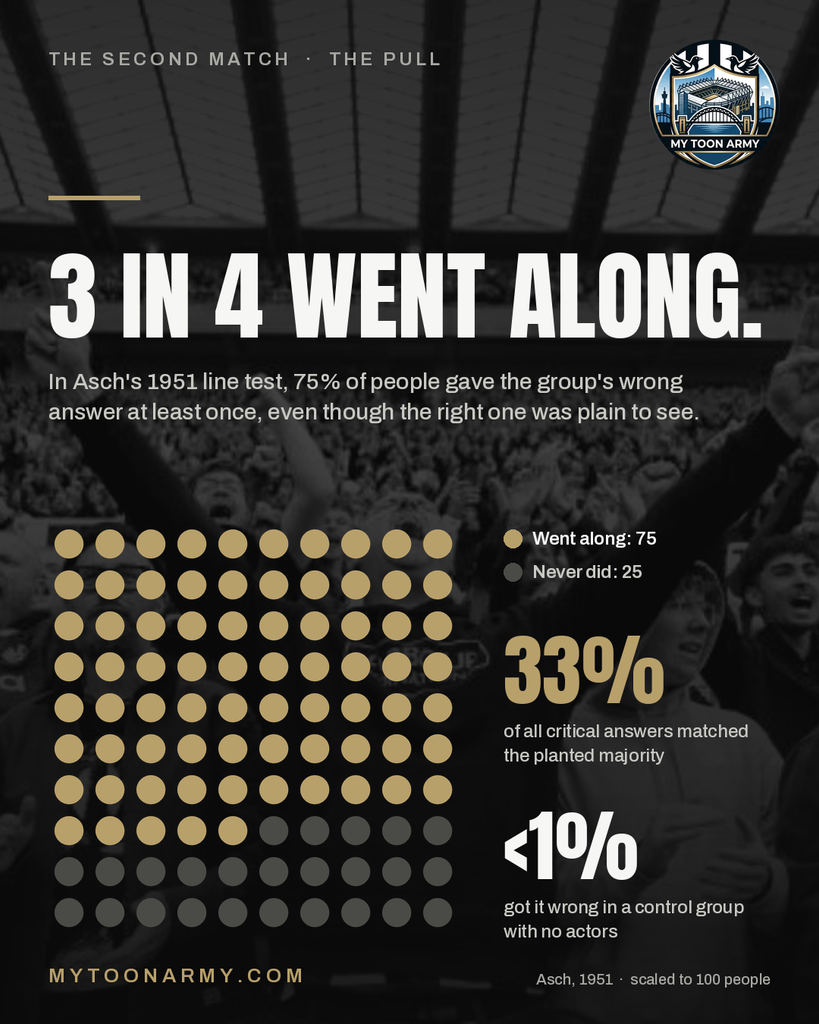
    In 1951, Solomon Asch put a young man in a room at Swarthmore College with seven other people and a card showing a line. The task was to say which of three other lines matched it. The answer was obvious. The other seven, all of them actors, had been told to give the same wrong answer on twelve of the eighteen rounds.

    About a third of the answers on those critical rounds matched the planted majority. Three-quarters of the participants went along with the room at least once. In a control group with no actors, fewer than one per cent of people got it wrong.

    Asch also found the thread that unravels the whole thing. When a single actor broke ranks and gave the right answer, conformity dropped sharply. One dissenting voice made the other seven far easier to resist.

    Asch’s lines had a correct answer printed on the back of the card. Football offers nothing of the kind. Is Matias Fernandez-Pardo ready to start? Does a particular system suit this particular squad? Is a manager two months into the job showing flaws or still finding his feet? Those questions have no card with the answer on the back, which makes the room even more persuasive.

    I’ll put my hand up. When I see a wall of people asking for something, whether it’s a manager sacked or a £51m forward in the starting eleven, it builds a sense of expectation. Often I catch myself agreeing because I want to belong to the right group. If the masses say it, part of me wants to be among the masses. When the subject is something I care about this much, the pressure is intense.

    It works the same way with politics and religion. Football just happens to be a small, niche, constantly observable laboratory for it, and Newcastle, with its fifty-two thousand voices and its permanent state of heightened feeling, is a very good place to watch it happen.

    A price is not a fact

    Bankers know this pattern in another costume.

    In 1983, Douglas Diamond and Philip Dybvig published a model of a bank run. Their point was uncomfortable. A perfectly solvent bank can fail if enough depositors believe other depositors are about to withdraw. Each individual’s decision is rational given what they expect everyone else to do. Nobody needs to have read the balance sheet. The belief about other people’s belief does the damage.

    A campaign to sack a manager, Jaissle now or anyone else in future, has the same architecture. The more people who say it, the more it seems that others must have seen something, and the more reasonable it feels to say it too. A share price works this way as well. It records what the market is willing to pay today, and whether the company is worth that is a separate question that someone has to answer by doing the work.

    The temperature of a timeline is a price. It tells you what the crowd is willing to say right now, which is useful information about the crowd.

    Who is actually talking

    A Pew Research Center study of American adults on Twitter, published in 2019, found that the most active ten per cent of users produced about eighty per cent of the tweets. The median user posted twice a month. Nothing in that study was about football, the platform has changed since, and the data is American. It still describes how a timeline gets its shape: a small, prolific minority generating most of the words, and a much larger audience that reads and says nothing.

    From where I sit, loud and numerous look identical. A thousand angry posts in an hour feel like a thousand angry supporters. Some of them are one supporter posting eleven times.

    Framing adds another layer. Several outlets this week ran headlines built around the word “sack”. Read beneath them and the reports describe a club with no plans to move, a board said to be standing by its man. I can’t see inside the building and those are reports, not facts, but the gap between the headline and the copy tells you something about how a story gets its temperature. The word that goes into the headline is the word that goes into the group chat.

    The best outcome and the likeliest one

    Thinking independently takes deliberate effort. It needs quiet time, away from the notifications, to sit with an issue and let it settle. Then comes a second job that I find harder: separating what would be the best outcome from what is the most likely one. They are sometimes mutually exclusive.

    A change in the dugout might be the best thing for the club and also the least likely to happen. A change might be the likeliest outcome and also a poor idea. A signing might deserve a start on merit and still sit on the bench for reasons nobody outside the training ground can see. The crowd tends to fuse these questions into a single demand, because a demand is easier to type than a probability.

    Inside a bank’s credit committee, nobody asks which outcome the room would like. They ask which outcome the file supports, and how confident anyone should be. It feels cold at first. It is also the only way I know to keep wishing and forecasting apart.

    The phrasing matters

    This is one of the things I think hardest about when I write for this blog. “Under pressure” and “failing” are different sentences. “Calls for” and “demands” are different sentences. A choice of verb can carry a conclusion into a reader’s head before the evidence has arrived, and I would rather the reader reach their own conclusion on the way. If I do my job properly, you finish a post of mine knowing what happened, why it might have happened, and where I am uncertain, with room left to disagree with me.

    Newcastle travel to Craven Cottage on Saturday to face Fulham. Before a ball is kicked, someone in the group chat will already have decided what the result is going to mean, win or lose. I’d like to watch the match first and make up my own mind afterwards.

  • The Note on the Grass

    Newcastle vs Everton Match Report

    A 1–0 home defeat to Everton left Newcastle 13th, Matthias Jaissle jeered on the lap of appreciation and a dropped sheet of paper carrying the argument. It also left a question that the manager’s own answers did not settle.

    Eighty-seven minutes in, with rain slanting through the St James’ Park floodlights, Bazoumana Touré jogs onto the pitch holding a sheet of paper. Fabian Schär takes a quick look. Then he lets it drop.

    The broadcast cameras find it on the wet turf: names in blue ink, Osula and Wissa across the top, Murphy and Steur lower down. Before the night is out, social media has spoken: the players, have stopped listening to Matthias Jaissle.

    It is a neat story, maybe it’s true. The note was dumped on the pitch because the players don’t care anymore.

    What the eye saw

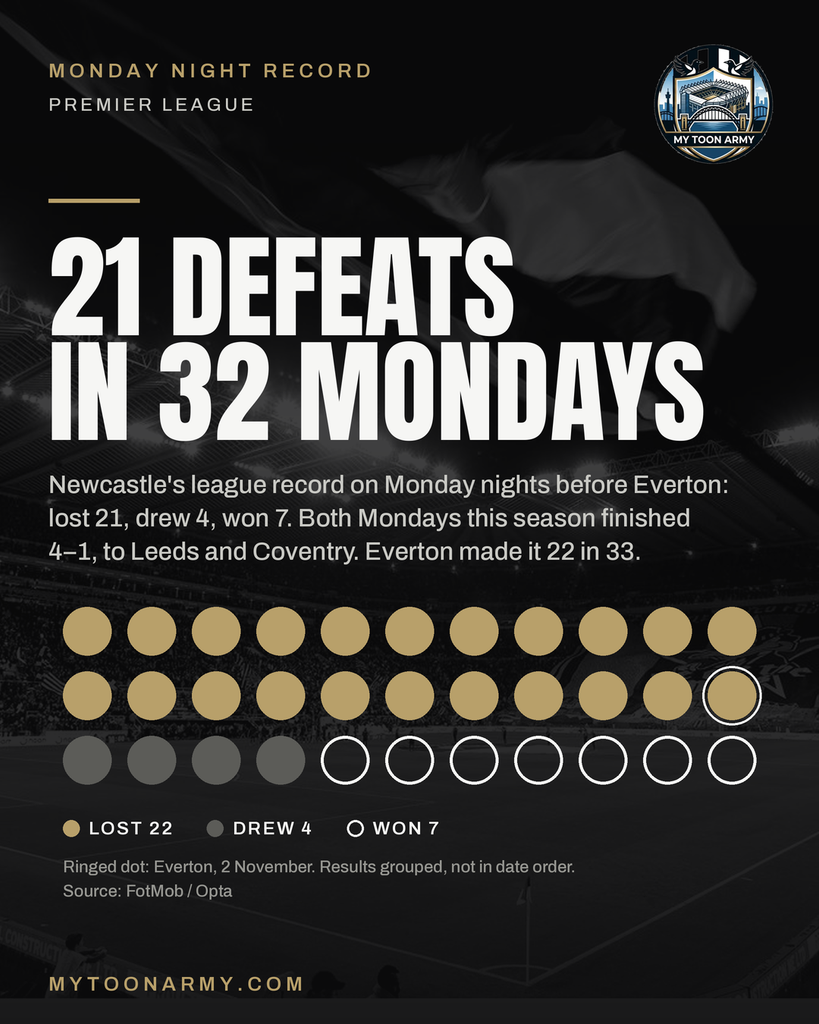
    Monday nights have been unkind to Newcastle for some time. They have lost 21 of their last 32 league games on the day, including both this season, 4–1 to Leeds and 4–1 to Coventry. This one starts promisingly enough, then drifts into the worst first half they have produced all season. The ball goes long, again and again, towards William Osula, who has touched it five times by the half-hour. Barely a quarter of those long balls find a team-mate. There is no pattern to the play, no obvious idea about who should be where, and no tempo until Everton choose to supply it. Thierno Barry, Everton’s French striker, spurns one clear chance and Harrison Armstrong, a young Everton midfielder, shoots wide with the goal at his mercy. The score at the break is 0–0 only because Everton are generous. The boos at the whistle come from a minority. They will not stay a minority for long.

    The second half is better, though not by much. Elanga’s touch at the back post spins off Jordan Pickford and the upright and along the goal line. Jacob Ramsey drives a clean strike inches past the post. But Newcastle’s first shot on target, a tame 25-yarder from Yoane Wissa, does not arrive until the 85th minute.

    By then they are behind, and the goal is the sort that hurts. Everton take a quick free kick after Joelinton and Barry tangle in Newcastle’s half. James Garner plays it short, Kiernan Dewsbury-Hall feeds Tyrique George, and George’s shot goes straight at Lukas Hornicek. It squirms beneath the goalkeeper, and Barry taps into an empty net. Newcastle appeal for a foul on Schär in the build-up and for offside. VAR takes its time and gives neither.

    It is another error leading to a goal. Newcastle’s count of those had reached four by the hour on Opta’s numbers, bettered only by Sunderland and Hull, and this one belonged to the goalkeeper. Hornicek makes several good saves afterwards, but the damage is done and the home crowd knows it.

    The Note

    Touré replaces Amar Dedić at 87 minutes and carries the sheet on. Players arriving with a note from the bench is a familiar sight, a way of passing a change of shape through the noise without shouting. What Schär did with this one has been read as contempt. I cannot see inside his head, no one can. Dropping a note after reading it is as consistent with a player who has absorbed it as with one who has ignored it.

    It could be a symptom or it could be nothing, and the truth is that nobody outside the dressing room knows which. The evidence on Schär is mixed. FotMob rates him Newcastle’s best outfield player on the night, and he is booked in the scuffle at the end. But on a night when the manager himself says the plan was not followed, a centre-half dropping a team sheet on the turf is not a picture anyone at the club will have wanted.

    Touré’s three minutes on the pitch do produce the best move of the night. Barnes finds him down the left, he reaches the byline and pulls it back, and Pickford saves Wissa’s shot with his right boot. Moments later Ramsey is sent off for two yellow cards in the space of two minutes, the second for catching Armstrong’s ankle. The final whistle brings the loudest booing of the evening.

    A manager on the defensive

    In the press room, Jaissle sounds defensive. He knew the questions would be hard, and he answers them by spreading the weight around.

    He talks about a week of good training that did not make it onto the pitch. He says the plan was to press high at home and to build through patterns, and that his side were “not brave enough in possession”. He is blunt about the long balls: “Long balls was not the plan.” He says the goal should have been disallowed for a foul on Schär. He accepts the unforced error that led to the free kick, says the team was “just sleeping”, and allows that on a better day the goalkeeper saves George’s shot. And in among it all he says: “I am responsible for that.”

    The ownership is there, but it arrives in general terms, while the specifics he offers point at the pitch and the officials. That produces the conflict in the coverage. Some of the next-morning headlines have him blaming the players for ignoring his instructions. Others stress that he took responsibility, and the recording supports both readings. If the long balls were not the plan, then either the players did not carry out the plan or the plan was not clear enough to survive the first bad ten minutes. The note may be a symptom of that disagreement, and it may just be a piece of paper.

    What it means

    The lack of confidence is the issue here, and the pattern behind it is easy to see. Newcastle have conceded in all five home league games this season and have gone 14 straight home league games without a clean sheet, the longest run in the club’s league history. A side braced for the next mistake will often play it long to avoid its own half. That is a fixable habit, and Jaissle is nine league games into a new job with a squad that has changed a great deal since the summer.

    He indicated he will not tear up the team after one bad night, because players need to feel one poor performance will not cost them their place. He also left a door open: anyone pushing hard in training makes the choice easier, and Sean Steur, who made an encouraging cameo, is clearly in his thinking.

    The next test is Fulham away on Saturday at 3pm, the last match before the international break. Ramsey’s red brings an automatic one-match suspension. After the break comes Arsenal at St James’ Park on 21 November, the league leaders fresh from a 1–0 win at Anfield, and then Brighton away on 29 November, a side sitting third on 19 points. The table still gives Newcastle some room: they are on 11 points, four clear of 18th. The fixtures give them very little.

    Everton, up to seventh on 13 points, have their first away league win of the season, and David Moyes’s side now turn to Coventry.

    On Saturday at Craven Cottage, a new sheet will be written, handed across and read. Plenty of people will be watching to see what Schär does with it.

  • Ten seconds at the touchline: Dedić, Moyes and the rookie’s lesson

    Newcastle v Everton

    Amar Dedić played under Matthias Jaissle long before Tyneside, and still gifted Everton two goals on Thursday. On Monday the pair of them face David Moyes again, and both have a point to prove.

    Thirty-four minutes into the Carabao Cup tie at the Hill Dickinson Stadium, Jordan Pickford, Everton’s England goalkeeper, hits a long kick forward. Tyrique George, a young Everton winger, closes down Amar Dedić near the touchline, and Newcastle’s right-back has a choice. He can put the ball into the stand. He tries to play his way out.

    Hayden Hackney, a holding midfielder signed from Middlesbrough in the summer, collects the loose ball and slides it to James Garner, who drives into the box and bends a shot into the far corner. It is 1-0. Jaissle will call it a “no-risk zone” afterwards, a patch of pitch where the only sensible answer is to clear the ball.

    Thirty-five minutes later it happens again. Newcastle are 2-0 down and chasing, the ball runs loose in their own half, and Garner leads a break that ends with Kiernan Dewsbury-Hall, Everton’s attacking midfielder, running in behind Dedić. Dedić cannot catch him or stay close to him. Dewsbury-Hall pulls the ball back, and Thierno Barry, Everton’s French striker, needs one touch to sweep it into the top corner.

    Two goals, one right-back, and no brilliance required from the opposition. Dedić was not alone on the night. As I wrote on Friday, Dan Burn and Jacob Ramsey share the blame for Hackney’s goal just before half-time. But Dedić’s two carry a different weight.

    Nobody in the squad knows what Jaissle wants better than he does. He played for him at Liefering and then at Salzburg, he was the first signing of the Jaissle era, and Newcastle paid about £30m to bring him from Benfica in August. The day he signed, Jaissle called him “incredibly hungry to prove himself” in the Premier League. In his first four matches he had three assists, two against West Brom in the cup and one at Tottenham. At Crystal Palace he added a fourth, a low cross from the overlap that Harvey Barnes finished, and by Thursday he led the club for assists with four in six starts.

    That is the strange part. The player who knows the system best made the two mistakes the system can least afford, and he made them in front of the whole squad.

    My gut tells me that Dedić will be the story of Monday night. Tino Livramento is out until after the international break and Lewis Miley, a midfielder who can cover at right-back in an emergency, is a doubt, so Dedić will probably start again. Everton will not need to be told where to look. A winger will run at him inside the first ten minutes, and I want to see a player with something to prove. The first month of his season says he has the tools to prove it.

    The rookie and the veteran

    Monday matters to both benches. Newcastle have lost three of their last four, and across the defeats at Leeds and Coventry and Thursday’s cup tie they have conceded eleven goals and scored three. Everton have scored eight league goals in eight games, lost 2-0 to both Chelsea and Arsenal before the cup win, and have yet to win away from home in the league. Moyes left out Jack Grealish, the Manchester City loanee, after he reportedly missed a training session, and still won comfortably without him. That says plenty about the grip he has on that dressing room.

    Moyes took charge of his first Premier League match in March 2002, when Jaissle was 13 years old. He is 63, reached 700 league matches in January 2025, and only Arsène Wenger and Sir Alex Ferguson have managed more. Jaissle, a young lad of just 38 years, will be managing his ninth Premier League match on Monday.

    He has won elsewhere, and it counts: the Austrian double in his first season at Salzburg, then back-to-back Asian Champions League titles at Al-Ahli. Nothing is like the Premier League, though, and Jaissle is learning that the hard way. He is a Premier League rookie facing a manager who has spent nearly a quarter of a century collecting every habit a rookie lacks.

    They have met twice since August, and Moyes has won both by the same score. The first, at Murrayfield in pre-season, was Jaissle’s second match in charge and came with ten changes at half-time, so I would not read much into it. The second, on Thursday, I would. Moyes has also won both of his league visits to St James’ Park since returning to Everton, 1-0 last May and 3-2 in February, and the side that scored first has won every meeting since last May, friendly included.

    Newcastle’s only win in that run, the 4-1 at Everton last November, began with Malick Thiaw heading in inside the opening minute. Afterwards Moyes said his team had been beaten by “a far more experienced looking team”. That line has aged oddly. Gordon went to Barcelona, Tonali to Tottenham and Guimarães to Arsenal this summer, and all eight of the new arrivals are 24 or younger.

    The cast list repeats itself. Barry has scored in each of his last three games against Newcastle, friendly included: the winner at St James’ Park in February, then Murrayfield, then Thursday. Garner supplied the corner for Jarrad Branthwaite’s header in February and scored on Thursday. Thiaw’s two headers in November remain the best afternoon any Newcastle player has had against a Moyes side.

    Two 3-1 scorelines look like a gulf, and I think they are the wrong evidence. On Thursday Newcastle had 28 shots, 57 per cent of the ball, 37 touches in the Everton box and ten corners, and Everton scored three times from five shots on target. The gulf is in the seconds after the ball turns over, where Moyes’s players know exactly what to do and Jaissle’s are still finding out.

    Lesson one: the Premier League is unforgiving

    Jaissle has two things to adapt, and the first is a habit of mind. In this league even a small mistake costs a goal, and it costs one quickly. Thursday’s three Everton goals began with a loose touch, a tackle Burn missed and a run nobody tracked. None of them needed a moment of quality from the opposition.

    Unai Emery’s Aston Villa won 1-0 at St James’ Park on 17 October, and the numbers from that night make uncomfortable reading. Newcastle had 16 shots worth 0.99 expected goals, a measure of chance quality, and Villa’s 15 were worth 1.57. In the second half Villa won 73 per cent of the ground duels, made 17 tackles to Newcastle’s seven and cleared the ball 24 times. Emery has said that clean sheets are what Villa have been working on. Moyes’s Everton did the same on Thursday: eight saves from Pickford, a last-ditch block from James Tarkowski on Will Osula, and three goals from five shots on target. Both men are happy to take risks, and both choose their moments.

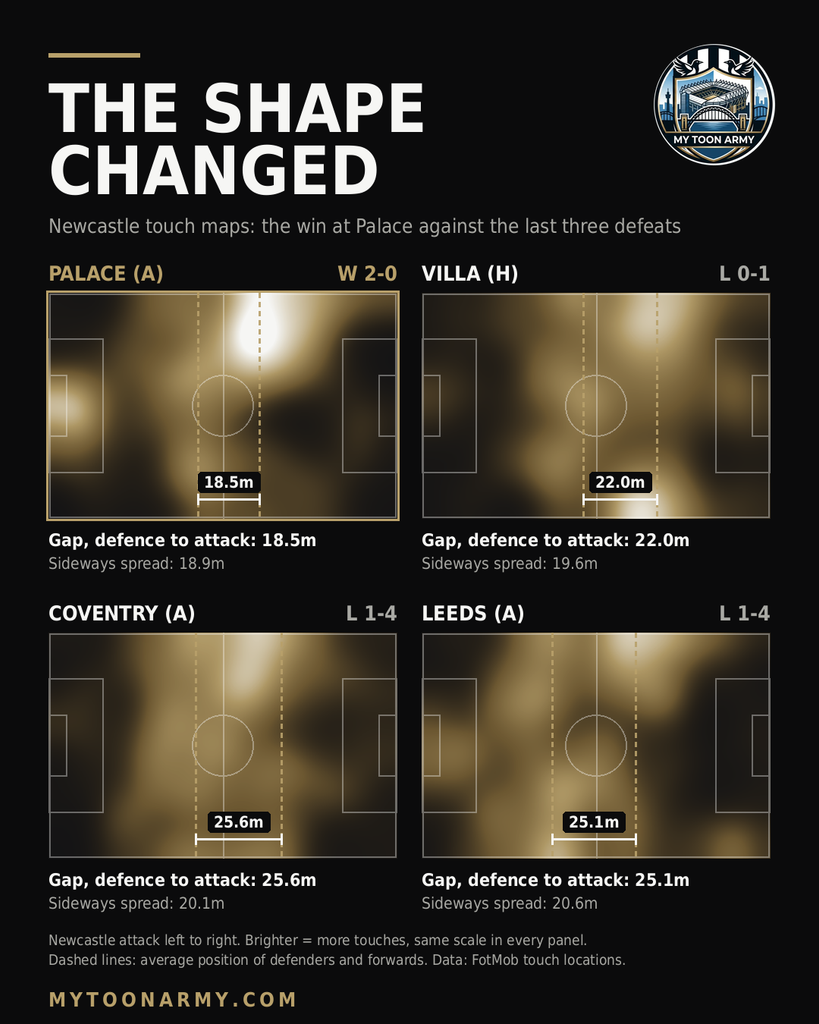
    It is not as if Jaissle lacks the instinct. His own principles keep a spare player in or in front of the back line, and at Selhurst Park he squeezed the gap between his defenders and his forwards to 18.5 metres, down from 25.6 at Coventry. Newcastle won 2-0 and kept their first clean sheet since the end of August. Four days later, against Moyes, the old habit returned in the moments that matter, and Jaissle said as much himself when he called the first goal again a no-risk zone.

    This is the part only he can fix, and he has to fix it in the dressing room more than on the whiteboard. Safe is a decision, and a good one, in the right part of the pitch: clear it in your own half and take your gambles in the other. My view is that the Premier League has no room for courageous, gung-ho football all the time, and the managers who last in it are pragmatists as well as ideas men. “Being a young team is not an excuse any more,” Jaissle said on Thursday. He is right, and he has to be the one to teach it.

    Lesson two: believe the plan

    The second change is the happier one, because the team is already making it. Jaissle’s football is organised chaos: a high press, forwards leaping on the first pass after a turnover, the opposition’s defence broken before it has time to reset. Many of Newcastle’s goals this season began as turnovers high up the pitch. The players understand the plan now, and the numbers behind the results have started to show it.

    The results are a fair counter-argument, with two wins and three defeats in the last five games in all competitions. Look beneath them. At Villa the expected goals in the second half climbed from 0.21 to 0.78 after a half-time message about belief, and the team covered 118.4 kilometres, the most in any league game this season. At Palace the tighter shape produced a 2-0 win. On Thursday, even in defeat, Newcastle took 28 shots and had 37 touches in the Everton box, and in the second half they outshot Everton 17 to two.

    What they lack is the nerve to finish what the press creates. The stat sheet says 28 shots. The number I would give a lot to see is the one for the shots that were never taken: the moments when a player with space and a sight of goal looked up, saw a team-mate and passed the responsibility on. They are all over these games, and I think they come from fear. A forward who has just watched Dedić try to play out of trouble and pay for it will think twice before he tries something of his own, whether the shot, the run in behind or the killer pass that might be cut out. Every mistake in front of the dugout makes the next risk look more expensive.

    Jaissle said his half-time message at Villa was about belief, and the second half looked like a team that had heard it. After Thursday he said he probably needed to scream more. I would suggest the squad needs another voice, the one that says the next hesitation will cost more than the next miss. The club spent more than £265m on eight first-team arrivals this summer, and these are good players. They need to start believing it, and it is the manager’s job to make them.

    Put together, the two lessons are one instruction about geography: be careful in your own half and reckless in theirs.

    Monday night

    Kick-off at St James’ Park is 8pm, live on Sky. Newcastle are eighth on 11 points and Everton 11th on 10, and what follows is busy: Fulham away on Saturday, Livramento back after the international break, Arsenal at St James’ Park on 21 November. Everton host Coventry on Friday, with Fleetwood Town waiting in the cup quarter-finals in December.

    Somewhere early in the first half Pickford will hit a long kick forward, and a winger will close Dedić down near the touchline. The Gallowgate will see it before anyone else does. He can put the ball into the stand and take the grumbles, or he can try to play. Thursday should have taught him which to choose in his own half. The next test is whether the lesson holds the first time it matters.

  • Newcastle 2, Crystal Palace 0: The Good, the Bad and the Ugly

    Crystal Palace v Newcastle Match Review

    A first away league win since August, a first clean sheet since the same weekend, and a first half Matthias Jaissle’s side would rather forget.

    Three minutes in, Adam Wharton, Palace’s England midfielder, floated a free-kick into the Newcastle penalty area and the ball refused to leave. Axel Disasi, the French centre-half, swung at it twice and was blocked twice. Jean-Philippe Mateta, the French striker who scored twice against Newcastle on this ground in April, got two clean looks of his own. Lukáš Horníček, the 24-year-old Czech goalkeeper, kept out both.

    Four efforts inside a minute, worth a little over a goal by FotMob’s reckoning. Selhurst Park, 25,018 strong on a bright, mild Sunday, roared like a ground that believed its season was about to turn. Palace had lost 5-0 at Brighton a week earlier, and Pierre Sage, their head coach, needed something to hold. For twenty minutes he had it. By half-time his side had taken eight shots, and Newcastle four.

    Newcastle won 2-0 anyway. William Osula scored in the 47th minute and Harvey Barnes in the 58th, which gave Newcastle their first league win on the road since Tottenham on 29 August, and their first clean sheet since that same afternoon. Getting there needs sorting into the good, the bad and the ugly.

    THE GOOD

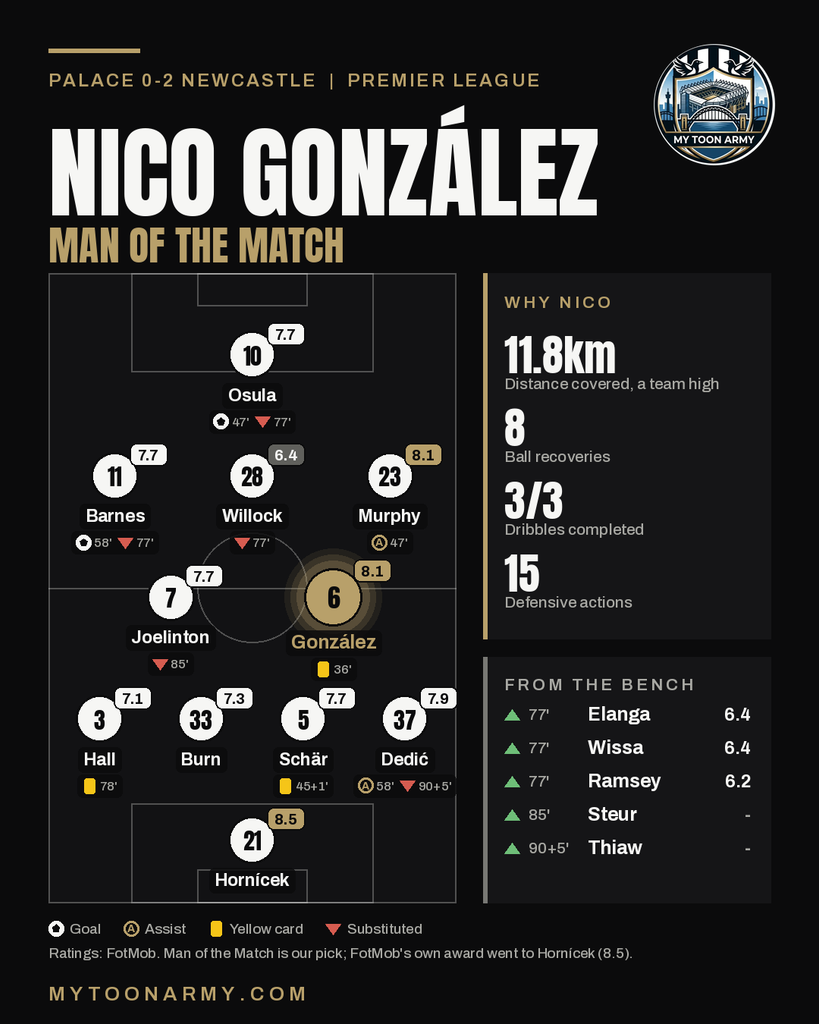
    Nico González finds his feet. For weeks he has looked like a player still arriving. On Sunday he arrived. The Spaniard held the middle of the pitch with a calm that spread outwards: unhurried on the ball, never still off it, and finished with eight recoveries and three dribbles attempted, all three completed. In the way he drifted into pockets and found the pass early, there were moments that recalled Bruno Guimarães.

    He is not quick. When a Palace attacker got past him in the first half, González grabbed what he could, took a yellow card on 36 minutes, and so collected his second booking in as many games after the one against Villa. That is the cost. The return is larger. Jaissle kept picking him through the Villa defeat and said on Friday that he was pleased with his progress, because a run of games was always the route to match fitness. This was the first proper payment on it, and he looks like a man with more to give.

    Burn’s return gives the back line a spine. Dan Burn came back as captain and the defence took his shape. Jaissle left out Sven Botman and Malick Thiaw for him and Fabian Schär, and Burn cleared seven times, five of them with his head. Palace put 17 shots towards the Newcastle goal. Four were on target, two of those in the third-minute scramble, and Horníček saved all four.

    Jaissle adjusts. He said he would change things after Villa and he did: five alterations, a 4-2-3-1 with González and Joelinton paired in front of the defence, and a game plan that dropped the approach behind the defeats at Coventry and against Villa. In both, the front line pushed up near the opposition box and the side stretched from back to front. At Selhurst Park Newcastle squeezed. FotMob’s touch locations put the gap between the defenders’ average position and the forwards’ at 18.5 metres, the tightest of Newcastle’s eight league games and well inside the 22 against Villa and 25.6 at Coventry. The attackers sat about seven metres deeper than in either of those matches, and the side was a little narrower than at any other point this season. Nearly half of Newcastle’s attacks, 49%, came down the left, the highest share of the eight games. Whether it is better football is another matter, but it is a response, and finding one after two defeats is the job.

    Newcastle’s touch maps for the win at Palace and the defeats at Villa, Coventry and Leeds. The bracket marks the distance between the average position of the defenders and the forwards. Source: FotMob touch locations.

    THE BAD

    The centre-halves. Schär and Burn are both 34. They organise well and win headers, and neither has been quick for years. Palace took three shots off the break, at 7, 12 and 85 minutes. None hurt Newcastle, and Palace were caught offside four times, which says the line stepped up and held. It is a gamble all the same, and Arsenal arrive at St James’ Park on 21 November level on points at the top with Manchester City, who follow on Boxing Day. A high line with those legs behind it will not get such an easy afternoon against either of them.

    Murphy and Willock were both poor. Each had one moment worth remembering and very little to put beside it.

    Jacob Murphy’s low, early cross put Newcastle ahead, and it was a lovely piece of work. For long stretches around it he was a spectator in the attack, touching the ball 32 times in 90 minutes, fewer than any other outfield starter bar Osula, and attempting only 14 passes all afternoon. He ran the right flank up and down and covered his full-back without complaint, and nobody doubts the engine. A winger on 14 passes is still not giving a team much.

    Joe Willock had his own moment: Joelinton’s through ball, a clean finish across Walter Benítez in the Palace goal, and a VAR flag for moving a fraction too early. Take that away and the afternoon was thin. He won four of 13 ground duels, completed one of five dribbles, made one tackle and one clearance, and finished with FotMob’s lowest rating of any Newcastle starter, 6.4. He gave little with the ball and little without it. Ramsey and Elanga, who replaced Willock and Barnes at 77, are only just back from injury. As the rest of the squad returns to fitness, the question is how Murphy and Willock fit in, and on this evidence their place may be the bench.

    THE UGLY

    The first half. It was grim. Newcastle managed four shots, every one blocked or off target. Palace, who had taken eight, were unlucky not to be ahead. The ball went sideways, then backwards, then nowhere. Had Mateta finished either of his early chances, Jaissle would have been standing at half-time with a plan in pieces.

    The second half. Something Jaissle said in the dressing room worked inside two minutes. Murphy crossed and Osula finished in the 47th. Willock’s goal went to VAR and came back offside in the 52nd. Barnes made it two in the 58th, finishing from Amar Dedić’s low cross from the overlap. Newcastle had two shots on target all afternoon and scored with both. It was the best half of away football they have played this season, and the competition is not stiff: Newcastle lost 4-1 at both Leeds and Coventry.

    Which raises an awkward question. Palace had played in Istanbul on Thursday night, a 2-2 draw with Beşiktaş in the Europa League, and kicked off roughly 64 hours after the final whistle there. Sage changed nobody. The eleven who started in Turkey were the eleven who started at Selhurst Park, and after the break they looked it. Did fatigue, physical and mental, work against them? Palace played Lyon, Brighton, Beşiktaş and Newcastle in 11 days and won none of the four. They know Thursday nights, having won the Conference League in May for the club’s first European trophy, but that run ended with Oliver Glasner leaving, and Sage may be inheriting a squad still carrying the load. Newcastle know the feeling. Their Champions League campaign last season ran alongside a league campaign that sat mid-table that autumn, and the league is usually where the cost of European football shows up. A 5-0 defeat at Brighton followed by a night in Istanbul is a lot to carry into Selhurst Park, and the second half looked as much like a mental collapse as a physical one.

    WHAT’S NEXT

    Newcastle’s next game is at Everton on Thursday (7.45pm) in the fourth round of the EFL Cup, with the same opponents due at St James’ Park for the league on Monday night. Expect David Moyes to set Everton up in a compact block, as they did in Saturday’s 2-0 defeat at Arsenal, where they defended well for long spells and were undone by a corner and a header. Thierno Barry, their centre-forward, won 11 duels in that game, so the centre-halves face an evening of physical work, and set pieces will matter, since that was where Palace hurt Newcastle in the opening minutes at Selhurst Park. On the line is a place in the last eight, and a first test of whether this tighter shape can create chances against a side that gives away little space.

    Palace are at Fulham in the same competition on Wednesday.