Data Driven Insights. Fearless Opinions.

Premier League

  • Twenty-One Months to a Verdict. How Long Until an Ending?

    Manchester City Justice?

    Manchester City have until Friday to appeal. The League’s own process should take weeks. The courts, and the compensation claims that follow, could take years.

    It took 21 months.

    That is how long an independent commission needed to reach its verdict on Manchester City after the hearing ended in December 2024. The answer was guilty on 114 of the 115 charges.

    So how long until it is actually over? Longer than the appeal. Possibly years longer.

    This piece follows our four-part series on the verdict and what it means for Newcastle. Here we look at one question only: the clock.

    What City were found guilty of

    According to Sky Sports, the commission found that City used “sham” contracts with commercial partners to make their income look bigger and their costs look smaller, by more than £900 million in total.

    It also found the club filed accounts that hid its true finances from auditors and regulators, broke both Premier League and UEFA spending limits, and failed to co-operate with the League’s investigation.

    Two things are still open: the punishment, and when anyone can say the matter is closed.

    Step one: Friday’s deadline

    City have said they will appeal, and the clock is short.

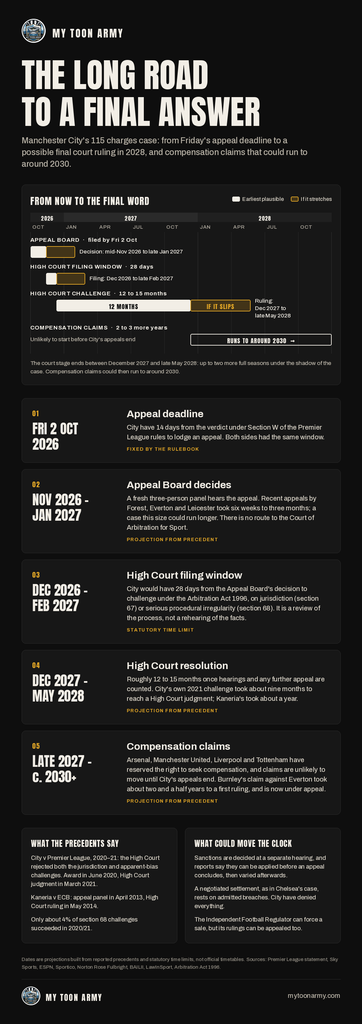
    The Premier League’s rulebook gives each side 14 days from the judgment to appeal. (The relevant part of the rulebook is called Section W.) Sky Sports reports the deadline as Friday 2 October, and other outlets give the same date.

    City’s response has been defiant. The club says it is disappointed and surprised, insists it is innocent, and promises to be “relentless” in any legal forum. Nobody expects it to let the deadline pass.

    Step two: the Appeal Board

    The first appeal stays inside the League’s own system, and it should be quick.

    It goes to a fresh three-person panel. One member must have held judicial office, and that person chairs it. It meets in private. It can uphold the original decision, overturn it, or change it.

    How long will it take? The best guide is recent history. Appeals by Nottingham Forest, Everton and Leicester City took between roughly six weeks and three months.

    City’s case is far bigger, so it is fair to expect the slow end of that range, or longer. Counting from Friday, that points to a decision between mid-November 2026 and late January 2027. That range is this blog’s own projection, built from those earlier cases, not an official timetable.

    One door is already shut. City cannot go to the Court of Arbitration for Sport, where they overturned a two-year UEFA ban in 2020. League rules keep these disputes in England and Wales.

    So the Appeal Board has the last word inside football.

    Step three: the High Court

    It does not have the last word in law.

    City could ask the High Court to step in, but the door opens only a crack. English law treats private arbitration, like the League’s process, as final. The Arbitration Act 1996 guarantees only two ways to challenge it in court:

    • The panel had no power to hear the case. Lawyers at Norton Rose Fulbright think this is highly unlikely to apply here.
    • Something went seriously wrong in how the case was run, and it caused a real injustice. Lawyers call this a “section 68” challenge.

    Either way, a judge would look at how the case was run, not at what City did. There would be no rehearing of the evidence, and nobody would re-argue whether the contracts were shams.

    City would have 28 days from the Appeal Board’s decision to file. On our projection, that means between December 2026 and late February 2027.

    The odds are long. Only about 4 per cent of section 68 challenges succeeded in 2020/21, according to figures cited by the law firm Clifford Chance.

    City know this ground well. In an earlier dispute with the League over its demands for documents, they argued the arbitrators were biased because of how they had been appointed. The High Court rejected that argument in March 2021. A new challenge would be a fresh case, but bias is the obvious argument to try again.

    How long would the High Court take?

    Two earlier cases give us a guide.

    City’s own challenge took about nine months: the tribunal ruled in June 2020, and the High Court judgment came in March 2021. (A Court of Appeal ruling that July dealt only with whether the judgments could be published.)

    In cricket, Danish Kaneria challenged a ruling against him by the England and Wales Cricket Board. The appeal panel ruled in April 2013 and the High Court in May 2014, about a year later.

    So a first High Court judgment tends to take nine months to a year. Allow for a possible further appeal and the sheer size of this case, and 12 to 15 months looks like a sensible window. That is our estimate, not a reported figure.

    Put the stages together:

    • Best case: a final High Court ruling around December 2027.
    • Worst case: late May 2028.

    That is up to two more full seasons played under the shadow of the case. And it assumes City lose at the Appeal Board and then choose to go to court.
    And then come the bills

    None of that counts the compensation claims. They could add years.

    Arsenal, Manchester United, Liverpool and Tottenham sent formal legal notices in November 2024, reserving the right to seek compensation if City were found guilty. Reports say their claims could be worth more than £200 million between them, for lost prize money, Champions League income and commercial revenue.

    Why November 2024? Claims like these generally have to be brought within six years. The clubs feared the clock had started in November 2018, when leaked documents about City’s finances first surfaced, so they acted before it ran out.

    Claims would be heard inside the League’s own arbitration system, as Burnley’s claim against Everton was, rather than in open court. The principle that one club can recover damages from another for breaking the League’s rules is established. Norton Rose Fulbright points back to Sheffield United’s successful claim against West Ham over the Carlos Tevez affair.

    Could other clubs join in? Reports say executives are discussing a joint approach, and clubs could also ask the League to seek redress on their behalf. But clubs that did not act in 2024 may face the argument that they are out of time, though English law can extend deadlines where wrongdoing was deliberately concealed. We have seen no report of a group claim being filed.

    What about Newcastle?

    The right to claim is one thing. Proving the loss is another.

    A club has to show what it actually lost. Manchester United, Liverpool, Arsenal and Tottenham have the clearest cases: titles and Champions League places that went elsewhere.

    Newcastle spent two of the nine seasons in question in the Championship and finished in the top five only once, in 2011/12. On the face of it, that makes a claim much harder to build, even before any argument about time limits. We have seen no report that Newcastle have taken advice on one.

    How long would compensation take?

    The best guide is Burnley against Everton.

    Everton were docked points in November 2023 for breaking financial rules in a single season, and the penalty was cut on appeal in February 2024. Burnley then pursued compensation, arguing that Everton’s breach had cost Burnley their place in the Premier League when they went down in 2022.

    A Premier League commission ruled in Burnley’s favour in June 2026, ordering Everton to pay more than £35 million including interest. Everton say the decision is flawed and are appealing, with a hearing due in January.

    So one club’s claim over one season took about two and a half years from Everton’s original punishment to a first ruling, and it is still not finished.

    City’s case covers nine seasons and more clubs.

    Reports say formal claims are unlikely to move until City’s own appeals are exhausted. If City go all the way to the High Court and the Burnley pattern holds, claims might not get going until late 2027 or 2028, then take another two to three years.

    That points to around 2030, perhaps later.

    What could speed things up, or muddy them

    Three things could change the picture.

    The sanctions hearing. The verdict and the punishment are separate stages. A separate hearing will decide the sanction, and Sky Sports reads the League as wanting that done this season.

    Reports suggest a sanction can be applied before the appeal ends, then changed afterwards. Al Jazeera sets out the dilemma. Punish City early and they could be relegated before they have had a chance to overturn the verdict. Wait, and other clubs could lose their top-flight place or a European spot in the meantime.

    A settlement. Chelsea settled their own case with the League, but only after admitting breaches. City have admitted nothing.

    The new regulator. The Independent Football Regulator has the power to force a club sale and put trustees in charge. Any such decision could itself be challenged. It is a second front, not a shortcut.

    The bottom line

    The verdict took 21 months.

    If City go all the way to the High Court, the League and court stages could run another 14 to 20 months. The compensation claims could take years after that.

    On this reading, we could still be talking about Manchester City’s finances around 2030.
  • The Long Way Round: Patience Was Always an Option

    Newcastle and Manchester City

    This is the final part of My Toon Army’s four-part series on Manchester City’s Premier League charges. Parts One to Three covered the verdict, the seasons and clubs it touched, and why no punishment on the table fits. This part turns to Newcastle United, and to the question City’s case poses for every ambitious club: was there another way?

    Two owners, thirteen years apart, made almost exactly the same promise.

    The first came in an open letter to City supporters as Sheikh Mansour’s takeover was completed in September 2008. The new owner said he was ambitious for the club, “but not unreasonably so”, and that building a team able to hold a top-four place and win in Europe would take time.

    The second is what Yasir Al-Rumayyan, governor of Saudi Arabia’s Public Investment Fund (PIF) and Newcastle’s chairman, has said in various forms since the October 2021 takeover, most recently at the FII Priority Summit in Rome: PIF is “a long-term patient investor.”

    Patient. Reasonable. Long-term. Both owners said it in public. Only one has kept to it.

    Behind Mansour’s letter, City were running a much faster clock. The National noted at the time that the letter played down earlier talk of major trophies within three years. When the title arrived in 2012, the Mail & Guardian reported that Abu Dhabi’s targets had included winning the Premier League in year four. City hit it in the 94th minute of the final game of that fourth season, through Sergio Agüero’s goal against Queens Park Rangers.

    Newcastle’s story runs the other way. Nearly five years into PIF’s ownership, the trophy cabinet holds one League Cup, won in March 2025 and the club’s first major trophy in 56 years, alongside a return to the Champions League. That is not a revolution. It is what a patient timetable looks like, and nobody has accused the club of hiding anything to get there.

    City’s defence: there was no other way in

    In August 2021, days after City broke the British transfer record to sign Jack Grealish, Pep Guardiola made City’s case in its plainest form. Manchester United and Arsenal, he argued, had won titles years earlier because they outspent everyone else, and City could only compete once they had owners who, in his words, “want to be in this world, they want to buy into football. What is the problem?”

    Call it the Red Cartel argument. The old red clubs, United, Liverpool and Arsenal, had decades of history and revenue stacked in their favour, and the only way to break in quickly was to outspend them. In the same breath, Guardiola added a line that has aged badly: “If we are wrong then OK, convict us.” Five years on, a commission has.

    Why the excuse doesn’t hold

    The trouble with the argument is the timeline. In City’s early years, outspending the old order broke no rule, because there were no spending rules to break. UEFA approved Financial Fair Play in 2009 and only began monitoring clubs in 2011-12. The Premier League’s Profit and Sustainability Rules (PSR), which cap how much a club can lose, arrived in 2013.

    City, meanwhile, moved fast. The takeover was agreed on 1 September 2008, the same day Robinho signed for £32.5 million. The spending that built the team, Robinho, then Tévez, Adebayor and Barry, then Silva, Yaya Touré and Balotelli, then Agüero, ran from 2008 to 2011. The first title came in May 2012. City broke into the elite almost entirely before any spending limit existed.

    So City didn’t need to cheat to get in. On the commission’s findings, they did anyway. The charge sheet starts in 2009-10, with rules on accurate accounts and on disclosing players’ and managers’ pay that already applied, and carries on through the Financial Fair Play and PSR breaches once the spending limits arrived. UEFA sanctioned City under Financial Fair Play in 2014. On the commission’s findings, the breaches ran on for another four seasons.

    Newcastle never had that head start. PSR was eight years old when PIF arrived, and within three years the League had docked Everton and Nottingham Forest points under it. New rules on deals with companies linked to a club’s owners, widely seen as a response to Newcastle’s takeover, followed within about two months. There was no unregulated window for Newcastle to exploit, even had it wanted one.

    What patience costs

    In the last days of June 2024, Newcastle sold academy graduate Elliot Anderson to Nottingham Forest and winger Yankuba Minteh to Brighton, for around £65 million combined, to stay inside PSR before the 30 June accounting deadline. Anderson was a boyhood Newcastle supporter Eddie Howe rated highly. Minteh had been signed for about £7 million a year earlier and had just had a breakout season on loan at Feyenoord. Reporting at the time described the club as reluctant to sell either. It sold anyway. As Part Three noted, those sales left Newcastle narrowly clear of a possible sanction.

    That is the difference in a single transfer window. Under financial pressure, City, on the commission’s findings, made their accounts say something untrue. Newcastle sold two players it wanted to keep.

    Nor does the patient route require a state-backed owner. According to one analysis, Liverpool’s net transfer spend from 2014 to 2024 under Fenway Sports Group was £304 million, seventeenth-highest in world football. That is spending minus sales, and the sales were the point. Philippe Coutinho arrived from Inter for £8.5 million and left for Barcelona for a reported £142 million, in the same window Liverpool paid £75 million for Virgil van Dijk. Buy well, sell at a premium, reinvest. In that decade Liverpool won the Premier League, the Champions League and six other trophies. Brighton run the same model on a smaller scale: Moisés Caicedo cost them a small fraction of the £115 million Chelsea later paid for him, and the money went back into a recruitment operation that keeps finding the next one. Patience isn’t a consolation prize for clubs that can’t afford to cheat. It’s a proven route to the top.

    Cheaters never prosper, even when they get there first

    City got there first. In the nine seasons under scrutiny they won eight trophies: three Premier League titles, an FA Cup, three League Cups and a Community Shield. On the commission’s findings, the accounts behind those years did not tell the truth, and reports say the panel found City acted in bad faith. Newcastle waited until their fourth season under PIF for one League Cup, and nothing guarantees more silverware soon.

    But winning something and being able to stand behind it are different things. While the verdict stands, City’s trophies from those years carry an asterisk. Newcastle’s League Cup carries none. It took 56 years and a summer of selling players the club wanted to keep, and every part of it is theirs. Doing it right takes longer. It’s also the one version of success that never has to fear the day someone checks the books.

    This concludes the four-part My Toon Army series on Manchester City’s 115 charges. Thank you for reading.

  • Justice, Theoretically: Why No Punishment Fits What Manchester City Did

    Justice on Man City

    This is Part Three of a four-part My Toon Army series on Manchester City’s Premier League charges and what the whole saga means for Newcastle United’s own position under Saudi ownership. Part One covered the verdict and the appeal to come; Part Two traced the seasons, the signings and the clubs now counting the cost.

    According to a Guardian report picked up widely after the verdict, the independent commission did not simply find Manchester City guilty of 114 breaches. It found the club had acted in bad faith. Two words, and they matter more than they look. Bad faith is not a filing error or an honest dispute over accounting standards. It is a panel of three people, after working through what is reported to be roughly half a million pages of evidence, concluding that Manchester City knew exactly what it was doing.

    And yet, days after that finding became public, nobody, including the people paid to know, can tell you what happens to City now. Not the size of the fine, not the number of points, not even the shape of the punishment. Part One explained why the appeal could drag deep into this season. This piece is about something else: even if the appeal were settled tomorrow, there may be no punishment on the shelf that actually fits what the commission found.

    The toolkit

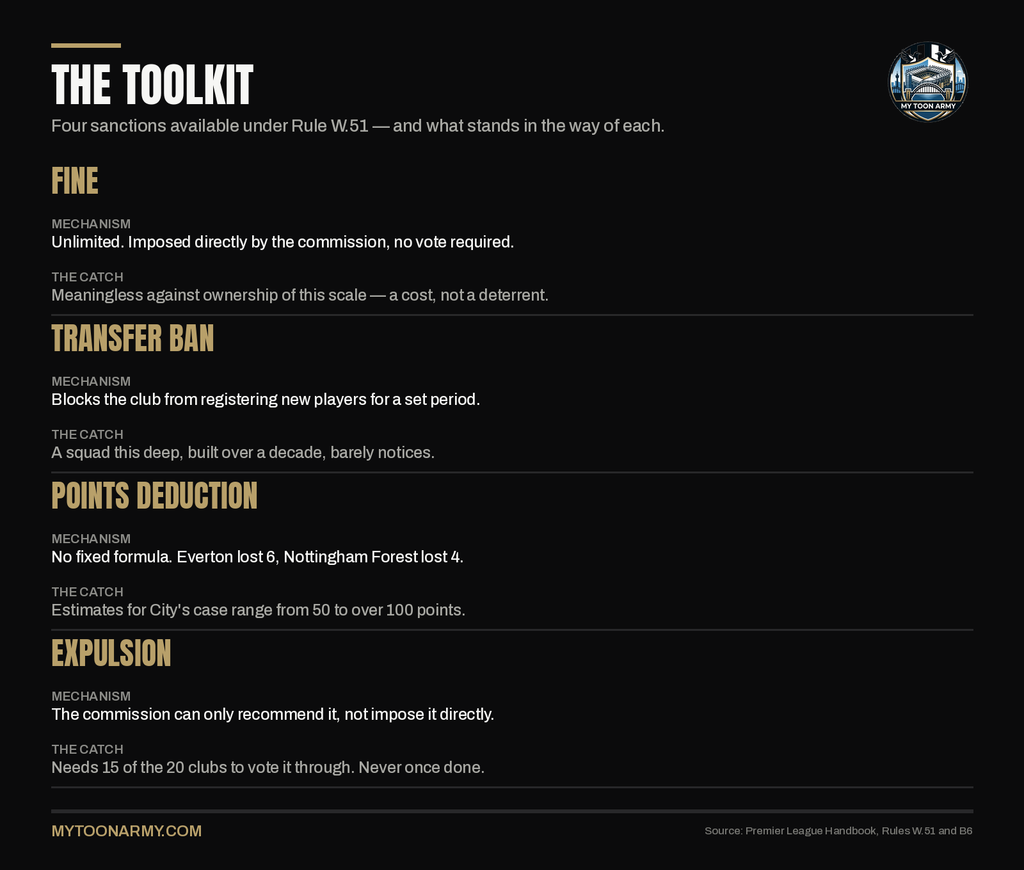
    The commission’s powers come from Rule W.51, the part of the Premier League Handbook that deals with disciplinary sanctions. It can impose an unlimited fine, deduct points, and recommend that a club be expelled. Ian Hargreaves, a partner at the disputes firm Quillon Law, summed up the range for Al Jazeera: a transfer ban at the moderate end of the spectrum, expulsion at the most severe. Fines and points deductions sit in between, and none of these options excludes the others. As sports barrister Yasin Patel has pointed out, a single ruling could combine a major fine, a points deduction and other sporting measures.

    What the rulebook does not contain is a tariff: no sentencing guideline, no points-per-charge formula. That absence is deliberate. Clubs chose not to set fixed penalties for financial breaches, fearing that a published price list would let a wealthy club simply budget for the punishment and treat it as a cost of doing business. Chief executive Richard Masters said in February 2025 that the League was exploring a “Sanctions Grid” of agreed penalties. It has not arrived in time for the biggest case in the competition’s history. Every option below is, to some degree, a guess dressed up as a precedent.

    Money means nothing here

    Start with the fine, because it can be dismissed fastest. City are owned by the Abu Dhabi United Group, the investment vehicle of Sheikh Mansour bin Zayed Al Nahyan, vice-president of the United Arab Emirates and a senior member of Abu Dhabi’s ruling family. Against wealth on that scale, any fine the Premier League could realistically impose is a rounding error rather than a deterrent. The only financial route with real teeth is the set of civil compensation claims being assembled by Arsenal, Liverpool, Manchester United and Tottenham, covered in Part Two, and even those would compensate specific wronged clubs rather than act as a punishment from the League itself.

    The points deduction nobody can actually calculate

    This is where the real disagreement lives. The benchmark cases are Everton and Nottingham Forest, both punished for breaching the Profit and Sustainability Rules (PSR), which cap how much a club can lose over a rolling three-year period. Everton’s first penalty was ten points, cut to six on appeal; Forest lost four. Each case covered a single three-year assessment period. City’s covers nine seasons and five categories of rules. Football finance expert Kieran Maguire’s phrase for scaling up is blunt: “you have to add a zero.”

    Since the verdict, the estimates have hardened. Maguire and fellow analyst Stefan Borson have floated deductions of 60 to 100 points, enough to relegate City almost regardless of how they play. Former Everton chief executive Keith Wyness told Football Insider he expects a 50-point deduction “to ensure relegation in some way”, arguing that with guilt found across virtually every area of the case, “it will be very hard to appeal on facts.”

    Others are more cautious. Dan Plumley, a sports finance academic, told Goal that a points deduction plus a fine is the most likely outcome, with relegation and title-stripping “the extreme, but unlikely, scenarios”. From a modest deduction to a table-bottom collapse, the spread of informed opinion shows how little precedent exists for a case of this size.

    There is one real data point at the lenient end. After Chelsea’s 2022 takeover, the new owners self-reported undisclosed payments made between 2011 and 2018 under Roman Abramovich. In March this year, Chelsea were fined £10.75 million and handed a suspended transfer ban, one that only takes effect if the club reoffends, with no points deduction at all. The fine was halved from £20 million, and the League explicitly credited Chelsea’s “proactive self-reporting” and “exceptional co-operation.” It also noted that Chelsea’s breaches, even if declared properly, would not have taken the club over its spending limits. City’s charge sheet includes 35 counts of doing the opposite of cooperating, over four years. If the system rewards clubs that come clean and punishes those that fight, City’s decision to contest everything may prove to be the costliest choice of the entire saga.

    Transfer bans: moderate on paper, toothless in practice

    A transfer ban, which stops a club registering new players for a set period, sounds severe but would cost City remarkably little. The squad was built over more than a decade of the spending the commission has now found breached the rules, it is young, with an average age of around 25, and it is deep enough to lose several players to rival clubs without collapsing. Behind it sit a productive academy and the scouting network of City Football Group’s sister clubs around the world. A transfer ban hurts a club that needs to rebuild. City’s squad was built long ago.

    Expulsion: the button nobody can actually press

    For many supporters of other clubs, expulsion is the only proportionate response to rule-breaking on this scale. It is also the option furthest from happening. The commission can only recommend it. Actually removing a club requires a Special Resolution under Rule B6 of the Handbook: 15 of the 20 Premier League clubs must vote in favour. No club has ever been expelled, and this time three-quarters of the division would have to vote to remove one of the competition’s biggest commercial draws.

    Opinion among the clubs was already split before the verdict. According to Goal, some were prepared to push for an outright expulsion, while others worried the delay was causing “undue damage to the Premier League” and wanted a resolution that let everyone move on. Relying on 15 clubs to set aside their own commercial interests is, at best, a coin flip.

    Even if the vote passed, there is a second problem: nobody knows where City would go. The English Football League (EFL), which runs the three professional divisions below the Premier League, would be under no obligation to accept an expelled City, according to The Telegraph. The EFL is also capped at 72 clubs, with no spare place for a 73rd. And because entry to the FA Cup and League Cup is tied to league membership, City could in theory lose those too.

    The doomsday scenario. Over the weekend, the picture darkened further. Journalist Ben Jacobs reported that if City are expelled, the EFL is not merely entitled to refuse them but is reportedly prepared to, standing in solidarity with the Premier League and keeping City out of the Championship, League One and League Two alike. Follow that to its end and one of the most expensively assembled squads in world football would have nowhere left to go but non-league football, outside the top four tiers of the English game.

    Nobody seriously expects that to play out as written. Enzo Maresca and a squad of full internationals do not report for pre-season in the National League. The realistic outcome is an immediate exodus of players and staff, leaving the owners with a stadium, a badge and very little else.

    The scenario also revives a question football thought it had closed. The European Super League, relaunched as the “Unify League,” was finally abandoned in February 2026, when Real Madrid, its last backer, reached an agreement with UEFA. But the legal ground beneath it has not moved. In December 2023, the European Court of Justice ruled that UEFA and FIFA had abused a dominant position in blocking rival competitions, though UEFA insists its rules have since been brought into line. A City locked out of English football would have a motive no founding Super League club ever had. Real Madrid wanted a richer competition alongside a healthy domestic league. A leagueless City would need somewhere, anywhere, to play, with Abu Dhabi money behind it. It is not hard to imagine its owners concluding that bankrolling a breakaway competition beats a National League fixture list.

    That is precisely why the more measured voices treat the doomsday scenario as a reason expulsion won’t happen, not evidence that it might. Former City midfielder Dietmar Hamann argues the Premier League has no interest in engineering the collapse of one of its biggest draws, because a competition needs more than three or four clubs capable of winning it. Clubs voting to expel City would not just be removing a rival. They would be gambling with the value of their own product, with no guarantee the wreckage lands anywhere useful.

    Where the real teeth are

    None of that makes a severe outcome impossible. It simply moves the teeth elsewhere. A points deduction large enough to leave City bottom of the table avoids both of expulsion’s problems. The commission can impose it alone, without a single club’s vote. And relegation, once it happens, is automatic. A standing “tripartite agreement” between the Premier League, the EFL and the Football Association guarantees that the bottom three Premier League clubs go down and the top three Championship clubs come up every season. When the Premier League floated suspending relegation during the pandemic, EFL chairman Rick Parry warned that doing so would breach that agreement and get “very messy”. City would drop into the Championship like any other relegated club, complete with the “parachute payments” the League pays relegated clubs to soften the financial fall.

    The most effective sanction, then, is not the most dramatic one. It is the one the commission can impose entirely on its own, with a guaranteed place for City to land.

    What history says happens next

    Play that forward: City relegated by a points deduction. What happens to a financially untouched giant dropped down a division is not the clean morality tale either side assumes.

    The closest precedent is Juventus. Calciopoli, the Italian referee-rigging scandal that broke in 2006 (its name is wordplay on “calcio,” Italian for football), saw Juventus stripped of two Serie A titles and relegated to Serie B, Italy’s second tier, for the first time in their history, starting the season with a nine-point deduction. Their wealth and ownership were untouched, and they won Serie B comfortably, returning to Serie A after a single season. But the football did not snap back with the finances. Ibrahimović, Vieira, Thuram and Cannavaro all left once relegation was confirmed, and Juventus spent the next few years cycling through coaches, finishing as low as seventh. Real dominance returned only with Antonio Conte in 2011-12, the start of nine consecutive titles. The money survived the drop. The football took half a decade to catch up.

    The counter-precedents are bleaker. Rangers’ 2012 liquidation sent them to Scotland’s fourth tier. That was genuine financial collapse rather than a punishment on top of intact wealth, but it took them four years to reach the top flight again and nine to win another title, while Celtic won nine in a row. Leeds United, Champions League semi-finalists in 2001, took sixteen years, three of them in the third tier, to return to the Premier League. Retained money does not guarantee a quick recovery. Lost money can keep a club out for a generation.

    The trophy question

    Calciopoli offers one more contrast. Italy’s federation had, and used, the power to strip Juventus of titles and hand one to Inter Milan. The Premier League’s rules set out no equivalent. Some reporting has raised the possibility that sanctions could reach back to City’s trophies, but nothing has been decided, and title-stripping is not an automatic consequence of a guilty verdict under the League’s published framework. The most emotionally satisfying punishment on anyone’s list, taking the eight trophies detailed in Part Two and handing them to the runners-up, may not be a lever the commission has been given.

    A proposal of our own

    Every option above treats City’s offence as a single event deserving a single sanction. It wasn’t. It ran for nine years, and a proportionate punishment would reflect that: a points deduction now, severe enough to guarantee relegation this season, followed by a pre-set penalty of around 30 points and a ban from cup competitions in each of City’s first two or three seasons back in the Premier League, closing any route into Europe for the length of the sentence. It is the only idea in this piece that matches the duration of the offence, rather than compressing nine years of rule-breaking into a single afternoon’s verdict.

    It is also almost certainly unworkable as things stand. The rules do not allow a commission to pre-sentence seasons that haven’t happened yet, against a squad and management that will have changed by the time the penalty bites. That hands City’s lawyers a ready-made argument that the sanction is disproportionate. It would need a rule change rather than a ruling, and rule changes need a two-thirds majority of the same self-interested clubs, voting to weaken their own competition for years at a stretch. It is more honest about the scale of the offence than anything on the table. For now, the rulebook has no room for it.

    The problem no punishment solves

    Line the options up and the pattern is clear. A fine means nothing to an owner of this wealth. A transfer ban barely dents a squad this deep. Expulsion needs 15 self-interested votes and may have nowhere to send City even if it gets them. The one sanction that avoids both problems, a relegation-sized points deduction, drops the same financial machine, largely intact, into a division of clubs who would then have to survive it. Title-stripping may not be available at all.

    These are not failures of imagination. They are what happens when a regulatory system built for ordinary financial misconduct is pointed, for the first time, at an owner with the resources of a state. The inequality between clubs was the water English football swam in long before City were found to have exploited it further. Caroline Dinenage, chair of Parliament’s Culture, Media and Sport Committee, said as much after the verdict, warning that the affair raises fresh questions about financial fairness across the football pyramid. No sanction handed down by a three-person panel can make the last nine years fair. It can only choose which unfairness comes next, and who bears it.

    That question is not academic for every club watching. Tucked into the same Al Jazeera report was a line about another club entirely: Newcastle United “narrowly avoided potential sanctions” after selling players before a June 2024 reporting deadline to stay within the spending rules. The rulebook that has just caught Manchester City has already brushed against the next state-backed ownership in the competition.

    Part Four turns to exactly that: what this verdict, and the regulatory machinery built partly because of it, means for Newcastle United under Saudi ownership. It follows tomorrow.

  • The Receipts: Nine Seasons, Eight Trophies, and the Clubs Left to Count the Cost

    Part 2: The Impact

    This is Part Two of a four-part My Toon Army series on Manchester City’s Premier League charges and what the whole saga means for Newcastle United’s own position under Saudi ownership. Part One covered the verdict itself and the appeal to come.

    On 27 April 2014, Steven Gerrard’s studs went from under him on the Anfield turf, Demba Ba ran clear to score, and a Liverpool title challenge that had carried the whole city began to come apart. A fortnight later, Manchester City were champions by two points. On the findings of the independent commission that has just ruled on City’s Premier League charges, that title race, like two others inside the same nine seasons, was not run on equal terms.

    A verdict on paper cannot capture that part. These were nine seasons that actually happened, watched by millions and decided by real goals and real slips, and an independent panel has now found they were played out inside a financial system built on 114 upheld breaches. This is about what those accounts bought.

    The empire, season by season

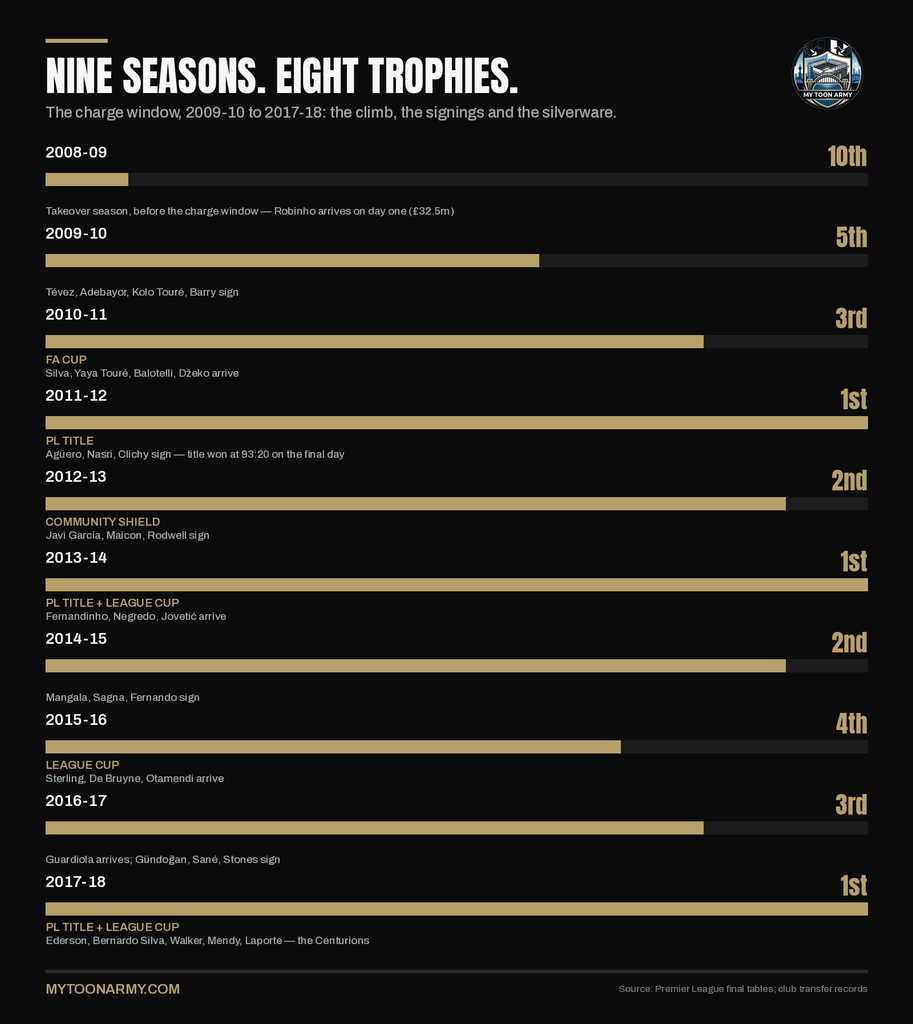
    City finished 10th in the season the Abu Dhabi United Group’s takeover went through, having spent £32.5 million on Robinho on the very day the deal closed. That signing set the pattern for the next decade: money first, results following close behind. They climbed to fifth the next season after bringing in Carlos Tévez, Emmanuel Adebayor and Gareth Barry, and swapped Mark Hughes for Roberto Mancini that December. By 2010-11 David Silva, Yaya Touré and Mario Balotelli were in the building, City finished third, and they won the FA Cup, their first trophy in 35 years.

    Then came the acceleration. Sergio Agüero arrived in 2011, and 93 minutes and 20 seconds into the final day of 2011-12 he scored the goal that won City their first Premier League title, level on points with Manchester United and ahead only on goal difference. Fernandinho and Álvaro Negredo followed in 2013, and Manuel Pellegrini’s side won the league and League Cup double. Kevin De Bruyne and Raheem Sterling arrived in 2015, bringing another League Cup and a first Champions League semi-final. Pep Guardiola took over in 2016, and by 2017-18, with Ederson, Bernardo Silva, Kyle Walker and Benjamin Mendy freshly signed, City became the first side in English top-flight history to reach 100 points, winning the league and League Cup once more.

    Here is the full climb, set against what arrived each summer:

    Eight trophies from nine seasons: three Premier League titles, an FA Cup, three League Cups and a Community Shield. On the commission’s findings, every one of them was won while the club’s accounts were not telling the truth about where its money came from.

    Who actually lost

    Every trophy City lifted had a runner-up. In the three title races, Manchester United finished second twice, beaten on goal difference in 2011-12 and by 19 points in 2017-18, and Liverpool once, two points short in 2013-14. Stoke City lost the 2011 FA Cup final 1-0. Sunderland, Liverpool and Arsenal lost League Cup finals to City in 2014, 2016 and 2018, and Chelsea lost the 2012 Community Shield.

    None of that is trivia. Under the Premier League’s merit payment system, each place in the final table was worth around £2.8 million in 2023-24, and that is before Champions League qualification, which adds tens of millions more in prize money, broadcast exposure and matchday revenue. Losing a title race to a club found to have broken the rules for nine straight years is not only a wound to pride. It is a financial injury that can be measured, and the clubs on the wrong end of it have started measuring.

    To be clear about what that does and does not mean: nobody can prove that a specific pound of disguised sponsorship bought a specific goal. There is no way to replay 2013-14 with City’s books clean and show Liverpool lifting the trophy instead, and no single moment across those nine seasons can be pinned to a line in a balance sheet. What the economics of the game show is blunter, and in some ways more damning. The long-running research of Stefan Szymanski and Simon Kuper found that relative wage spending explains around 90 per cent of the variation in English league position over time. Money does not buy a particular result. It shifts the odds of an entire era. For nine seasons City operated with financial firepower the commission says was inflated by rule-breaking, in a league where firepower is already the best predictor of who finishes where. The charge was never that fraud won any one match. It is that fraud tilted the table beneath all of them.

    The bill being drawn up

    The clubs worked this out long before the verdict. By November 2024, almost two years before Friday’s news, Arsenal, Manchester United, Liverpool and Tottenham had all lodged legal notices reserving the right to claim compensation from City, with Arsenal reportedly the first to move. The timing was not sentimental. Their lawyers feared the six-year limitation period might run from November 2018, when Der Spiegel’s reporting first triggered the investigation, and expire long before any verdict arrived. Waiting for justice risked forfeiting the right to be compensated for its absence.

    Since Friday, that groundwork has started to move. According to The Athletic, several clubs have instructed leading lawyers to assess their damages, with talks reportedly under way on a coordinated approach. Sources quoted by The Independent suggest a successful claim could be worth more than £200 million to some individual clubs, while Liverpool’s claim, built on lost income from lower finishes and the knock-on effect on Champions League qualification, has been put at around £100 million.

    Those figures are not fantasy, because the route has already been tested. Burnley, relegated in 2021-22, sued Everton over the PSR breach from that same season, arguing that had Everton’s six-point penalty been applied at the time, Burnley would have stayed up instead. In June, a Premier League commission agreed, and ordered Everton to pay £26 million plus interest, a bill that could approach £40 million. Everton have appealed, calling the ruling a dangerous precedent.

    The Burnley case matters for a reason that goes beyond the money. The commission did not have to prove that Everton’s overspending produced a particular goal. It accepted a simpler counterfactual: apply the sanction to the table in the season it belonged to, and see who ends up where. That is precisely the argument City’s rivals will make. It will still be a far harder fight at this scale, with nine seasons, several title races and a club that will contest every step, and nothing can begin until City’s appeal has run its course.

    None of this softens what Part One established. It sharpens it. This was not nine seasons of City being brilliant while everyone else was merely good. On the commission’s findings, it was nine seasons in which the margins, whether a point here, a slip there or a Champions League place worth tens of millions, were decided on a pitch that was not level – City’s spending beyond the rules distorted the competition. The clubs who lost by those margins are now adding up exactly what it cost them.

    Part Three turns to the punishment nobody can agree on — why fines, points deductions and even expulsion all struggle to fit a case this size, and why the underlying problem might not be fixable at all. It follows tomorrow.

  • Guilty: The Decade of Deceit Behind Manchester City’s Empire

    Man City: The Verdict

    This is Part One of a four-part My Toon Army series on Manchester City’s Premier League charges and what the whole saga means for Newcastle United’s own position under Saudi ownership.

    On Thursday, in a Premier League shareholders’ meeting, the division’s clubs were told the outcome of the biggest disciplinary case English football has ever heard — and then made to sign non-disclosure agreements. The silence held for barely a day. On Friday, David Ornstein of The Athletic reported what those executives had been told: an independent commission had found Manchester City guilty on 114 of the 115 charges brought against them.

    Say it plainly. For nine consecutive seasons, the commission found, Manchester City’s accounts did not tell the truth. And when the Premier League came asking questions, City spent the best part of four years refusing to help it find the answers. This was not a clerical slip or a misread rulebook. It was a system, and it ran for a decade.

    No sanction has yet been decided, City are expected to appeal, and the League itself has published nothing, citing a confidential process. But City’s response told its own story. According to ESPN, the club refused to deny the reports when approached, and its statement insisted it had respected due process for eight years on the basis that the League would act as a fair-minded regulator “free from partisan influence.” Even with 114 findings against them, City were still questioning the referee.

    Meanwhile, the club found guilty of building its empire on false accounts sits top of the Premier League, five wins from five under Enzo Maresca. The dividends of those nine seasons are still being paid out every weekend.

    What the emails said

    The paper trail begins in November 2018, when the German magazine Der Spiegel published a series built on hacked internal City correspondence from the Football Leaks archive. Its reporting described backdated contracts, illusory sponsorship payments and a “we can do what we want” culture at the top of the club.

    The detail was specific enough to follow the money. City’s Etihad deal was said to be worth £67.5 million a year, but according to an internal email from the club’s chief financial officer, Jorge Chumillas, £59.9 million of it was channelled back through the owner’s holding company, the Abu Dhabi United Group. Another email reportedly flagged a £9.9 million Financial Fair Play shortfall after Roberto Mancini’s sacking in 2013, and proposed plugging it with extra Abu Dhabi sponsorship. City, the Associated Press noted at the time, did not dispute the authenticity of any of the emails.

    The first escape

    UEFA moved first. In February 2020 it banned City from the Champions League for two seasons and fined them €30 million. City took the case to the Court of Arbitration for Sport, and that July the ban was overturned. CAS ruled that most of UEFA’s allegations were either not established on the evidence before it or time-barred under UEFA’s five-year limit.

    City called it vindication. Read the ruling, though, and the picture is less flattering. CAS still fined the club €10 million, citing City’s disregard for the duty to cooperate and its “obstruction of the investigations.” Remember that word. It comes back.

    Nor was 2020 City’s first brush with European regulators. In 2014, UEFA had already sanctioned them for FFP breaches, with a €60 million fine, a spending cap and a trimmed Champions League squad. By the time the Premier League case began, City had been punished once for breaking Europe’s spending rules and once for obstructing the people enforcing them.

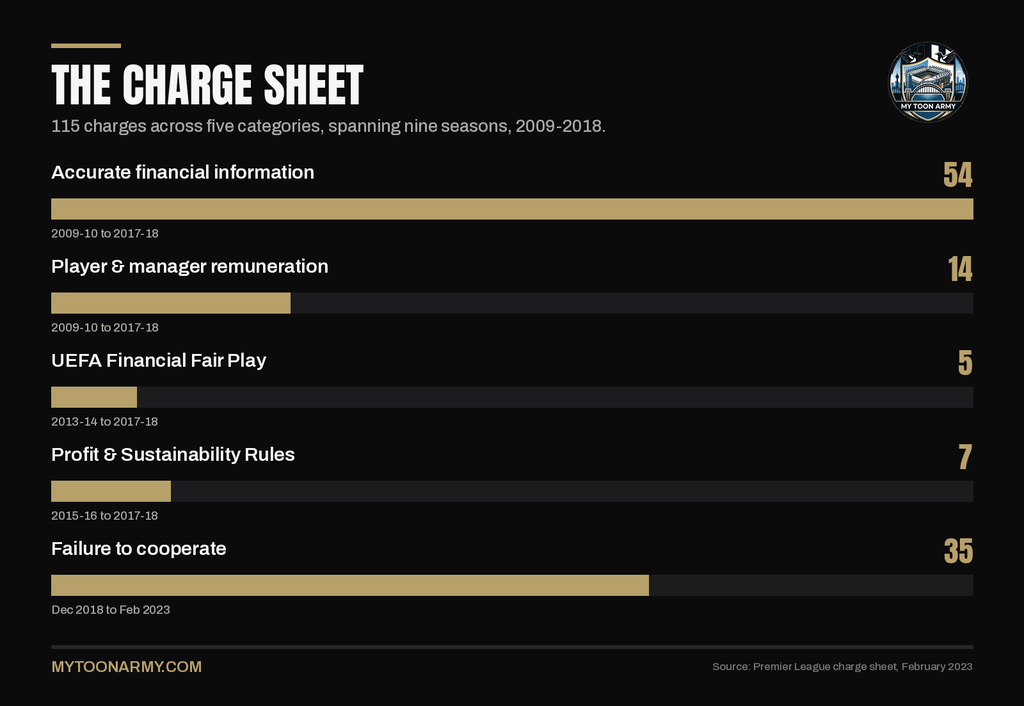
    The Premier League’s rules carry no five-year limit, and this time there was no clock to run down. The League opened its investigation in December 2018, and after more than four years of forensic accounting work, City were charged in February 2023 over a pattern stretching across nine seasons, from 2009-10 to 2017-18. That window covers the entire arc of City’s transformation from mid-table also-rans into the dominant force in English football.

    The charge sheet breaks into five categories, and the anatomy of it is easier to take in at a glance than in a paragraph of numbers:

    Look at the last bar. Thirty-five charges, close to a third of the case, have nothing to do with what City’s accounts said. They concern how the club behaved once it knew investigators were looking, from December 2018 onwards. While CAS was fining City for obstructing UEFA, the Premier League says the same conduct was happening on home soil, and it carried on for years afterwards. That is not a club caught out by complexity. It is a club that decided, again and again, that the regulators should not see what was in the books.

    The trial and the wait

    The hearing finally opened in September 2024, before a three-person independent commission, and ran for roughly twelve weeks until December. Back in February 2023, the club had promised the commission a “comprehensive body of irrefutable evidence.” Of 115 charges, it has seemingly persuaded the panel on one.

    Then came the wait. Early forecasts pointed to a verdict in the first months of 2025. It slipped to the summer, then past the start of 2025-26 altogether. Twenty-one months passed between closing arguments and Friday’s report.

    Delay in a case like this is never neutral, and it only ever benefits one side. Since being charged in February 2023, City have added two more league titles and a Champions League to their honours, signed fresh sponsorship deals, and sold their success around the world, all under a status the commission has now found was built on rule-breaking.

    What the commission can actually do

    Here the story becomes less satisfying, not more. There is no published formula linking a number of upheld charges to a set punishment. Under Rule W.51, the commission can impose an unlimited fine, deduct points, and recommend that City be expelled. The operative word is “recommend.” The commission cannot throw City out on its own authority.

    Expulsion runs through Rule B6 of the Premier League Handbook, which requires a Special Resolution, with 15 of the 20 clubs voting in favour. No club has ever been expelled from the Premier League. For it to happen here, three-quarters of the division would have to vote to remove one of its biggest broadcast draws. The clubs City cheated out of titles and prize money would, in effect, be asked to damage their own product to punish the club that wronged them. It would be brave to bet on that.

    Nor is title-stripping written into the rulebook as a sanction. Some reporting has raised the prospect that retrospective punishments could reach back to the trophies themselves, but nothing of the sort has been decided. Unless that changes, City keep everything they won inside the charge window: three Premier League titles, an FA Cup and three League Cups, plus the 2012 Community Shield. Eight trophies from nine seasons that an independent panel has now found were not played on equal terms.

    The appeal that could take just as long

    City have 14 days from the ruling to lodge an appeal. It would be heard by a fresh three-person appeal board, appointed by the independent chair of the Premier League’s Judicial Panel and separate from the commission that has just ruled.

    One exit is sealed this time. Unlike 2020, there is no route to the Court of Arbitration for Sport. This is a domestic Premier League arbitration, and an appeal board’s decision is effectively final, open to challenge in the ordinary courts only on narrow procedural grounds rather than on the merits. City cannot escape on a technicality in Lausanne a second time.

    How long the appeal will take is the honest unknown, and the usual comparisons undersell the difference. Everton’s 10-point deduction, handed down on 17 November 2023, was cut to six on appeal on 26 February 2024 — a little over three months. Nottingham Forest’s four-point deduction was appealed and dismissed inside about seven weeks. Both moved fast for the same reason: both clubs admitted their breach and appealed only the size of the punishment. There was no dispute left to relitigate, only a number to argue over.

    City have never conceded a single one of the 115 charges, and nothing in Friday’s reporting suggests that’s about to change. An appeal that only argues sanction is a different exercise, and a much shorter one, than an appeal that continues to deny the underlying findings themselves. Richard Masters, the Premier League’s own chief executive, told a parliamentary committee that City’s case was being heard in what he called “a completely different environment” to Everton’s and Forest’s, precisely because of the volume and character of the charges. Add City’s case spanning 114 upheld charges, five categories of rules and nine seasons of evidence, and scaling Everton’s three months up to something of this size is guesswork, not arithmetic. A final answer before the second half of the season looks optimistic, and every week of waiting is another week City play on at the top of the table.

    That is the part that must not get lost beneath the procedure and the legal chess. The titles, the cups, and the climb from a club that played in English football’s third tier as recently as 1998-99 to the most commercially powerful institution in the country did not happen in spite of what the commission says went on between 2009 and 2018. On the panel’s own findings, a meaningful part of it happened because of it.

    Eight trophies, nine seasons, one guilty verdict. Every medal from that decade now carries a question City’s lawyers cannot make disappear, however long the appeal takes.

    Part Two follows the receipts: the seasons, the signings, the results, and the clubs now counting what those nine years cost them. It follows tomorrow.