On the day PIF bought the club, one of its new co-owners asked supporters to be patient. Five years later, patience looks less like a plea and more like a strategy.
Newcastle lost 2–1 at Wolves on 2 October 2021. Five days later, nobody on Tyneside was talking about it.
On 7 October, the Premier League confirmed that the club had been sold to a consortium led by Saudi Arabia’s Public Investment Fund (PIF), the state’s sovereign wealth fund. Mike Ashley’s 14-year ownership was over. The reported price was about £305m, roughly twice what the club earned in a year.
Supporters celebrated. A Newcastle United Supporters’ Trust survey days earlier had found 93.8% in favour.
Hours after the deal, Amanda Staveley, then a co-owner, promised investment at every level. She also asked for patience.
It was a strange request to make of a fanbase that had waited since 1955 for a domestic trophy. It turned out to be the whole story.
A club left to rot
Patience was needed because of what the new owners had bought.
Ashley took over in 2007 and spent much of the next 14 years trying, on and off, to sell. Relegations came in 2009 and 2016. Turnover was £129.7m in 2014-15. By 2021 it had reached only about £140m.
The training ground at Benton told the story in bricks. It opened in 2002, and Sir Bobby Robson described it with pride as state-of-the-art. Under Ashley it received little more than a coat of paint. After the takeover, the club’s own planning application admitted its facilities fell “significantly below the Premier League and perhaps even Championship standards”. Staveley later called the place a joke.
St James’ Park carried Sports Direct advertising. The trophy drought ran back to 1955. The Champions League was a distant memory.
So the mood on 7 October was less triumph than relief. For 14 years, supporters had wondered whether anyone at the top was trying. Now somebody was, and with resources no Newcastle owner had ever had.
Hope arrived with a shopping list.
Steve Bruce left on 20 October. Eddie Howe arrived on 8 November. In January 2022 came Bruno Guimarães, Kieran Trippier and Dan Burn, with Matt Targett on loan. Across 2022, Newcastle collected 38 points, a total that only three teams in the division bettered.
They finished 11th. It was survival with a future.
The door closes
Then reality arrived, and it arrived quickly.
Money was the new owners’ obvious advantage. The Premier League moved to limit one of the ways it could be used. At an emergency meeting in October 2021, clubs voted for a temporary ban on deals between Newcastle and companies linked to its owners.
The ban lasted two months. On 14 December, it was replaced by a permanent rule.
The rule has an acronym: APT, for associated party transactions. These are commercial deals between a club and companies connected to its owners. Under the new regime, they must reflect fair market value (FMV), meaning the price an unconnected sponsor would pay. The league checks each deal against a database of comparable contracts and can call in independent assessors. Sponsorship deals above £1m had to be submitted for review, going back to 2016.
The fear behind the rule was simple. A club owned by a state-backed fund could sign sponsors from the same state at prices the open market would never pay. That income would lift revenue, and revenue sets how much a club can spend.
Newcastle and Manchester City were understood to be the only two clubs that voted against.
The pivot
Nobody outside the boardroom can say what the owners expected. But it is reasonable to suspect this was not the plan. A project built on fast, owner-funded growth had run into a rulebook rewritten in direct response to it.
The first bill arrived in the accounts. Newcastle lost roughly £73m in each of 2022 and 2023.
The Premier League’s Profit and Sustainability Rules (PSR) cap a club’s permitted losses at £105m over three seasons, before allowable adjustments. By January 2024, the club was acknowledging that it might have to sell one of its best players to stay compliant.
That left two choices: argue with the rulebook, or build inside it.
Newcastle built. The pivot had three parts. (1) Grow revenue in ways that would survive scrutiny. (2) Trade players deliberately. (3) And lean on the owners for patient capital rather than unlimited spending.
Growing inside the lines
Fair market value made the commercial department one of the most closely watched parts of the club.
In June 2023, Newcastle announced a multi-year front-of-shirt deal with Sela, a Saudi events company backed by PIF, reported at about £25m a year. The club’s chief executive, Darren Eales, said it followed a highly competitive commercial process. As a PIF-linked company, Sela’s deal had to be deemed fair market value.
The results show how much of the work happened elsewhere.
In 2023-24, commercial income rose 90%, from £43.9m to £83.6m. New partners included Adidas, Fenwick and the Saudi companies Sela and Noon, and an Amazon Prime documentary helped. Matchday income rose 32% to £50.1m, with three Champions League nights at St James’ Park. The competition added nearly £30m in distributions.
Even in 2024-25, with no European football, commercial income rose another 44%, helped by a new in-house retail operation and the St James’ STACK fan zone.
Turnover tells the story at a glance. It was about £140m in 2021. It reached £180m in 2022, £250.3m in 2023 and £320.3m in 2024. In the year to June 2025, it edged up to a record £335.3m.
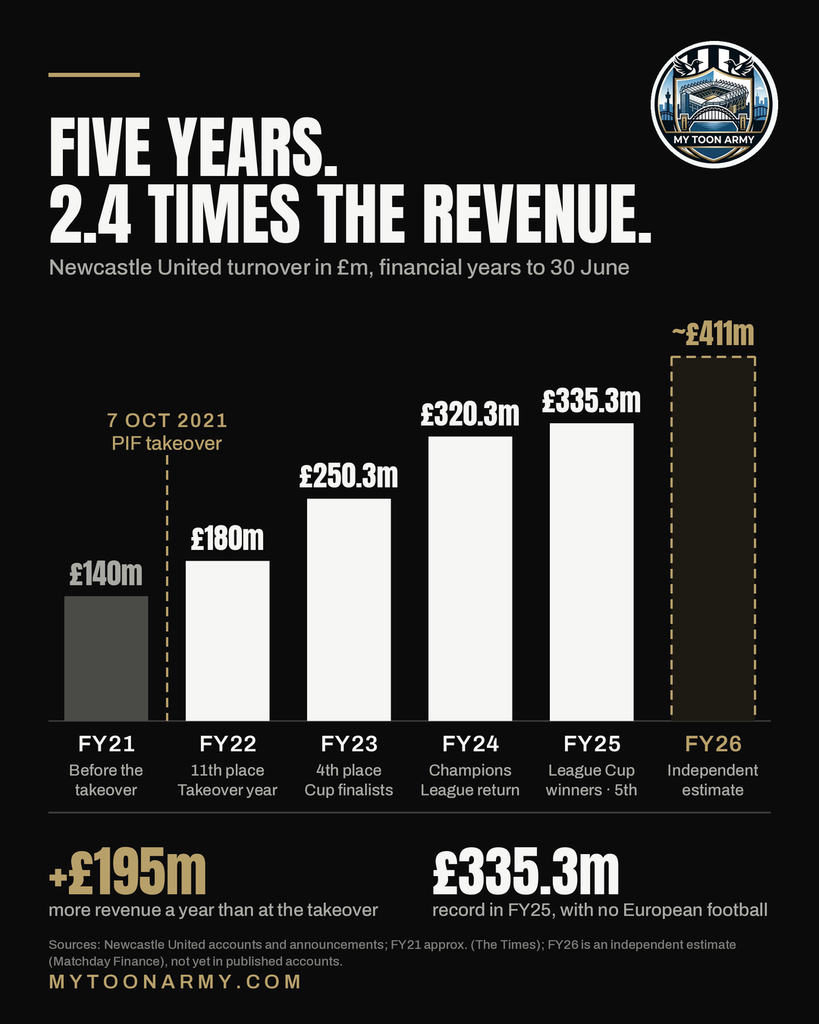
Newcastle United’s turnover since the takeover. FY26 is an independent estimate. Sources: club accounts and announcements; Matchday Finance.
Losses fell with it, to £11.1m in 2024. The 2025 accounts show a profit after tax of £34.7m.
The footnotes add detail. That profit includes a £133.2m gain on selling the leasehold improvements at St James’ Park, and a project company, to PZ Holdings, another subsidiary of the club’s parent group. In plain terms, one part of the group sold an asset to another. The league tested it under the same FMV process, and the club says that process has concluded.
It is disclosed, audited and tested. It also means two numbers sit side by side: a £34.7m headline profit, and an operating loss that PSRwatch puts at roughly £109m.
Player trading became part of the model. Allan Saint-Maximin and Chris Wood were sold in 2023-24 for £23m and £15m. The owners kept their side of the bargain too. In September 2025, the parent group put in £106.5m of fresh equity. In July 2025, the club refinanced with a £50m term loan and a £50m revolving credit facility, a flexible borrowing line. Both run to July 2028 and are secured on Premier League central funds and ticket revenues.
The going-concern note in the same accounts is the most revealing line. Auditors need a reason to believe a company can keep trading for twelve months. Here, it is a letter from the parent company saying its present policy will see the club receive the funds it needs through June 2027. The letter describes a policy, not a promise.
That is not a warning. It is patient capital, described precisely.
What it bought
Everything above was a means. Here is the end.
Hard to beat
The first Champions League place came from the back.
In 2021-22, Newcastle conceded 62 goals. In 2022-23, they conceded 33, level with Manchester City for the fewest in the league. They lost five games, again level with City.
The recruitment behind it was precise. Nick Pope arrived from relegated Burnley for £10m and kept 14 clean sheets in his first season. Sven Botman cost £35m, and Newcastle beat AC Milan to him. Trippier and Burn gave Howe experience and an edge. Alexander Isak, signed for a club-record £63m, supplied the goals.
Fourth place came with 19 wins, 14 draws and five defeats, and a positive goal difference for the first time since 2011-12. There was a 6–1 against Tottenham in April. A goalless draw with Leicester in the last home game sealed the return to Europe’s top table after two decades.
The cost came the next year. In 2023-24, Newcastle beat Paris Saint-Germain 4–1 at St James’ Park, but won only one of their six group games and finished seventh. Managing Europe and the league together proved harder than reaching Europe.
Value for money
The more telling number is the wage bill.
Newcastle’s 2024-25 wage bill was £243.5m, the eighth highest in England, according to The Athletic’s reading of the accounts. By that measure, they finished above their wage ranking in each of Howe’s three full seasons.
Isak is the clearest case. Signed for £63m, he scored in the cup final. In September 2025, he left for Liverpool for a British record £125m, and one independent estimate puts the accounting profit at around £83m.
A club under PSR cannot spend its way out of mistakes. It has to buy right the first time. The numbers suggest it did, more often than not.
Wembley
Then, on 16 March 2025, the wait ended.
Over 32,000 Geordies made the trip to Wembley. Newcastle’s road had gone through Chelsea at St James’ Park, and a 3–1 quarter-final in which Sandro Tonali scored twice.
Just before half-time, Burn, a boyhood Newcastle supporter, rose to meet a corner and headed the opener. Isak scored early in the second half. Federico Chiesa pulled one back for Liverpool deep into stoppage time, but there was too little time left.
Bruno Guimarães and Trippier lifted the trophy. It was Newcastle’s first domestic trophy since the 1955 FA Cup, a gap of 70 years.
Howe said afterwards that he was emotional, and that the players had been desperate to end the years of hurt.
Fifth, on goal difference
The league season closed on a narrower margin.
Despite a slip at home to Everton on the final day, Newcastle finished fifth with 66 points, level with Aston Villa and ahead on goal difference. That put them back in the Champions League for 2025-26.
So why did it work twice?
Three things stand out. First, a head coach given time to build a settled identity. Second, recruitment aimed at fit and value rather than headlines. Third, a commercial and financial machine that kept the money coming without testing the rulebook’s patience.
None of it was quick. All of it was inside the lines.
The other road
A Gulf-backed club took a different road.
City’s rise began with Sheikh Mansour’s Abu Dhabi takeover in 2008. Between 2009 and 2018, they won the Premier League three times, plus one FA Cup and three League Cups. It is the same period a Premier League commission has just examined.
On Tuesday 29 September, the league published its findings. The commission found City guilty of all charges relating to serious breaches of the financial rules over nine seasons, and most of the charges relating to failing to co-operate with the investigation. Reports put the total at 114 of the 115 charges. The league’s chief executive, Richard Masters, said the club had systematically broken the rules for nearly a decade.
City says it is innocent and lodged an appeal on 1 October. The hearing is due by Christmas Eve, and sanctions will be decided separately, with options ranging from a reprimand to expulsion. Nothing is final.
The contrast is worth drawing carefully.
Start with the revenue lines. For the first three years after each takeover, the two clubs grew at almost the same pace: City’s revenue was up 76% on Year 1 by Year 3, Newcastle’s 78%. Then City’s revenue jumped 51% in a single year, while Newcastle’s, in a season without European football, rose 5%.
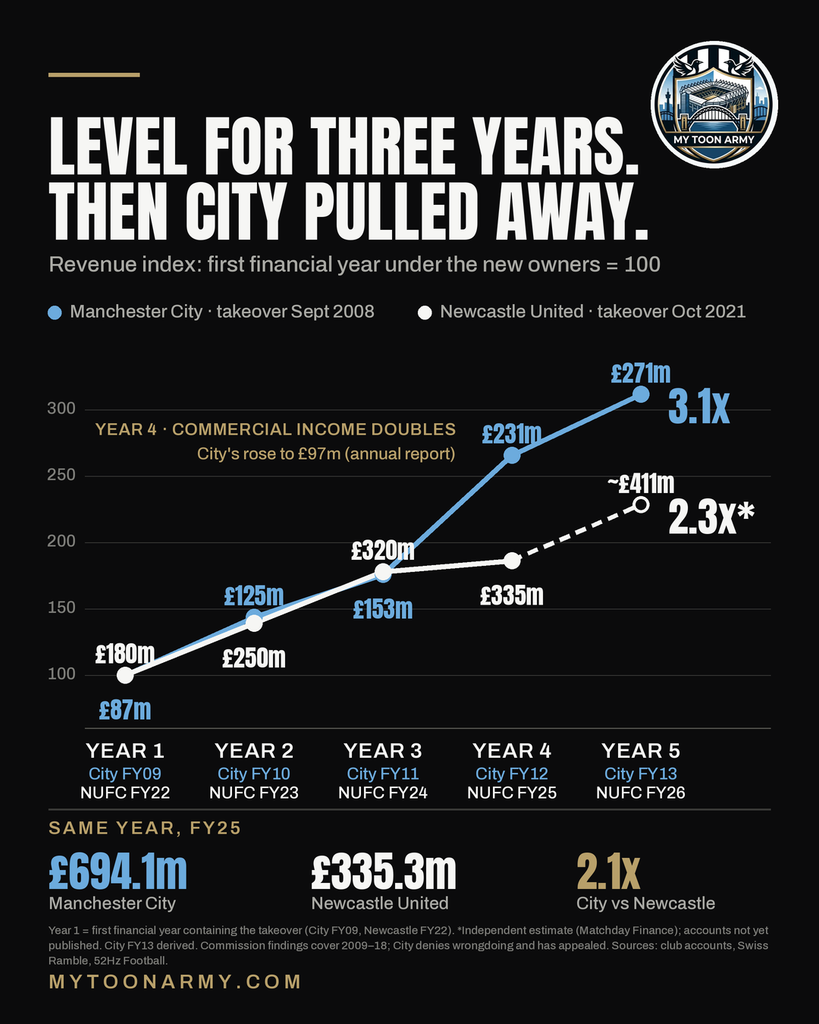
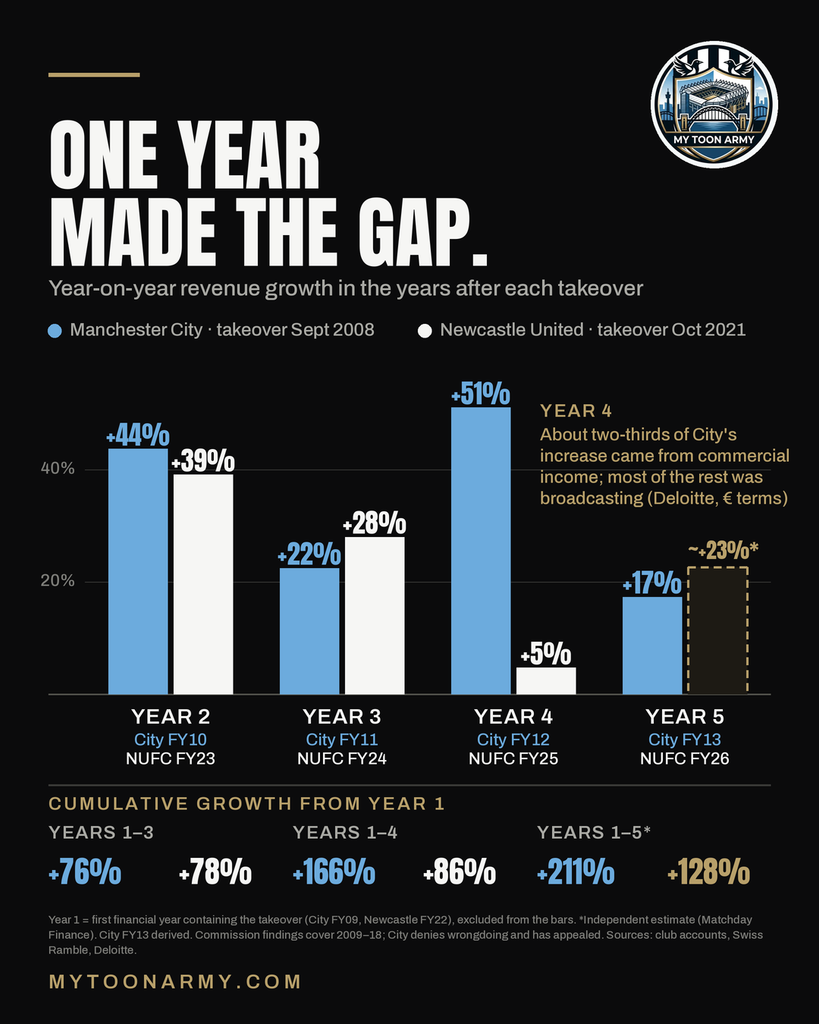
Year-on-year revenue growth after each takeover. Year 1 is the first financial year containing the takeover. Sources: club accounts, Swiss Ramble, Deloitte; Newcastle Year 5 is an estimate.
Newcastle’s first trophy took three years and five months. They reached it under rules built in response to their own arrival, so the patience was partly imposed. City challenged those same rules in a legal fight, then settled in September 2025, accepting them as valid and binding.
Newcastle’s route was slower, and visible in the books. Every deal passed through a test the club did not choose. The verdict against City is not a finding about Newcastle, and the ownership question, with a state fund at the top, is not settled by one case. Masters told MPs in 2023 that he could not say whether the league was re-examining its assurances.
But the difference is clear enough. One club’s story is now in the hands of an appeal board. The other is still being written in the accounts.
Year six
Newcastle return from the international break on 12 October under a new head coach. Matthias Jaissle told supporters in a Q&A on 3 October that his staff joined late in the summer window, with little time to work with the squad.
The build continues. The 2025 accounts describe the group as exploring an expansion of St James’ Park or a new stadium. From the start, the training-ground plan was an upgrade to Benton first and a new site later, and the 2025 accounts say work continues on the way forward.
On the first day, the co-owner asked for patience. The surprise is not that the club had to learn it. It is that, five years on, patience is what has set Newcastle apart.
What are your best memories of the PIF era? Can bring PIF bring Newcastle to the pinnacle of the Premier League? Join the conversation on X @mytoonarmy #NUFC
Leave a Reply