Data Driven Insights. Fearless Opinions.

Finance

  • Twenty-One Months to a Verdict. How Long Until an Ending?

    Manchester City Justice?

    Manchester City have until Friday to appeal. The League’s own process should take weeks. The courts, and the compensation claims that follow, could take years.

    It took 21 months.

    That is how long an independent commission needed to reach its verdict on Manchester City after the hearing ended in December 2024. The answer was guilty on 114 of the 115 charges.

    So how long until it is actually over? Longer than the appeal. Possibly years longer.

    This piece follows our four-part series on the verdict and what it means for Newcastle. Here we look at one question only: the clock.

    What City were found guilty of

    According to Sky Sports, the commission found that City used “sham” contracts with commercial partners to make their income look bigger and their costs look smaller, by more than £900 million in total.

    It also found the club filed accounts that hid its true finances from auditors and regulators, broke both Premier League and UEFA spending limits, and failed to co-operate with the League’s investigation.

    Two things are still open: the punishment, and when anyone can say the matter is closed.

    Step one: Friday’s deadline

    City have said they will appeal, and the clock is short.

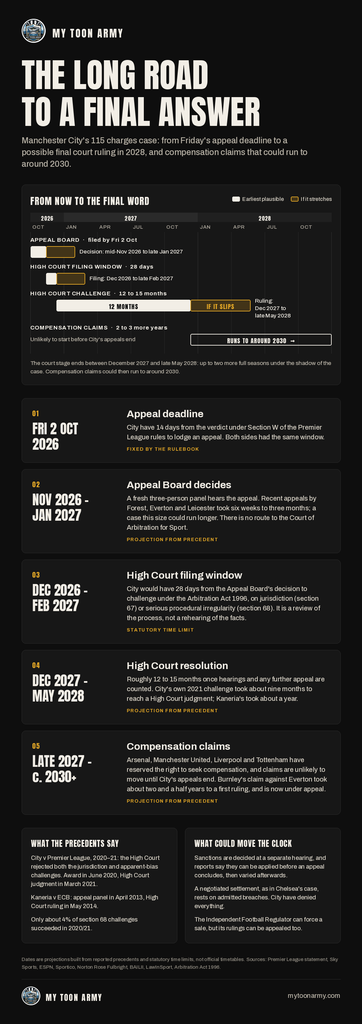
    The Premier League’s rulebook gives each side 14 days from the judgment to appeal. (The relevant part of the rulebook is called Section W.) Sky Sports reports the deadline as Friday 2 October, and other outlets give the same date.

    City’s response has been defiant. The club says it is disappointed and surprised, insists it is innocent, and promises to be “relentless” in any legal forum. Nobody expects it to let the deadline pass.

    Step two: the Appeal Board

    The first appeal stays inside the League’s own system, and it should be quick.

    It goes to a fresh three-person panel. One member must have held judicial office, and that person chairs it. It meets in private. It can uphold the original decision, overturn it, or change it.

    How long will it take? The best guide is recent history. Appeals by Nottingham Forest, Everton and Leicester City took between roughly six weeks and three months.

    City’s case is far bigger, so it is fair to expect the slow end of that range, or longer. Counting from Friday, that points to a decision between mid-November 2026 and late January 2027. That range is this blog’s own projection, built from those earlier cases, not an official timetable.

    One door is already shut. City cannot go to the Court of Arbitration for Sport, where they overturned a two-year UEFA ban in 2020. League rules keep these disputes in England and Wales.

    So the Appeal Board has the last word inside football.

    Step three: the High Court

    It does not have the last word in law.

    City could ask the High Court to step in, but the door opens only a crack. English law treats private arbitration, like the League’s process, as final. The Arbitration Act 1996 guarantees only two ways to challenge it in court:

    • The panel had no power to hear the case. Lawyers at Norton Rose Fulbright think this is highly unlikely to apply here.
    • Something went seriously wrong in how the case was run, and it caused a real injustice. Lawyers call this a “section 68” challenge.

    Either way, a judge would look at how the case was run, not at what City did. There would be no rehearing of the evidence, and nobody would re-argue whether the contracts were shams.

    City would have 28 days from the Appeal Board’s decision to file. On our projection, that means between December 2026 and late February 2027.

    The odds are long. Only about 4 per cent of section 68 challenges succeeded in 2020/21, according to figures cited by the law firm Clifford Chance.

    City know this ground well. In an earlier dispute with the League over its demands for documents, they argued the arbitrators were biased because of how they had been appointed. The High Court rejected that argument in March 2021. A new challenge would be a fresh case, but bias is the obvious argument to try again.

    How long would the High Court take?

    Two earlier cases give us a guide.

    City’s own challenge took about nine months: the tribunal ruled in June 2020, and the High Court judgment came in March 2021. (A Court of Appeal ruling that July dealt only with whether the judgments could be published.)

    In cricket, Danish Kaneria challenged a ruling against him by the England and Wales Cricket Board. The appeal panel ruled in April 2013 and the High Court in May 2014, about a year later.

    So a first High Court judgment tends to take nine months to a year. Allow for a possible further appeal and the sheer size of this case, and 12 to 15 months looks like a sensible window. That is our estimate, not a reported figure.

    Put the stages together:

    • Best case: a final High Court ruling around December 2027.
    • Worst case: late May 2028.

    That is up to two more full seasons played under the shadow of the case. And it assumes City lose at the Appeal Board and then choose to go to court.
    And then come the bills

    None of that counts the compensation claims. They could add years.

    Arsenal, Manchester United, Liverpool and Tottenham sent formal legal notices in November 2024, reserving the right to seek compensation if City were found guilty. Reports say their claims could be worth more than £200 million between them, for lost prize money, Champions League income and commercial revenue.

    Why November 2024? Claims like these generally have to be brought within six years. The clubs feared the clock had started in November 2018, when leaked documents about City’s finances first surfaced, so they acted before it ran out.

    Claims would be heard inside the League’s own arbitration system, as Burnley’s claim against Everton was, rather than in open court. The principle that one club can recover damages from another for breaking the League’s rules is established. Norton Rose Fulbright points back to Sheffield United’s successful claim against West Ham over the Carlos Tevez affair.

    Could other clubs join in? Reports say executives are discussing a joint approach, and clubs could also ask the League to seek redress on their behalf. But clubs that did not act in 2024 may face the argument that they are out of time, though English law can extend deadlines where wrongdoing was deliberately concealed. We have seen no report of a group claim being filed.

    What about Newcastle?

    The right to claim is one thing. Proving the loss is another.

    A club has to show what it actually lost. Manchester United, Liverpool, Arsenal and Tottenham have the clearest cases: titles and Champions League places that went elsewhere.

    Newcastle spent two of the nine seasons in question in the Championship and finished in the top five only once, in 2011/12. On the face of it, that makes a claim much harder to build, even before any argument about time limits. We have seen no report that Newcastle have taken advice on one.

    How long would compensation take?

    The best guide is Burnley against Everton.

    Everton were docked points in November 2023 for breaking financial rules in a single season, and the penalty was cut on appeal in February 2024. Burnley then pursued compensation, arguing that Everton’s breach had cost Burnley their place in the Premier League when they went down in 2022.

    A Premier League commission ruled in Burnley’s favour in June 2026, ordering Everton to pay more than £35 million including interest. Everton say the decision is flawed and are appealing, with a hearing due in January.

    So one club’s claim over one season took about two and a half years from Everton’s original punishment to a first ruling, and it is still not finished.

    City’s case covers nine seasons and more clubs.

    Reports say formal claims are unlikely to move until City’s own appeals are exhausted. If City go all the way to the High Court and the Burnley pattern holds, claims might not get going until late 2027 or 2028, then take another two to three years.

    That points to around 2030, perhaps later.

    What could speed things up, or muddy them

    Three things could change the picture.

    The sanctions hearing. The verdict and the punishment are separate stages. A separate hearing will decide the sanction, and Sky Sports reads the League as wanting that done this season.

    Reports suggest a sanction can be applied before the appeal ends, then changed afterwards. Al Jazeera sets out the dilemma. Punish City early and they could be relegated before they have had a chance to overturn the verdict. Wait, and other clubs could lose their top-flight place or a European spot in the meantime.

    A settlement. Chelsea settled their own case with the League, but only after admitting breaches. City have admitted nothing.

    The new regulator. The Independent Football Regulator has the power to force a club sale and put trustees in charge. Any such decision could itself be challenged. It is a second front, not a shortcut.

    The bottom line

    The verdict took 21 months.

    If City go all the way to the High Court, the League and court stages could run another 14 to 20 months. The compensation claims could take years after that.

    On this reading, we could still be talking about Manchester City’s finances around 2030.
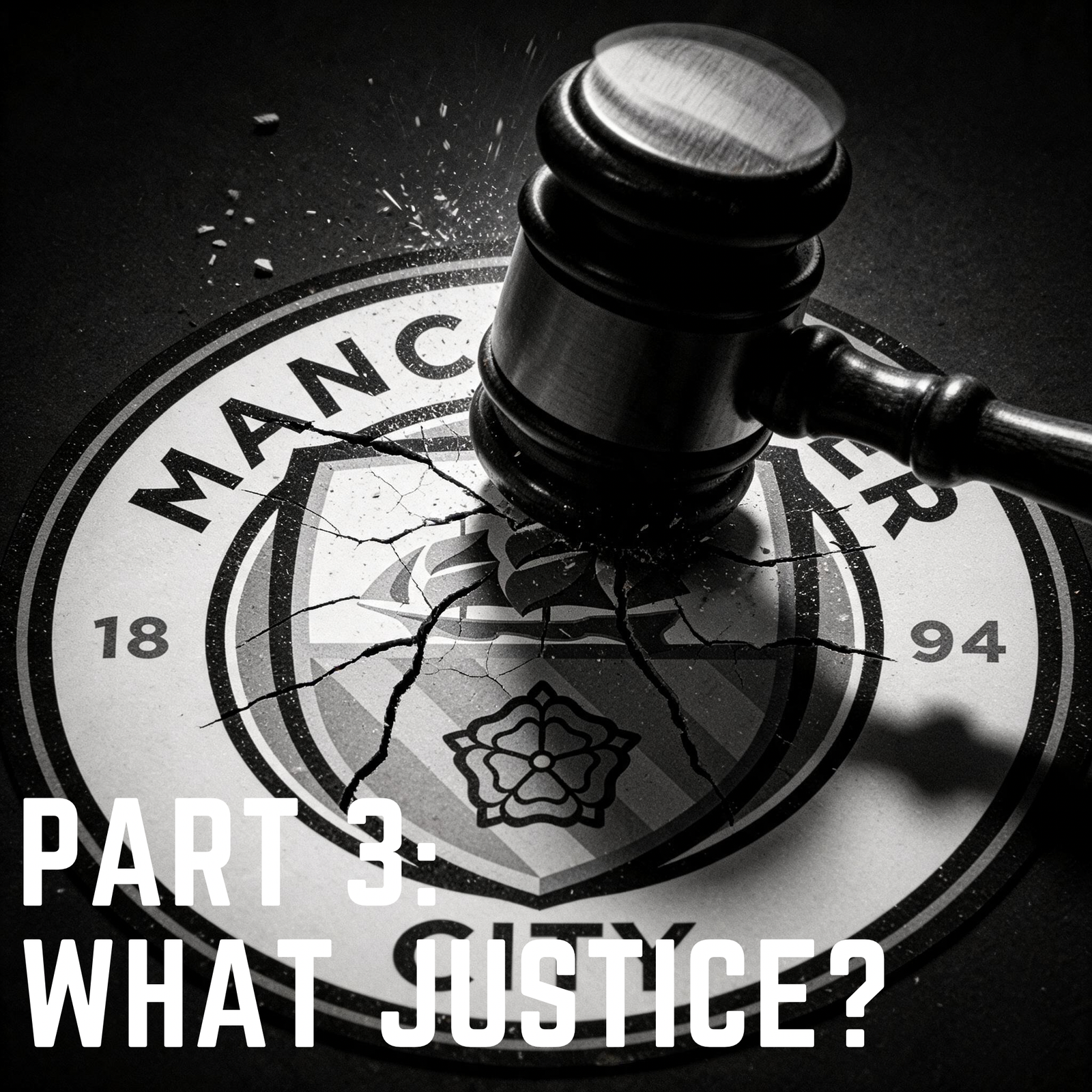
  • Justice, Theoretically: Why No Punishment Fits What Manchester City Did

    Justice on Man City

    This is Part Three of a four-part My Toon Army series on Manchester City’s Premier League charges and what the whole saga means for Newcastle United’s own position under Saudi ownership. Part One covered the verdict and the appeal to come; Part Two traced the seasons, the signings and the clubs now counting the cost.

    According to a Guardian report picked up widely after the verdict, the independent commission did not simply find Manchester City guilty of 114 breaches. It found the club had acted in bad faith. Two words, and they matter more than they look. Bad faith is not a filing error or an honest dispute over accounting standards. It is a panel of three people, after working through what is reported to be roughly half a million pages of evidence, concluding that Manchester City knew exactly what it was doing.

    And yet, days after that finding became public, nobody, including the people paid to know, can tell you what happens to City now. Not the size of the fine, not the number of points, not even the shape of the punishment. Part One explained why the appeal could drag deep into this season. This piece is about something else: even if the appeal were settled tomorrow, there may be no punishment on the shelf that actually fits what the commission found.

    The toolkit

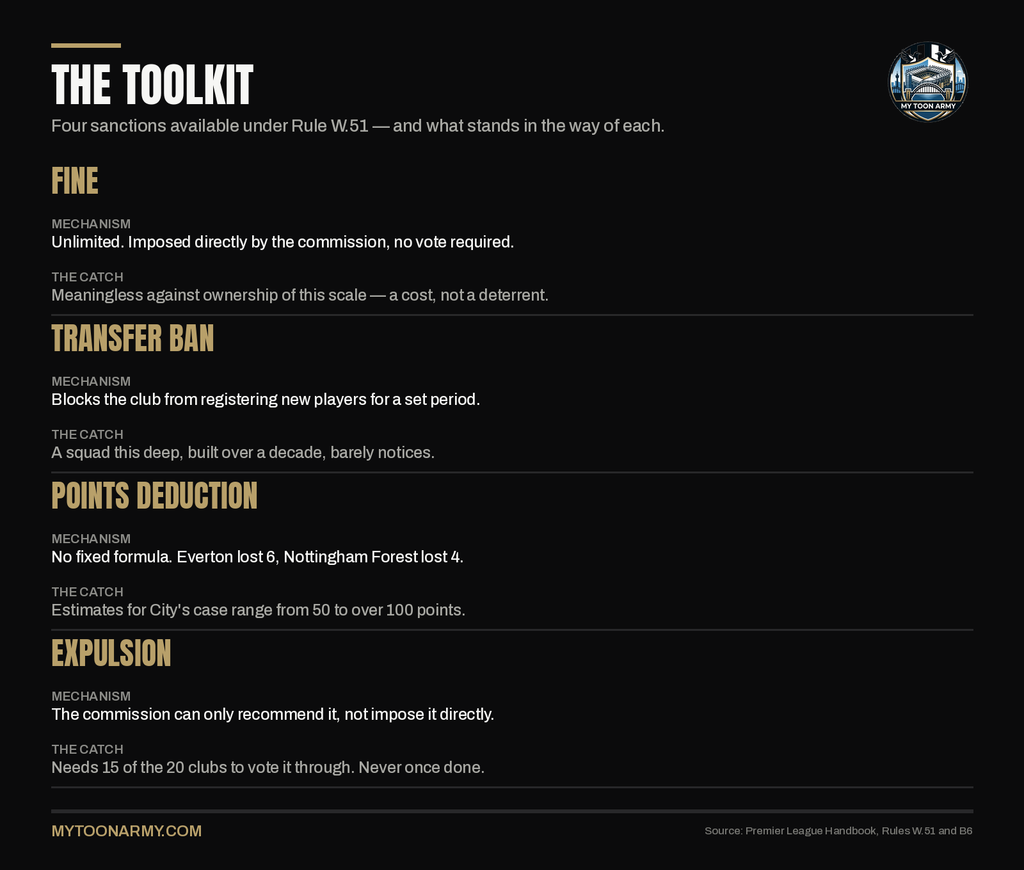
    The commission’s powers come from Rule W.51, the part of the Premier League Handbook that deals with disciplinary sanctions. It can impose an unlimited fine, deduct points, and recommend that a club be expelled. Ian Hargreaves, a partner at the disputes firm Quillon Law, summed up the range for Al Jazeera: a transfer ban at the moderate end of the spectrum, expulsion at the most severe. Fines and points deductions sit in between, and none of these options excludes the others. As sports barrister Yasin Patel has pointed out, a single ruling could combine a major fine, a points deduction and other sporting measures.

    What the rulebook does not contain is a tariff: no sentencing guideline, no points-per-charge formula. That absence is deliberate. Clubs chose not to set fixed penalties for financial breaches, fearing that a published price list would let a wealthy club simply budget for the punishment and treat it as a cost of doing business. Chief executive Richard Masters said in February 2025 that the League was exploring a “Sanctions Grid” of agreed penalties. It has not arrived in time for the biggest case in the competition’s history. Every option below is, to some degree, a guess dressed up as a precedent.

    Money means nothing here

    Start with the fine, because it can be dismissed fastest. City are owned by the Abu Dhabi United Group, the investment vehicle of Sheikh Mansour bin Zayed Al Nahyan, vice-president of the United Arab Emirates and a senior member of Abu Dhabi’s ruling family. Against wealth on that scale, any fine the Premier League could realistically impose is a rounding error rather than a deterrent. The only financial route with real teeth is the set of civil compensation claims being assembled by Arsenal, Liverpool, Manchester United and Tottenham, covered in Part Two, and even those would compensate specific wronged clubs rather than act as a punishment from the League itself.

    The points deduction nobody can actually calculate

    This is where the real disagreement lives. The benchmark cases are Everton and Nottingham Forest, both punished for breaching the Profit and Sustainability Rules (PSR), which cap how much a club can lose over a rolling three-year period. Everton’s first penalty was ten points, cut to six on appeal; Forest lost four. Each case covered a single three-year assessment period. City’s covers nine seasons and five categories of rules. Football finance expert Kieran Maguire’s phrase for scaling up is blunt: “you have to add a zero.”

    Since the verdict, the estimates have hardened. Maguire and fellow analyst Stefan Borson have floated deductions of 60 to 100 points, enough to relegate City almost regardless of how they play. Former Everton chief executive Keith Wyness told Football Insider he expects a 50-point deduction “to ensure relegation in some way”, arguing that with guilt found across virtually every area of the case, “it will be very hard to appeal on facts.”

    Others are more cautious. Dan Plumley, a sports finance academic, told Goal that a points deduction plus a fine is the most likely outcome, with relegation and title-stripping “the extreme, but unlikely, scenarios”. From a modest deduction to a table-bottom collapse, the spread of informed opinion shows how little precedent exists for a case of this size.

    There is one real data point at the lenient end. After Chelsea’s 2022 takeover, the new owners self-reported undisclosed payments made between 2011 and 2018 under Roman Abramovich. In March this year, Chelsea were fined £10.75 million and handed a suspended transfer ban, one that only takes effect if the club reoffends, with no points deduction at all. The fine was halved from £20 million, and the League explicitly credited Chelsea’s “proactive self-reporting” and “exceptional co-operation.” It also noted that Chelsea’s breaches, even if declared properly, would not have taken the club over its spending limits. City’s charge sheet includes 35 counts of doing the opposite of cooperating, over four years. If the system rewards clubs that come clean and punishes those that fight, City’s decision to contest everything may prove to be the costliest choice of the entire saga.

    Transfer bans: moderate on paper, toothless in practice

    A transfer ban, which stops a club registering new players for a set period, sounds severe but would cost City remarkably little. The squad was built over more than a decade of the spending the commission has now found breached the rules, it is young, with an average age of around 25, and it is deep enough to lose several players to rival clubs without collapsing. Behind it sit a productive academy and the scouting network of City Football Group’s sister clubs around the world. A transfer ban hurts a club that needs to rebuild. City’s squad was built long ago.

    Expulsion: the button nobody can actually press

    For many supporters of other clubs, expulsion is the only proportionate response to rule-breaking on this scale. It is also the option furthest from happening. The commission can only recommend it. Actually removing a club requires a Special Resolution under Rule B6 of the Handbook: 15 of the 20 Premier League clubs must vote in favour. No club has ever been expelled, and this time three-quarters of the division would have to vote to remove one of the competition’s biggest commercial draws.

    Opinion among the clubs was already split before the verdict. According to Goal, some were prepared to push for an outright expulsion, while others worried the delay was causing “undue damage to the Premier League” and wanted a resolution that let everyone move on. Relying on 15 clubs to set aside their own commercial interests is, at best, a coin flip.

    Even if the vote passed, there is a second problem: nobody knows where City would go. The English Football League (EFL), which runs the three professional divisions below the Premier League, would be under no obligation to accept an expelled City, according to The Telegraph. The EFL is also capped at 72 clubs, with no spare place for a 73rd. And because entry to the FA Cup and League Cup is tied to league membership, City could in theory lose those too.

    The doomsday scenario. Over the weekend, the picture darkened further. Journalist Ben Jacobs reported that if City are expelled, the EFL is not merely entitled to refuse them but is reportedly prepared to, standing in solidarity with the Premier League and keeping City out of the Championship, League One and League Two alike. Follow that to its end and one of the most expensively assembled squads in world football would have nowhere left to go but non-league football, outside the top four tiers of the English game.

    Nobody seriously expects that to play out as written. Enzo Maresca and a squad of full internationals do not report for pre-season in the National League. The realistic outcome is an immediate exodus of players and staff, leaving the owners with a stadium, a badge and very little else.

    The scenario also revives a question football thought it had closed. The European Super League, relaunched as the “Unify League,” was finally abandoned in February 2026, when Real Madrid, its last backer, reached an agreement with UEFA. But the legal ground beneath it has not moved. In December 2023, the European Court of Justice ruled that UEFA and FIFA had abused a dominant position in blocking rival competitions, though UEFA insists its rules have since been brought into line. A City locked out of English football would have a motive no founding Super League club ever had. Real Madrid wanted a richer competition alongside a healthy domestic league. A leagueless City would need somewhere, anywhere, to play, with Abu Dhabi money behind it. It is not hard to imagine its owners concluding that bankrolling a breakaway competition beats a National League fixture list.

    That is precisely why the more measured voices treat the doomsday scenario as a reason expulsion won’t happen, not evidence that it might. Former City midfielder Dietmar Hamann argues the Premier League has no interest in engineering the collapse of one of its biggest draws, because a competition needs more than three or four clubs capable of winning it. Clubs voting to expel City would not just be removing a rival. They would be gambling with the value of their own product, with no guarantee the wreckage lands anywhere useful.

    Where the real teeth are

    None of that makes a severe outcome impossible. It simply moves the teeth elsewhere. A points deduction large enough to leave City bottom of the table avoids both of expulsion’s problems. The commission can impose it alone, without a single club’s vote. And relegation, once it happens, is automatic. A standing “tripartite agreement” between the Premier League, the EFL and the Football Association guarantees that the bottom three Premier League clubs go down and the top three Championship clubs come up every season. When the Premier League floated suspending relegation during the pandemic, EFL chairman Rick Parry warned that doing so would breach that agreement and get “very messy”. City would drop into the Championship like any other relegated club, complete with the “parachute payments” the League pays relegated clubs to soften the financial fall.

    The most effective sanction, then, is not the most dramatic one. It is the one the commission can impose entirely on its own, with a guaranteed place for City to land.

    What history says happens next

    Play that forward: City relegated by a points deduction. What happens to a financially untouched giant dropped down a division is not the clean morality tale either side assumes.

    The closest precedent is Juventus. Calciopoli, the Italian referee-rigging scandal that broke in 2006 (its name is wordplay on “calcio,” Italian for football), saw Juventus stripped of two Serie A titles and relegated to Serie B, Italy’s second tier, for the first time in their history, starting the season with a nine-point deduction. Their wealth and ownership were untouched, and they won Serie B comfortably, returning to Serie A after a single season. But the football did not snap back with the finances. Ibrahimović, Vieira, Thuram and Cannavaro all left once relegation was confirmed, and Juventus spent the next few years cycling through coaches, finishing as low as seventh. Real dominance returned only with Antonio Conte in 2011-12, the start of nine consecutive titles. The money survived the drop. The football took half a decade to catch up.

    The counter-precedents are bleaker. Rangers’ 2012 liquidation sent them to Scotland’s fourth tier. That was genuine financial collapse rather than a punishment on top of intact wealth, but it took them four years to reach the top flight again and nine to win another title, while Celtic won nine in a row. Leeds United, Champions League semi-finalists in 2001, took sixteen years, three of them in the third tier, to return to the Premier League. Retained money does not guarantee a quick recovery. Lost money can keep a club out for a generation.

    The trophy question

    Calciopoli offers one more contrast. Italy’s federation had, and used, the power to strip Juventus of titles and hand one to Inter Milan. The Premier League’s rules set out no equivalent. Some reporting has raised the possibility that sanctions could reach back to City’s trophies, but nothing has been decided, and title-stripping is not an automatic consequence of a guilty verdict under the League’s published framework. The most emotionally satisfying punishment on anyone’s list, taking the eight trophies detailed in Part Two and handing them to the runners-up, may not be a lever the commission has been given.

    A proposal of our own

    Every option above treats City’s offence as a single event deserving a single sanction. It wasn’t. It ran for nine years, and a proportionate punishment would reflect that: a points deduction now, severe enough to guarantee relegation this season, followed by a pre-set penalty of around 30 points and a ban from cup competitions in each of City’s first two or three seasons back in the Premier League, closing any route into Europe for the length of the sentence. It is the only idea in this piece that matches the duration of the offence, rather than compressing nine years of rule-breaking into a single afternoon’s verdict.

    It is also almost certainly unworkable as things stand. The rules do not allow a commission to pre-sentence seasons that haven’t happened yet, against a squad and management that will have changed by the time the penalty bites. That hands City’s lawyers a ready-made argument that the sanction is disproportionate. It would need a rule change rather than a ruling, and rule changes need a two-thirds majority of the same self-interested clubs, voting to weaken their own competition for years at a stretch. It is more honest about the scale of the offence than anything on the table. For now, the rulebook has no room for it.

    The problem no punishment solves

    Line the options up and the pattern is clear. A fine means nothing to an owner of this wealth. A transfer ban barely dents a squad this deep. Expulsion needs 15 self-interested votes and may have nowhere to send City even if it gets them. The one sanction that avoids both problems, a relegation-sized points deduction, drops the same financial machine, largely intact, into a division of clubs who would then have to survive it. Title-stripping may not be available at all.

    These are not failures of imagination. They are what happens when a regulatory system built for ordinary financial misconduct is pointed, for the first time, at an owner with the resources of a state. The inequality between clubs was the water English football swam in long before City were found to have exploited it further. Caroline Dinenage, chair of Parliament’s Culture, Media and Sport Committee, said as much after the verdict, warning that the affair raises fresh questions about financial fairness across the football pyramid. No sanction handed down by a three-person panel can make the last nine years fair. It can only choose which unfairness comes next, and who bears it.

    That question is not academic for every club watching. Tucked into the same Al Jazeera report was a line about another club entirely: Newcastle United “narrowly avoided potential sanctions” after selling players before a June 2024 reporting deadline to stay within the spending rules. The rulebook that has just caught Manchester City has already brushed against the next state-backed ownership in the competition.

    Part Four turns to exactly that: what this verdict, and the regulatory machinery built partly because of it, means for Newcastle United under Saudi ownership. It follows tomorrow.

  • Manchester United’s record year lost £43m. Newcastle should read the small print

    What Can We Learn From MU

    United’s books for 2025/26 look like a triumph until you break them down. What can Newcastle learn from it.

    Manchester United finished third, earned a record £677.6 million and lost £43 million doing it.

    The loss came out on Wednesday, inside a results release that led with the record. Chief executive Omar Berrada said the numbers showed a club “on the right trajectory”, and on the operating lines he had a point. Adjusted EBITDA reached £216.4 million, up 18.4 per cent. The club made an operating profit of £22.6 million, against a loss of £18.4 million the year before.

    The story lies inside the headline.

    The bill for yesterday

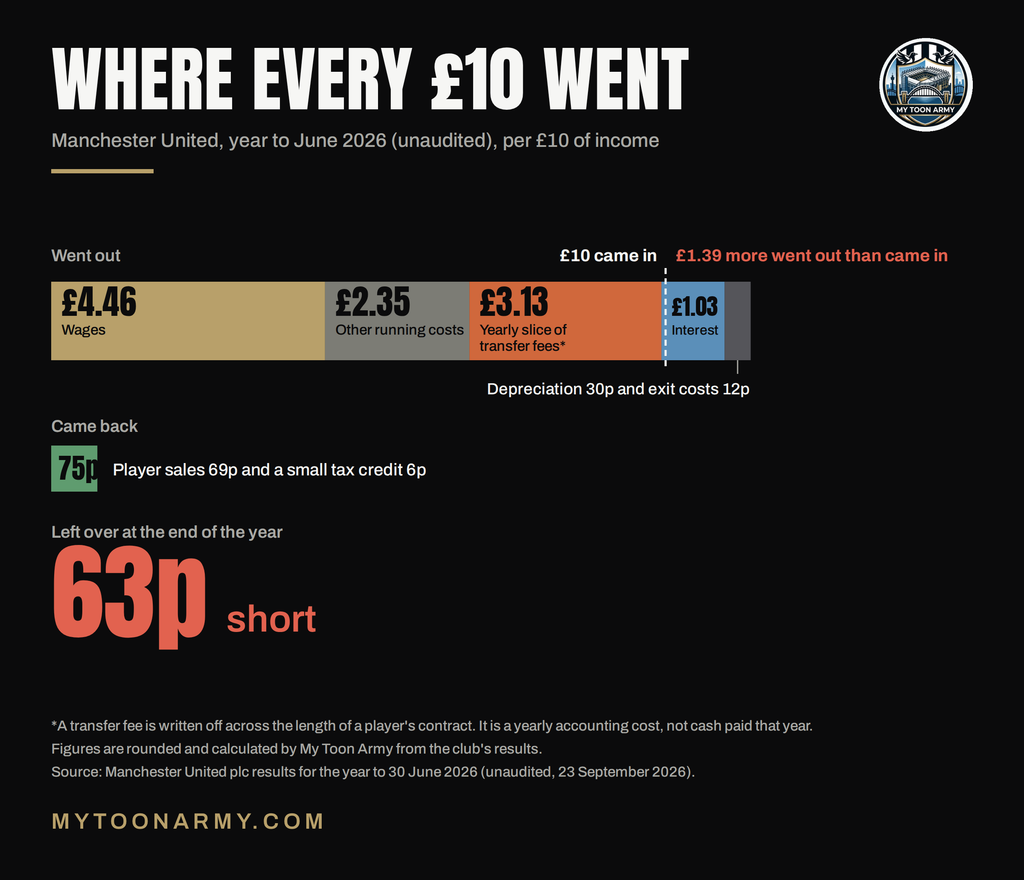
    Take a fan’s view of it. Put £10 of United’s income in a drawer and watch where it goes.

    £6.81 leaves at once to run the club, £4.46 of it in wages. That leaves £3.19.

    Then the past arrives. £3.13 goes on players already in the squad. It isn’t cash out of the door this year. It is the yearly slice of their transfer fees, spread across the length of their contracts, and it lands on the books whether or not a penny changes hands. Just over £1 goes to lenders: £69.6 million in net finance costs across the year, more than the £63.5 million the club spent buying land for a new stadium. Thirty pence covers depreciation on buildings and equipment. Player sales hand back 69p. The last of the restructuring bills take 12p, and a small tax credit gives back 6p.

    The drawer ends 63p short.

    Some of that interest bill is currency. £10 million was an unrealised loss on dollar-denominated debt, against a gain of nearly £23 million the year before. Strip that out and the underlying interest cost is still higher, by roughly £18 million. In June United also replaced some of its bonds, the notes it sold to investors, with a larger issue that added $125 million to its dollar borrowings.

    So the club got better at the parts a fan can see. Third place, Champions League football, a bigger television cheque for finishing twelve places higher. And the same £10 still arrives with claims on it before the head coach sees a penny.

    The ceiling

    Every supporter has asked why a club doesn’t simply spend more. Moreso when your owner is the richest in the world, like the PIF.

    A squad budget is not set by how rich the owner is. It is set by how much the club earns. The Premier League’s squad-cost rules tie what a club can commit to its players, meaning wages, agents’ fees and those yearly slices of transfer fees, to what comes in at the other end. Raise the income and the ceiling rises. Trim the other bills and there is more room beneath it.

    United did both this year, in a season without a single European night.

    Commercial income came to £317.3 million, and the release announces a training-kit partner in Betway and a sleeve partner in SumUp on top of adidas on the shirt and Snapdragon across the front. The club is selling every square inch of the kit.

    The climb from fifteenth to third lifted broadcasting income by £33.9 million, even after the European money vanished. Matchday income held at £153.5 million from just 20 home games, ten fewer than the year before, which the club credits to “strong demand for our general admission and hospitality offerings”. That works out at roughly £7.7 million a home game. Old Trafford holds 74,244 people, and United make them count.

    On the other side of the ledger, wages fell 3.6 per cent to £302.0 million, after two years of headcount cuts. The bill for getting there was £36.6 million and then £8.2 million in restructuring, head-coach exits and a pension top-up.

    Now the warning label. United expect £740 million to £760 million of revenue next season and £205 million to £225 million of adjusted EBITDA. Subtract one from the other and both ends of the range imply about £535 million of running costs, roughly £74 million more than this year. In the fourth quarter alone, wages already ran at 52.3 per cent of revenue, up from 48.3.

    The Champions League money hasn’t arrived, and it has been spent.

    What Newcastle should take from it

    Every club in the Premier League works under the same arithmetic. So the useful question isn’t what United got wrong. It is which of their moves a club in a different position can copy, and which of their habits it should avoid.

    Four things worth copying

    Treat league position as income. The climb from fifteenth to third added £33.9 million to United’s broadcasting revenue, and that is after losing their European money. A place in the table needs no new partner and no new stand. For Newcastle, every decision that protects league position, from the depth of the squad to the stability around it, is a financial decision as well as a sporting one.

    Sell every surface. United’s commercial income was £317.3 million, 46.8 per cent of their revenue, in a year with no European football and after losing a training-kit sponsor. The club has since filled that space with Betway and added a sleeve partner in SumUp. The lesson is that inventory is a choice: the shirt, the sleeve and the training kit are three sales, not one. For Newcastle the lesson is breadth. The more of the club’s commercial income comes from partners with no link to the owner, the less of it ever faces a fair-market-value question.

    Make every seat earn more. The release credits strong demand for hospitality and general admission with holding matchday income up while the number of home games fell by a third. That is yield, not capacity. Old Trafford’s 74,244 seats are about 22,000 more than St James’ Park’s 52,264, so the gap in seats is real. But pricing and hospitality are levers a club can pull before it pours a foundation.

    Build in the right order. United finished the Carrington training-ground rebuild in August 2025 and then bought the land for a new stadium. The cheaper, quicker project went first. It is a sequence any club weighing a stadium can borrow.

    Five things to fear

    Spending money before it lands. United’s guidance shows how fast a Champions League uplift is absorbed by wages. The safer way to treat European income is as a bonus. Where a contract pays more for a European season, the extra should be triggered only when the money arrives.

    Interest. More than £1 of every £10 at United goes to lenders, and none of it puts a player on the pitch. When a stadium needs financing, the question for Newcastle is how to keep that cost out of the football budget altogether.

    The transfer credit card. Amortisation rose £15.4 million to £211.8 million, and £452.3 million of unamortised fees still sits on the balance sheet. United’s net cash spend on players fell to £143.7 million from £230.0 million, partly by selling future transfer receivables, which brings cash forward and takes it from later years. At June 2025 they owed other clubs £447.1 million in fees. The better measure of a signing is its yearly write-down, not the fee on the headline.

    Currency. A £10.0 million loss on dollar debt, after a £22.9 million gain the year before, turned a manageable year into a bigger loss. A club should borrow in the currency it earns.

    Slow stadium decisions and churn. United have bought the land for a new ground and the release discloses no cost or funding plan for it. Meanwhile the £44.8 million spent over two years on restructuring and exits shows what changing course costs. For Newcastle, in transition under Matthias Jaissle, the lesson is to settle the big structural questions early, the stadium route above all, and to keep the structure around the team steady while it does.

    What happens next

    Newcastle’s latest accounts, when they arrive by March year, are the place to test these lessons: are we still on the right path. Until then the ceiling is the fixed point around which every club plans.

    The finances of a Big 6 team is quite different from Newcastle’s – how are we charting our own path? Join the conversation on X @mytoonarmy #NUFC

  • A Stacked Deck: Newcastle’s Commercial Ceiling, By Design

    A Stacked Deck?

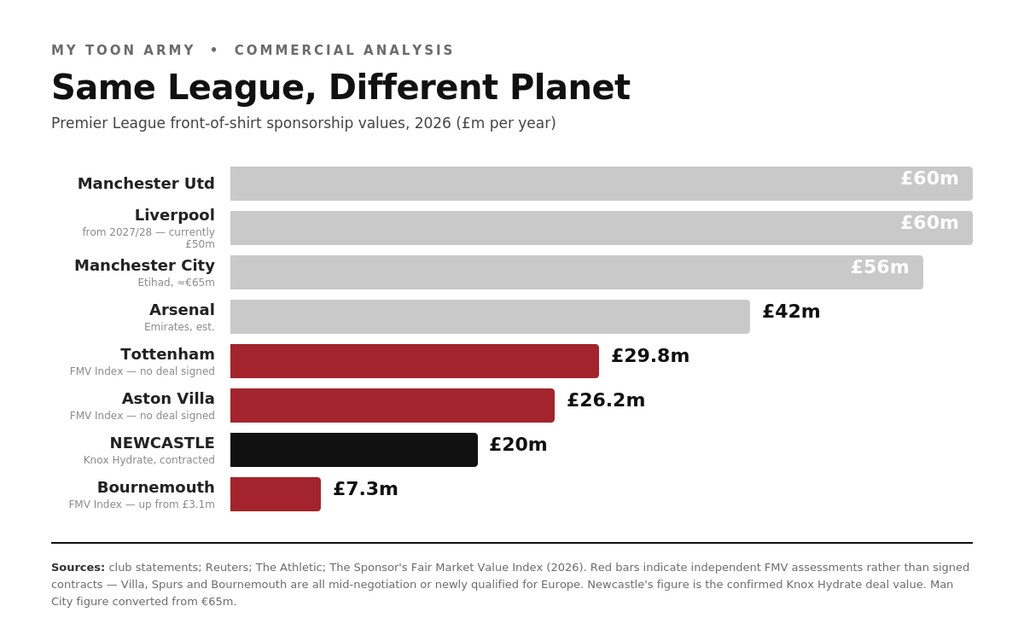
    Sixty million pounds a year, guaranteed for five seasons, confirmed on a Tuesday morning in September. Turkish Airlines’ logo will replace Standard Chartered’s on Liverpool’s shirt from 2027/28, and within hours a Newcastle supporter on X had done the only useful thing anyone could do with that number: held it up against Knox Hydrate’s £20 million a year and asked the obvious question. How does a club backed by one of the richest sovereign wealth funds on the planet end up being outspent three-to-one on shirt sponsorship by an airline?

    The uncomfortable answer is that Newcastle isn’t losing this fight by accident, and it isn’t losing it purely on merit either. It’s losing it because the Premier League rewrote its rulebook within weeks of PIF’s arrival, specifically to stop state-backed owners inflating club revenue through their own companies. Newcastle is now boxed in by rules its own takeover provoked.

    Start with what Knox actually represents. The £60 million deal, split roughly £10 million in year one rising to £25 million a year after that, replaced Sela — the Saudi events company backed by PIF that had occupied the shirt front since 2023. There’s also an £18 million training-ground naming agreement running alongside it, with Darsley Park now branded as The Knox. Chief executive David Hopkinson called it transformative for the club. It’s a decent deal by the standards of clubs finishing mid-table without European football. It is not remotely close to what the traditional aristocracy commands, and the gap between “decent” and “competitive” is the whole argument in miniature.

    That gap has a name: the Premier League’s Associated Party Transaction rules, introduced on 14 December 2021, weeks after PIF completed its takeover, and tightened twice since, in March and November 2024. The mechanism is straightforward enough — any commercial deal between a club and an entity connected to its ownership has to clear an independent Fair Market Value assessment before the league will count the revenue, with anything over £1 million a year or 5% of turnover going to the Premier League board for review. What it means in practice is that PIF cannot simply route money to Newcastle through a friendly sponsor and call it commercial income. Sela’s 2023 deal was, by the league’s own admission at the time, treated as a live test of exactly that mechanism, partly because Newcastle chairman Yasir Al-Rumayyan also sits on the board of Qiddiya, the PIF-owned entertainment project that Sela’s founder is separately linked to. Overlapping ownership, overlapping directors — precisely the structure the rules exist to police.

    Newcastle’s restraint since has been almost pointed. PIF is currently in the process of acquiring EA Sports, and sources close to the club were explicit this summer that Newcastle deliberately didn’t pursue a shirt deal with EA, choosing Knox instead specifically so as not to lean on related-party transactions to inflate revenue. That’s a club voluntarily walking past money it could plausibly have taken, because the regulatory environment around it makes even a clean deal with a PIF-adjacent company a headache not worth having.

    Here’s where the irony sharpens into something with real teeth. The APT rules exist in their current form largely because of what Manchester City are alleged to have done for the best part of a decade before anyone was checking.

    The Premier League’s case against City — 115 charges, referred to an independent commission in February 2023, hearing concluded in December 2024, verdict still not delivered as of this writing — centres on allegations that ownership investment from Sheikh Mansour’s Abu Dhabi United Group was disguised as sponsorship income from state-linked companies including Etihad Airways, Etisalat and Aabar Investments between 2009/10 and 2017/18. The specifics, drawn from the Football Leaks documents published by Der Spiegel in 2018, are stark: of Etihad’s headline £67.5 million sponsorship figure in 2015, only £8 million is alleged to have come from the airline itself, with the remaining £59.5 million said to have been routed through its accounts from ADUG. A separate £30 million in Etisalat payments is alleged to have been channelled via a broker rather than paid directly. UEFA banned City from European competition for two years and fined the club €30 million over related findings in 2020, before the Court of Arbitration for Sport overturned the ban and reduced the fine to €10 million, ruling some of the allegations time-barred and others not proven to the required standard. City deny all wrongdoing, and more than three years after the Premier League’s charges were filed, the independent commission still hasn’t ruled.

    Nobody, including this blog, gets to treat unresolved allegations as fact. But the timeline tells its own story regardless of how the commission eventually rules. The Premier League built the APT framework in the direct aftermath of Newcastle’s takeover, worried — reasonably, given what was already being alleged about City — that a second state-backed owner might attempt something similar. Newcastle arrived at the table just as the rules were being written specifically because of clubs like Newcastle, and the club has been playing by them from day one while the case against the club that arguably wrote the playbook remains, after three and a half years, entirely unresolved. Newcastle can’t do quietly what City are accused of having done for a decade in the open. That’s not a complaint. It’s just the mechanics of arriving late to a party the league had already decided to shut down.

    None of which would matter much if the pure market gap weren’t also brutal. Manchester City’s Etihad deal is worth in the region of €65 million a season. Manchester United’s front-of-shirt asset is independently valued at £60 million by The Sponsor’s Fair Market Value Index, with a further £16.7 million from the sleeve. Arsenal’s Emirates partnership sits comfortably above £40 million. Liverpool are about to move from £50 million to £60 million-plus. Against that company, Newcastle’s £20 million looks like what it is: a mid-table number for a club with top-six ambitions and precisely none of the Champions League football that would let it charge top-six prices.

    Further down, the picture is uglier still. The Premier League’s front-of-shirt gambling ban lands fully from 2026/27, and West Ham, Wolves, Crystal Palace, Nottingham Forest and newly promoted Sunderland all start the season without a confirmed shirt sponsor, replacement deals reportedly worth roughly half what the departing betting money paid. Bournemouth’s shirt value has more than doubled, from £3.1 million to £7.3 million, purely off the back of European qualification — proof that even a modest run in Europe moves the needle harder than most clubs’ entire commercial departments.

    Put the two halves together and the “stacked deck” framing holds up better than it might first sound like empty grievance. Newcastle can’t fully exploit the one advantage that separates it from every club chasing it from below — ownership wealth — because the rules were built, in significant part reactively, to stop exactly that kind of exploitation. And it can’t yet command what the six clubs above it charge, because the market simply hasn’t priced in ambition without European football to back it up. The hand PIF was dealt in October 2021 came with real aces in it. It’s just that several of them were removed from the deck two months later, and the club a few years down the road might reasonably ask why the dealer waited for Newcastle to sit down before changing the rules of the game everyone else had already been playing.

    Will Newcastle ever catch the leading pack of Top 6 clubs, in terms of revenue? What else can we do to improve our financial standings? Join the conversation on X @mytoonarmy #NUFC

  • Nine and Not Out: The Bournemouth Hoodoo Survives, But Newcastle’s Soft Centre Doesn’t

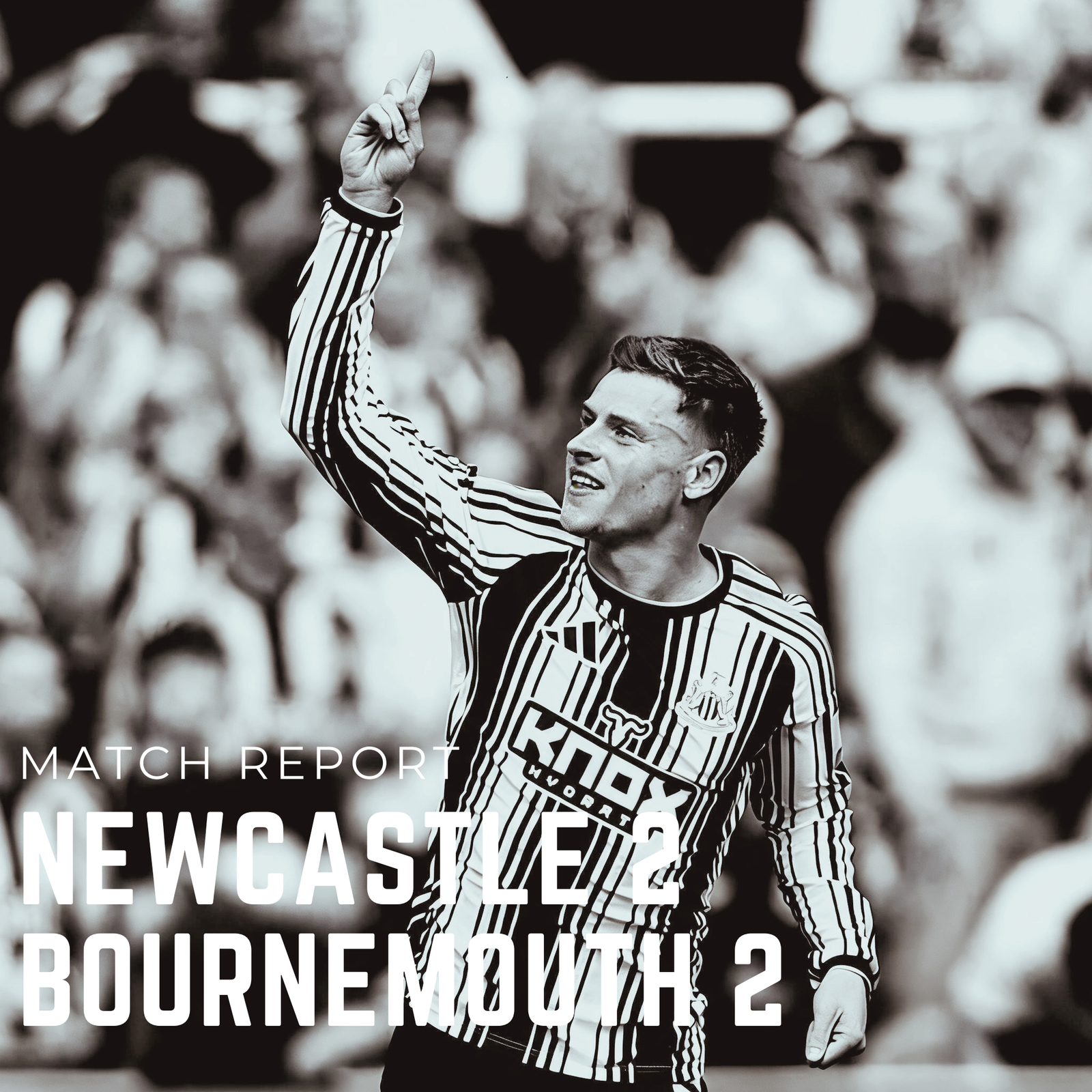
    Newcastle 2 Bournemouth 2

    Twelve yards out, eighty-eighth minute, Jacob Ramsey took one touch to settle a half-cleared ball and side-footed it low past Djordje Petrovic. St James’ Park did not so much roar as exhale — fifty-two thousand people releasing eighty-eight minutes of accumulated grievance in one go.

    It was Newcastle’s second shot on target all afternoon. Their second. Against a side who had managed five.

    That single statistic tells you almost everything about the shape of Saturday lunchtime, and almost nothing about what actually mattered. Because the question posed in this column on Friday was never whether Newcastle would out-pass or out-create Bournemouth. It was whether this team, carrying the sudden and uncomfortable weight of expectation, could handle a fixture they were supposed to win against opposition they cannot beat. The answer arrived in two parts, and the second part was more revealing than the first.

    The First Half That Proved the Warning and Missed the Point

    Friday’s preview flagged the number that should have frightened everyone: no side in the Premier League had faced more shots than Newcastle across the opening two rounds. Jaissle’s system creates through aggression and concedes through it, and Bournemouth — pacey, direct, built to punish an open midfield — looked like precisely the wrong opponent to test it against.

    Forty-five minutes later that warning looked prophetic. Thirteen Bournemouth shots to Newcastle’s three. An expected goals reading of 1.29 to 0.14. Marco Rose’s side did not merely start brightly; they arrived at St James’ Park with the clarity of a team who had watched the Liverpool and Tottenham tapes and decided that Newcastle’s high line was an invitation.

    But the mechanism was not the one predicted. Both goals traced back to the same right boot, and it belonged to Newcastle’s own right-back.

    The ninth minute: Alex Scott’s shot deflected off a Newcastle body and spun loose at the back post, and Amar Dedić stood watching it as though the phase of play had ended when the shot was struck. Marcus Tavernier did not stand watching. He arrived, and he finished, and Newcastle’s players surrounded referee Rob Jones insisting Anthony Elanga had been fouled in the build-up. VAR looked. VAR declined. Former PGMOL chief Keith Hackett has since backed the non-intervention as a legitimate refereeing judgement, and on the replays it is hard to argue otherwise — but the mood of the afternoon was set in that opening exchange, and it never fully recovered.

    The thirty-fifth was worse, and it was worse because it was structural rather than accidental. Dedić lost the ball high up the pitch, in the advanced position his attacking instincts keep dragging him towards. Tavernier skipped past Nico González in the space that Dedić had vacated. Justin Kluivert’s shot smashed against the post and rebounded off Lukáš Horníček’s back; Scott collected the loose ball on a desperately tight angle and clipped a low cross that ricocheted off Malick Thiaw and looped over his own goalkeeper.

    Call it misfortune if you like. The scoresheet does — Thiaw’s name sits there with the letters OG beside it, and he will not enjoy seeing them. But the dominoes fell in a very particular order, and the first one was pushed by a twenty-four-year-old full-back who has been outstanding going forward and repeatedly caught out coming back.

    Here is the complication, and it is the reason this is a character study rather than a hanging. Dedić’s delivery into the box is what led to the equaliser. He also curled a late free-kick high over the crossbar chasing a winner. Three of the four goals in this match had his fingerprints on them, in both directions. Ross Wilson signed a right-back whose attacking threat and defensive naivety are not two separate traits but the same trait, pointed in opposite directions. That is a coaching problem, not a recruitment error — but it is a problem, and Leeds away is not the place you want it unresolved.

    The Boy Newcastle Let Go

    There is a small, sour piece of poetry buried in the identity of Bournemouth’s scorer.

    Marcus Tavernier grew up in Newcastle’s academy. He was released as a boy, picked up by Middlesbrough at under-14 level a fortnight later, and has spent the years since building a career that keeps intersecting with the club that decided he was not good enough. Saturday’s opener was, by the Press Association’s count, his fourth goal in five appearances against Newcastle United.

    Which brings us to the harder question this column promised to answer: why can’t we beat them?

    The lazy explanation is that Bournemouth are a bogey side and bogey sides defy analysis. The better explanation is that the Cherries possess a specific structural weapon that has now survived a complete change of managerial philosophy. Andoni Iraola built a team around fast, direct wide players who attack space behind a committed defensive line. Marco Rose — Leipzig, Dortmund, Mönchengladbach — coaches a different game in most respects, but he inherited Kluivert, Tavernier and Rayan, and he did not have to be taught what they were for.

    Nine Premier League matches without a Newcastle win, stretching back to July 2020. Two Bournemouth managers, four Newcastle ones. The dugouts keep changing. The puzzle piece that unlocks us does not.

    What Bournemouth Actually Are

    And here we should be honest about the opposition, because “mid-table side Newcastle should beat” undersells them badly.

    The summer of 2026 was, on paper, the summer Bournemouth were supposed to be dismantled. Alex Scott — twenty-three, England-capped, refusing a new contract — was chased by Manchester United, Chelsea, Arsenal and Liverpool, with a late Chelsea bid rejected outright. Rayan, the Brazilian teenager they paid Vasco da Gama £30m for in January, drew Real Madrid’s attention. Eli Junior Kroupi, thirteen Premier League goals in his first full season, was watched by Arsenal and Paris Saint-Germain.

    None of them left.

    For a finance-literate readership this is the detail worth sitting with. Bournemouth did not merely wish their players would stay; they had built the contractual architecture to make refusal credible — long deals, release clauses set at levels (£87m for Rayan, roughly £86.5m for Kroupi) that price out opportunism rather than invite it. They sold Marcos Senesi, a defender approaching the end of his deal, and reinvested. António Silva, the man who replaced him, won nine duels on Saturday and eight of eleven in the air, more than any player on the pitch in either shirt.

    That is not a plucky small club. That is a properly run one, refusing to accept the role of feeder club that the league’s economics keep pressing on everybody outside the top six. Newcastle, of all clubs, should recognise the achievement — we spent the summer watching Bruno Guimarães and Sandro Tonali walk out of the door.

    Twenty Yards, Two Minutes, One Moment

    Newcastle were drowning. And then Harvey Barnes decided they weren’t.

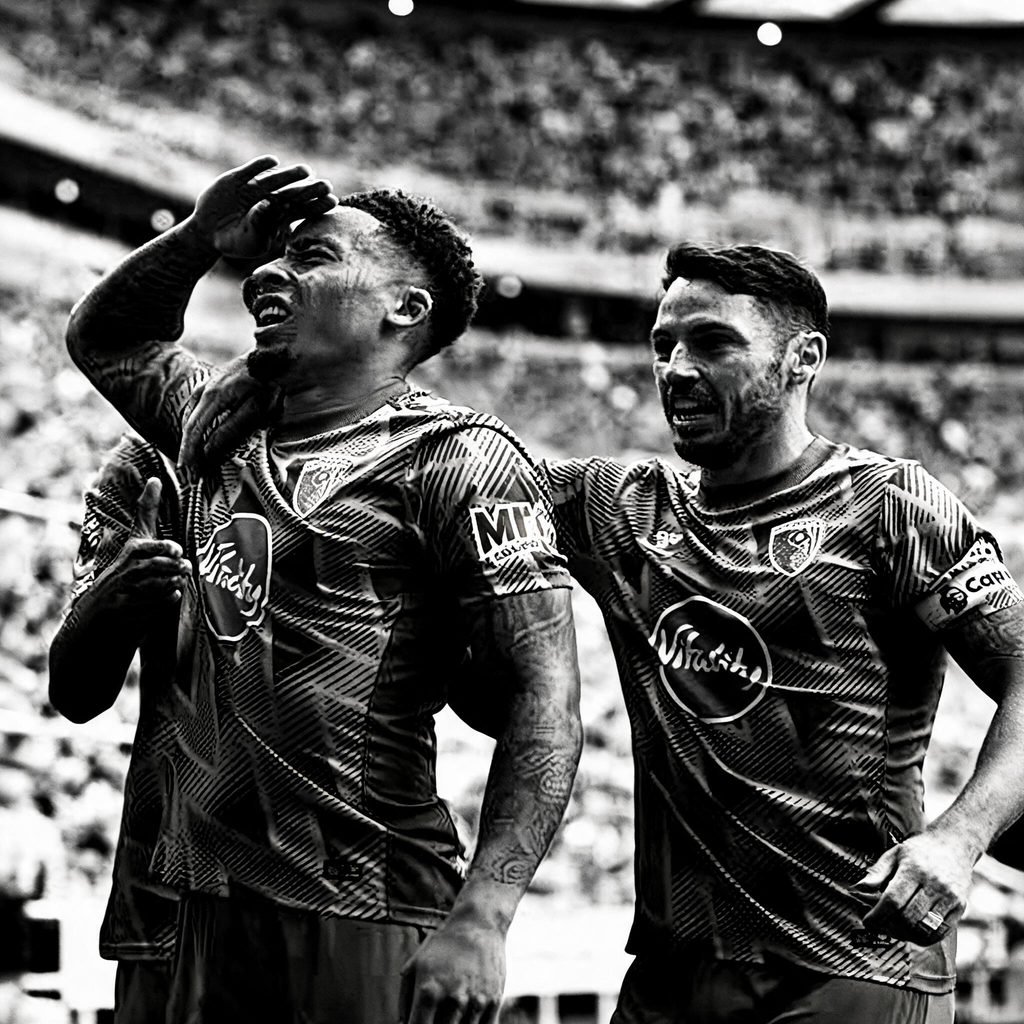
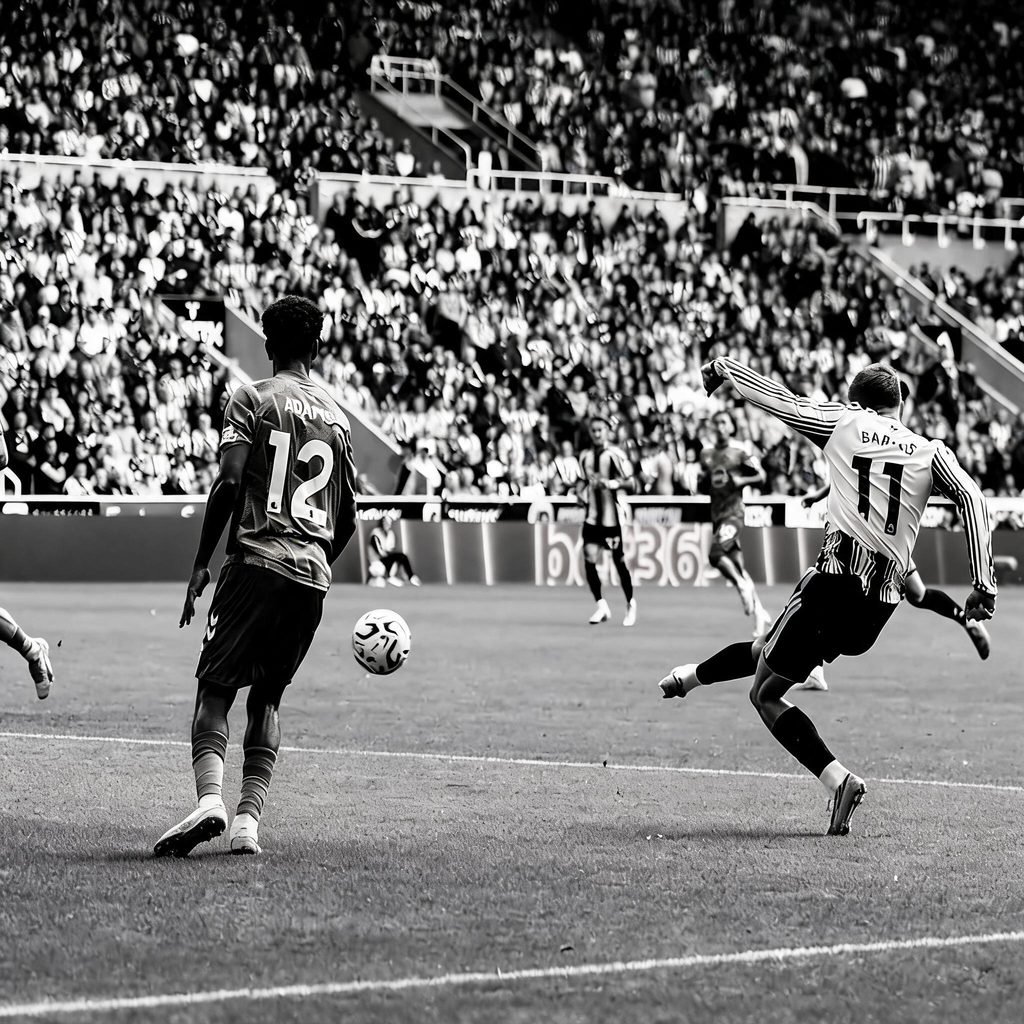
    Less than two minutes after Thiaw’s own goal, Lewis Hall slid the ball down the left channel, Barnes collected it, cut inside onto his right foot and curled a shot into the far top corner from the edge of the box. The underlying numbers rate the chance at 0.11 expected goals. The execution rated 0.83 on target. In plain English: nobody scores that shot, and he scored it.

    Football is not usually decided by moments of individual defiance. It just is often enough that teams keep believing in them. Had that ball gone two feet wider, Newcastle go in three down or two down and dead, Jaissle’s substitutions become damage limitation rather than intervention, and this article is about a very different afternoon.

    The Referee, and a Problem the League Has Not Solved

    The second half is where the argument starts.

    Newcastle came out quicker, sharper and with a settled idea of where the game was to be won. They did not get the chance to build any rhythm — and that was by design, though not solely Bournemouth’s.

    Thirty-five fouls were awarded across ninety minutes. Rob Jones’s own season average coming into this fixture ran at 22.7 fouls per game, itself flagged as above the Premier League norm. This match ran hotter and choppier than his usual, and it ran that way at exactly the moment Newcastle needed continuity. Bournemouth’s players, comfortably ahead, discovered a succession of ailments requiring attention. Physios came on in rotation. Every restart took a beat longer than it needed to.

    One passage captures it precisely. Shortly after coming on, Matias Fernandez-Pardo won a free-kick thirty-four yards from goal — the sort of set-piece that keeps a siege alive. The whistle went again for something else, and the moment evaporated. Jaissle, whose reading of the situation was entirely correct, collected the first booking of his Premier League managerial career in the seventy-first minute for saying so. Six minutes were added at the end.

    Let us be precise about the complaint, because it is not the tired one. Bournemouth were entitled to manage the game; every side ahead in the eighty-second minute does the same, and Newcastle would have done it too. The issue is that the Premier League spent years introducing stopwatch timekeeping specifically to make this behaviour unprofitable — precise added time for treatment, substitutions, celebrations, delay. Howard Webb promised the clampdown was not a matter of “days and weeks.” Three seasons on, a visiting side slowed a match to a crawl at St James’ Park and it worked, right up until it didn’t.

    The pre-season assessment of the 2026-27 officiating pool framed the coming year’s real test not as new technology or fresh guidance, but as whether the same foul, the same holding offence, the same threshold for stopping play is judged identically in August and in May. Saturday was a data point. It will not be the last, and it will not only ever fall against us.

    Jaissle’s Hour

    Now the part that should genuinely encourage you.

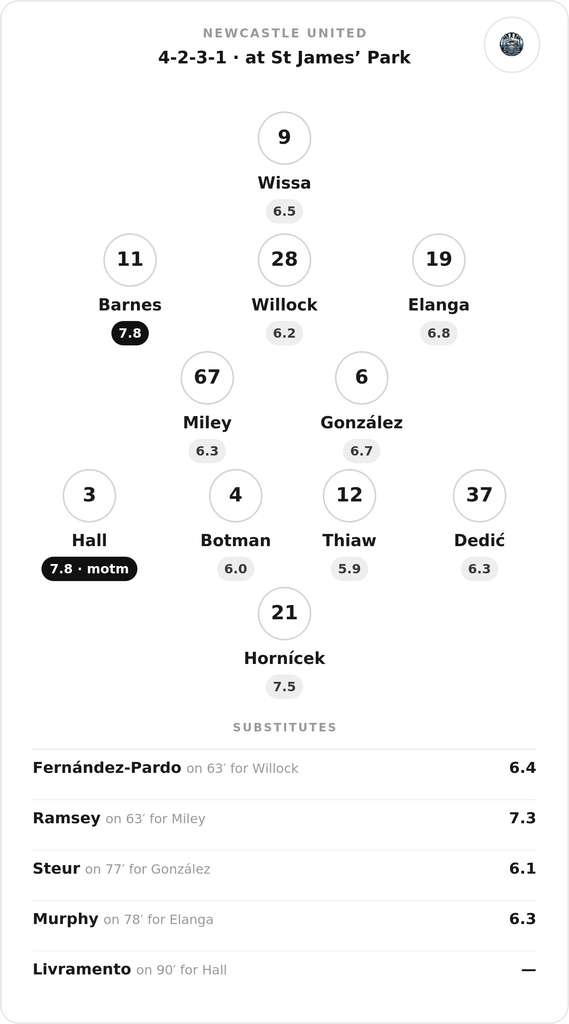
    At sixty-three minutes, still 1-2 down, still creating little, Jaissle removed Joe Willock and Lewis Miley and sent on Fernandez-Pardo and Ramsey together. Not a late throw of the dice — a considered intervention with nearly half an hour left, from a manager who had watched the first half and concluded that the problem was not effort but structure.

    The numbers either side of that change are stark. Bournemouth outshot Newcastle 13-3 before the break; after it, Newcastle edged the shot count 5-4 and the expected goals 0.57 to 0.08. The Cherries, who looked genuinely unplayable for half an hour, simply stopped being able to reach Newcastle’s box. Possession shifted, but more importantly the shape of possession shifted — quicker, straighter, forward.

    Twenty-five minutes after arriving, Ramsey scored.

    And the crowd, it must be said, did as much of the work as the tactics board. Fifty-two thousand six hundred and forty-three inside a full house, and by the closing quarter they had turned St James’ Park into something Bournemouth visibly did not want to be standing in. Speaking to Match of the Day afterwards, Jaissle said: “I have mixed feelings. But after that start, you should be happy. But if we could have performed at the best level over 90 minutes, we could have had all three points. We couldn’t match Bournemouth’s intensity in the first half and conceded twice.”

    That is the correct read. This was not a good performance. It was, however, evidence of a thing this club has conspicuously lacked. Last season Newcastle led the division in points thrown away from winning positions. On Saturday they were the ones doing the clawing.

    The Best Player Was Not the One Who Scored

    Harvey Barnes produced the moment. Lewis Hall produced the performance.

    Both were rated 7.8, but the composition differs entirely. Hall supplied the assist for Barnes’s goal, made thirteen ball recoveries — more than any player on the pitch, in either shirt — completed 87 per cent of his passes and played nine line-breaking passes from left-back. When Newcastle were being overrun, he was the one repeatedly winning the ball back and pointing it forward. When they were chasing, he was the platform underneath the chase.

    Yoane Wissa ran ten kilometres and hit 33.7 km/h without registering a single shot, which is its own kind of thankless. Nico González played more line-breaking passes than anyone on the pitch — twelve — while also conceding six fouls and being dribbled past three times, a rookie’s afternoon in an English midfield.

    But Hall is the answer. Barnes won the highlights reel; Hall won the hour.

    Twenty-Seven Minutes of a £51m Question

    Friday’s preview predicted Jaissle would introduce Fernandez-Pardo gradually, from the bench, rather than disturb a functioning front line. That is precisely what happened, and the Belgian’s afternoon lasted twenty-seven minutes.

    He did not score, did not assist, and was thoroughly upstaged by the man who came on alongside him. What he did do was cover 875 metres at running pace and register nine sprints in under half an hour, take three touches inside the Bournemouth box, and beat his man the one time he tried. He also won the free-kick that the referee’s whistle promptly buried.

    Flashes, then. Nothing more, and nothing to worry about. Jaissle called it “a lot of quality” and stressed the need to manage a young player carefully. Judgement deferred, which is exactly where it should sit.

    What’s Next

    Newcastle travel to Millwall on Tuesday for a Carabao Cup third-round tie that will hand minutes to the players who did not get them here — and Tino Livramento, who Friday’s preview said would not be risked, has already returned for a stoppage-time cameo. Then Leeds away on Monday the fourteenth, and Hull City at St James’ Park the following Saturday. Five points from three games with a trip to Elland Road next is a perfectly respectable platform; it is also a schedule with no more free passes in it.

    Bournemouth host Lincoln City on Tuesday and Brentford next Saturday, and Rose’s problem is now a matter of public record. His side became the first team in Premier League history to score first in each of their opening three fixtures and win none of them. They have dropped seven points from winning positions already this season and twenty-nine since the start of the last — a figure they share, with some irony, with Newcastle. Four of the five goals they have conceded this term arrived after the eightieth minute. “If we can’t finish the games,” Rose said afterwards, “we need to defend our goal like it’s the last game of our lives.”

    The hoodoo stands at nine. We still cannot beat them.

    But for the first time in a long while, the story on the way back down Barrack Road was not about what Newcastle let slip. It was about what they refused to. Friday’s column asked whether this team could handle the sudden, uncomfortable presence of expectation. They failed the first half of that examination badly, and then they answered it in the only currency that has ever mattered on Tyneside.

    They did not give in.

    What do you think about the fightback from 2 goals down? Shall Pardo start the next league game against Leeds? Join the conversation on X @mytoonarmy #NUFC