Manchester City have until Friday to appeal. The League’s own process should take weeks. The courts, and the compensation claims that follow, could take years.
It took 21 months.
That is how long an independent commission needed to reach its verdict on Manchester City after the hearing ended in December 2024. The answer was guilty on 114 of the 115 charges.
So how long until it is actually over? Longer than the appeal. Possibly years longer.
This piece follows our four-part series on the verdict and what it means for Newcastle. Here we look at one question only: the clock.
What City were found guilty of
According to Sky Sports, the commission found that City used “sham” contracts with commercial partners to make their income look bigger and their costs look smaller, by more than £900 million in total.
It also found the club filed accounts that hid its true finances from auditors and regulators, broke both Premier League and UEFA spending limits, and failed to co-operate with the League’s investigation.
Two things are still open: the punishment, and when anyone can say the matter is closed.
Step one: Friday’s deadline
City have said they will appeal, and the clock is short.
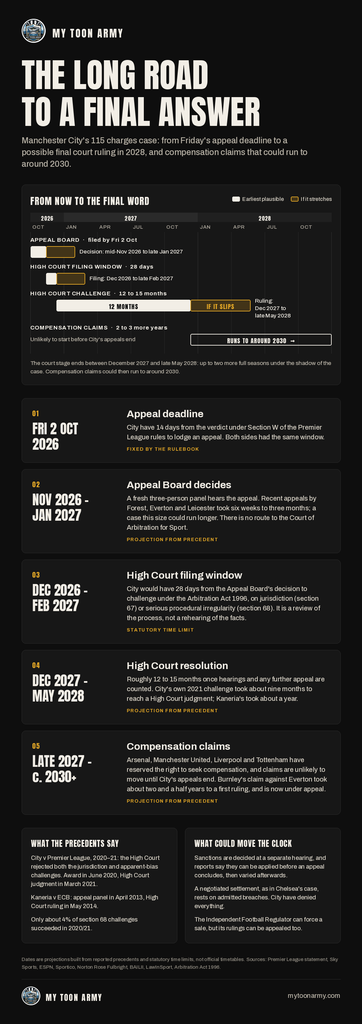
The Premier League’s rulebook gives each side 14 days from the judgment to appeal. (The relevant part of the rulebook is called Section W.) Sky Sports reports the deadline as Friday 2 October, and other outlets give the same date.
City’s response has been defiant. The club says it is disappointed and surprised, insists it is innocent, and promises to be “relentless” in any legal forum. Nobody expects it to let the deadline pass.
Step two: the Appeal Board
The first appeal stays inside the League’s own system, and it should be quick.
It goes to a fresh three-person panel. One member must have held judicial office, and that person chairs it. It meets in private. It can uphold the original decision, overturn it, or change it.
How long will it take? The best guide is recent history. Appeals by Nottingham Forest, Everton and Leicester City took between roughly six weeks and three months.
City’s case is far bigger, so it is fair to expect the slow end of that range, or longer. Counting from Friday, that points to a decision between mid-November 2026 and late January 2027. That range is this blog’s own projection, built from those earlier cases, not an official timetable.
One door is already shut. City cannot go to the Court of Arbitration for Sport, where they overturned a two-year UEFA ban in 2020. League rules keep these disputes in England and Wales.
So the Appeal Board has the last word inside football.
Step three: the High Court
It does not have the last word in law.
City could ask the High Court to step in, but the door opens only a crack. English law treats private arbitration, like the League’s process, as final. The Arbitration Act 1996 guarantees only two ways to challenge it in court:
- The panel had no power to hear the case. Lawyers at Norton Rose Fulbright think this is highly unlikely to apply here.
- Something went seriously wrong in how the case was run, and it caused a real injustice. Lawyers call this a “section 68” challenge.
Either way, a judge would look at how the case was run, not at what City did. There would be no rehearing of the evidence, and nobody would re-argue whether the contracts were shams.
City would have 28 days from the Appeal Board’s decision to file. On our projection, that means between December 2026 and late February 2027.
The odds are long. Only about 4 per cent of section 68 challenges succeeded in 2020/21, according to figures cited by the law firm Clifford Chance.
City know this ground well. In an earlier dispute with the League over its demands for documents, they argued the arbitrators were biased because of how they had been appointed. The High Court rejected that argument in March 2021. A new challenge would be a fresh case, but bias is the obvious argument to try again.
How long would the High Court take?
Two earlier cases give us a guide.
City’s own challenge took about nine months: the tribunal ruled in June 2020, and the High Court judgment came in March 2021. (A Court of Appeal ruling that July dealt only with whether the judgments could be published.)
In cricket, Danish Kaneria challenged a ruling against him by the England and Wales Cricket Board. The appeal panel ruled in April 2013 and the High Court in May 2014, about a year later.
So a first High Court judgment tends to take nine months to a year. Allow for a possible further appeal and the sheer size of this case, and 12 to 15 months looks like a sensible window. That is our estimate, not a reported figure.
Put the stages together:
- Best case: a final High Court ruling around December 2027.
- Worst case: late May 2028.
That is up to two more full seasons played under the shadow of the case. And it assumes City lose at the Appeal Board and then choose to go to court.
And then come the bills
None of that counts the compensation claims. They could add years.
Arsenal, Manchester United, Liverpool and Tottenham sent formal legal notices in November 2024, reserving the right to seek compensation if City were found guilty. Reports say their claims could be worth more than £200 million between them, for lost prize money, Champions League income and commercial revenue.
Why November 2024? Claims like these generally have to be brought within six years. The clubs feared the clock had started in November 2018, when leaked documents about City’s finances first surfaced, so they acted before it ran out.
Claims would be heard inside the League’s own arbitration system, as Burnley’s claim against Everton was, rather than in open court. The principle that one club can recover damages from another for breaking the League’s rules is established. Norton Rose Fulbright points back to Sheffield United’s successful claim against West Ham over the Carlos Tevez affair.
Could other clubs join in? Reports say executives are discussing a joint approach, and clubs could also ask the League to seek redress on their behalf. But clubs that did not act in 2024 may face the argument that they are out of time, though English law can extend deadlines where wrongdoing was deliberately concealed. We have seen no report of a group claim being filed.
What about Newcastle?
The right to claim is one thing. Proving the loss is another.
A club has to show what it actually lost. Manchester United, Liverpool, Arsenal and Tottenham have the clearest cases: titles and Champions League places that went elsewhere.
Newcastle spent two of the nine seasons in question in the Championship and finished in the top five only once, in 2011/12. On the face of it, that makes a claim much harder to build, even before any argument about time limits. We have seen no report that Newcastle have taken advice on one.
How long would compensation take?
The best guide is Burnley against Everton.
Everton were docked points in November 2023 for breaking financial rules in a single season, and the penalty was cut on appeal in February 2024. Burnley then pursued compensation, arguing that Everton’s breach had cost Burnley their place in the Premier League when they went down in 2022.
A Premier League commission ruled in Burnley’s favour in June 2026, ordering Everton to pay more than £35 million including interest. Everton say the decision is flawed and are appealing, with a hearing due in January.
So one club’s claim over one season took about two and a half years from Everton’s original punishment to a first ruling, and it is still not finished.
City’s case covers nine seasons and more clubs.
Reports say formal claims are unlikely to move until City’s own appeals are exhausted. If City go all the way to the High Court and the Burnley pattern holds, claims might not get going until late 2027 or 2028, then take another two to three years.
That points to around 2030, perhaps later.
What could speed things up, or muddy them
Three things could change the picture.
The sanctions hearing. The verdict and the punishment are separate stages. A separate hearing will decide the sanction, and Sky Sports reads the League as wanting that done this season.
Reports suggest a sanction can be applied before the appeal ends, then changed afterwards. Al Jazeera sets out the dilemma. Punish City early and they could be relegated before they have had a chance to overturn the verdict. Wait, and other clubs could lose their top-flight place or a European spot in the meantime.
A settlement. Chelsea settled their own case with the League, but only after admitting breaches. City have admitted nothing.
The new regulator. The Independent Football Regulator has the power to force a club sale and put trustees in charge. Any such decision could itself be challenged. It is a second front, not a shortcut.
The bottom line
The verdict took 21 months.
If City go all the way to the High Court, the League and court stages could run another 14 to 20 months. The compensation claims could take years after that.
On this reading, we could still be talking about Manchester City’s finances around 2030.
Leave a Reply