
Inside the corridors of St James’ Park, the thrill of sovereign wealth has met the cold, unyielding mechanics of modern football regulation. While headlines fixate on the unfathomable depth of Saudi Arabia’s Public Investment Fund (PIF) balance sheet, Newcastle United operates inside a financial straitjacket defined by UEFA’s Squad Cost Rule (SCR) and the Premier League’s evolving financial guardrails.
To understand how a modern football powerhouse is built in the 2020s, one must look past oil reserves and focus on balance sheet accounting.
1. Understanding the Regulatory Ceiling: UEFA’s Squad Cost Rule (SCR)
The traditional era of unconstrained owner funding is dead. Under UEFA’s Financial Sustainability Regulations, clubs participating in European competition are bound by the Squad Cost Rule (SCR), which limits aggregate squad expenditure to a maximum of 70% of total club revenue (plus net transfer profit).
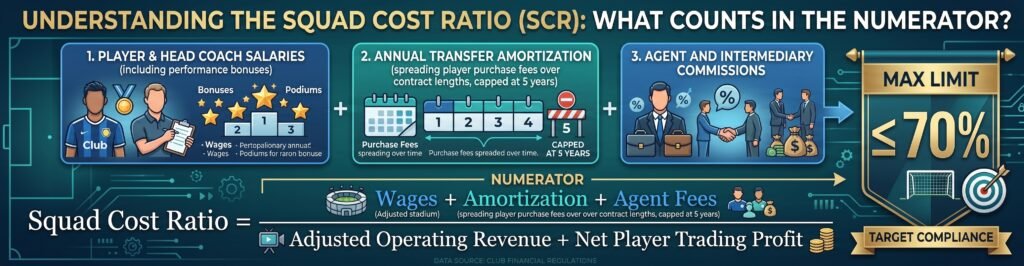
With Newcastle United’s latest turnover reaching a record £335.3 million (boosted by a 44% surge in commercial revenues to £120.2 million), the mathematical limit becomes immediately apparent:
- Baseline Turnover: ~£335m – £360m
- 70% Hard SCR Cap: ~£235m – £252m maximum allowable squad spend.
Prior to recent squad restructuring, Newcastle’s staff costs alone stood at £243.5 million (72.6% of turnover), while annual player amortization hovered near £99.9 million. Without player sales or dramatic commercial growth, Newcastle had effectively hit their regulatory ceiling—leaving zero operational space for gross transfer spending.
2. The Balance-Sheet Reset: Summer Transfer Audit
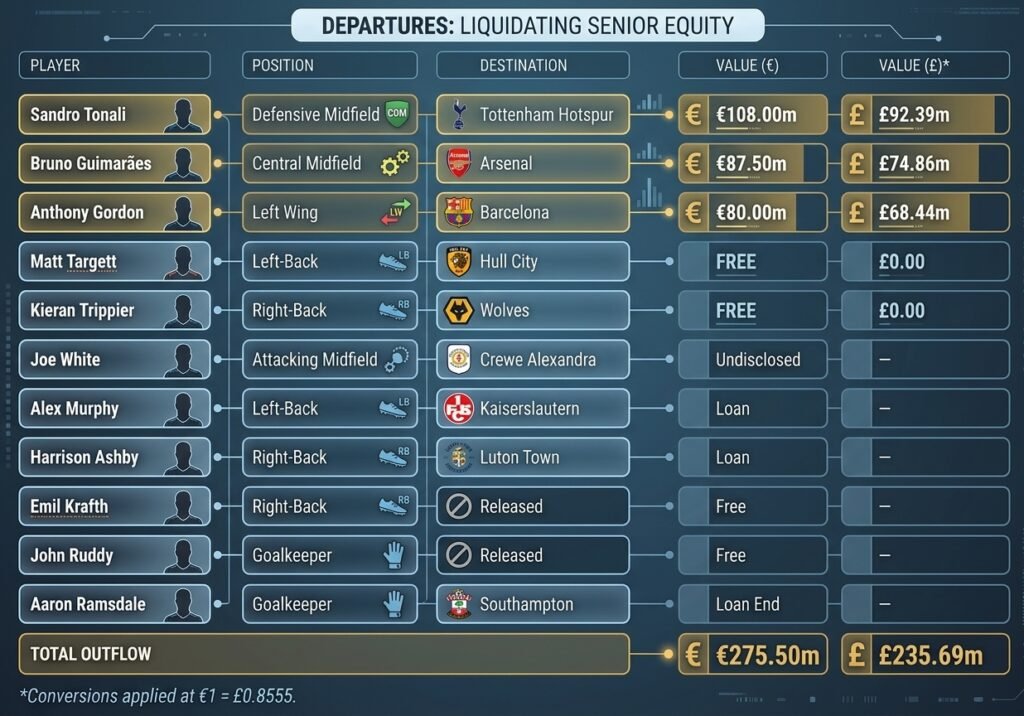
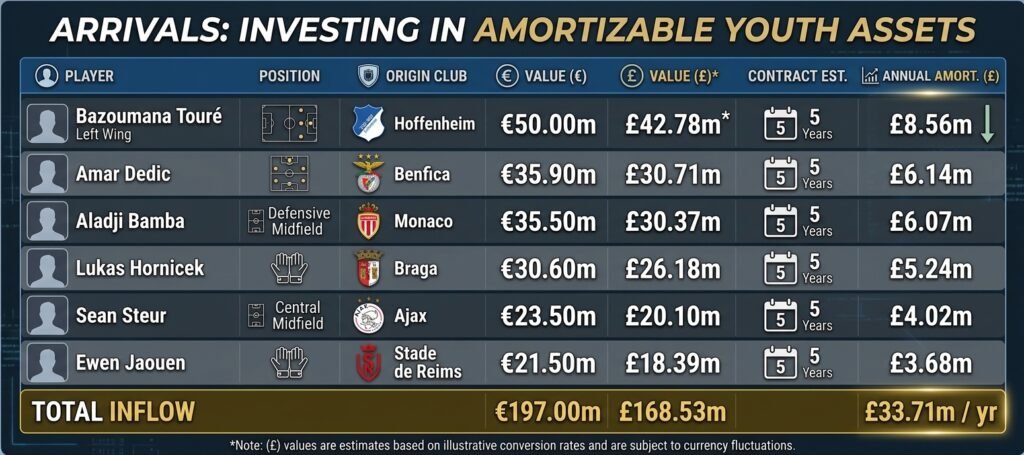
To break through this structural bottleneck, Newcastle executed a deliberate, high-stakes portfolio rebalancing during the transfer window.
3. The Accounting Asymmetry: How Much Can Newcastle Spend Now?
The financial genius of this window lies in the structural asymmetry between player sales and player acquisitions on a club’s Profit & Loss (P&L) statement.
Amortization vs. Instant Profit Realization
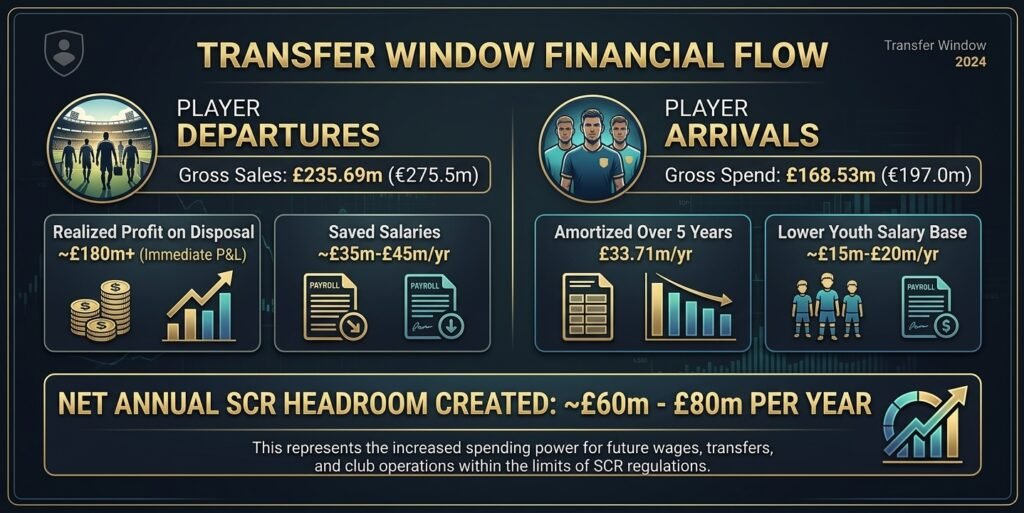
- Immediate P&L Credit: The £235.69m generated from selling Tonali, Bruno, and Gordon hits the accounting books as an immediate profit on disposal (minus any unamortized remaining book values).
- Deferred Expense: The £168.53m spent on incoming players is divided equally over 5-year contracts, resulting in an annual amortization charge of just £33.71m.
- Wage Cleansing: Offloading senior star wages (Tonali, Bruno, Trippier, Targett) clears an estimated £35m+ per year, easily offsetting the lighter wage requirements of younger recruits like Touré, Dedic, and Bamba.
Real Transfer Capacity Under the 70% SCR Cap
With the wage bill re-anchored and £180m+ in book profits feeding the SCR denominator, Newcastle has created roughly £60m to £80m of fresh annual headroom within their 70% threshold.
Because transfer fees are amortized over five years, every £20m of annual SCR headroom supports £100m in gross transfer spending capacity (assuming modest wages).
- Available SCR Headroom: £60m–£80m / year
- Gross Spending Capacity Unlocked: £200m – £280m in future transfer outlays, without breaching UEFA limits.
4. The 5-Year Roadmap: Patiently Growing Turnover
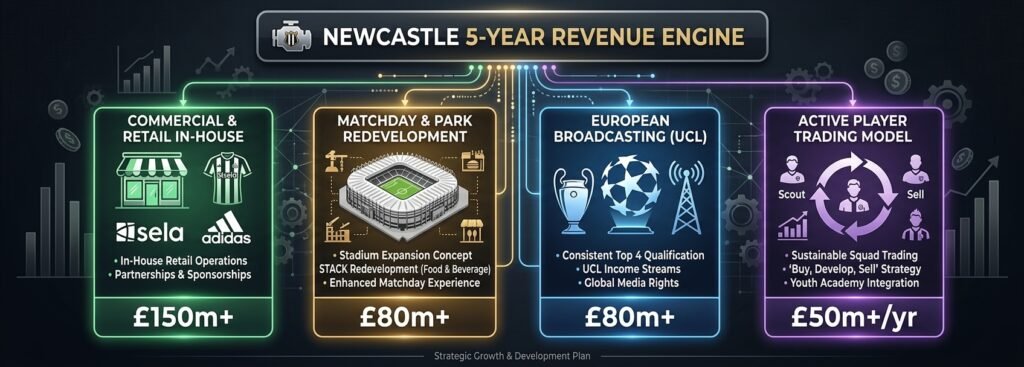
Sustained competitive success cannot rely indefinitely on liquidating key assets. To achieve permanent parity with European super-clubs, Newcastle must organically expand the SCR denominator (Total Revenue) over the next five years through four core pillars:
- Commercial & Retail Expansion (£150m+ Target): Bringing retail and licensing back in-house, coupled with the success of the St. James’ STACK powered by Sela (soon to be Coca-Cola) drove commercial revenue up 44% to £120.2m. Expanding tier-one global sponsorships (adidas, SumUp, Noon) will push this baseline beyond £150m annually.
- Matchday & Infrastructure Yield (£80m+ Target): With matchday revenue lingering at ~£51.6m due to stadium capacity constraints, long-term plans to expand St James’ Park or modernize hospitality offerings will be crucial to increasing matchday yield toward the £80m–£100m figures seen at Arsenal and Tottenham.
- Consistent European Qualification (£70m–£100m / season): Champions League distribution fees and UEFA prize money provide an instant 20–25% lift to total turnover, expanding the 70% SCR expenditure cap organically.
- Normalized Player Trading Flywheel: Selling Bruno, Tonali, and Gordon proves that Newcastle has embraced the “buy-develop-sell” flywheel. Developing prospects like Touré (£42.78m) or Steur (£20.10m) into £80m+ players ensures a recurring stream of player-disposal profits to supplement operating revenue.
Conclusion: The New Tyneside Blueprint
The £235.69m summer sell-off was not a step backward—it was the mandatory execution of modern football finance. By trading high-wage senior stars for amortizable youth talent, Newcastle United reset their squad cost ratio, unlocked over £200m in forward spending capacity, and protected themselves against regulatory sanctions.
As commercial revenues continue their upward trajectory toward £400m+ turnover, Newcastle’s balance sheet will evolve from a compliance constraint into an unstoppable, self-sustaining financial engine.
Do you think the plan will work? Will Newcastle become a financial powerhouse in the years to come? Join the conversation on X @mytoonarmy #NUFC
Responses
[…] Jaissle views this fixture as an essential litmus test for Newcastle’s squad architecture. Under strict SCR frameworks, the club’s recent transfer windows were calculated not just to strengthen the starting XI, but […]
[…] the kind of self-funding, needs-based trading that a club still managing its Profit and Sustainability position — even one backed by PIF’s resources — has to make work on its own terms. […]
[…] those two columns side by side and the strategy stops being a mystery. Newcastle have converted three mature, fully-amortised assets into cash at the top of their valuatio…. The profit on the sales lands in a single accounting period. The cost of the arrivals is smeared […]