This is Part One of a four-part My Toon Army series on Manchester City’s Premier League charges and what the whole saga means for Newcastle United’s own position under Saudi ownership.
On Thursday, in a Premier League shareholders’ meeting, the division’s clubs were told the outcome of the biggest disciplinary case English football has ever heard — and then made to sign non-disclosure agreements. The silence held for barely a day. On Friday, David Ornstein of The Athletic reported what those executives had been told: an independent commission had found Manchester City guilty on 114 of the 115 charges brought against them.
Say it plainly. For nine consecutive seasons, the commission found, Manchester City’s accounts did not tell the truth. And when the Premier League came asking questions, City spent the best part of four years refusing to help it find the answers. This was not a clerical slip or a misread rulebook. It was a system, and it ran for a decade.
No sanction has yet been decided, City are expected to appeal, and the League itself has published nothing, citing a confidential process. But City’s response told its own story. According to ESPN, the club refused to deny the reports when approached, and its statement insisted it had respected due process for eight years on the basis that the League would act as a fair-minded regulator “free from partisan influence.” Even with 114 findings against them, City were still questioning the referee.
Meanwhile, the club found guilty of building its empire on false accounts sits top of the Premier League, five wins from five under Enzo Maresca. The dividends of those nine seasons are still being paid out every weekend.
What the emails said
The paper trail begins in November 2018, when the German magazine Der Spiegel published a series built on hacked internal City correspondence from the Football Leaks archive. Its reporting described backdated contracts, illusory sponsorship payments and a “we can do what we want” culture at the top of the club.
The detail was specific enough to follow the money. City’s Etihad deal was said to be worth £67.5 million a year, but according to an internal email from the club’s chief financial officer, Jorge Chumillas, £59.9 million of it was channelled back through the owner’s holding company, the Abu Dhabi United Group. Another email reportedly flagged a £9.9 million Financial Fair Play shortfall after Roberto Mancini’s sacking in 2013, and proposed plugging it with extra Abu Dhabi sponsorship. City, the Associated Press noted at the time, did not dispute the authenticity of any of the emails.
The first escape
UEFA moved first. In February 2020 it banned City from the Champions League for two seasons and fined them €30 million. City took the case to the Court of Arbitration for Sport, and that July the ban was overturned. CAS ruled that most of UEFA’s allegations were either not established on the evidence before it or time-barred under UEFA’s five-year limit.
City called it vindication. Read the ruling, though, and the picture is less flattering. CAS still fined the club €10 million, citing City’s disregard for the duty to cooperate and its “obstruction of the investigations.” Remember that word. It comes back.
Nor was 2020 City’s first brush with European regulators. In 2014, UEFA had already sanctioned them for FFP breaches, with a €60 million fine, a spending cap and a trimmed Champions League squad. By the time the Premier League case began, City had been punished once for breaking Europe’s spending rules and once for obstructing the people enforcing them.
The Premier League’s rules carry no five-year limit, and this time there was no clock to run down. The League opened its investigation in December 2018, and after more than four years of forensic accounting work, City were charged in February 2023 over a pattern stretching across nine seasons, from 2009-10 to 2017-18. That window covers the entire arc of City’s transformation from mid-table also-rans into the dominant force in English football.
The charge sheet breaks into five categories, and the anatomy of it is easier to take in at a glance than in a paragraph of numbers:
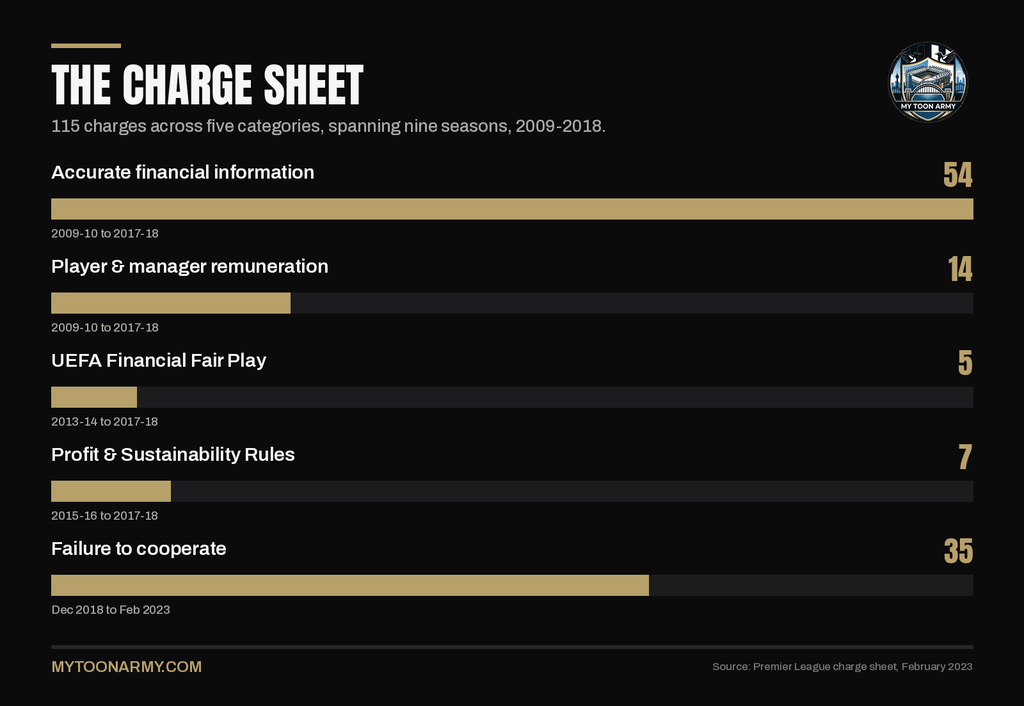
Look at the last bar. Thirty-five charges, close to a third of the case, have nothing to do with what City’s accounts said. They concern how the club behaved once it knew investigators were looking, from December 2018 onwards. While CAS was fining City for obstructing UEFA, the Premier League says the same conduct was happening on home soil, and it carried on for years afterwards. That is not a club caught out by complexity. It is a club that decided, again and again, that the regulators should not see what was in the books.
The trial and the wait
The hearing finally opened in September 2024, before a three-person independent commission, and ran for roughly twelve weeks until December. Back in February 2023, the club had promised the commission a “comprehensive body of irrefutable evidence.” Of 115 charges, it has seemingly persuaded the panel on one.
Then came the wait. Early forecasts pointed to a verdict in the first months of 2025. It slipped to the summer, then past the start of 2025-26 altogether. Twenty-one months passed between closing arguments and Friday’s report.
Delay in a case like this is never neutral, and it only ever benefits one side. Since being charged in February 2023, City have added two more league titles and a Champions League to their honours, signed fresh sponsorship deals, and sold their success around the world, all under a status the commission has now found was built on rule-breaking.
What the commission can actually do
Here the story becomes less satisfying, not more. There is no published formula linking a number of upheld charges to a set punishment. Under Rule W.51, the commission can impose an unlimited fine, deduct points, and recommend that City be expelled. The operative word is “recommend.” The commission cannot throw City out on its own authority.
Expulsion runs through Rule B6 of the Premier League Handbook, which requires a Special Resolution, with 15 of the 20 clubs voting in favour. No club has ever been expelled from the Premier League. For it to happen here, three-quarters of the division would have to vote to remove one of its biggest broadcast draws. The clubs City cheated out of titles and prize money would, in effect, be asked to damage their own product to punish the club that wronged them. It would be brave to bet on that.
Nor is title-stripping written into the rulebook as a sanction. Some reporting has raised the prospect that retrospective punishments could reach back to the trophies themselves, but nothing of the sort has been decided. Unless that changes, City keep everything they won inside the charge window: three Premier League titles, an FA Cup and three League Cups, plus the 2012 Community Shield. Eight trophies from nine seasons that an independent panel has now found were not played on equal terms.
The appeal that could take just as long
City have 14 days from the ruling to lodge an appeal. It would be heard by a fresh three-person appeal board, appointed by the independent chair of the Premier League’s Judicial Panel and separate from the commission that has just ruled.
One exit is sealed this time. Unlike 2020, there is no route to the Court of Arbitration for Sport. This is a domestic Premier League arbitration, and an appeal board’s decision is effectively final, open to challenge in the ordinary courts only on narrow procedural grounds rather than on the merits. City cannot escape on a technicality in Lausanne a second time.
How long the appeal will take is the honest unknown, and the usual comparisons undersell the difference. Everton’s 10-point deduction, handed down on 17 November 2023, was cut to six on appeal on 26 February 2024 — a little over three months. Nottingham Forest’s four-point deduction was appealed and dismissed inside about seven weeks. Both moved fast for the same reason: both clubs admitted their breach and appealed only the size of the punishment. There was no dispute left to relitigate, only a number to argue over.
City have never conceded a single one of the 115 charges, and nothing in Friday’s reporting suggests that’s about to change. An appeal that only argues sanction is a different exercise, and a much shorter one, than an appeal that continues to deny the underlying findings themselves. Richard Masters, the Premier League’s own chief executive, told a parliamentary committee that City’s case was being heard in what he called “a completely different environment” to Everton’s and Forest’s, precisely because of the volume and character of the charges. Add City’s case spanning 114 upheld charges, five categories of rules and nine seasons of evidence, and scaling Everton’s three months up to something of this size is guesswork, not arithmetic. A final answer before the second half of the season looks optimistic, and every week of waiting is another week City play on at the top of the table.
That is the part that must not get lost beneath the procedure and the legal chess. The titles, the cups, and the climb from a club that played in English football’s third tier as recently as 1998-99 to the most commercially powerful institution in the country did not happen in spite of what the commission says went on between 2009 and 2018. On the panel’s own findings, a meaningful part of it happened because of it.
Eight trophies, nine seasons, one guilty verdict. Every medal from that decade now carries a question City’s lawyers cannot make disappear, however long the appeal takes.
Part Two follows the receipts: the seasons, the signings, the results, and the clubs now counting what those nine years cost them. It follows tomorrow.
Leave a Reply