
Data Driven Insights. Fearless Opinions.

SCR

  • The Passer Who Plays It Safe: Why Nico González Solves Newcastle’s Midfield Problem

    Welcome, Nico Gonzales!

    Sixty-eight. That’s the number of successful passes per 90 minutes Nico González has averaged since his Premier League debut — a figure bettered by exactly one midfielder in the competition. His name is Rodri. Everyone else sits behind a 24-year-old Galician who Manchester City signed as an emergency understudy and is now, in the final week of August 2026, boarding a car north to complete a move to St James’ Park worth up to £52m.

    There is a version of this transfer that reads as vanity spending — a club flush with sovereign wealth topping up a midfield that, on the surface, already looks crowded. That version misses the point entirely. Newcastle didn’t lose a player this summer. They lost a spine. Bruno Guimarães left for Arsenal, Sandro Tonali left for Tottenham, and Matthias Jaissle was handed a training pitch at Darsley Park with a gaping hole where his double pivot used to stand. González isn’t an addition to strength. He’s a replacement for two departures at once, and the numbers explain, with unusual precision, why he can do that job.

    The vacancy Jaissle actually has

    Strip away the sentiment around Guimarães’s vision and Tonali’s engine, and what Newcastle really lost was a specific mechanical function: a body that could receive under pressure, keep possession alive through crowded central areas, and win it back the moment it was lost. Joelinton can still occupy that zone. Joseph Willock and Jacob Ramsey offer energy further forward. Lewis Miley, barely into his twenties, has the technical range to eventually own the base of midfield outright. What none of them quite replicates is the sheer defensive and distributive volume that Bruno and Tonali produced together, night after night, as a pair.

    González doesn’t need to replicate two players. His statistical profile suggests he can function as the connective tissue that makes the other four more effective — freeing Miley to carry the ball into the final third rather than screen the back four, and letting Joelinton drift into the half-spaces he actually enjoys.

    What the data says he actually is

    Here is the uncomfortable truth for anyone hoping for a like-for-like Rodri: González isn’t a deep-lying metronome, and he isn’t a creator either. Across 2025–26 in the Premier League he completed 90.6% of an extraordinary 74.2 passes per 90 minutes — both figures sit in the mid-to-high nineties percentile among Premier League players full stop, not just midfielders. That passing volume is the platform on which everything else about him is built: he rarely loses the ball in possession, and Newcastle’s build-up under pressure has, since Bruno’s departure, badly needed exactly that kind of reliability.

    Where he differs sharply from the archetype City signed him to cover for is in what he does with the ball once it’s progressed. Opta’s data from his final season at Porto found him ranked third in the entire Primeira Liga for carries of ten metres or fewer, and fourth among outfield non-defenders for carries that were immediately followed by a pass — short, sharp bursts that break a defensive line by a few crucial yards rather than the long, diagonal surges associated with a box-to-box runner. It’s a specific, repeatable action: receive, drive, release. Multiply that across ninety minutes and you get a midfielder who manufactures space for others without ever needing to be the headline act himself.

    Defensively, the numbers back up the reputation. He won 2.47 tackles per 90 in his last Premier League season, an 86th-percentile return, alongside 1.32 interceptions per 90 at the same percentile, and he regularly topped 90 ball recoveries across a campaign. At Porto he led the entire squad for possession regains, tackles and aerial duels contested in his final half-season there. At 6ft 2in and built like it, he wins the physical battles that Tonali used to win by craft and Bruno occasionally avoided altogether.

    What he doesn’t do — and Newcastle’s supporters should hear this plainly rather than discover it three months in — is create. His expected-assists return sat at roughly 0.15 per 90 last season, with barely more than half a key pass per game and a non-penalty expected-goals contribution close to zero. Guimarães, for all his defensive lapses, could thread a pass that changed a match. González, on this evidence, will not be that player.

    “Plays too safe” — and why that’s the point

    Pep Guardiola put his finger on the exact trade-off in April, after González had scored the FA Cup semi-final winner against Southampton, when he suggested his midfielder needed to trust his own attacking instincts more, adding that sometimes he plays too safe. It reads, at City, like mild criticism of a talented squad player who never quite forced his way past Rodri. At Newcastle, the same trait becomes the entire point of the signing.

    City didn’t need safety. They needed a goal threat from deep to supplement a front line already stacked with creators, and González’s caution made him surplus to a very specific requirement. Newcastle’s requirement is the opposite. Jaissle’s team, still finding its identity after Eddie Howe’s departure, has spent the opening weeks of the season vulnerable exactly when possession breaks down in the middle third — the residue of losing two midfielders who between them offered composure and aggression in equal measure. A player whose defining statistical trait is retaining the ball at a 90%-plus clip, refusing risk, and winning it back within seconds of losing it, isn’t a limitation in that context. It’s the repair.

    There’s a tactical logic here too. Salzburg sides under Jaissle pressed high and won the ball back inside seconds, trusting a compact defensive structure to force turnovers in dangerous areas before springing vertically. That system demands central midfielders who can execute the recovery — the interception, the tackle, the immediate five-yard carry that turns a defensive stop into an attacking transition — rather than midfielders who need the ball at their feet in space to be effective. González’s whole statistical signature, tackles and interceptions in the 86th percentile paired with elite short-carry numbers, maps almost exactly onto that requirement. He was arguably miscast at City as a creative-minded deputy. At St James’ Park, playing it safe is the job description.

    The ledger behind the deal

    Newcastle’s accountants will recognise the shape of this deal before the supporters do. City paid roughly £50m to activate González’s release clause from Porto in February 2025; Transfermarkt’s most recent valuation of him sits closer to £40m. Reports from Fabrizio Romano and The Athletic’s David Ornstein put Newcastle’s fee at somewhere between £50m and £52m once add-ons are included — a structure of guaranteed money in the high forties with performance-related increments layered on top, the standard architecture of a Premier League deal negotiated under PSR scrutiny. On paper, that means Newcastle are paying above market value for a player City are selling at a discount to what they spent — a trade that only makes sense once you accept the club isn’t buying a name, it’s buying a specific set of defensive and progressive numbers to plug a specific hole, funded substantially by the money recouped from the Guimarães and Tonali sales themselves.

    It’s the kind of self-funding, needs-based trading that a club still managing its Profit and Sustainability position — even one backed by PIF’s resources — has to make work on its own terms. Newcastle’s most recent accounts describe a going concern reliant on continued parental support and secured facilities running to 2028; every transfer window still has to be justified against that backdrop, regardless of who ultimately underwrites it. González isn’t glamour spending. He’s a specific, data-supported fix for a specific, data-visible problem, bought at a price the ledger can accept because the alternative — entering a Champions League campaign with a converted winger and a teenager as the only cover at the base of midfield — carries a cost of its own.

    What actually changes on the pitch

    Picture the pattern that should now recur through autumn: González drops to receive from Botman or Schär under pressure, takes it on the half-turn with that 90%-plus completion rate behind him, and either releases first-time or carries it those trademark ten yards before laying it off. A yard of space opens for Miley to run into. Joelinton, freed from screening duties, drifts into the half-space he’s always preferred. When the move breaks down — and under Jaissle’s pressing structure, it will be designed to break down high up the pitch — González is the one already positioned to win it back within three seconds, in the 86th percentile for exactly that action.

    None of that guarantees Newcastle become more entertaining. It very possibly guarantees they become sturdier, which, three weeks into life without their two best-loved midfielders, is precisely what a club rebuilding under a new head coach actually needs. The Gallowgate End didn’t fall in love with Bruno Guimarães for his defensive positioning. They may end up falling in love with Nico González for exactly that — and for very little else, which, on this evidence, is entirely by design.

    Are you excited about Nico Gonzales’ arrival? Will he be able to deliver in a Jaissle team? Join the conversation on X @mytoonarmy #NUFC

  • SCR Explained: How Financial Rules Force Newcastle United into a Slow-Burn Revolution

    Inside the corridors of St James’ Park, the thrill of sovereign wealth has met the cold, unyielding mechanics of modern football regulation. While headlines fixate on the unfathomable depth of Saudi Arabia’s Public Investment Fund (PIF) balance sheet, Newcastle United operates inside a financial straitjacket defined by UEFA’s Squad Cost Rule (SCR) and the Premier League’s evolving financial guardrails.

    To understand how a modern football powerhouse is built in the 2020s, one must look past oil reserves and focus on balance sheet accounting.

    1. Understanding the Regulatory Ceiling: UEFA’s Squad Cost Rule (SCR)

    The traditional era of unconstrained owner funding is dead. Under UEFA’s Financial Sustainability Regulations, clubs participating in European competition are bound by the Squad Cost Rule (SCR), which limits aggregate squad expenditure to a maximum of 70% of total club revenue (plus net transfer profit).

    With Newcastle United’s latest turnover reaching a record £335.3 million (boosted by a 44% surge in commercial revenues to £120.2 million), the mathematical limit becomes immediately apparent:

    • Baseline Turnover: ~£335m – £360m
    • 70% Hard SCR Cap: ~£235m – £252m maximum allowable squad spend.

    Prior to recent squad restructuring, Newcastle’s staff costs alone stood at £243.5 million (72.6% of turnover), while annual player amortization hovered near £99.9 million. Without player sales or dramatic commercial growth, Newcastle had effectively hit their regulatory ceiling—leaving zero operational space for gross transfer spending.

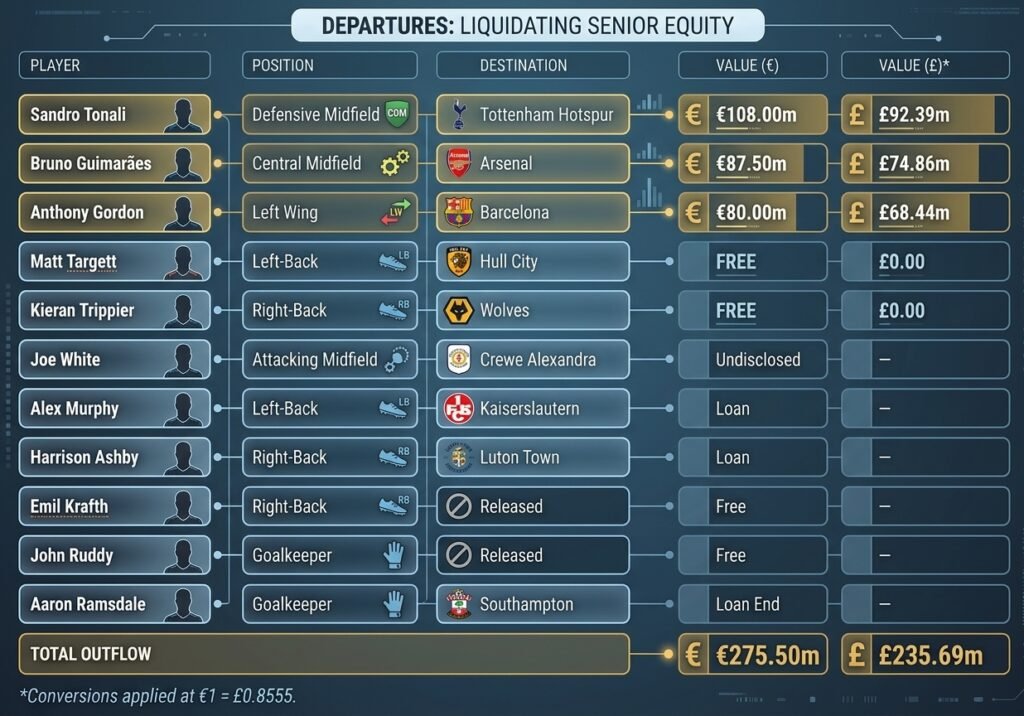
    2. The Balance-Sheet Reset: Summer Transfer Audit

    To break through this structural bottleneck, Newcastle executed a deliberate, high-stakes portfolio rebalancing during the transfer window.

    3. The Accounting Asymmetry: How Much Can Newcastle Spend Now?

    The financial genius of this window lies in the structural asymmetry between player sales and player acquisitions on a club’s Profit & Loss (P&L) statement.

    Amortization vs. Instant Profit Realization

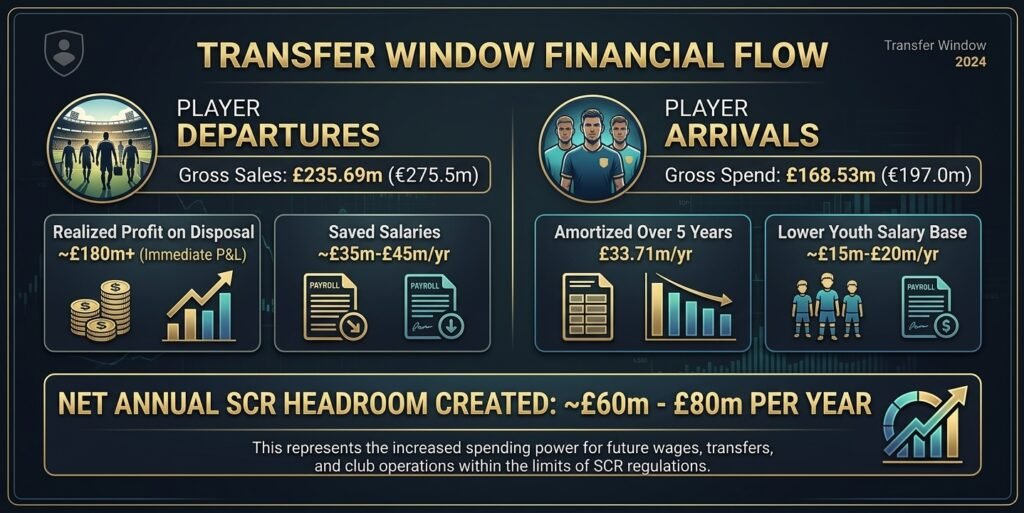
    1. Immediate P&L Credit: The £235.69m generated from selling Tonali, Bruno, and Gordon hits the accounting books as an immediate profit on disposal (minus any unamortized remaining book values).
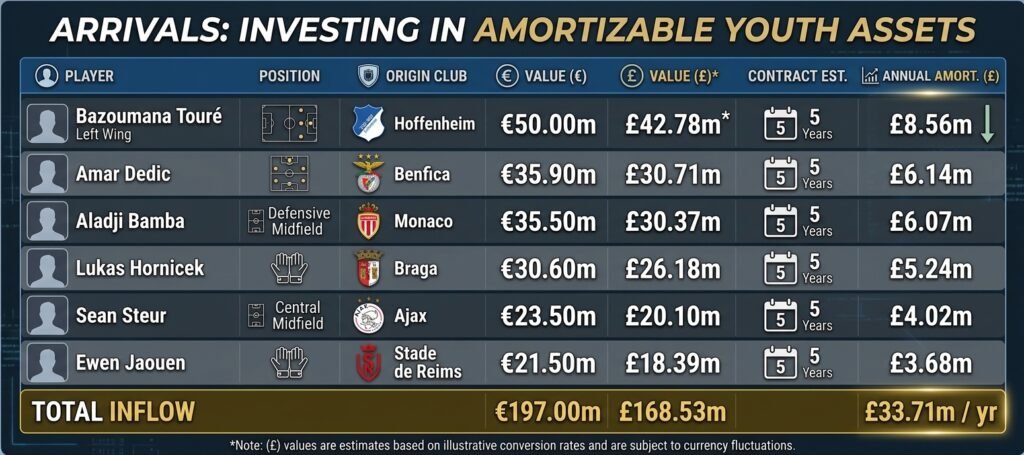
    2. Deferred Expense: The £168.53m spent on incoming players is divided equally over 5-year contracts, resulting in an annual amortization charge of just £33.71m.
    3. Wage Cleansing: Offloading senior star wages (Tonali, Bruno, Trippier, Targett) clears an estimated £35m+ per year, easily offsetting the lighter wage requirements of younger recruits like Touré, Dedic, and Bamba.

    Real Transfer Capacity Under the 70% SCR Cap

    With the wage bill re-anchored and £180m+ in book profits feeding the SCR denominator, Newcastle has created roughly £60m to £80m of fresh annual headroom within their 70% threshold.

    Because transfer fees are amortized over five years, every £20m of annual SCR headroom supports £100m in gross transfer spending capacity (assuming modest wages).

    • Available SCR Headroom: £60m–£80m / year
    • Gross Spending Capacity Unlocked: £200m – £280m in future transfer outlays, without breaching UEFA limits.

    4. The 5-Year Roadmap: Patiently Growing Turnover

    Sustained competitive success cannot rely indefinitely on liquidating key assets. To achieve permanent parity with European super-clubs, Newcastle must organically expand the SCR denominator (Total Revenue) over the next five years through four core pillars:

    1. Commercial & Retail Expansion (£150m+ Target): Bringing retail and licensing back in-house, coupled with the success of the St. James’ STACK powered by Sela (soon to be Coca-Cola) drove commercial revenue up 44% to £120.2m. Expanding tier-one global sponsorships (adidas, SumUp, Noon) will push this baseline beyond £150m annually.
    2. Matchday & Infrastructure Yield (£80m+ Target): With matchday revenue lingering at ~£51.6m due to stadium capacity constraints, long-term plans to expand St James’ Park or modernize hospitality offerings will be crucial to increasing matchday yield toward the £80m–£100m figures seen at Arsenal and Tottenham.
    3. Consistent European Qualification (£70m–£100m / season): Champions League distribution fees and UEFA prize money provide an instant 20–25% lift to total turnover, expanding the 70% SCR expenditure cap organically.
    4. Normalized Player Trading Flywheel: Selling Bruno, Tonali, and Gordon proves that Newcastle has embraced the “buy-develop-sell” flywheel. Developing prospects like Touré (£42.78m) or Steur (£20.10m) into £80m+ players ensures a recurring stream of player-disposal profits to supplement operating revenue.

    Conclusion: The New Tyneside Blueprint

    The £235.69m summer sell-off was not a step backward—it was the mandatory execution of modern football finance. By trading high-wage senior stars for amortizable youth talent, Newcastle United reset their squad cost ratio, unlocked over £200m in forward spending capacity, and protected themselves against regulatory sanctions.

    As commercial revenues continue their upward trajectory toward £400m+ turnover, Newcastle’s balance sheet will evolve from a compliance constraint into an unstoppable, self-sustaining financial engine.

    Do you think the plan will work? Will Newcastle become a financial powerhouse in the years to come? Join the conversation on X @mytoonarmy #NUFC
  • Carabao Cup: Why West Bromwich Albion Pose a Methodical Trap for Jaissle’s Reshuffled Newcastle

    #NEWWBA Carabao Cup

    Barely three days after the thunderclap of Sunday’s contentious brawl with Liverpool echoed down Gallowgate, St James’ Park bracingly turns its gaze toward the unglamorous, high-stakes choreography of domestic cup survival.

    There is a treacherous romance to evenings like this on Tyneside. Midweek fixture congestion under the floodlights has historically tested the depth, nerve, and structural coherence of Newcastle United squads. As Matthias Jaissle prepares his side for the visit of West Bromwich Albion in the second round of the League Cup, the German head coach finds himself walking a tightrope between squad preservation and competitive ruthlessness. Coming off an emotionally draining afternoon against Arne Slot’s side—where high-intensity pressing and physical attrition left several key starters visually depleted—Jaissle must rotate. Yet, to dismiss their Black Country visitors as mere Championship fodder would be to misread the analytical reality of Albion’s early-season resurrection.

    The Anatomy of the Albion Threat: Momentum, Verticality, and Dead-Ball Precision

    To understand the peril West Bromwich Albion bring up the A1, one must look past the league division marker and analyze their tactical blueprint. Albion arrive in the North East carrying the momentum of an unbeaten opening month, characterized by a lethal blend of structural compactness and rapid vertical execution. Far from a passive mid-block, Albion’s tactical identity under their current setup is designed precisely to punish elite sides in moments of transition.

    According to Opta’s underlying metrics, West Brom rank among the top three sides in the Football League for direct speed—measuring how quickly a team moves the ball upfield per second of open-play possession. They average 13.8 progressive passes and 3.1 high turnovers per 90 minutes that lead directly to a shot, demonstrating a frightening efficiency at converting mid-pitch turnovers into immediate penalty-box chaos. Their goal-scoring sprees against Shrewsbury and Bromley were not flukes; they were the product of a side that relentlessly attacks the space behind over-extended full-backs.

    Equally concerning for Newcastle’s coaching staff is Albion’s dead-ball output. Boasting an expected goals figure of xG = 1.42 from set pieces per match, West Brom feature an array of towering aerial targets and intricate short-corner routines designed to exploit second-phase defensive lapses. If Newcastle’s rotated backline shows even a fraction of a physical or emotional hangover from Sunday’s league fixture, Albion possess both the structural balance and physical profile to turn an uncomfortable evening into an outright crisis.

    Jaissle’s Rotational Blueprint: The 4-2-3-1 and Newcastle’s New Horizon

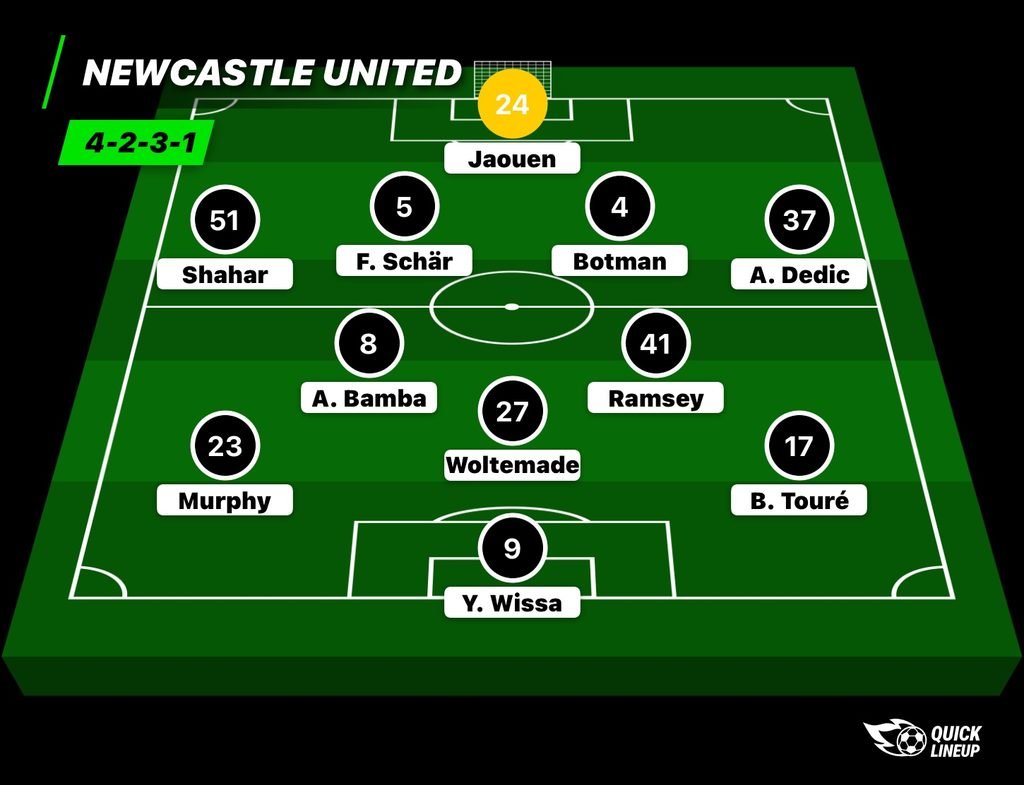
    Figures familiar with strategy at Benton indicate that Jaissle views this fixture as an essential litmus test for Newcastle’s squad architecture. Under strict SCR frameworks, the club’s recent transfer windows were calculated not just to strengthen the starting XI, but to build a dynamic second unit capable of executing Jaissle’s high-tempo 4-2-3-1 system without a catastrophic drop in performance.

    After the tremendous weekend effort against Liverpool, the German coach will give key starters like Lewis Hall and Malick Thiaw a necessary rest, handing opportunities to eager squad options and academy prospects.

    In goal, 20-year-old French prospect Ewen Jaouen is set for his full competitive debut. Standing at an imposing 197cm, Jaouen steps in to give Lukáš Horníček a well-earned rest. Jaouen will be shielded by a reconfigured central defense pairing of veteran leader Fabian Schär and Sven Botman. Schär’s elite composure, long-range diagonal distribution, and veteran reading of the game provide a calming counterbalance to Botman’s aerial dominance and line-breaking physical presence.

    On the flanks, 19-year-old academy right-back Leo Shahar is expected to make his senior full debut. To accommodate resting Lewis Hall on the left, Bosnia international Amar Dedić—who possesses extensive experience operating on either flank from his tenure at Red Bull Salzburg—shifts across to left-back. Dedić’s comfortable two-footedness allows him to invert smoothly into midfield corridors when building out from the back, granting Shahar room to overlap on the right. Although he played on Sunday, the feeling will be to give the new recruit as much game time as possible as quickly as possible to rapidly acclimatise him to his new team mates.

    In the double pivot, 20-year-old French recruit Aladji Bamba is expected to make his full home debut alongside Jacob Ramsey. Bamba’s underlying FBref data from pre-season painted a picture of a rare defensive anchor—averaging 8.1 ball recoveries and a 72% duel success rate per 90 minutes. Partnering him with Ramsey’s dynamic guile gives Newcastle an engine room capable of breaking Albion’s initial press.

    The attacking triumvirate behind single striker Yoane Wissa will spark immense curiosity among the Gallowgate faithful. Standing at 6’6″, German playmaker Nick Woltemade is slated to operate as the central number ten, bringing a unique blend of technical finesse, hold-up play, and half-space creativity. Flanking Woltemade will be the experienced Jacob Murphy on the right—whose cross-delivery remains among the most consistent in the squad—and £42m Ivorian winger Bazoumana Touré on the left. Touré’s electric 1v1 ability promises to be the primary engine of disruption against West Brom’s narrow defensive block.

    Tactical Keys: How Newcastle Control and Conclude the Tie

    For Newcastle to avoid an embarrassing early exit and book their passage into the third round, Jaissle’s side must master three key tactical themes.

    1. Neutralizing Second-Phase Transitions at the Source

    West Brom’s primary route to goal will come from intercepting Newcastle’s build-up play in central areas and instantly launching long, linear passes behind Shahar and Dedić. The central pairing of Bamba and Ramsey must exercise rigorous positional discipline. Bamba’s primary duty will be to act as a defensive screen, cutting off central passing lanes before Albion can release their wide sprinters, while Ramsey must track the second balls that drop on the edge of the defensive third.

    2. Isolating Bazoumana Touré and Overloading the Right

    West Brom are expected to set up in a low-block 5-4-1 structure, funneling play out wide and dropping their wing-backs deep. To puncture this low block, Newcastle must speed up their ball circulation from Schär through to the flanks. Bazoumana Touré, who averaged 6.2 dribble attempts per 90 minutes during his breakthrough campaign, must be fed early in isolated 1v1 scenarios against Albion’s right wing-back. Simultaneously, Shahar’s overlapping runs alongside Murphy on the right will force Albion’s backline to stretch horizontally, creating pocket spaces for Woltemade to operate between the lines.

    3. Utilizing Woltemade as the Link-Man for Wissa

    Wissa’s pace and direct running are potent, but he requires service into feet rather than persistent aerial duels against Albion’s tall center-backs. Nick Woltemade’s role in the half-space will be crucial; by dropping deep to draw out a West Brom defender, the German playmaker can turn and slide incisive balls into the path of Wissa’s diagonal runs. If Woltemade can establish dominance in the central zone, Newcastle will consistently breach Albion’s low block and put the tie beyond reach before the final quarter-hour.

    The Verdict & Score Prediction

    Given the extent of Jaissle’s planned structural rotation and the raw friction that inevitably accompanies a newly assembled backline, Newcastle should expect an uncomfortable opening half-hour. Albion’s aerial prowess from set pieces and direct vertical breaks will inevitably test young Ewen Jaouen and Leo Shahar under early pressure.

    However, over ninety minutes, Newcastle’s superior depth and technical quality in the final third ought to tell. The creative interplay between Woltemade and Touré will eventually pry open West Brom’s low block, while the insurance of bench firepower—including Harvey Barnes and Anthony Elanga—gives Jaissle late options if the tie remains tight. Expect a competitive, full-throated cup tie where Newcastle’s individual quality ultimate seals passage to the third round.

    Score Prediction: Newcastle United 3–1 West Bromwich Albion

    Will Nick Woltemade start this game? Does he fit into Jaissle’s long term plans? Join the conversation on X @mytoonarmy #NUFC
  • Chaos, Pressure, and the Red Bull Blueprint: Analyzing Matthias Jaissle’s St. James’ Park Debut

    Under the blinding floodlights of St. James’ Park, Newcastle United provided an intoxicating, chaotic glimpse into life after Eddie Howe—a high-wire act of relentless pressing that nearly felled Liverpool.

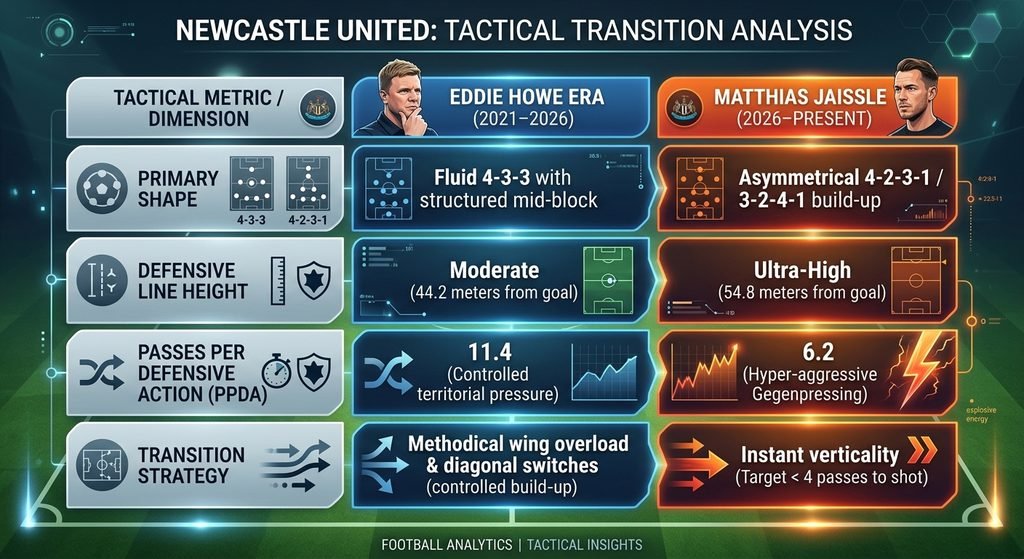
    The post-Eddie Howe era at Newcastle United did not arrive with a cautious handshake; it tore through Tyneside like a gale off the North Sea. In last night’s pulsating 2-2 draw against Liverpool, Matthias Jaissle’s tactical fingerprints were plastered across every blade of grass, signaling a seismic philosophical departure from the structured, methodical tenure of his predecessor. Where Howe spent four and a half years cultivating a disciplined, possession-oriented 4-3-3 that relied on controlled territorial overload and deep build-up geometry, Jaissle’s Newcastle is an uncompromising machine built on vertical velocity and central harassment. 

    The Good: A Ferocious Turnover Engine

    What worked for the Magpies was the sheer velocity of their suffocating high press. Operating in an aggressive 4-2-3-1 that seamlessly transformed into a 3-2-4-1 in possession, Newcastle generated eight high turn-overs in the opening twenty minutes alone. Opta tracking metrics revealed an astonishing PPDA (Passes Per Defensive Action) of 6.2 during the first half—a drastic reduction from the 11.4 average recorded during the final months under Howe.

    This relentless central trapping yielded an immediate dividend in the fifth minute. When Sean Steur and Lewis Miley converged to choke off Liverpool’s spatial exit, Anthony Elanga seized the ball and dispatched a lethal finish past Alisson. Sources close to the squad indicate that Jaissle spent his first two weeks at Benton drilling a strict “three-second rule”—demanding that any ball won in the opposition half must result in a shot on target before the opponent’s defensive block can re-establish its width. The dynamic width provided by summer acquisition Amar Dedić—reunited with Jaissle after their successful partnership in Salzburg—stretched Liverpool horizontally while Harvey Barnes and Anthony Elanga collapsed inside, creating numerical superiorities in the half-spaces that Howe’s wider, traditional wingers rarely attempted.

    The Unique: Jaissle’s Red Bull DNA vs. Howe’s Tactical Foundation

    The contrast between Jaissle’s Red Bull-inspired doctrine and Eddie Howe’s regime is starkest in central midfield structure and defensive line height. Under Howe, Newcastle’s build-up was orchestrated from deep, utilizing a single pivot to dictate tempo while full-backs inverted selectively to guard against counter-attacks. Jaissle has abandoned this patient rhythm entirely. Figures familiar with PIF’s sporting directive suggest the board specifically targeted Jaissle to modernize Newcastle’s physical metrics, aligning the club with Europe’s elite vertical pressers.

    Jaissle pushes his center-back pairing of Malick Thiaw and Sven Botman almost to the halfway line, compressing the field into a claustrophobic 30-yard rectangle. Rather than recycling possession back through goalkeeper Lukáš Horníček, Newcastle’s double-pivot is instructed to break lines vertically at the first opportunity, taking maximum numerical risk to force chaotic scrambles inside the opponent’s defensive third.

    The Bad: Naïveté, Fatigue, and Stoppage-Time Scrambles

    Yet, for all the adrenaline-fueled dominance that saw substitute Joe Willock restore Newcastle’s lead in the 57th minute, Jaissle’s high-wire act exposes glaring vulnerabilities that top-tier European sides will ruthlessly exploit. Executing a full Red Bull press demands pristine physical conditioning, and as neuromuscular fatigue inevitably set in after the 75th minute, Newcastle’s compact block fractured.

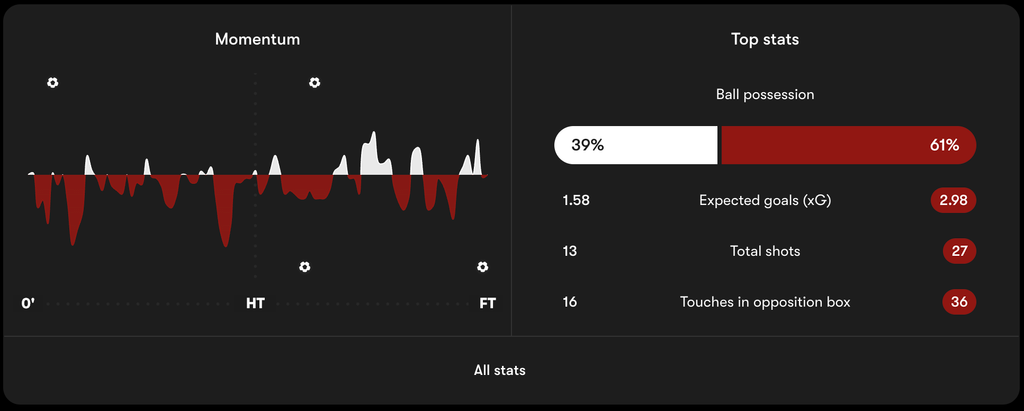
    With Dedić and Lewis Hall trapped deep in Liverpool’s half, the massive spaces behind Newcastle’s full-backs became hunting grounds for Liverpool’s wingers. When the initial wave of pressing failed to win the ball, Newcastle lacked the structural safety net that Howe so painstakingly engineered. The resulting chaos led to five yellow cards and an increasingly frantic back-line retreat, culminating in the 95th-minute penalty conceded when the defense were caught scrambling in stoppage time, allowing Dominik Szoboszlai to steal a point.

    Adapting Red Bull Ideology to Premier League Rigours

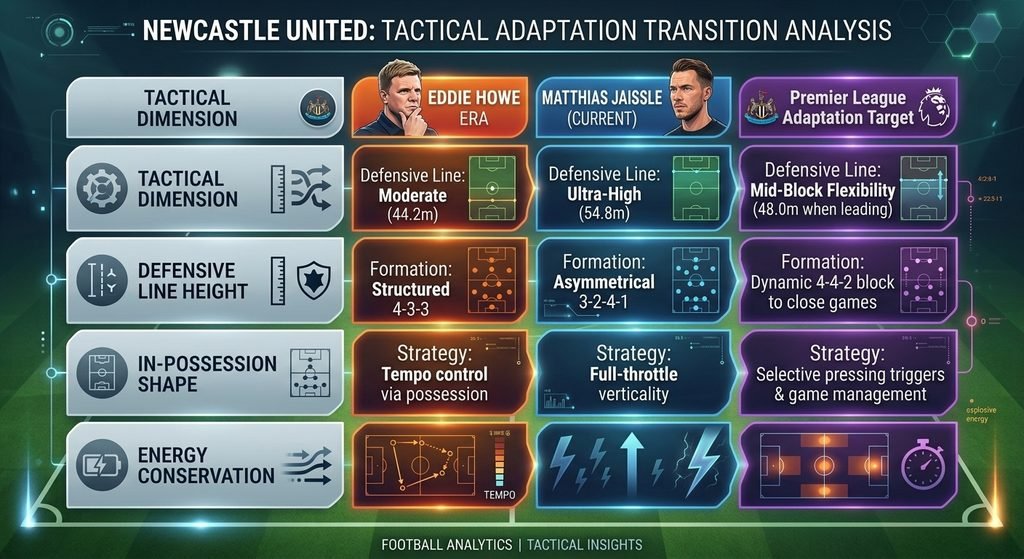
    If Jaissle is to turn breathless displays into sustained victories, he must adapt his tactical zeal to the unique demands of the Premier League. Figures familiar with PIF’s sporting directive acknowledge that full-pitch hyper-pressing for 90 minutes is physically impossible across a grueling 38-game campaign.

    To bridge the gap, Jaissle must incorporate tactical gear-shifting. When holding a second-half lead, Newcastle cannot remain pinned to the halfway line; they must learn to drop into a compact, Howe-esque 4-5-1 mid-block to starve opponents of space in behind. Furthermore, Jaissle must optimize his substitution timing—utilizing his bench far earlier to protect full-backs from late physical degradation—and instruct his team to slow restarts when momentum swings against them. Blending his exhilarating vertical chaos with pragmatic game management will determine whether this new era delivers European qualification or continuous late-game heartbreak.

    What do you think? Is Jaissle a breath of tactical fresh air? Will he be able to adapt and bring us long term success in the Premier League? Join the conversation on X @mytoonarmy #NUFC

  • Cruel Tyneside Poetry: Newcastle Masterclass Ruined at the death

    Under the towering lights, Newcastle United delivered ninety minutes of breathless, high-octane tactical poetry only to be denied a statement victory by the cruelest of stoppage-time penalties.

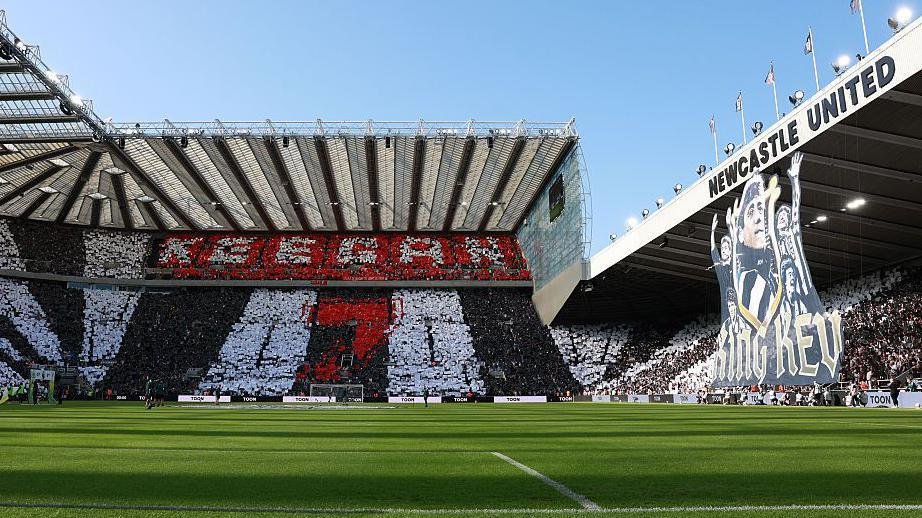
    Before a ball was even kicked on a sweltering Tyneside afternoon, the emotional temperature inside the stadium was already at boiling point. A deeply moving, pre-match tribute to Kevin Keegan—marked by a huge display across the stadium in his honour. One banner read:

    “I want people to dream about their football club. They should. We should all be dreamers at heart.” – King Kev

    That thunderous nostalgic pride immediately shifted into pure, unadulterated hostility the moment Alexander Isak took the kick-off in Liverpool red. The Swede was subjected to a ferocious cacophony of jeers and whistles with every touch, a psychological cauldron that visibly unsettled the striker. He finished the night with just 10 completed passes, and just 2 shots on target.

    Riding that wave of emotional fervor, Matthias Jaissle’s new-look Newcastle delivered a masterclass in suffocating structural intensity and devastating directness. The dividend arrived after just four minutes via a lightning-fast counter-attack. Pouncing quickly an attack that broke down, William Osula threaded a razor-sharp through ball into the open channel for Anthony Elanga.

    Clocking a blisteringly fast top speed of 36.4 km/h, Elanga left Milos Kerkez completely in his wake before entering the penalty box and calmly slotting a precise finish low past Alisson into the bottom corner. Those first 20 minutes, Liverpool was treated to a suffocating spell of Tyneside football that encapsulated everything Jaissle wants his side to represent.

    Liverpool adjusted their build-up shape after the interval, squeezing the space through central channels and clawing back an equalizer in the fifty-fourth minute when Cody Gakpo launched a precise daisy cutter to beat the keeper after some tentative defending; the team had begun to tire and foolishly stood off Gakpo. You simply cannot give a player of his quality time and space.

    The equalizer could have deflated the team, but what followed was another stroke of transitional genius that sent St. James’ Park into absolute ecstasy. Barely sixty seconds after Gakpo’s strike, Jaissle made a decisive double change, introducing Joe Willock for Osula to alter the midfield dynamic, and Newcastle responded immediately with another devastating break.

    Picking up possession in his own half, Yoane Wissa ignited the attack with a mesmerizing piece of ball-carrying, expertly weaving through the middle of the park and gliding past a clutch of red shirts under heavy pressure. Spotting Willock advancing in support, Wissa slipped a perfectly weighted lateral pass to the midfielder, who took one touch to set himself before curling a gorgeous, sweeping strike beyond Alisson’s reach from just outside the penalty area. The goal came a mere sixty seconds after Willock stepped onto the pitch, marking one of the fastest substitute strikes in recent Premier League history.

    The decisive moment. Was it a pen?

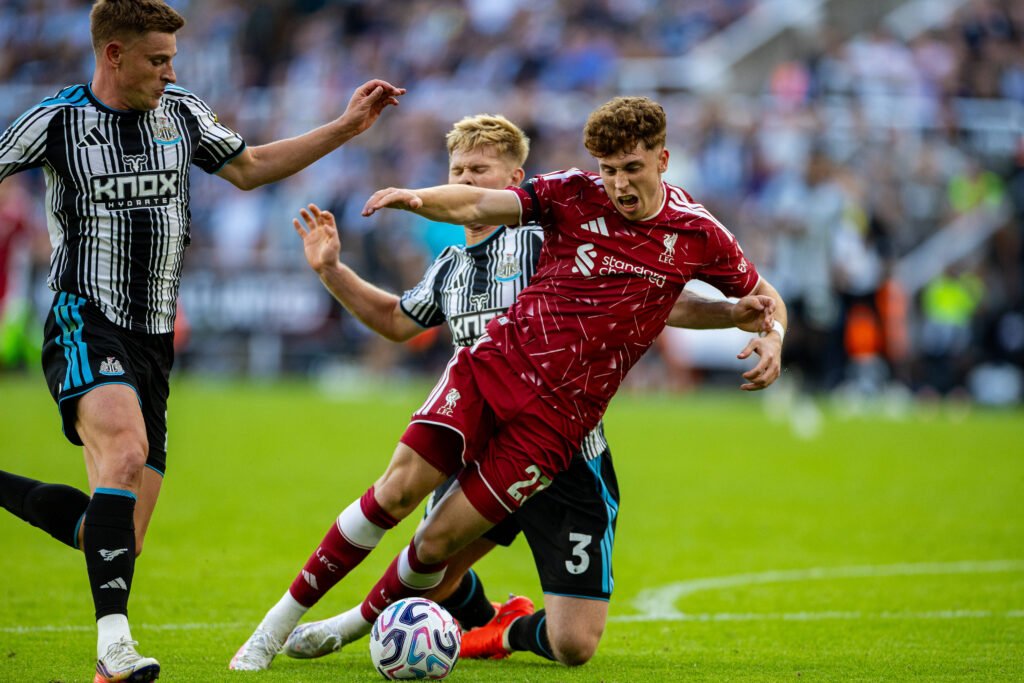
    What should have been a triumphant victory march, however, devolved into heartbreak deep into added time. In the ninety-fifth minute, with Newcastle defending resiliently inside their own box, Lewis Hall clumsily clattering into Victor Muñoz who was trying to glide past him resulted in a referee’s whistle. It was a bitterly soft call to concede—the exact kind of physical coming together that another referee on a different afternoon would have waved on without a second thought. But the referee pointed to the spot, allowing Dominik Szoboszlai to step up in the ninety-eighth minute and smash the ball emphatically into the top corner, leaving the Newcastle goalkeeper with absolutely zero chance despite diving the right way to salvage a 2-2 draw for the visitors.

    While the emotional toll of two dropped points in the dying seconds is heavy, the structural foundation Jaissle is building offers immense encouragement. The immediate focus now shifts to a relentless early-season schedule where momentum must be preserved. Newcastle return to St. James’ Park on Wednesday, August 26 at 20:45 BST to take on West Bromwich Albion in the League Cup, a fixture that represents an essential opportunity for squad rotation and deep-cup progress—a vital component for the club’s broader financial and squad-building objectives under SCR frameworks.

    Following mid-week cup duties, the Magpies face a stern Premier League test on Saturday, August 29 at 17:30 BST when they travel to North London to face Roberto De Zerbi’s Tottenham Hotspur. That trip to the capital will serve as an early barometer of Newcastle’s aspirations this season, pitting Jaissle’s high-intensity pressing system against De Zerbi’s fluid possession mechanics in a match that could dictate the early trajectory of Newcastle’s European push.

    Was it a penalty? Should Wissa have put the game beyond reach when clean through on goal? Join the conversation on X @mytoonarmy #NUFC