

Data Driven Insights. Fearless Opinions.

Squad

  • North London Awaits: Newcastle Carry Tyneside’s Faith Into a Ground Where They Rarely Lose

    #TOTNEW

    Seventeen thousand miles of pre-season goodwill count for nothing once Matthias Jaissle’s players step down the tunnel at Tottenham Hotspur Stadium on Saturday. Kick-off is 17:30 BST, and for a Newcastle side still finding its shape under a manager who has now taken precisely one competitive match in English football, this is the fixture that tells you something real.

    It arrives with history leaning heavily black-and-white. Newcastle have won seven of their last nine competitive meetings with Spurs, scoring at a rate of 3.78 goals per game across that sequence, and no ground in the country has been kinder to Newcastle away from home than N17 — thirteen away league wins there is more than they have managed at any other opponent’s stadium. Last February, Archie Gray cancelled out Malick Thiaw’s opener before Jacob Ramsey struck the winner in a 2-1 away victory that continued a run of taking maximum points on three of the last four visits. Tottenham’s fans know this fixture’s recent taste, and it is bitter.

    Two clubs mid-rebuild, both still finding the join

    What makes this early-season meeting so combustible is that neither manager has had time to stamp real authority on his squad. Roberto De Zerbi arrived at Spurs in April, inheriting a relegation fight, and has since been backed with signings — Savio arriving from Manchester City, Omar Marmoush finalised in the days before this game — while simultaneously trying to coax an attacking identity out of a group he inherited mid-crisis. His side were humbled 3-0 at Brentford on the opening weekend, Keane Lewis-Potter and Vitaly Janelt punishing early defensive slackness before Michael Kayode added gloss to the scoreline after the break. The response came in the Carabao Cup, a 5-1 dismantling of Charlton Athletic in which Savio scored off the bench on his introduction to English football and Mikey Moore, Dominic Solanke, Kevin Danso and Ben Davies all found the net. It settled nerves. It did not answer the question Saturday will ask.

    Jaissle’s rebuild is more radical still. Newcastle enter this game having said goodbye to Bruno Guimarães, Sandro Tonali, Anthony Gordon and Alexander Isak inside a single transfer window — a hollowing-out of the spine that would unsettle any dressing room, let alone one adjusting simultaneously to a head coach steeped in Red Bull pressing principles rather than Eddie Howe’s mid-block patience.

    The opening evidence was encouraging in patches and alarming in others. Anthony Elanga’s fifth-minute strike and a second-half Joe Willock finish had St James’ Park dreaming of a routine opening win over Liverpool, only for Lewis Hall’s foul on Victor Muñoz to gift Dominik Szoboszlai a 99th-minute penalty and turn three points into one. It extended an uncomfortable trend: since the start of last season, no Premier League club has surrendered more points from winning positions than Newcastle, twenty-nine and counting. Jaissle’s first task, by his own admission, is not tactical philosophy — it is concentration.

    What the managers have said

    Jaissle, speaking to the media at the club’s Darsley Park training base, did not disguise the scale of the task awaiting his side in north London.

    “We’re doing our best and have a clear picture of what to expect,” he said, “but we also need to be honest. We are facing a top, top team that will fight for the top places in the table for sure with these signings. But it’s a good challenge.”

    Facing Sandro Tonali in Spurs colours for the first time added a personal edge to his preparation.

    “It’s always nice when you face old team-mates,” Jaissle said. “There should be a special motivation. I think it worked against Isak already, so hopefully it will also work on Saturday” — a pointed reference to Newcastle’s summer victory over their own former striker in a pre-season fixture, and a reminder of just how much turnover this squad has absorbed.

    On his new £50 million signing Nico González, unveiled at St James’ Park in midweek following his move from Manchester City, Jaissle was unambiguous: “He trained with us, and he looks sharp. He’s an option. He is a smart player. He has huge potential and already brings so much quality to the squad, so I think he will adapt fast into our system, into our way of playing, and then we can enjoy.”

    De Zerbi, for his part, has spent the week talking less about Newcastle specifically and more about the identity he is trying to graft onto his squad after the Brentford chastening.

    “We are building, I think, a new project,” he told Spurs’ media at Hotspur Way. “The first two targets we have very clear in ourselves — to find the soul of the team, and to improve our organisation of football. With the ball, without the ball, our style has to be the key of our season, like our soul.”

    It is the language of a coach who knows his side’s talent has never been the issue at Tottenham — their capacity to defend a lead has been. Since the start of the 2023-24 season only three clubs have lost more Premier League matches by three goals or more than Spurs’ eleven, a statistic that will not have escaped Jaissle’s notice as he plots his away-day approach.
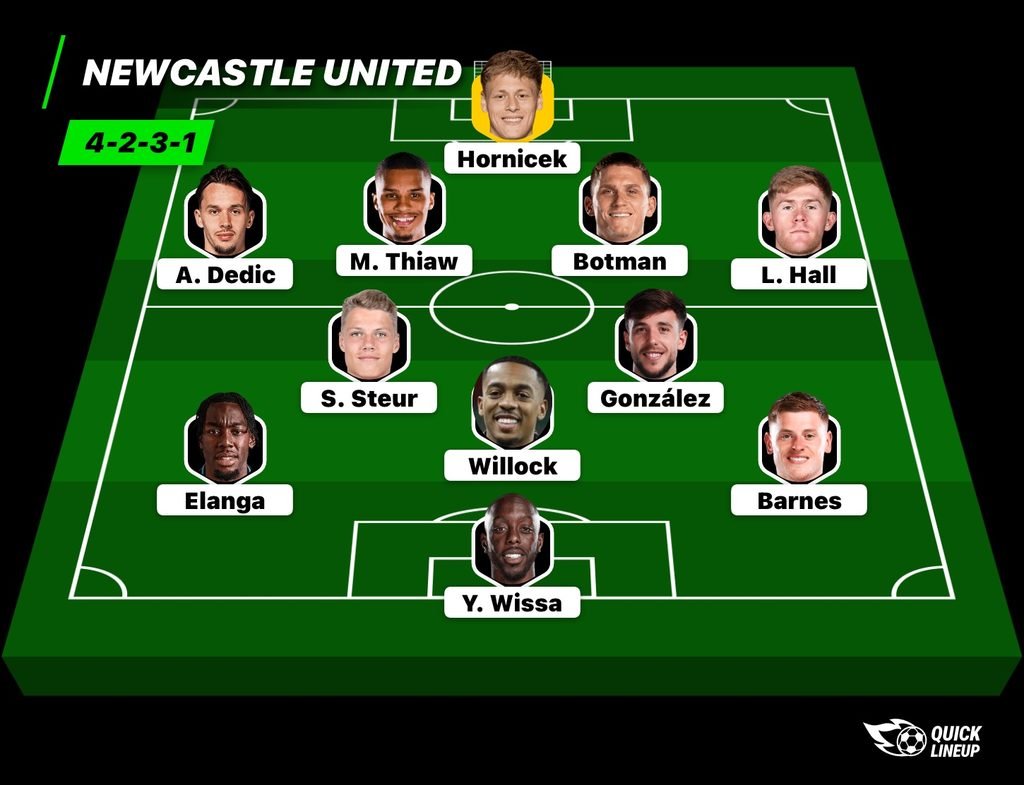
    The key men

    For Newcastle, Elanga is the name catching everyone’s eye early. He has already scored more league goals this season — one, from two shots — than he managed across the entirety of last term, when seventeen shots yielded nothing. His directness against a Tottenham back line still shaking off the rust — Pedro Porro only just back from the fitness issue that kept him out at Brentford — could be the difference between a frustrating afternoon and a productive one.

    Behind him, Joe Willock’s timing in the box has already been proven against Liverpool, while Nico González, sharp in training according to his manager, offers Jaissle a genuine option to freshen a midfield stripped of its two most influential passers over the summer. Malick Thiaw, scorer in February’s win at this very stadium, will need to be alert against a Tottenham front line sharpened by new arrivals.

    For Tottenham, the returns of Micky van de Ven and Pedro Porro from the bench against Charlton offer De Zerbi genuine defensive reinforcement after their absence at Brentford exposed exactly the kind of gaps Newcastle’s front three will look to exploit.

    Dominic Solanke’s movement and finishing gave Spurs bite in the cup, and Savio’s introduction hints at a wide threat that troubled Charlton and could trouble a Newcastle back line still finding its feet under a new head coach. James Maddison’s shoulder fracture is a blow to Spurs’ craft in the final third, ruling him out for a fortnight, while Pape Matar Sarr remains a doubt with a minor foot issue — leaving De Zerbi’s midfield options thinner than he would like against a Newcastle side built to press and counter at pace.

    Prediction

    The underlying numbers point one way, the earliest-season form points another, and the truth likely sits somewhere between the two. Newcastle’s away record at this stadium, their pressing intent shown in flashes against Liverpool, and Tottenham’s alarming susceptibility to heavy defeats all suggest the visitors travel with a genuine chance. But De Zerbi’s side, wounded by Brentford and freshly reinforced, will not want to suffer back-to-back league defeats to open the De Zerbi era at Tottenham Hotspur Stadium, and home advantage in a raucous, expectant N17 counts for something against a Newcastle side still learning its new manager’s demands under pressure.

    Expect goals, expect nerves, and expect Newcastle’s away record at this ground to hold up — just.

    Tottenham Hotspur 2-3 Newcastle United

    What’s your score prediction? Will Wissa score his first goal of the season? Join the conversation on X @mytoonarmy #NUFC
  • What Jaissle Actually Sees in Nick Woltemade

    Nick Woltemade

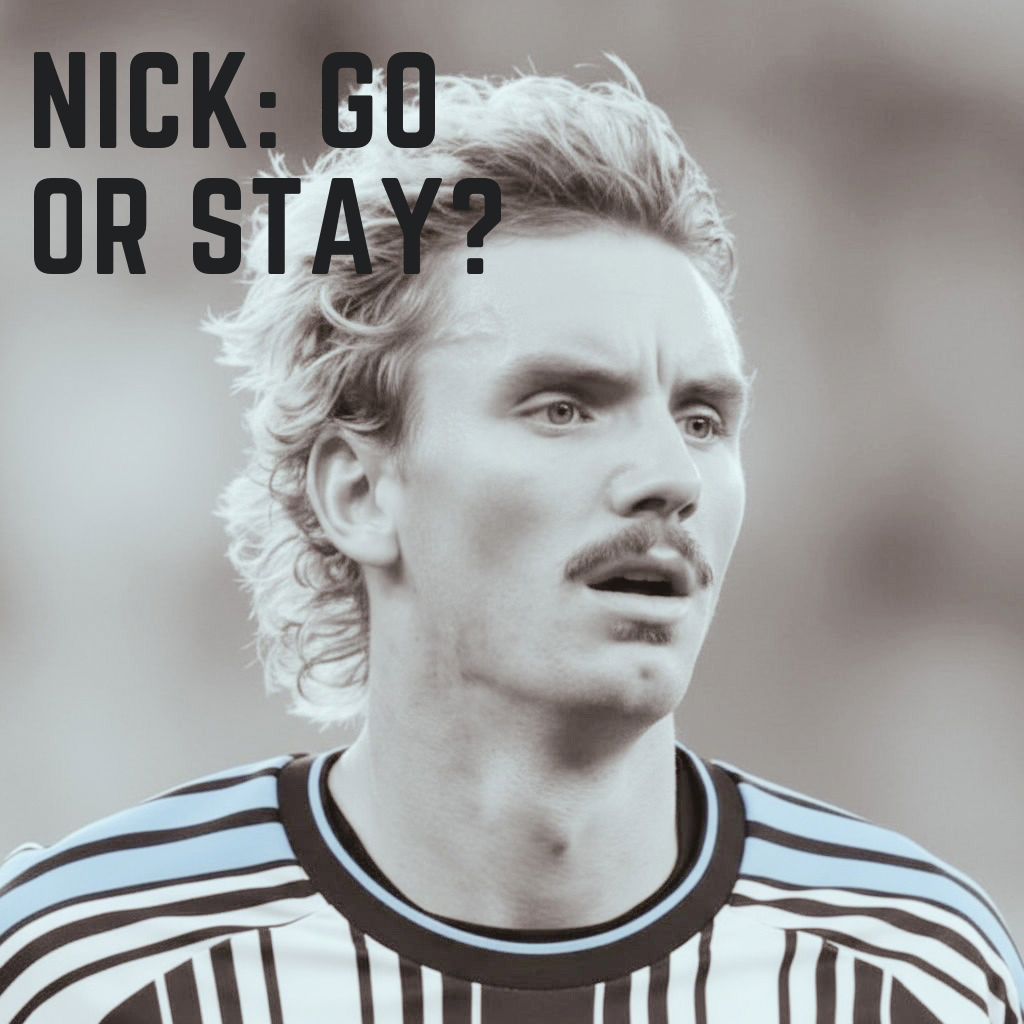
    Wednesday night, West Bromwich Albion at St James’ Park, and Nick Woltemade plays a full ninety minutes as a central striker for Matthias Jaissle for the first time. Newcastle win 3-2 in the Carabao Cup. Less than twenty-four hours later, Fabrizio Romano is reporting that Napoli have been on the phone to Tyneside, sounding out a loan move before Tuesday’s deadline. Two signals arriving in the same week, pointing in opposite directions — one manager finally building around him, one Serie A club wondering if he’s available. Rather than chase that contradiction round in circles, it’s worth asking the more useful question: what does Jaissle actually have in Woltemade, and what is he still waiting to find out?

    What he brings

    Start with what nobody disputes. At 6ft 6in, Woltemade is not a target man in the crude, knock-it-long sense — he’s technically better than his height suggests, comfortable receiving with his back to goal, capable of turning defenders with a single touch, and unusually mobile in the final third for a player his size. That combination was on full display in his opening month on Tyneside last September: a debut goal against Wolves, a strike on his Champions League bow, and finishes in each of his first three home league games, a run good enough that supporters were drawing comparisons to Alan Shearer within a fortnight of him arriving.

    The technical package is real. He can drop into a pocket and lay the ball off first time, and when he carries the ball forward on the ground he does it with a stride length that eats up space defenders think they’ve closed down. Chris Waddle offered the clearest outside read on that physical profile last summer, in the aftermath of Bayern Munich’s public strop over losing out on the deal — a Bayern board member had branded Newcastle’s spending “idiots’” money, and Waddle was asked on air why Bayern were so sore about missing out on a player they’d expected to get cheaply. His answer, stripped of the Bayern context, still holds: a tall, technically capable forward with more mobility than his size suggests. That’s the profile Jaissle inherited — a striker built to occupy the width of a box and finish the chances a possession-heavy side is going to generate.

    What he cannot do (yet?)

    The other half of the ledger is just as clear, and it’s the half that got him shifted out of his best position for most of last season. Eddie Howe moved Woltemade into a deeper, quasi-midfield role for long stretches of the campaign specifically because his lack of top-end pace made him a liability in the space in behind that Newcastle’s system was trying to create. It didn’t work particularly well in either direction — Woltemade never looked comfortable circulating possession from deep, and Newcastle lost the focal point his height was supposed to provide.

    The output collapsed alongside the positional confusion. After a red-hot opening month, he managed just two goals and one assist across the final six months of the season, a drop-off stark enough that his own frustration became public. Eleven goal contributions from thirty-three league starts is a mediocre return for a club-record forward, and the deeper problem it points to — inconsistent service, no settled role, and a player whose engine isn’t built for pressing at the intensity a modern front line demands — is exactly the problem Jaissle now has to solve.

    Where the numbers place him

    Since Howe first pulled him inside from a pure No. 9 role, and Jaissle has continued using him in deeper, more creative positions in phases this season, Woltemade has effectively been auditioning for two different jobs at once — lead the line, and help build the attack from just behind it. His debut Premier League season offers a genuine, if unflattering, data set against both requirements.

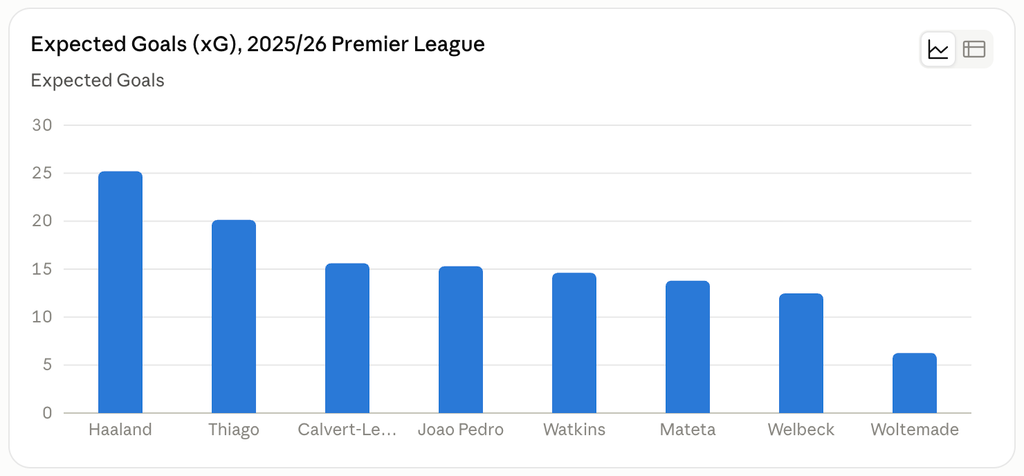
    Finishing. Seven league goals and two assists from twenty-five appearances, generated from 6.26 expected goals off thirty shots — a return that roughly matched rather than flattered his underlying numbers, with 40 per cent of those shots on target. That’s competent, but it sits well outside the range of the league’s genuine No. 9s: Erling Haaland led the division with 25.2 xG, Igor Thiago posted 20.1, and even the seventh name on that list, Danny Welbeck, generated 12.5. Woltemade’s 6.26 wasn’t half of Welbeck’s — a gap that’s about the volume and quality of the chances reaching him as much as his own finishing.

    Chance creation. This is where the No. 10 minutes should show up, and they barely do. Twelve chances created and two big chances created across the season, translating to 0.80 expected assists and two actual assists. For context, Bruno Fernandes — having the most productive creative season in Premier League history — finished with roughly 11.7 xA and a record 21 assists. Nobody expects Woltemade to approach that; but a forward being used centrally in a creative role for stretches of the campaign producing barely a chance a game is a modest return, and it suggests Jaissle’s deeper positioning of him hasn’t yet unlocked genuine creative output, whatever else it’s done for his touches on the ball.

    Progression. He’s not beating people with the dribble: ten successful take-ons from twenty-five attempts, a 40 per cent success rate that’s unremarkable for a forward operating in tight areas. His pass completion sits at a reasonable 74.7 per cent, and he’s averaging just over four touches in the opposition box per 90 across all competitions — evidence he still finds the danger areas even when he’s dropped deeper, but not evidence of a player carrying Newcastle up the pitch.

    Duels and press resistance. This is the number that should concern Jaissle most, and it’s the one behind the “loses a lot of duels” impression from the eye test. Woltemade won just 37.8 per cent of his total duels in the Premier League last season — 76 from 201 contested — with his aerial win rate sitting at 39.5 per cent (32 of 81). Strip out the aerial contests and his ground-duel win rate drops to roughly 36.7 per cent. That means he’s losing close to two out of every three physical contests he enters, on the floor as much as in the air, which is a genuine problem for a Red Bull-schooled coach whose football depends on forwards winning the ball back high up the pitch. It’s also not simply a height issue: Crystal Palace’s Jean-Philippe Mateta, three inches shorter, won a near-identical 40.8 per cent of his aerial duels (60 of 147) — suggesting the gap is about timing, positioning and physical engagement rather than raw size. Woltemade has the frame to win these contests; the data says he isn’t winning them yet.

    Put together, the numbers describe a forward who hasn’t fully delivered on any of the three things his hybrid role has asked of him this season — goals relative to service, creation from deeper positions, or the physical duel-winning his frame promises. None of that rules out improvement under a settled system and a coach who rates him. But it’s a considerably more demanding set of numbers to turn around than the goals column alone suggests.

    What Jaissle has actually said

    Asked directly this week whether Woltemade would still be at the club after Tuesday’s deadline, Jaissle didn’t produce a ringing endorsement, but he didn’t hedge into ambiguity either. “I expect him to stay,” he told reporters, before acknowledging that circumstances in football can shift quickly. That is calculated, not cagey — no manager slams a door on a genuine loan enquiry three days before deadline day when it might still suit the club to walk through it, and no manager who’s decided a player has no future hands him ninety first-team minutes in a cup tie forty-eight hours earlier. The two facts sit together more comfortably than the transfer gossip cycle wants them to.

    Reading the system, not just the soundbite

    The more revealing evidence isn’t the quote. It’s the shape Jaissle has built everywhere he’s coached. At Salzburg his forwards led an aggressive counter-press aimed at the opposition’s centre-backs, built for speed and relentless work-rate. At Al Ahli, faced with a more experienced squad, he adapted into a 4-2-3-1 with a single central focal point — and the man he chose to lead that line was Ivan Toney, a physically dominant, hold-up-and-finish No. 9 who is not, and has never pretended to be, a pressing terrier in the Salzburg mould. Jaissle proved there that his football doesn’t require every striker to fit the same athletic template; it requires a striker who fits the specific team he’s building at that moment.

    That’s the case for Woltemade. His frame, hold-up strength and technical quality in tight areas map far more closely onto the Toney role at Al Ahli than onto the box-to-box pressing forward Howe tried, unsuccessfully, to turn him into — even if the aerial numbers above suggest that fit is still more potential than proven. If Jaissle wants a focal point to combine with quicker, more mobile runners either side of him — and Newcastle’s business this summer, chasing wide players with genuine pace, suggests exactly that intention — Woltemade’s frame and technique are precisely what that role calls for.

    What Jaissle doesn’t yet know, because a single Carabao Cup tie against Championship opposition can’t tell him, is whether Woltemade can hit the defensive triggers a Red Bull-schooled coach still demands even from a target man — closing passing lanes on cue, forcing the first pass square rather than forward, not simply existing at the top of the pitch waiting for service. That is the actual audition running between now and the World Cup break, not the noise from Naples.

    Where that leaves the debate

    None of this resolves neatly into keep-him or sell-him. It reframes the question. Jaissle’s comments and his selection this week both point toward a manager giving Woltemade the specific role his attributes were always suited to, rather than the one that broke his confidence last season. Whether that experiment succeeds is a football question that needs six or eight matches to answer, not a transfer deadline. A loan to Naples would end the experiment before it’s begun; keeping him in a settled central role, even through a difficult September, is the only route that actually tells Newcastle what they own.

    Will Nick still be with us when the window shuts in a few days time? What is his best position and role in a Jaissle team? Join the conversation on X @mytoonarmy #NUFC

  • Handshakes, hard edges: reading Jaissle’s first month in front of the cameras

    Matthias Jaissle

    The same media suite at the training ground that grew used to Eddie Howe’s careful, guarded cadence for the best part of five years now has a new occupant. On Thursday evening it hosted Matthias Jaissle for the third time in a fortnight, and by now the room has started to learn his rhythms — the measured pauses before he answers on selection, the flicker of irritation whenever a question edges towards officiating, the diplomatic warmth he reserves for anything involving the city itself.

    This was the briefing ahead of Saturday’s trip to the Tottenham Hotspur Stadium, Newcastle’s first away fixture of the new season, and it landed at an interesting moment in the German’s tenure. Two competitive matches into life on Tyneside — a 2-2 draw with Liverpool undone by Dominik Szoboszlai’s stoppage-time penalty, followed by a scratchy 3-2 Carabao Cup win over Championship side West Brom in which Lewis Hall conceded a second penalty in as many games — and already the shape of his relationship with the press is beginning to set.

    What he was asked, and what he said

    The team-news line dominated. Nico González, signed from Manchester City this summer, trained fully with the group this week, and Jaissle confirmed the Spaniard is under consideration for a first involvement at the Lane. He described González as sharp in training and a player of real quality and potential, though he stopped short of promising a debut — the kind of calculated non-answer that will become familiar to anyone covering this side over the coming months. Tino Livramento, meanwhile, remains on a graduated return from his World Cup injury; Jaissle was clear that the club has no intention of rushing him, a caution that reads as much about squad depth as medical prudence given how threadbare Newcastle’s options at full-back have looked since the summer exodus.

    And it was some exodus. Bruno Guimarães, Sandro Tonali and Anthony Gordon all left St James’ Park during the window, and Tonali could conceivably win the point back against his old club on Saturday having joined Roberto De Zerbi’s rebuilt Spurs side. Jaissle was asked directly about facing a former teammate turned opponent and gave the pundit-friendly answer rather than the sentimental one: Spurs are a serious side, but Newcastle’s approach won’t bend for anyone. It’s a stance he has repeated in some form at every press conference so far — an insistence that identity outranks opposition, even against a club that finished above Newcastle for long stretches last season.

    There was also a personal note. Asked to reflect on his first fortnight in the job, Jaissle spoke about the warmth of his reception, both in the city and inside the two competitive fixtures he’s overseen at St James’ Park so far, and pointed to game-day atmosphere as something that had genuinely struck him — not press-conference boilerplate so much as a coach registering, out loud, that Tyneside expects to be taken seriously as a spectacle as well as a football club. On his emerging crop of academy graduates and fringe first-teamers thrust into senior involvement by the summer’s departures, he asked for patience, framing inconsistency as the accepted cost of blooding young players into a Premier League squad mid-rebuild.

    The first impression: warmth with teeth

    Go back to his unveiling and the tone was set almost immediately, and not through anything he said. Rather than take the podium cold, Jaissle broke from convention and walked the room, shaking hands with every journalist present before he’d answered a single question — an unforced, faintly theatrical gesture that immediately marked him out from the guarded, monosyllabic house style Eddie Howe’s final months had settled into. He followed it by describing his first days in the city with something close to genuine sentiment, talking about touring an empty St James’ Park and being unable to wait to see it full. None of that costs a manager anything, but it buys goodwill, and reporters on the beat noticed.

    What’s been more revealing, though, is what happens when the questions turn adversarial. After Lewis Hall’s coming-together with a Liverpool forward produced the stoppage-time penalty that cost Newcastle the win on his competitive debut, Jaissle didn’t retreat into platitudes. He went to the pitchside monitor visibly unhappy, then used his press conference to dismantle the decision — calling it soft, arguing the contact didn’t meet the threshold, and pointedly noting he was holding back further comment to avoid an FA charge. That last line matters: it’s the sound of a manager who understands exactly where the boundary sits and is choosing to graze it rather than cross it, which is its own kind of media management. He was visibly unhappy with the officials again four days later when Hall conceded that second penalty against West Brom, suggesting Liverpool wasn’t a one-off flashpoint so much as a look at how he’ll behave under pressure all season. Jamie Carragher, watching the same clips, picked up on precisely that combustibility and read it as a selling point rather than a liability, suggesting there’s a competitive edge to Jaissle that Premier League opponents — and Newcastle’s support — will come to enjoy. Not everyone was as charitable; Tim Sherwood took the same touchline reaction and framed it as calculated pressure on referees and the VAR process rather than spontaneous frustration, which is the more cynical read and one Jaissle will hear plenty more of the longer this job goes on.

    Put those two data points together — the handshake tour and the pitchside monitor eruption — and you get a more useful picture than either alone. This is a head coach who has clearly thought about the PR dimension of the job, who knows that a four-year contract signed after Newcastle paid Al Ahli £9.5million in compensation buys him goodwill but not infinite patience, and who is choosing to spend some of that goodwill early by being visibly competitive rather than blandly diplomatic. It’s a more textured start than the club probably expected from a 38-year-old with no previous experience of English football or its press pack, and it suggests Jaissle intends to control the media relationship rather than simply survive it. Saturday at the Lane, against a former player and a manager pursuing an identical high-press philosophy, will offer the next real test of whether that approach holds up once results start cutting the other way.

    What do you think of our new manager? Does he have what it takes to be successful in the Premier League? Join the conversation on X @mytoonarmy #NUFC