Data Driven Insights. Fearless Opinions.

Squad

  • The Bill for Bravery: What the Shot Counts Say About Jaissle’s Newcastle

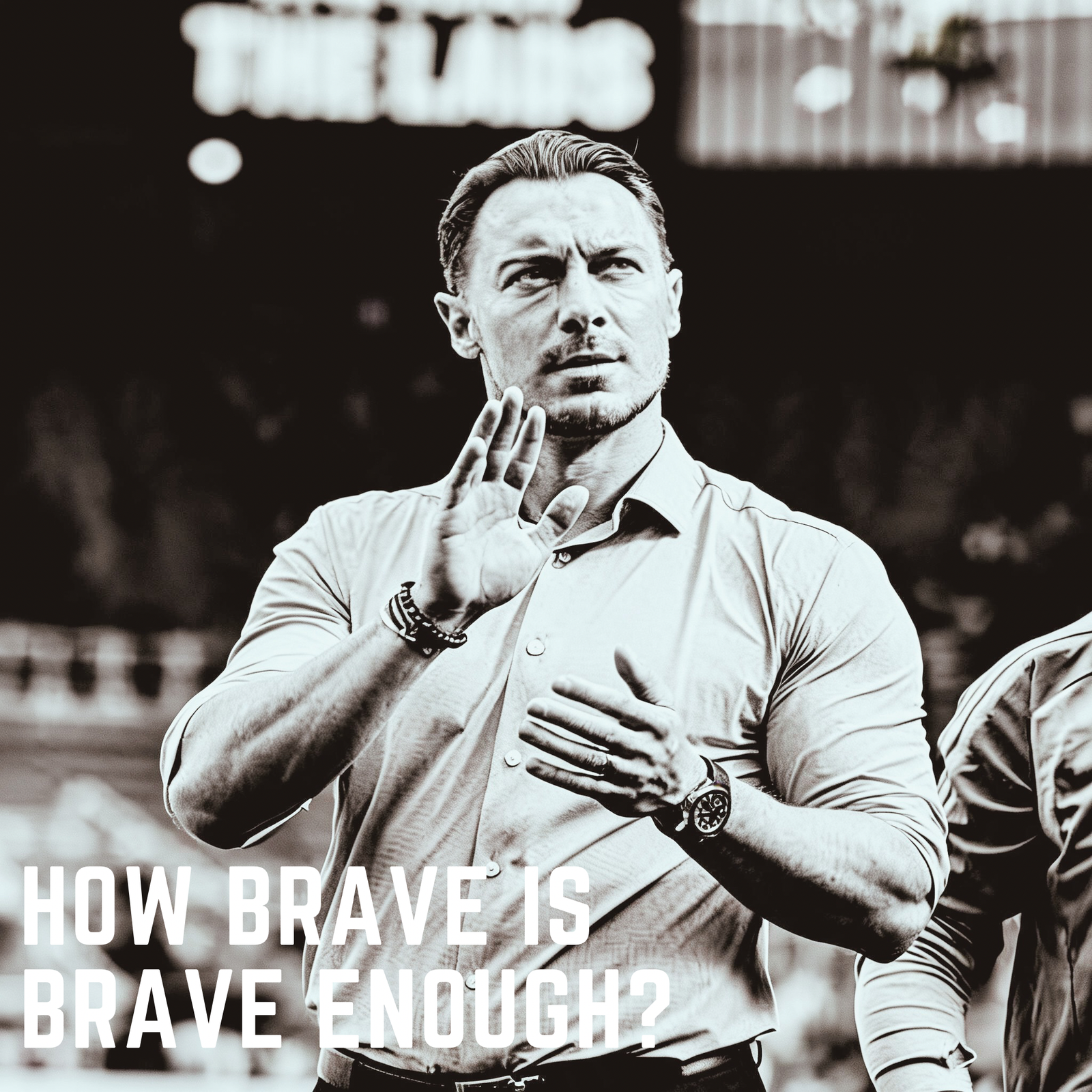
    How brave is brave enough?

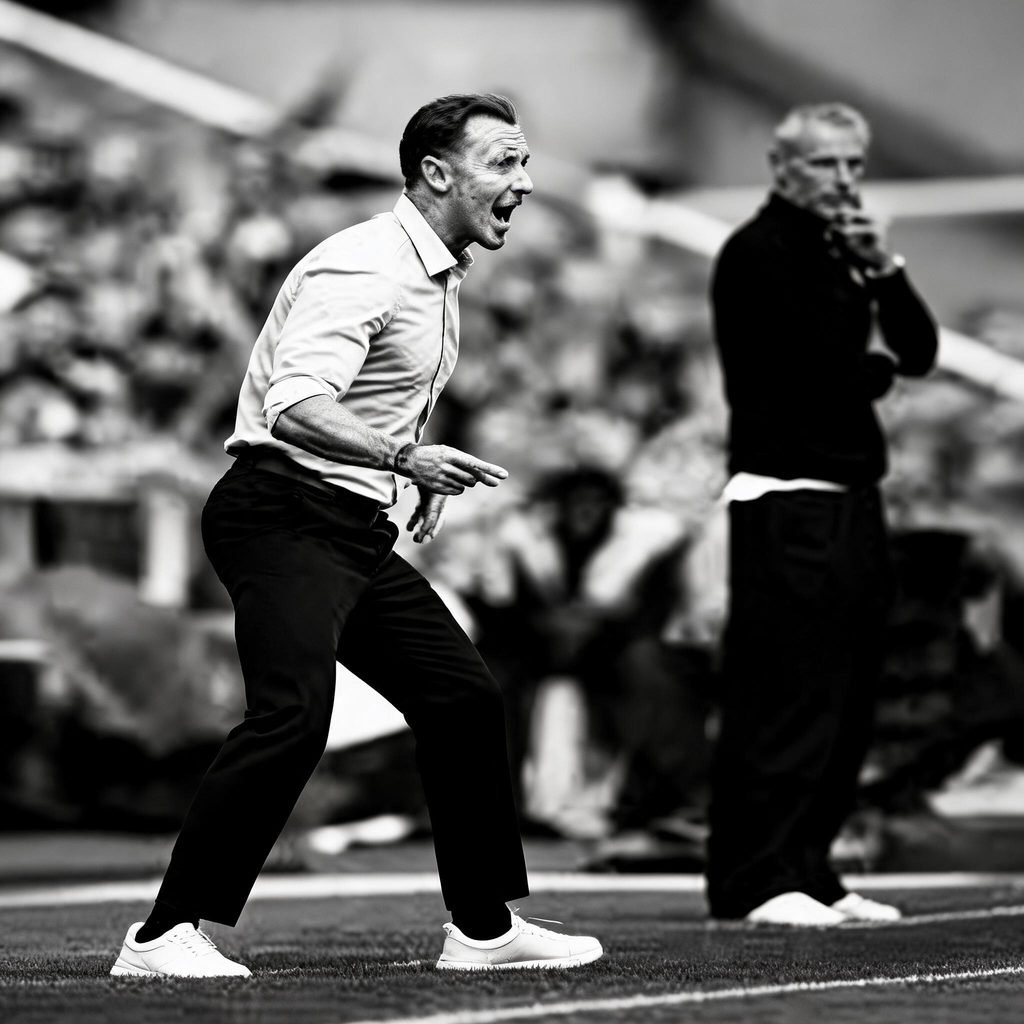
    Watch the split-second after Newcastle lose the ball in midfield and you are watching Matthias Jaissle’s entire football philosophy compressed into one freeze-frame: full-backs already stepping past the halfway line, a front four pushing into spaces that haven’t been vacated yet, a defensive line inching up before the ball has even changed hands. Nobody drops off. Nobody manages the game. The instruction, evidently, is to go and get it back higher than you lost it.

    It is thrilling to watch. It is also why fifty-eight shots have been fired at Newcastle’s goal in Jaissle’s first three Premier League matches — an average of just over nineteen a game, against Liverpool, Tottenham and Bournemouth. One win and two draws have Newcastle unbeaten through those three games. The record reads fine. The process behind it has not.

    The Brave Way, Tactically Speaking

    Jaissle has never pretended otherwise. Asked before the Bournemouth match whether he’d tighten up against a side built to counter, he said the approach stays “independent of the opponent, we have a clear way, clear identity.” That is not a throwaway line. It is a manager telling you, in advance, that he will not shape-shift to protect his defence no matter who’s coming the other way — the same conviction that has powered this summer’s recruitment strategy, which he has described, more than once, as simply “a brave way, but the way we want to go.”

    Go back through his press conferences from the opening month and the phrase turns up again and again, attached to something different each time: rating a transfer window he wouldn’t score out of ten, defending a net spend he wouldn’t itemise, tempering Dan Burn’s talk of Europe against a squad he called one of the league’s youngest coming off a 12th-place finish, and pre-loading an excuse for Matias Fernandez-Pardo before the winger had kicked a competitive ball. Nick Woltemade, last year’s £69m club-record signing, left on loan to Juventus this window for a fee somewhere around a twentieth of what Newcastle paid for him thirteen months ago. That is what brave costs when you write it down on a balance sheet: patience, and faith that this summer’s twenty-one-year-old is a sounder long-run bet than last year’s.

    The tactics are the same wager, run out on grass instead of a spreadsheet. Amar Dedić didn’t arrive as a blind punt — Jaissle brought him in from Benfica specifically because he already trusted the player’s game from their time together at Salzburg. Joe Willock and Jacob Murphy, both linked with exits all summer, were kept and immediately rewarded with bench impact against Liverpool. None of that sits apart from the shot count Newcastle are conceding; it’s the same operating principle expressed as a back four instead of a squad list. Commit to players you already trust, push bodies forward before the ball is fully won, accept that youth and unfamiliarity will produce ugly patches along the way, and bank on the upside outweighing them over a longer stretch than three games.

    Same Coach, Different Numbers

    The useful test is whether this shot count is simply what Jaissle’s football produces wherever he goes, or whether Newcastle are seeing something specific to this squad and this moment.

    The early signs point to the latter, and the case is stronger than a hunch. A statistical comparison published before Jaissle’s first game, setting his final two seasons at Al-Ahli against Newcastle’s own recent defensive record, found the pressing identity translates almost exactly: near-identical shot counts generated directly from the high press, a defensive line sitting at a comparable height, the same volume of aggressive defensive actions. The one place the numbers diverged sharply was transition defending — Jaissle’s Al-Ahli conceded roughly 0.77 shots a game from counter-attacks, comfortably tighter than the 1.22 Newcastle had been shipping under their previous regime. By that measure, Jaissle arrived with a reputation for being harder to hit on the break, not easier.

    Which makes nineteen shots a game — including twenty-five in a single afternoon against Liverpool — sit oddly against his own history. At Al-Ahli he averaged closer to ten shots conceded a match across two seasons while running practically the same press. At Salzburg, operating almost exclusively out of a 4-1-2-1-2 diamond that barely changed regardless of the scoreline, his sides won back-to-back titles and reached the Champions League knockout stage for the first time in the club’s history playing the same vertical, front-foot football — without bleeding shots at anything like this rate.

    So this is not simply how Jaissle’s tactics work everywhere. Something about Newcastle right now is amplifying the risk beyond what his own managerial record would predict.

    Why, Then?

    A few explanations sit alongside each other rather than compete.

    The obvious one is time. Jaissle walked into the building weeks before a ball was kicked, replacing a manager who had spent four years drilling a different structure into these exact players. He said as much himself before his first game, acknowledging the squad remains a work in progress and that building a new identity — after losing Bruno Guimarães, Sandro Tonali and Anthony Gordon in the same window — would take longer than one pre-season allows.

    The second is personnel, though the mechanism is sharper than “he plays too high.” Dedić’s own touch map this season argues against that reading — his heaviest zones sit deep, inside Newcastle’s own defensive and middle thirds, with barely a mark inside the final third. Nothing like the habitual overlap you’d see from a Diego Dalot or a Matty Cash. His baseline position is conservative, not advanced, which makes the two moments that undid Newcastle against Bournemouth more concerning, not less. They weren’t the recurring cost of a full-back who lives up the pitch finally getting caught out. They were isolated lapses inside an otherwise disciplined pattern, arriving at precisely the moments the game needed him switched on. A structural habit is something a manager coaches out by holding the line higher or lower. A specific lapse in concentration, twice in one afternoon, at the moments that decided the game, is a harder thing to promise will simply improve with time — trust from Salzburg or not.

    There’s also a simpler fix sitting on the bench, worth flagging even with the caveats attached. Tino Livramento is Newcastle’s first-choice right-back when available, an England Under-21 European champion in two different tournaments, and a player whose reputation — concentration named specifically as a strength in his profile — is built on defensive solidity as much as attacking output. Set his final full season alongside Dedić’s opening three games and the gap turns up in exactly the places you’d expect: 1.25 xG conceded per 90 while on the pitch against Dedić’s 1.82, 0.95 goals conceded per 90 against 1.33, and a foul-committed rate of 0.47 per 90 against Dedić’s 2.00 — roughly four times fewer fouls, often the tell of a defender managing the game rather than recovering from having just been beaten by it.

    None of that is a clean verdict. Three games is a small enough sample that one bad afternoon at Bournemouth can drag an average a long way on its own, and Livramento’s numbers come from an entirely different system under the previous manager, not from any minutes inside Jaissle’s actual structure. But directionally, it’s the same story the touch map told: the calmer, lower-event full-back profile is sitting on the bench, still working back from the calf injury and surgery that wiped out his entire pre-season. Nobody should rush him for the sake of a headline. Once he’s genuinely match-sharp rather than fresh off a comeback minute, though, he looks like the lowest-risk route back to solving this specific problem without touching the system at all.

    The third is the level. Ten shots a game in the Saudi Pro League and a title-winning diamond in Austria are not the same test as Liverpool’s front four in August. Jaissle himself has drawn the distinction before, noting that his time working with a squad full of the established internationals at Al-Ahli forced him to think “much more game-to-game” than the fixed system Salzburg’s academy conveyor belt demanded of him. Newcastle currently ask something closer to the Salzburg version of him — one settled idea, applied without much in-game modification — against opposition that punishes fixed ideas fastest.

    The Bill Comes Due, Eventually

    Here is the part worth being honest about rather than papering over with good vibes from an unbeaten start.
    Three games of quality finishing and a couple of slices of fortune — Barnes’ cannot-do-that-again strike, Ramsey scoring on his introduction, Liverpool’s leveller arriving from the penalty spot in stoppage time rather than a chance this back line actually conceded in open play — have made a shots-conceded column read fine on the league table. That is not a stable equilibrium across thirty-eight games. Defences that concede at close to nineteen shots a game across a full season, historically, are relegation-adjacent defences, not mid-table ones, unless the goalkeeper and finishing at both ends keep overperforming for nine months running. That basically never happens. The law of averages does not negotiate with good vibes, and it has a very long season to make its point.

    None of which means the approach is wrong. It means it’s a wager, exactly like the summer’s transfer business was a wager, and wagers carry the possibility of losing as the explicit cost of the potential upside. The same afternoon that saw a teenager score Bournemouth’s equaliser off Dedić’s own delivery also saw two lapses from that same player gift Bournemouth a two-goal cushion inside thirty-five minutes. You do not get to keep one half of that trade and discard the other.

    What happens next is the actual story of this season, more than any single result. If the counter-attack numbers tighten as Dedić’s concentration catches up with his positioning, as the back four settles, as Jaissle finds the flexibility at St James’ Park that he found in Saudi Arabia once he had time to build it — the brave way pays off, the way Ross Wilson’s transfer strategy is designed to pay off three years from now rather than three months. If it doesn’t, nineteen shots a game stops being a number Newcastle survive and starts being one that costs them points nobody can quality-finish their way back from.

    Either way, watch the shots-conceded column more closely than the league table for the next ten games. It will tell you which version of brave this is going to be.

    The brave way already showed us what this costs on a balance sheet. The shot count is showing us what it costs on the pitch.

    What do you think of Jaissle after the first three league games? Will Newcastle be able to tighten up their leaky defence? Join the conversation on X @mytoonarmy #NUFC

  • The Real Test: Why Bournemouth, Not Liverpool or Spurs, Will Define Jaissle’s Newcastle

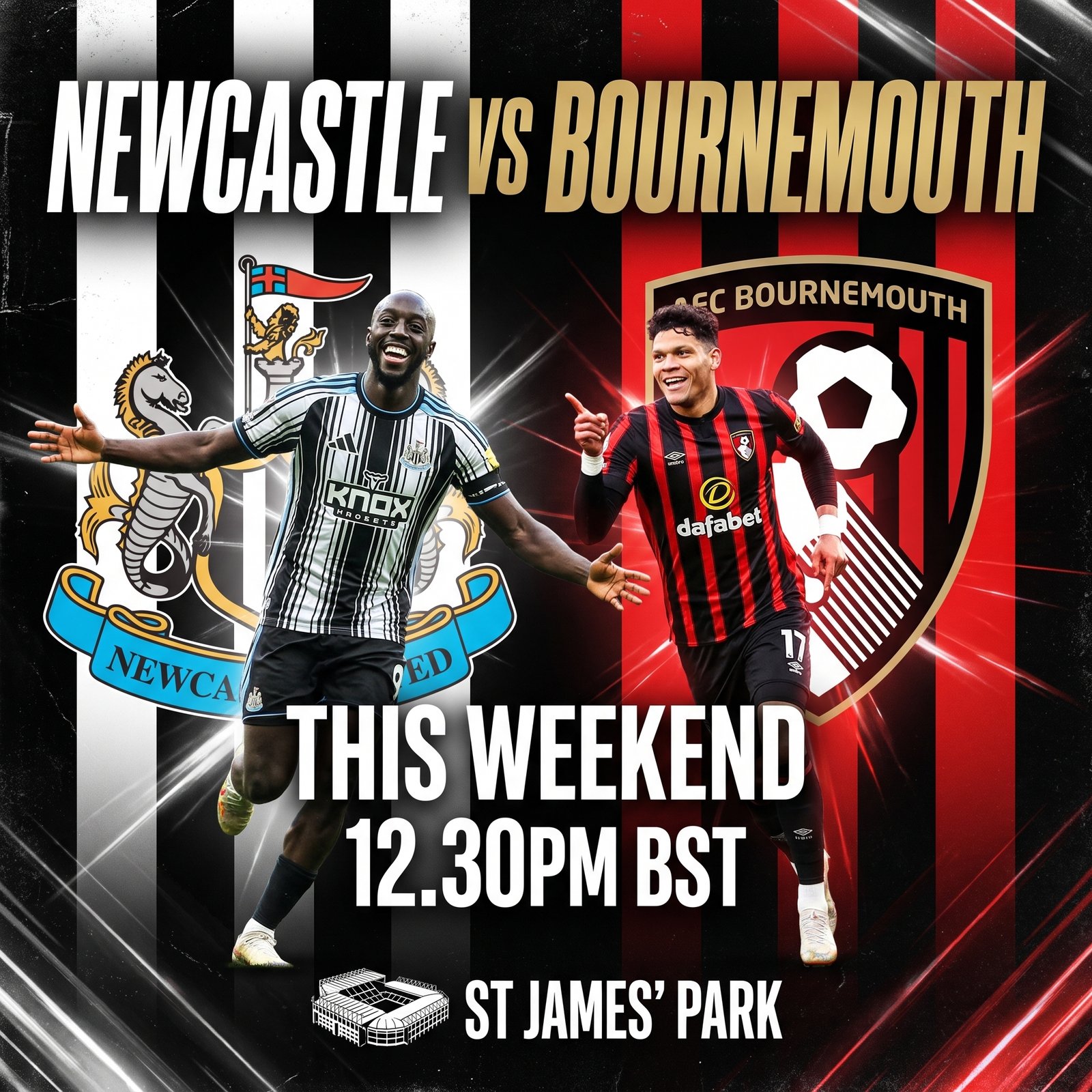
    Newcastle v Bournemouth, 5 Sept

    Twelve-thirty on Saturday, low September light slanting across the Gallowgate End, and Newcastle United are about to face the fixture that actually matters. Not Anfield, where a point arrived against Liverpool with nobody demanding more. Not Tottenham Hotspur Stadium, where a 2-0 win away from home was pure bonus, the kind of result that earns a head coach goodwill rather than scrutiny. Bournemouth at St James’ Park is different in kind, not degree. This is the game Newcastle are supposed to win, against the one mid-table side that has spent five years making a mockery of that supposition.

    That is what makes it the most revealing fixture of Matthias Jaissle’s young reign so far. Liverpool and Spurs told us Newcastle could compete with superior opposition when written off in advance. Bournemouth will tell us whether this team can convert raised expectations into three points against a side they traditionally cannot beat — whether the German’s vertical, high-intensity system holds up not against talent gaps that flatter it, but against the low-block, ambush-counter version of Premier League football that has undone Newcastle again and again on Tyneside.

    The Hoodoo

    Eight matches. Three defeats, five draws, not a single win. That is Newcastle’s Premier League record against Bournemouth since a 4-1 victory in July 2020, back when the visitors were managed by a young Eddie Howe — the same Eddie Howe who would go on to spend four years in the home dugout and now, following his summer departure, manages neither club in this fixture. Howe shares the record for the most Premier League games a manager has gone without beating a former employer, and the currency of that statistic has not devalued since he left St James’ Park.

    The most recent instalment offered no relief. April this year, St James’ Park, and Newcastle were 85 minutes from ending the run when Adrien Truffert found space at the back post and buried a winner that sent Bournemouth back down the A1 with all three points. It capped a run in which the Cherries have won their last two top-flight visits to Tyneside and now average 1.75 points per game at St James’ Park across eight visits — a return bettered, among grounds where they have played at least five times, only at Wolverhampton’s Molineux. Newcastle have spent parts of two decades building a fortress on Barrack Road. Bournemouth, unaccountably, hold a key.

    Jaissle’s Opening Statement, Interrupted

    Three games into the German’s competitive life in English football, the shape of his intentions is already legible. Newcastle pressed Liverpool into a stalemate they were unfortunate not to win outright, then travelled to north London and beat Tottenham 2-0 with goals from Anthony Elanga and Yoane Wissa, a result Jaissle afterwards called a “step in the right direction,” insisting that his squad’s underlying “DNA” is a “good fit” for the vertical, front-footed approach he has installed. There is substance behind the framing: Newcastle have won three of their last six league matches, a marked upturn on the one victory managed in the thirteen fixtures before that.

    But the same two matches expose the cost of the method. No side in the Premier League this season has faced more shots than Newcastle’s 44 — a startling reversal for a team that allowed only eight shots across its opening two league fixtures twelve months ago, itself the fewest they had conceded to open a campaign since 2003-04. Jaissle’s Newcastle create through aggression and concede through it too, inviting transition moments by committing bodies forward and pressing high up the pitch. Against Liverpool’s individual quality and Tottenham’s toothless finishing, that trade-off paid for itself. Bournemouth, built by Marco Rose around precisely the kind of direct, transitional football that punishes an open midfield, represent a sterner examination of whether the approach can survive contact with a side that knows how to exploit it.

    A Midfield Rebuilt From the Ground Up

    Context matters here, and it runs deeper than results. Newcastle lost both first-choice central midfielders this summer — Bruno Guimarães to Arsenal, Sandro Tonali to Tottenham — a departure of authority and control that would have derailed most rebuilding projects launched simultaneously with a managerial change. Sporting director Ross Wilson’s response was Nico González, a £50 million-plus deal struck with Manchester City for a 24-year-old La Masia graduate who had already won a Carabao Cup and an FA Cup at the Etihad. González made his debut at Tottenham and looked entirely unbothered by the occasion, screening the back four and dictating tempo in a manner Newcastle have missed since Guimarães departed. He is expected to retain his place alongside Lewis Miley, the academy graduate whose passing range increasingly resembles a player several seasons his senior.

    The rebuild is not finished. Matias Fernandez-Pardo, a deadline-day, £51 million arrival from Lille, is available for selection but Jaissle has signalled he intends to introduce the Belgian gradually, most likely from the bench, rather than throw him into a settled front line. That patience says something about the head coach’s confidence in what he already has: Elanga, Wissa and Harvey Barnes have combined for the goals that have carried Newcastle’s start, and none of the three appears likely to make way this weekend.

    Bournemouth’s Own Reinvention

    The visitors arrive mid-transition themselves. Andoni Iraola’s departure to Liverpool this summer — the same Liverpool who held Newcastle to a draw on the opening weekend — left Bournemouth needing a fresh identity, and the club turned to Marco Rose, formerly of RB Leipzig, Borussia Dortmund and Borussia Mönchengladbach, to provide it. Two German head coaches now face each other in a fixture that a decade ago would have been unthinkable in south coast and north-east dugouts alike.

    Rose’s start has been shakier than his opposite number’s. Bournemouth are one of eight Premier League clubs yet to register a win, having conceded twice in the closing ten minutes of a 2-1 defeat at Manchester City before James Tarkowski’s stoppage-time header rescued a point for Everton at Dean Court. The underlying pattern is troubling for the Cherries: they have surrendered 28 points from winning positions since the start of last season, a fragility that suggests a team capable of matching anyone for an hour but not yet equipped to see games out. Rose, for his part, has been at pains to stress the value of continuity, expressing satisfaction that the club retained Alex Scott, Rayan and Junior Kroupi through the window rather than cashing in — “we need these type of players,” he said this week, framing squad stability as deliberate strategy rather than accident.

    That continuity brings genuine menace in behind Newcastle’s high line. Justin Kluivert, Marcus Tavernier and the increasingly influential Rayan give Bournemouth pace and directness in the transition exactly where Jaissle’s system is most exposed, with Evanilson leading the line to occupy Newcastle’s centre-backs and create the space in which the front three like to operate. It is not difficult to see how Saturday could unfold as a version of last season’s collapse: control for long spells, chances created, and then a sting in a game Newcastle should have already put to bed.

    Team News

    Jaissle’s selection headache is more about absence than doubt. Captain Dan Burn remains sidelined with an ankle injury and, along with William Osula’s foot problem, is not expected back until October. Joelinton (thigh) and Tino Livramento (calf) are both closing on returns but will not be risked this weekend, meaning Lewis Hall continues at left-back and the midfield engine room stays as it has been. Bournemouth, by contrast, report no fresh fitness concerns, giving Rose a full complement to choose from.

    Predicted Line-ups

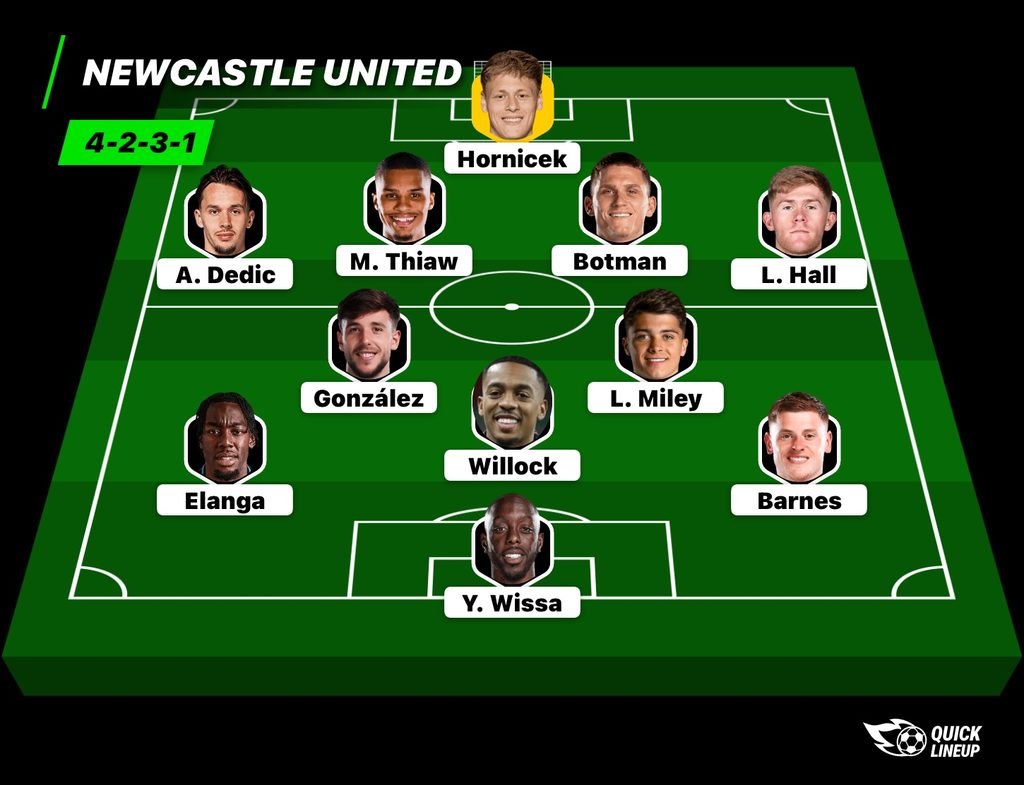
    Newcastle United (4-2-3-1): Horníček; Dedić, Thiaw, Botman, Hall; Miley, González; Elanga, Willock, Barnes; Wissa

    AFC Bournemouth (4-2-3-1): Petrović; Smith, Silva, Hill, Truffert; Cook, Scott; Kluivert, Rayan, Tavernier; Evanilson

    The Verdict Awaiting

    Nobody at St James’ Park expected much from the trips to Anfield and Tottenham, which is precisely why both results felt like pure gain. Saturday offers no such shelter. This is a fixture Newcastle are favoured to win, against opposition they have not beaten in the league for half a decade, with a system that has already shown both its teeth and its soft underbelly across two matches. How Jaissle’s team handles that pressure — not the absence of expectation but its sudden, uncomfortable presence — will say more about the direction of this project than anything Liverpool or Spurs could offer. The Gallowgate End will find out by half past two.

    Score Prediction: 2-1 victory to Newcastle.

    What’s your score prediction? Will Pardo start? Join the conversation on X @mytoonarmy #NUFC
  • The Brave Way

    Matthias Jaissle - The Brave Way

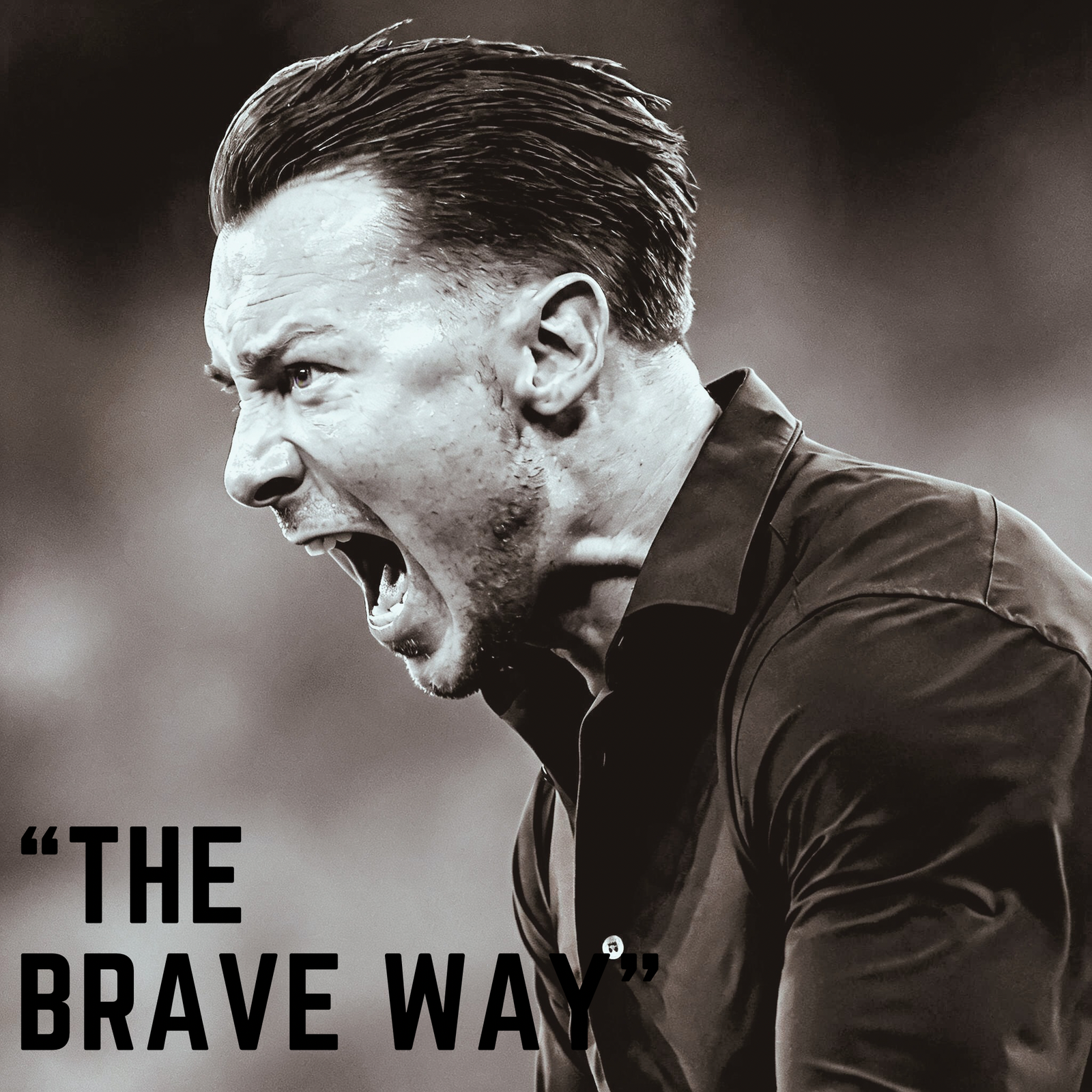
    Four times in twenty minutes, Matthias Jaissle reached for the same two words — and between them sits the clearest account yet of how he means to run Newcastle United.

    He said it rating a transfer window he refused to rate. He said it explaining a balance sheet he refused to itemise. He said it defending a squad he refused to over-promise on. And he said it again, gently, warning supporters not to expect too much too soon from a twenty-one-year-old signed on deadline day. The brave way. Not a slogan pushed out by the club’s media team, not a line borrowed from a press release — a phrase Jaissle kept returning to unprompted, in a training-ground media suite on Thursday, as though it were the only honest answer available to four different questions.

    It is worth sitting with why he needed it four times.


    The first came from a straightforward ask: rate the transfer window out of ten. Jaissle declined the number, then explained the refusal. “I won’t rate it, but I’m happy — a great job from Ross and his team,” he said. “A clear idea with all the signings: a young squad in general, young signings with huge potential. That’s a brave way, but this is the way we want to go here in Newcastle.” Eight arrivals across the window, five of them summer signings, five of the club’s fresh faces born after January 2005 — young enough that they do not even occupy a place on Newcastle’s 25-man Premier League squad list, because the rules do not require it. That is not incidental colour. It is the clearest possible evidence that the words match the recruitment: a sporting director building a squad so structurally youthful that half a dozen of its newest members are, on paper, still developmental cover.

    The second use came wrapped in numbers he wouldn’t give. Asked about the £100m-plus spent on marquee arrivals this year, Jaissle pivoted to the ledger rather than the fee. “When you see the balance in what we spent and what we earned, it’s interesting — a great step from the club,” he said. “It’s exactly the description of that transition phase right now, and bringing the average age heavily down compared to last season — all these things are so consistent with our brave way for the future, and that will be successful.” He would not put a figure on net spend. He didn’t need to. Nick Woltemade, the club’s own £69m record signing from thirteen months ago, left for Juventus on loan this week for a fee amounting to roughly a twentieth of what Newcastle paid for him — while Matias Fernandez-Pardo, twenty-one and untested in the Premier League, arrived on deadline day to effectively do his job. That is what “brave way” costs when you say it out loud on a balance sheet: write-downs, patience, and faith that the next twenty-one-year-old is a better bet than the last twenty-four-year-old.

    The third use was pure temperature control. Dan Burn had talked before the season about the squad challenging for Europe; asked whether that was realistic, Jaissle didn’t dismiss it, but he did contain it. “I like that Dan is ambitious, I like that players are ambitious — but we are realistic,” he said. “We’re clear that we have one of the youngest squads in the Premier League right now. This is a brave way, but we see a lot of potential. After last season and the 12th-place finish, we know about the transition phase, we know about the challenges ahead.” Here, the phrase stopped being about recruitment and started being about expectation management — a coach drawing a line between what his squad might become and what it currently is, three games into his tenure, unbeaten but hardly the finished article: a 2-2 draw with Liverpool salvaged only by a stoppage-time Szoboszlai penalty against them, then a battling 2-0 win away at Tottenham built on second-half substitute impact from Elanga and Wissa.

    The fourth use was the quietest, and perhaps the most telling. Pressed on whether Fernandez-Pardo’s age called for caution from supporters, Jaissle didn’t hedge. “Yes, this is always needed. This is the brave way, like I said, with these signings, with young players — they need time to adapt,” he said. “Yes, some players adapt really fast, but usually there will be ups and downs, and this is something I’m aware of, hopefully the fans too.” No coach enjoys pre-loading an excuse for a signing before that signing has kicked a ball in anger. But Jaissle did it anyway, calmly, because the phrase had already done the work across three previous answers — the fans in that room had heard “brave way” enough times by then to understand it as a standing disclaimer rather than a soundbite.


    “The Brave Way” – Jaissle’s Mantra?

    Put the four together and a coaching philosophy comes into focus that owes as much to risk management as it does to tactics. Amar Dedić, plucked from Benfica specifically because Jaissle already trusts him from their Salzburg days, started the season fit and sharp inside a fortnight. Joe Willock and Jacob Murphy, both linked with exits all summer, were kept and immediately rewarded with a goalscoring impact off the bench against Liverpool. Nico González was handed his debut inside the Tottenham back four. None of this is accidental man-management — it is the operational expression of “brave way”: trust the graft of players already inside the building, absorb the occasional loss on a record signing who hasn’t clicked, and accept that youth means volatility before it means value.

    Bournemouth arrive at St James’ Park on Saturday as the next examination of that patience — a side unbeaten against Newcastle in five, still carrying the scars of a 4-1 mauling the last time these two met at a 12:30 kick-off. Jaissle will not be rating this one out of ten either. He does not need to. He has already told everyone, four times over, exactly what kind of result he is building towards, and exactly how long he is prepared to wait for it.

    What do you think about Jaissle’s “brave way”? Is this the new recipe for success in a Newcastle 2.0? Join the conversation on X @mytoonarmy #NUFC
  • Catching Them From Behind: Newcastle’s Plan to Out-Earn Its Way Up the Table

    Catching Them From Behind

    Fifty per cent. That’s how much David Hopkinson wants Newcastle United’s revenues to grow between now and 2030. He reckons the Premier League’s old aristocracy — the clubs Newcastle is chasing — will manage four, compounded, over the same stretch. It’s a wide gap to close, and under the division’s new financial rules, revenue isn’t just a boardroom concern any more. It’s the whole game. Newcastle’s plan, in Hopkinson’s own words, is to “catch them from behind.”

    Why revenue is the whole game now

    The Premier League swapped its old Profit and Sustainability Rules for a new system this season: Squad Cost Ratio, which caps what a club can spend on wages, transfers and agents’ fees at a fixed share of the revenue it generates — 85 per cent domestically, a tighter 70 per cent for anyone in Europe. It passed by the narrowest possible margin last November, fourteen votes to six, the exact minimum required. Newcastle was one of the fourteen.

    Hopkinson, a year removed from Madison Square Garden Sports — the Knicks, the Rangers, leagues built on hard salary caps where every club fishes from “about the same size bag of money” — finds the contrast instructive. Under SCR, the correlation between wage bill and league position is, in his words, “incredibly tight,” almost one to one. And the size of the envelope a club can spend is “directly correlated to the revenues you generate.” The consequence is structural: clubs already earning more get bigger envelopes to earn even more from, while anyone starting behind inherits a gap that widens on its own. “It’s frustrating when it rains,” he said of a system his own club voted through — an admission that the rules he backed are also the rules now working against him.

    It also explains why Public Investment Fund ownership doesn’t simply solve the problem. PIF capital can still build things outright — a new £190 million training complex is going up at Woolsington, near Newcastle Airport, funded as equity rather than revenue. What it cannot do, under SCR, is buy squad-cost headroom the way a benefactor once might have. What Newcastle is allowed to spend on players is a function of what Newcastle itself earns. Nothing else counts.

    The self-help ledger

    Hopkinson calls the response “self-help,” and some of it is already on the books. The training ground’s naming-rights partner, Knox Hydration, and the club’s newer training-kit sponsor, SumUp, between them now generate around £11 million a year in commercial income that didn’t exist twelve months ago — a figure Hopkinson cited himself and one independently reported elsewhere. Knox’s separate front-of-shirt agreement, worth roughly £60 million through to the end of the 2028-29 season, has replaced the outgoing Sela deal entirely. The next lever he’s pulling is retail: a “monobrand” operation in which Newcastle becomes both manufacturer and vendor of its own product, rather than licensing that margin away to a kit supplier.

    The Europe feedback loop

    The mechanism cuts both ways, and Newcastle already knows the downside. Finishing twelfth last season shrank this year’s SCR envelope directly — missing Champions League football costs revenue, and revenue is now the only currency that buys squad spending. The bill arrived quickly: Victor Muñoz chose Liverpool’s Champions League football over a Newcastle side with no European football at all this season, and Johan Manzambi picked Aston Villa’s £59.5 million bid over Newcastle’s own £49 million offer, for the same reason. Missing Europe doesn’t just cost prestige. Under SCR, it costs the money that buys the players who might get you back into it.

    Growing outward, not upward

    Crucially, Hopkinson doesn’t see existing supporters as where that fifty per cent has to come from. Asked directly about ticket prices, he was unambiguous that he isn’t looking there, citing near-daily contact with the Fan Advisory Board and the Newcastle United Supporters Trust as evidence the club knows exactly how sensitive that ground is. Instead, the growth target points outward: global retail, VIP hospitality, and revenue from supporters who live outside this market entirely. Eventually, stadium capacity becomes the biggest lever of all — more seats simply mean more revenue — though whether that means renovating St James’ Park or building new remains, in his telling, genuinely undecided. What he’s ruled out is any shortcut: an AI-generated stadium render, he said, “is not really a transactable option.”

    David Hopkinson, interview 4 Sept

    None of this arrives quickly. Hopkinson is explicit that 2030 is the checkpoint, not this season, and that the plan requires Newcastle to out-earn its way up a table it can no longer simply outspend its way up. But for a club whose finances have usually been discussed in terms of what the owners might inject, hearing the chief executive talk instead about training-kit sponsors and retail margins, in the same breath as fourteen-to-six regulatory votes, is itself the clearest sign of where Newcastle’s actual advantage is now expected to come from.

    Does it sound like the club’s plan to increase revenues and catch the bigger teams work? What will it take for us to achieve success? Join the conversation on X @mytoonarmy #NUFC

  • The £3.3bn Question: Inside Football’s Most Expensive Arms Race

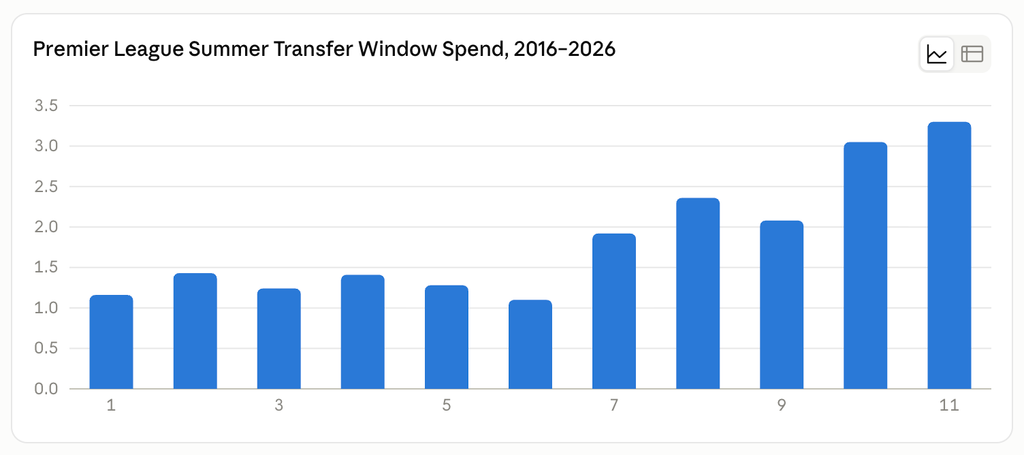
    3.3B, Premier League Transfer Spend 2026

    Matias Fernandez-Pardo touched down at Newcastle Airport on deadline day eve with a medical to complete and a nation’s transfer trackers refreshing every ninety seconds. By the time St James’ Park’s summer business was done, the Belgian winger’s £51m arrival from Lille had pushed Newcastle’s outlay past £275m for the window — fourth-highest in the Premier League, behind only Manchester City, Chelsea and Tottenham. Multiply that scramble by twenty clubs, add in a World Cup year’s worth of urgency, and you arrive at the number now rippling through boardrooms from Tyneside to the City of London: Premier League clubs spent somewhere between £3.2bn and £3.48bn this summer, depending on which data house you trust, comfortably eclipsing last year’s record and confirming what anyone watching deadline day already suspected. English football’s transfer market no longer has a ceiling — only a series of records waiting to be broken by the following September.

    A decade of compounding numbers

    Ten years ago, the entire Premier League spent £1.16bn across a single summer window — a figure that felt seismic at the time, driven by the first instalment of a new £5.1bn domestic broadcast deal. Today, that sum wouldn’t cover Manchester City’s spending alone this window; the champions committed £440.3m on their own, more than the whole division managed in 2016. Sky Sports’ own analysis puts this summer’s outlay at “almost three times the amount clubs spent a decade ago” — and the shape of that growth curve tells its own story.

    The climb wasn’t smooth. Summer 2017 pushed the record to £1.43bn on the back of another broadcast uplift. The pandemic years flattened the curve — as recently as 2021, the all-time single-window record stood at a comparatively modest £1.4bn. Then came the snap-back: £1.92bn in 2022, a leap to £2.36bn in 2023, a brief dip to £2.08bn in 2024 as clubs caught their breath under Profit and Sustainability Rules scrutiny, before the market detonated. Summer 2025 smashed through £3bn for the first time, propelled by Alexander Isak’s British-record £125m move from Newcastle to Liverpool. This summer did it again, breaking £3bn for a second consecutive year and, by some trackers, setting a fresh all-time high.

    The steepness sits in the acceleration, not the average. Analysis from the football finance newsletter Swiss Ramble calculated that the Premier League spent more than £9.6bn across its four most recent transfer windows — nearly double the £5.1bn spent in the preceding four-year stretch. Put another way: it took the division roughly fourteen years, from the current transfer system’s introduction in 2003, to first crack £1bn in a single window. It has taken barely half that time to triple it.

    Why the market keeps climbing

    Three forces are compounding at once, and none of them show signs of easing.

    The first is simple: broadcast and commercial revenue keeps growing, and clubs spend against what they expect to earn, not what they’ve already banked. Every uplift in the Premier League’s domestic and overseas rights packages since that original 2016 windfall has fed directly into transfer budgets, because clubs know rivals will spend theirs regardless.

    The second is accounting mechanics. Under both the outgoing Profit and Sustainability Rules and the incoming Squad Cost Ratio system — replacing PSR from this season, 2026/27, after Premier League clubs voted through the change — transfer fees aren’t booked as one lump sum. They’re amortised, spread evenly across the life of a contract. A £100m signing on a five-year deal shows up as £20m a year on the books, which makes eye-watering headline fees far more palatable against annual revenue than the number itself suggests. Clubs have responded by lengthening contracts to soften the annual hit, which in turn makes bigger fees easier to justify upfront.

    The third is regulatory transition itself. This is the first transfer window conducted with SCR on the horizon rather than PSR’s rolling three-year loss cap. SCR ties permitted spending on wages, transfers and agent fees to a fixed share of revenue — 85% for clubs playing only domestically, dropping to 70% for anyone in Europe. Crucially, that’s a percentage of turnover, which means a club’s spending ceiling rises automatically as its revenue does, with no equivalent brake on the biggest six clubs whose commercial and European income dwarfs the rest of the division. Unused allowance can even roll over between seasons, giving well-run clubs further incentive to spend up to the line rather than bank a surplus.

    Layer on top of that what one football finance academic, Professor Rob Wilson of UCFB, described to City AM as a genuine fear of missing out — the calculation, increasingly explicit in boardrooms, that standing still while direct rivals strengthen costs far more in relegation risk or missed European qualification than overpaying by £10m or £20m on a targeted signing. And layer on sovereign and state-backed ownership models, of which Newcastle’s PIF-controlled structure is the most obvious Tyneside example, which have injected a different risk appetite into a market where cash-rich challengers can absorb short-term losses that traditional family or plc ownership structures could not.

    Sustainable, or simply recycled?

    Here the picture gets more interesting than the headline figure suggests, and Newcastle’s own summer is the clearest illustration of it. This was not simply PIF money flowing outward. St James’ Park sold its spine to fund the rebuild: Sandro Tonali to Tottenham for £92.5m, Bruno Guimarães to Arsenal for £75m, Anthony Gordon to Barcelona for £68m — roughly £236m recouped from three of the dressing room’s most important players, reinvested largely in players under twenty-four. That is not the behaviour of a club with an open chequebook and no constraints; it is the behaviour of a club navigating PSR discipline right up until the rules change beneath it, forced to sell its best players to buy its next ones. Even state-backed ownership, in other words, still has to balance the books under the current framework — sustainability, for Newcastle at least, has meant painful player trading as much as reckless spending.

    That’s the case for optimism. The harder question is what the market looks like from outside the top of the table. Manchester City’s £440m gross outlay this summer, or Chelsea’s £342m, sits alongside Premier League new-boys and mid-table sides working with a fraction of that firepower and a £39m three-year PSR loss cap rather than the established clubs’ £105m ceiling. Crystal Palace co-owner John Textor put the underlying grievance bluntly at the Financial Times Business of Football summit earlier this year, arguing the financial rules are built to protect clubs that already generate significant revenue from being caught by those that don’t. SCR doesn’t resolve that tension so much as formalise it: tying spending power to existing revenue essentially locks in the current hierarchy, because the clubs already earning the most from global broadcast deals, Champions League football and commercial partnerships get to spend the most, while newly promoted or historically smaller clubs are permitted to compete only up to a ceiling defined by revenue they don’t yet have.

    The macro risk for the division is one of its own making. The Premier League’s global commercial value rests on its billing as English football’s greatest asset — the most unpredictable top flight in world football, where mid-table sides can beat champions and a top-half finish is never guaranteed. A transfer market compounding at close to 20% a year, concentrated overwhelmingly among six or seven clubs with the deepest revenue bases, risks calcifying precisely the competitive uncertainty that makes the league worth £3bn a summer to broadcast in the first place. For a club like Newcastle — big enough in ambition and ownership to compete at the spending table, but still building toward the revenue base of the traditional elite — the coming SCR era will test whether Tyneside can keep trading its way up the table, or whether the accounting now simply confirms who was always going to stay at the top.

    What it costs the fan on the Gallowgate

    None of the £3.3bn moves through a supporter’s wallet directly. Transfer fees are financed by broadcast contracts, Champions League prize money and commercial deals struck in boardrooms far from Barrack Road, not by the price of a matchday pie. But ask a fan queuing at the turnstiles whether the arms race feels distant, and the honest answer is no.

    Newcastle’s own season ticket price rose 5% for 2026/27, the fourth successive year of increases, drawing criticism alongside Manchester United even as the club spent £275m rebuilding the squad that same summer. Across the division, 13 of the 20 clubs raised prices again this season, and 115 supporter organisations and Fan Advisory Boards backed the Football Supporters’ Association’s “Stop Exploiting Loyalty” campaign for a two-year freeze — rejected almost everywhere, bar a handful of clubs including Manchester City, Nottingham Forest and Tottenham, who chose restraint rather than necessity. The average Premier League season ticket now sits at a record £535. None of that is transfer spending landing in a supporter’s bank statement as a line item, but it is the same clubs, flush with the same broadcast windfall, asking fans to absorb rising costs in the same window they spend nine figures on a winger barely out of his teens.

    The subtler cost is emotional rather than financial. At £50m-£90m a head, a signing is rarely allowed to develop quietly — expectation arrives with the fee attached, and patience for a player finding his feet shrinks in proportion to what he cost. Newcastle said goodbye to Sandro Tonali, Bruno Guimarães and Anthony Gordon inside nine weeks this summer, three players supporters had watched grow into folk heroes since 2022, and absorbed that loss the way this era increasingly demands: quickly, and in service of a rebuild rather than treated as a betrayal. Attachment to a matchday XI now competes with the accounting reality that almost every player is, eventually, an asset waiting to be monetised.

    Set against that is the football itself, which by most measures has never been better to watch. Four of the eleven most expensive transfers in history happened this summer alone, three of them Premier League deals, and the calibre arriving at St James’ Park — Woltemade, Elanga, Fernandez-Pardo — would have been unthinkable for a mid-table English club a decade ago. That is the trade a supporter is actually being asked to make: a faster, more disposable relationship with the players wearing the shirt, in exchange for a standard of football no previous generation of Geordies got to watch, even if the price of getting through the gate keeps climbing alongside it. Whether that trade feels worth it has less to do with the spreadsheet than with what a fan actually goes to St James’ Park for in the first place.

    Do you think the massive spending has made the Premier League “better”? How much higher can it go? Join the conversation on X @mytoonarmy #NUFC