
Data Driven Insights. Fearless Opinions.

Match Report

  • Barnes Off the Bench, Dedić Pulling the Strings: Newcastle Survive a Carabao Cup Scare Against West Brom

    Amar Dedic

    Nineteen minutes gone at St James’ Park and Isaac Price, on his debut, has just bent a free-kick round a static wall and beyond a flat-footed Ewen Jaouen. The away end erupts. Somewhere in the directors’ box, Nico González watched on, unveiled to the Gallowgate before kick-off to great applause and reception. Down on the pitch, Newcastle’s kids are getting a lesson in the brutal unsentimentality of knockout football from a Championship side who mean business.

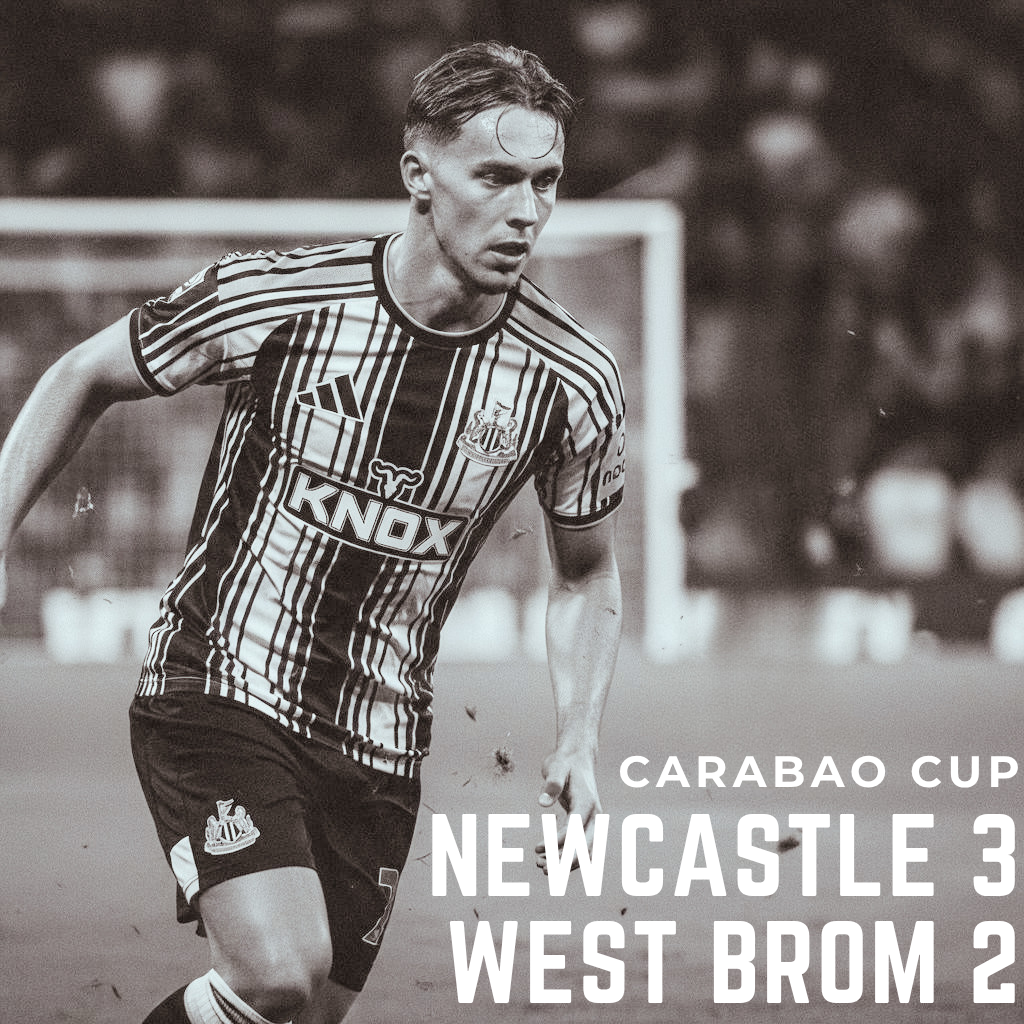
    By 10.12pm BST, none of that mattered. Harvey Barnes, forty-five minutes into his night’s work, had scored twice from the bench, Amar Dedić had carved the game open from right-back with the composure of a man twice his experience, and Newcastle were through to round three of the Carabao Cup, 3-2, in a tie that swung four times before Matthias Jaissle could exhale.

    The Numbers Behind a Ragged, Absorbing Night

    Strip away the theatre and the underlying picture is one of a Newcastle side still assembling its identity under Jaissle — fluent going forward in bursts, alarmingly loose without the ball, and reliant on individual quality to bail out structural uncertainty.

    Where Newcastle were strong:

    • Transition speed down the right. The axis of Dedić and Murphy (and later, Elanga) repeatedly turned West Brom’s back four before they’d set. The move for the 81st-minute winner — Elanga surging beyond his full-back, teeing up Dedić, whose low centre Barnes turned home first time — was a carbon copy of the pattern Newcastle had been probing for the better part of twenty minutes.
    • Set-piece opportunism. Barnes’ first goal, the 48th-minute equaliser-turned-lead-changer, came from a corner that West Brom’s back line failed to clear cleanly; Barnes’ low drive from the edge of the box wasn’t even meant to be the final act, and he arrived to finish his own rebound.
    • Goal-productivity from midfield architecture. Sean Steur’s driving run and incisive pass — after he’d been the one to concede the free-kick for West Brom’s opener, a detail Jaissle will have clocked — was the platform for the leveller on 38 minutes, worked wide to Dedić, whose whipped delivery Bazoumana Touré forced in under pressure from Chris Mepham.

    Where the cracks showed:

    • Two penalties conceded, both through Lewis Hall. A repeat offender inside four days — having given away a spot-kick against Liverpool on the Sunday — Hall’s second penalty of the week, on 76 minutes, allowed Price to draw West Brom level from twelve yards and expose a Newcastle back line that, shorn of Dan Burn and Tino Livramento to injury, is still finding its shape.
    • A two-man midfield stretched thin. With Steur and Jacob Ramsey the only bodies shielding the back four for large spells, West Brom’s front two — Barney Stewart and Jimmy-Jay Morgan — found pockets of space between the lines that a Championship side ought not to have found against a Premier League defence. It is, as more than one voice inside St James’ Park noted afterwards, still early days for Jaissle’s system, but the vulnerability was structural rather than incidental.
    • Goalkeeping uncertainty. Jaouen, stepping in for first-choice Lukáš Hornícek in a summer that has seen Nick Pope pushed down to third in the pecking order behind the two new arrivals, got a hand to Price’s free-kick for the opener and will feel he should have done better; competition for the gloves at St James’ Park is fierce enough now that even a rare off-night carries consequences.

    Dedić: Two Assists, Ninety Minutes, and the Discipline That Wins a Manager’s Trust

    If Barnes takes the headline for his brace, the man pulling the game’s strings from right-back was Amar Dedić, and the case for his man-of-the-match award is not close to marginal.

    Start with the end product: two assists in ninety minutes, delivered from two different phases of play and two different sides of the pitch. The first — a fizzed, first-time cross into the six-yard box for Touré’s equaliser — required Dedić to receive Steur’s pass under pressure and produce a delivery with pace and precision inside a single touch. The second, for Barnes’ winner, was a lower-tempo, patient centre picked out after Elanga’s overlap had dragged West Brom’s shape apart; different circumstances, same clean execution.

    End product alone tells only half the story. With Hall conceding two penalties in four days and Newcastle’s midfield often outnumbered by West Brom’s front two, the defensive burden on the opposite flank fell disproportionately on Dedić, tracking runners and closing lanes while still offering the outlet going forward that both goals required. A full-back doing a full-back’s unglamorous defensive job and a creator’s job simultaneously, for the full ninety minutes, against a well-organised Championship side, is precisely the profile of performance that shows up nowhere on a highlights reel but everywhere on a coach’s notes.

    Compare that to the alternative candidates. Steur was excellent in the moments that mattered — his surge and pass built the equaliser, and Newcastle fans inside the ground were already murmuring his name for the individual honours — but he was culpable for the foul that led to Price’s opening free-kick, and was withdrawn before full time, replaced by Charlie McArthur Miley, meaning his influence on the closing stages, when Hall’s second penalty and Barnes’ winner both arrived, was zero. Barnes scored twice, which is precisely what a substitute introduced at half-time is asked to do, and Jaissle’s post-match praise for him was pointed and specific — more on that below — but a forty-five-minute cameo, however clinical, does not carry the same weight as ninety minutes of two-way defensive and creative work from right-back. Dedić’s case rests on volume as much as quality: he did more, for longer, in more phases of the game, than anyone else in a black-and-white shirt.

    Man of the Match: Amar Dedić

    Steur’s Statement and Barnes’ Instant Impact

    None of which should diminish Steur’s night. At eighteen, deployed in the deeper of Newcastle’s two central midfield roles, he looked entirely unbothered by the step up — his passing range under pressure, particularly the ball that released Dedić for the first goal, suggested a footballing intelligence well beyond his conditions, and it was that combination of press-resistance and vision that had supporters and pundits alike pencilling him in for the individual award before West Brom’s second penalty complicated the picture. Jaissle’s decision to withdraw him rather than risk fatigue or a second yellow, with Miley a like-for-like swap, spoke to a coaching staff already trusting the teenager with genuine tactical responsibility.

    And then there was Barnes. Introduced at the interval for the debutant Touré, he needed three minutes of the second half to make his mark and forty-five to complete the job: a driven shot from the edge of the area that West Brom couldn’t clear, followed by the simplest of finishes to the loose ball; then, on 81 minutes, the coolest of first-time turns onto Dedić’s low cross to restore a lead that had been surrendered moments earlier. Two goals from two genuinely different types of chance — the scrambled rebound and the clinical first-time strike — is the kind of instant-impact substitute cameo that reshapes a manager’s thinking about a matchday squad.

    Asked specifically about Barnes afterwards, Jaissle was unambiguous that the value went beyond the scoreline. “It’s not only goals,” he said. “As we saw also against Liverpool he was doing a really great job, not only in possession, also out of possession. He is disciplined, especially also with the combination with Lewis Hall. We’re really pleased, I thanked him after the match, it was important that he scored.” It is a rare thing for a head coach to volunteer a defensive compliment about a winger who has just scored twice, and it points to exactly the kind of two-way team ethic Jaissle is trying to instil across his rebuilt squad.

    Next Up: The Den Awaits

    The reward for seeing off West Brom arrived within hours of the final whistle. Newcastle have been drawn away to Millwall in the Carabao Cup third round, a trip to The Den that will offer an altogether different examination of Jaissle’s young side to the one West Brom posed under the Gallowgate floodlights. With Round Three fixtures scheduled across the weeks commencing 7 and 14 September to accommodate the nine clubs still competing in Europe, and Newcastle among the sides not required to juggle a continental commitment that week, the tie is expected to fall in the earlier of the two windows — though the EFL is yet to confirm the precise date and kick-off time.

    It is, on paper, a tie stripped of the glamour of a Manchester City or a Liverpool, but anyone who has made the journey to South Bermondsey knows The Den carries its own particular menace: a tight, hostile arena where Championship promotion-chasers have made life uncomfortable for bigger names than this Newcastle side in recent seasons. For a Jaissle project still finding its balance between the calm authority of Steur and the defensive uncertainty exposed by Hall’s fortnight of penalty concessions, it promises to be a useful, unglamorous test before the serious business of the Premier League campaign resumes.

    The Broader Picture

    Newcastle move into the third-round draw having survived rather than dominated, against opposition managed by James Morrison that Jaissle, in his post-match conversation with his opposite number, rated highly enough to suggest West Brom “will play a great role” in this season’s Championship. For a Newcastle side still stitching together a new-look XI in the opening weeks of Jaissle’s tenure — light on senior central midfield cover, still bedding in summer arrivals like Dedić, Steur and Touré, and managing without Burn, Joelinton and Livramento — a scrappy cup win with two goals from the bench and a captain’s-innings performance at right-back is, on balance, exactly the kind of result a rebuilding project needs: uncomfortable enough to expose the gaps, convincing enough to bank the points and the confidence.

    What did you think of the victory against West Brom? Will Newcastle progress deep into the Carabao Cup competition? Join the conversation on X @mytoonarmy #NUFC
  • Cruel Tyneside Poetry: Newcastle Masterclass Ruined at the death

    Under the towering lights, Newcastle United delivered ninety minutes of breathless, high-octane tactical poetry only to be denied a statement victory by the cruelest of stoppage-time penalties.

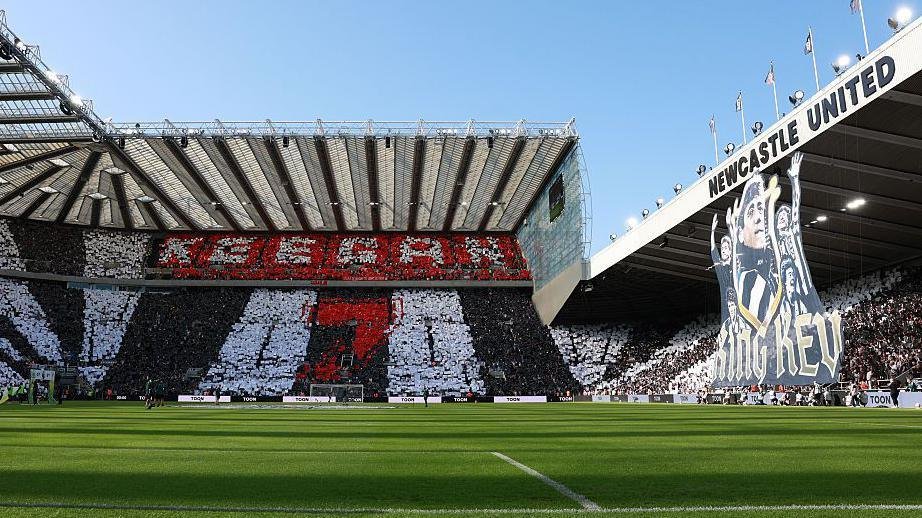
    Before a ball was even kicked on a sweltering Tyneside afternoon, the emotional temperature inside the stadium was already at boiling point. A deeply moving, pre-match tribute to Kevin Keegan—marked by a huge display across the stadium in his honour. One banner read:

    “I want people to dream about their football club. They should. We should all be dreamers at heart.” – King Kev

    That thunderous nostalgic pride immediately shifted into pure, unadulterated hostility the moment Alexander Isak took the kick-off in Liverpool red. The Swede was subjected to a ferocious cacophony of jeers and whistles with every touch, a psychological cauldron that visibly unsettled the striker. He finished the night with just 10 completed passes, and just 2 shots on target.

    Riding that wave of emotional fervor, Matthias Jaissle’s new-look Newcastle delivered a masterclass in suffocating structural intensity and devastating directness. The dividend arrived after just four minutes via a lightning-fast counter-attack. Pouncing quickly an attack that broke down, William Osula threaded a razor-sharp through ball into the open channel for Anthony Elanga.

    Clocking a blisteringly fast top speed of 36.4 km/h, Elanga left Milos Kerkez completely in his wake before entering the penalty box and calmly slotting a precise finish low past Alisson into the bottom corner. Those first 20 minutes, Liverpool was treated to a suffocating spell of Tyneside football that encapsulated everything Jaissle wants his side to represent.

    Liverpool adjusted their build-up shape after the interval, squeezing the space through central channels and clawing back an equalizer in the fifty-fourth minute when Cody Gakpo launched a precise daisy cutter to beat the keeper after some tentative defending; the team had begun to tire and foolishly stood off Gakpo. You simply cannot give a player of his quality time and space.

    The equalizer could have deflated the team, but what followed was another stroke of transitional genius that sent St. James’ Park into absolute ecstasy. Barely sixty seconds after Gakpo’s strike, Jaissle made a decisive double change, introducing Joe Willock for Osula to alter the midfield dynamic, and Newcastle responded immediately with another devastating break.

    Picking up possession in his own half, Yoane Wissa ignited the attack with a mesmerizing piece of ball-carrying, expertly weaving through the middle of the park and gliding past a clutch of red shirts under heavy pressure. Spotting Willock advancing in support, Wissa slipped a perfectly weighted lateral pass to the midfielder, who took one touch to set himself before curling a gorgeous, sweeping strike beyond Alisson’s reach from just outside the penalty area. The goal came a mere sixty seconds after Willock stepped onto the pitch, marking one of the fastest substitute strikes in recent Premier League history.

    The decisive moment. Was it a pen?

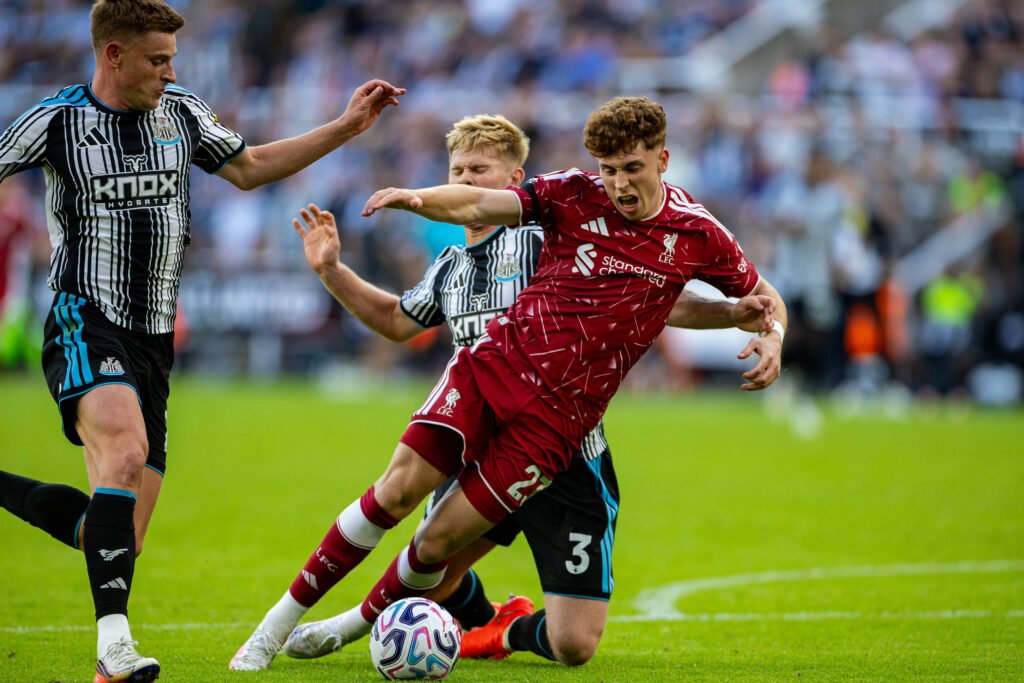
    What should have been a triumphant victory march, however, devolved into heartbreak deep into added time. In the ninety-fifth minute, with Newcastle defending resiliently inside their own box, Lewis Hall clumsily clattering into Victor Muñoz who was trying to glide past him resulted in a referee’s whistle. It was a bitterly soft call to concede—the exact kind of physical coming together that another referee on a different afternoon would have waved on without a second thought. But the referee pointed to the spot, allowing Dominik Szoboszlai to step up in the ninety-eighth minute and smash the ball emphatically into the top corner, leaving the Newcastle goalkeeper with absolutely zero chance despite diving the right way to salvage a 2-2 draw for the visitors.

    While the emotional toll of two dropped points in the dying seconds is heavy, the structural foundation Jaissle is building offers immense encouragement. The immediate focus now shifts to a relentless early-season schedule where momentum must be preserved. Newcastle return to St. James’ Park on Wednesday, August 26 at 20:45 BST to take on West Bromwich Albion in the League Cup, a fixture that represents an essential opportunity for squad rotation and deep-cup progress—a vital component for the club’s broader financial and squad-building objectives under SCR frameworks.

    Following mid-week cup duties, the Magpies face a stern Premier League test on Saturday, August 29 at 17:30 BST when they travel to North London to face Roberto De Zerbi’s Tottenham Hotspur. That trip to the capital will serve as an early barometer of Newcastle’s aspirations this season, pitting Jaissle’s high-intensity pressing system against De Zerbi’s fluid possession mechanics in a match that could dictate the early trajectory of Newcastle’s European push.

    Was it a penalty? Should Wissa have put the game beyond reach when clean through on goal? Join the conversation on X @mytoonarmy #NUFC
  • MKM Mayhem: Hull City’s Shocking Takedown of Manchester United Shakes the Opening Weekend—and Offers Newcastle a Blueprint

    If Premier League opening weekends are meant to establish a natural order, Saturday’s fixtures instead took a blowtorch to the script. As St. James’ Park prepares to switch on the floodlights for Sunday evening’s blockbuster against Iraola’s Liverpool, the top flight has already delivered a series of seismic, bloody noses to the established elite.

    The loudest crack of thunder came from the MKM Stadium. There, newly promoted Hull City produced a display of breathless, snarling transition play to send Manchester United crashing to a 2-0 defeat—a result that instantly rewrites the early-season narrative and offers a tantalizing blueprint for Matthias Jaissle’s Newcastle.

    The Shock at the MKM: Anatomy of a Masterclass

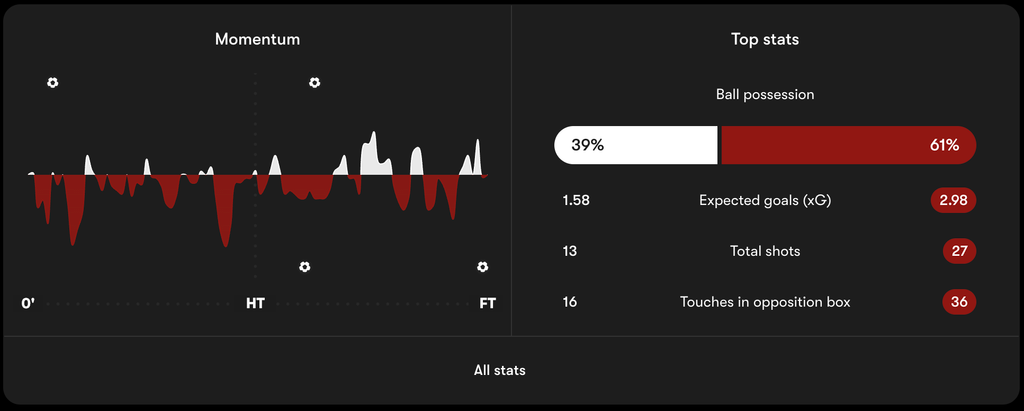
    Hull City’s victory was no smash-and-grab; it was a structural triumph backed by overwhelming underlying metrics. While Manchester United controlled the illusion of dominance with a 59% field tilt in the final third, they were completely toothless, generating a paltry 0.41 Expected Goals (xG)—their lowest output in a league fixture in over two years.

    Hull’s mid-block completely suffocated United’s deep build-up, restricting the visitors to just two shots inside the penalty box all afternoon. The real story, however, was dictated by the press. Hull’s central engine room dominated second-ball recovery, registering 14 high turnovers within 40 metres of the opposition goal. In stark contrast, United logged a staggering 18.4 Passes Per Defensive Action (PPDA).

    It was a terrifyingly familiar story for Michael Carrick’s men: defensive disorientation on the transition and a complete lack of spatial awareness. When Semi Ajayi poked home the opener after 17 minutes, the noise on Humberside was deafening. By the time Nobel Mendy powered a header past Senne Lammens just before halftime, United looked entirely unspooled.

    Around the Grounds: Brentford Bludgeon a Fragile Spurs

    The vulnerability of the established elite wasn’t isolated to Yorkshire. Down in the capital, Brentford delivered an equally brutal tactical dismantling of Tottenham Hotspur, running out 3-0 winners.

    The pre-match discourse had been dominated by the vast financial chasm between the two clubs. Spurs, having spent massively on a lavish summer rebuild under Roberto De Zerbi, were widely expected to roll over a Brentford side defined by its shrewd, data-driven frugality. Yet, on the grass, Keith Andrews orchestrated a performance that made a mockery of those price tags.

    To be fair to De Zerbi, his tactical preparations were severely undermined by a brutal injury crisis that sidelined seven first-team players, forcing him to field a makeshift backline featuring Jan Paul van Hecke and an out-of-position Andrew Robertson. However, that mitigation does not excuse the sheer passivity of the visitors.

    Andrews’ side smothered Spurs in the second phase, winning 68% of second-phase duels and generating 2.74 xG to Tottenham’s paltry 0.58. The architect of the misery was their club-record summer signing, Mamadou Sangare. The 24-year-old covered every blade of grass, orchestrating the opener for Keane Lewis-Potter. When Michael Kayode fired in the third just after halftime, the Gtech Community Stadium erupted into a chorus of “You’re going down with the Fulham.” Had Igor Thiago not hammered a second-half penalty off the post, the humiliation would have been absolute.

    Elsewhere, the heavyweights who did show up put on clinics in control. Mikel Arteta’s Arsenal cruised to a 3-0 win over Coventry City, suffocating the newly promoted side with an incredible 89.2% pass accuracy in the opposition half.

    The rest of the slate saw physical dominance dictate outcomes. Everton controlled the direct channels with a 64% aerial duel win rate to dispatch Crystal Palace 2-0, while Ipswich Town won 58 total ground duels to overturn an early deficit and beat Sunderland 2-1 in a frantic, blood-and-thunder clash at Portman Road. On Friday night, Daniel Farke’s Leeds United displayed relentless off-ball intensity, logging a weekend-best 7.2 PPDA to deny Nottingham Forest any rhythm in a gritty 1-0 away win.

    What It Means for Newcastle United Ahead of Liverpool

    For Matthias Jaissle and Newcastle, Saturday’s chaos elsewhere in the country provides both a warning and a massive opportunity ahead of the clash with Liverpool under the Gallowgate lights. Read the MTA’s pre-match analysis here.

    First, the vulnerability of the “Big Six” transition defense has been laid bare. Both Manchester United and Tottenham were dismantled by teams that prioritized verticality and aggressive pressing over passive, sterile possession. If Newcastle execute Jaissle’s high-octane, Red Bull-style pressing triggers, Liverpool’s evolving midfield can be put under severe duress.

    Secondly, the top-four race is already showing signs of extreme volatility; this could be a crazy season. With United and Spurs dropping points so emphatically on day one, the race for European places remains wide open. Establishing momentum on Matchday 1 is paramount.

    Hull and Brentford proved that games in August are won in the secondary phases, by winning the dirty balls, and punishing high turnovers. Newcastle’s ability to force those turnovers in the middle third will be the decisive factor in controlling Sunday’s narrative. The door to the top four has been kicked open; now, Newcastle must step through it.

    What a start to the new season! Early shocks, can the apple cart be upturned? Can Newcastle upset the form book and pundits alike against Liverpool tonight? Join the conversation on X @mytoonarmy #NUFC