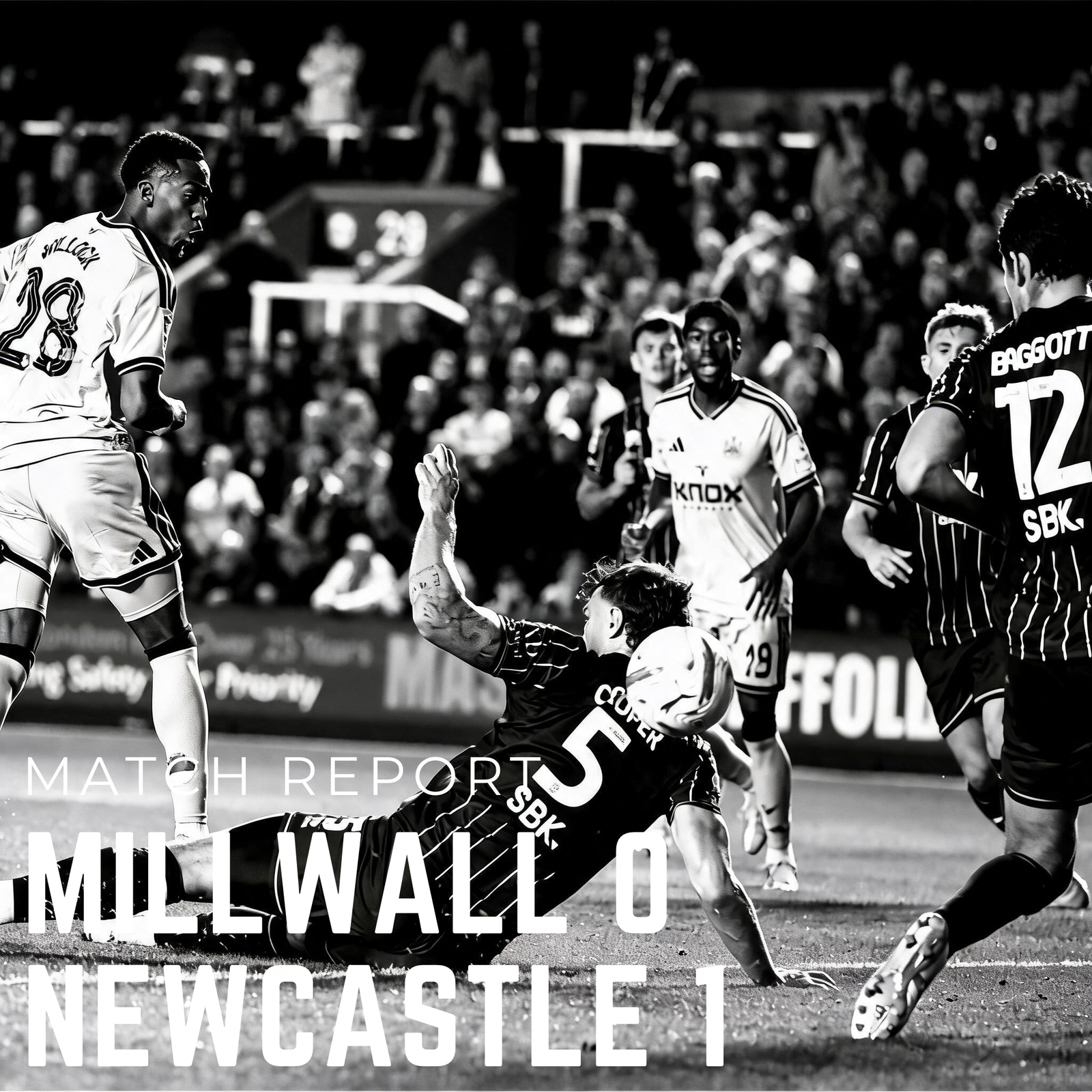
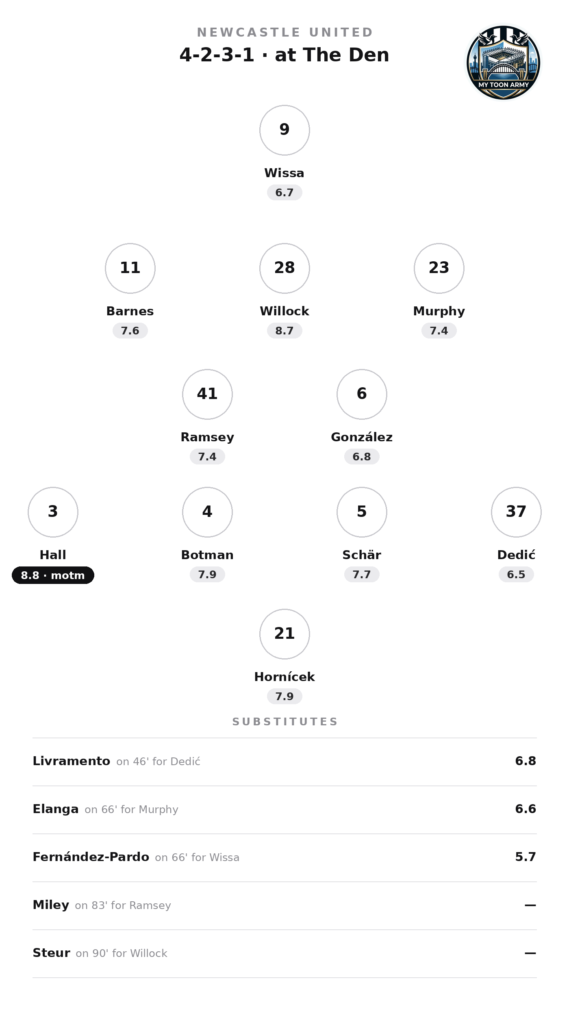
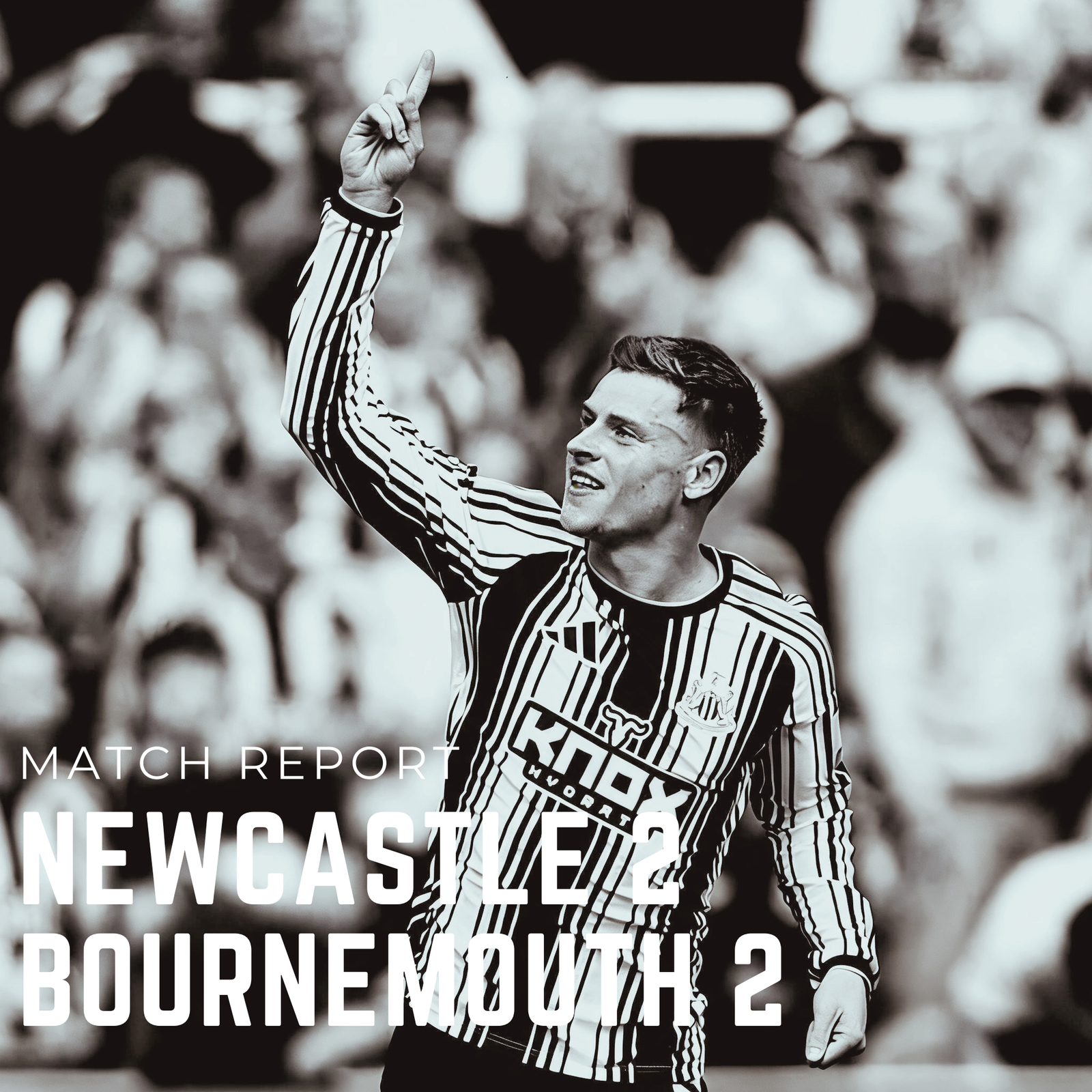
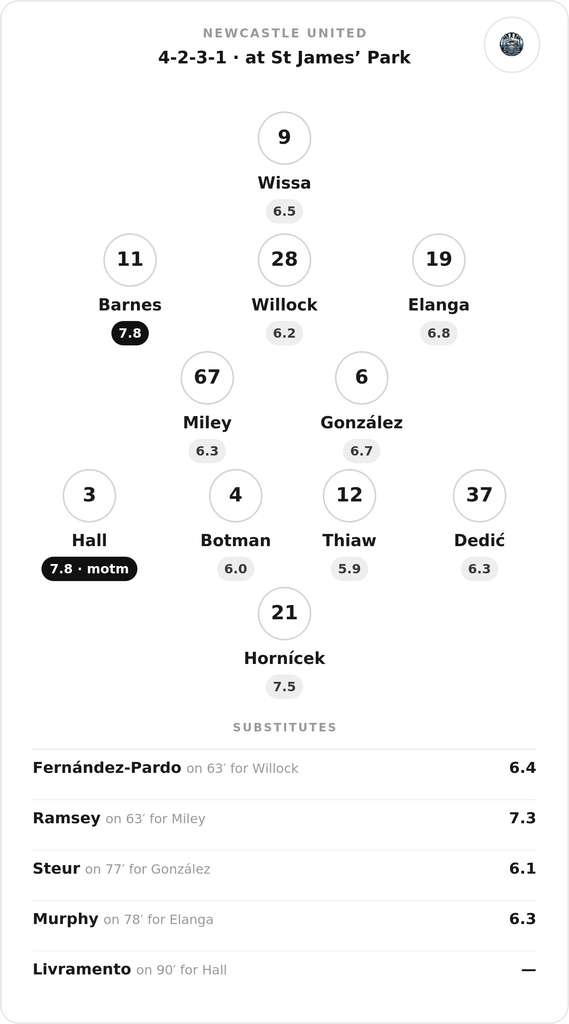
The teamsheet dropped at The Den forty minutes before kick-off and settled an argument before a ball had been struck: three changes, not the wholesale clearout that had seemed the safer bet for a Tuesday night in Bermondsey against Championship opposition. Sven Botman, Lewis Hall, Joe Willock, Harvey Barnes, Yoane Wissa and Amar Dedić all kept their places from Saturday’s draw with Bournemouth. Only Malick Thiaw, Lewis Miley and Anthony Elanga made way, for Fabián Schär, Jacob Ramsey and Jacob Murphy. For a manager five matches into the job, at a ground with a genuine history of humbling bigger clubs, that is a team sheet with intent written through it.
The reasoning isn’t hard to trace. Newcastle arrived at The Den as past winners of this competition and semi-finalists last season, and a young head coach fielding a second-string XI in round three away to a side sitting handily in the Championship risked exactly the kind of night this competition has previously punished sides for taking lightly. Millwall had won 4-0 three days earlier, had lost only one of three home league matches, and had never once hosted Newcastle at the current stadium in the thirty-three years since it opened — the sides hadn’t met at all, anywhere, since 1993. Alex Neil’s side had every reason to fancy their night, and Jaissle’s team selection reads as a direct answer to that threat rather than a nod to the calendar. With Leeds not arriving until Monday, there was no fixture-congestion argument forcing his hand toward heavy changes in the first place — the six-day gap gave him the freedom to rotate hard if he’d wanted to, and he chose largely not to take it.
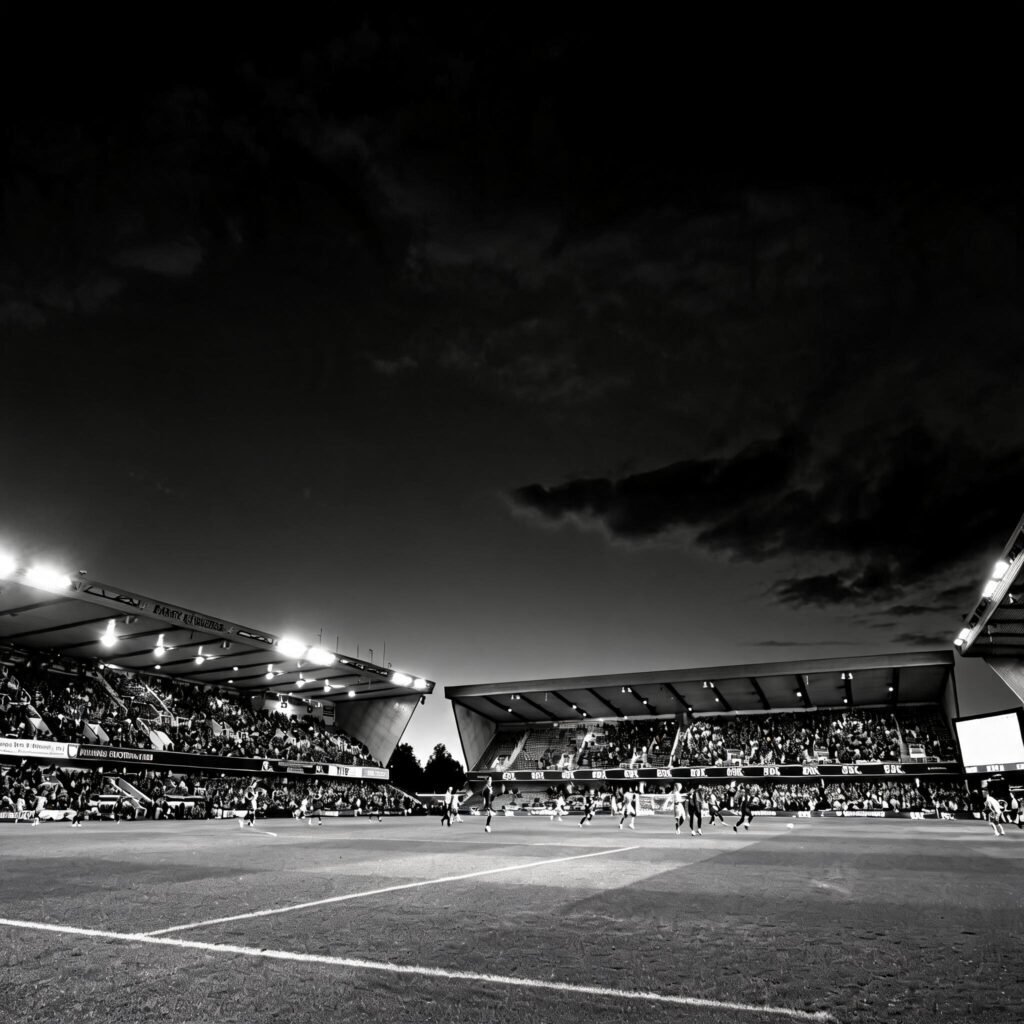
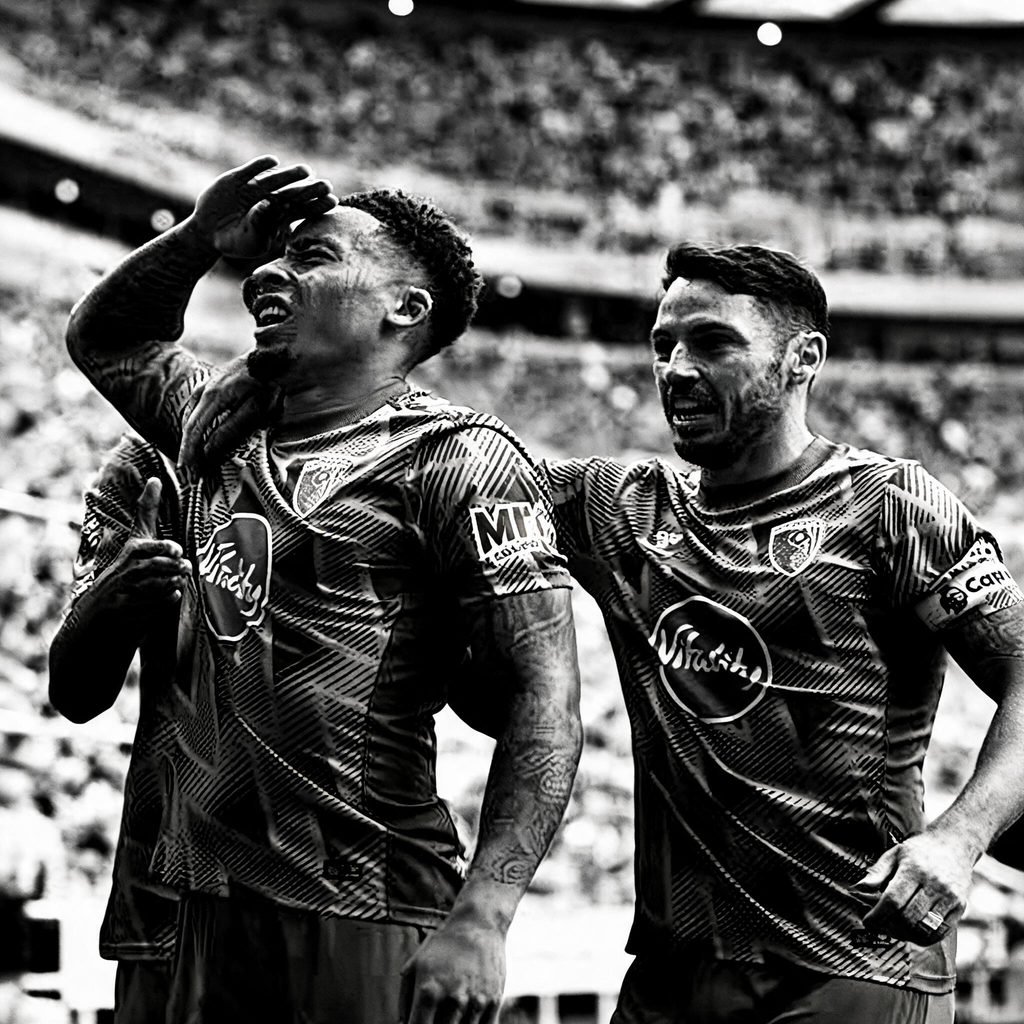
The Den, imposing by night
Look closer at who did sit out, too, and it reads less like a rotation policy than individual maintenance: Thiaw, Miley and Elanga rested on their own specific terms rather than as representatives of a fringe cohort given a run-out. That distinction matters. A coach still bedding in a high-press structure that depends on players reading one another’s triggers has good reason to protect continuity over giving minutes away — wholesale changes cost cohesion faster than they save legs this early into a new system, and Jaissle appears to have judged that trade-off wasn’t worth making against a Millwall side sitting deep and compact.
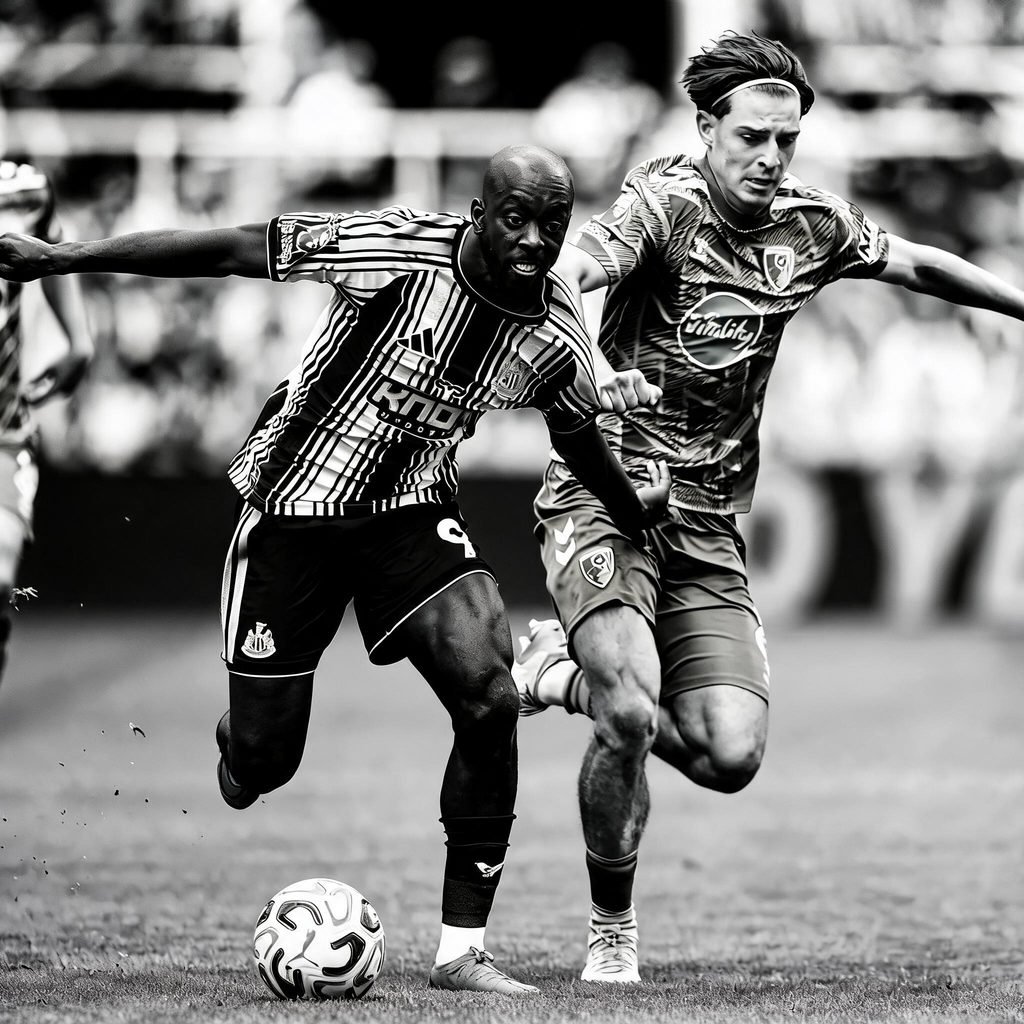
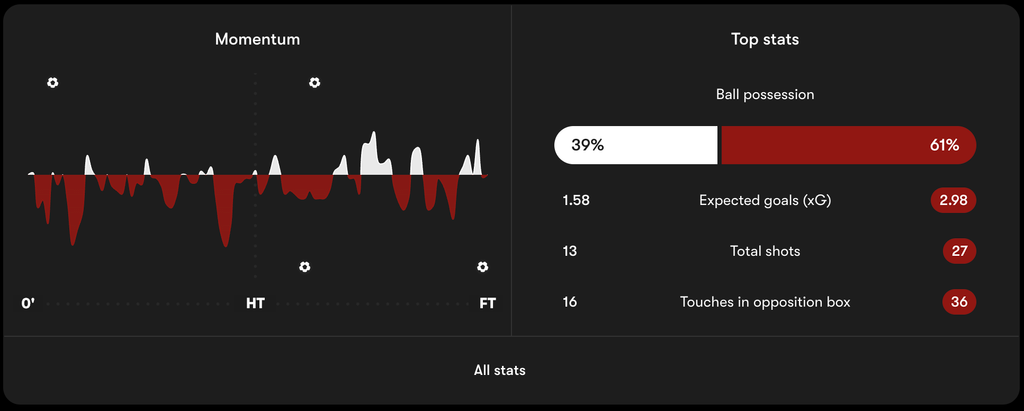
Which is what makes the eighty minutes that followed so instructive. This was, by most reasonable definitions, close to full strength — and it still took until the 81st minute to break Millwall down. Newcastle finished with 25 shots to Millwall’s nine, 15 corners to one, and an expected-goals reading of 1.77 against 0.50, yet spent long stretches of the first half unable to turn territory into anything alarming for Filip Marschall, handed his Millwall debut after a spell on loan at Gateshead. Of Newcastle’s 25 attempts, only one was rated a genuine big chance by the data — and they took it. Fourteen efforts before the break produced one shot on target, Willock’s low strike parried into the six-yard box rather than finished by the lurking Wissa. Murphy dragged an early sighter over. Jake Cooper and Caleb Taylor gave nothing away cheaply in the Millwall backline, and for a team picked specifically to win rather than to rest, the profligacy carried more weight than it would have against a weekend reserve XI — there was no fatigue or unfamiliarity to point to as mitigation.
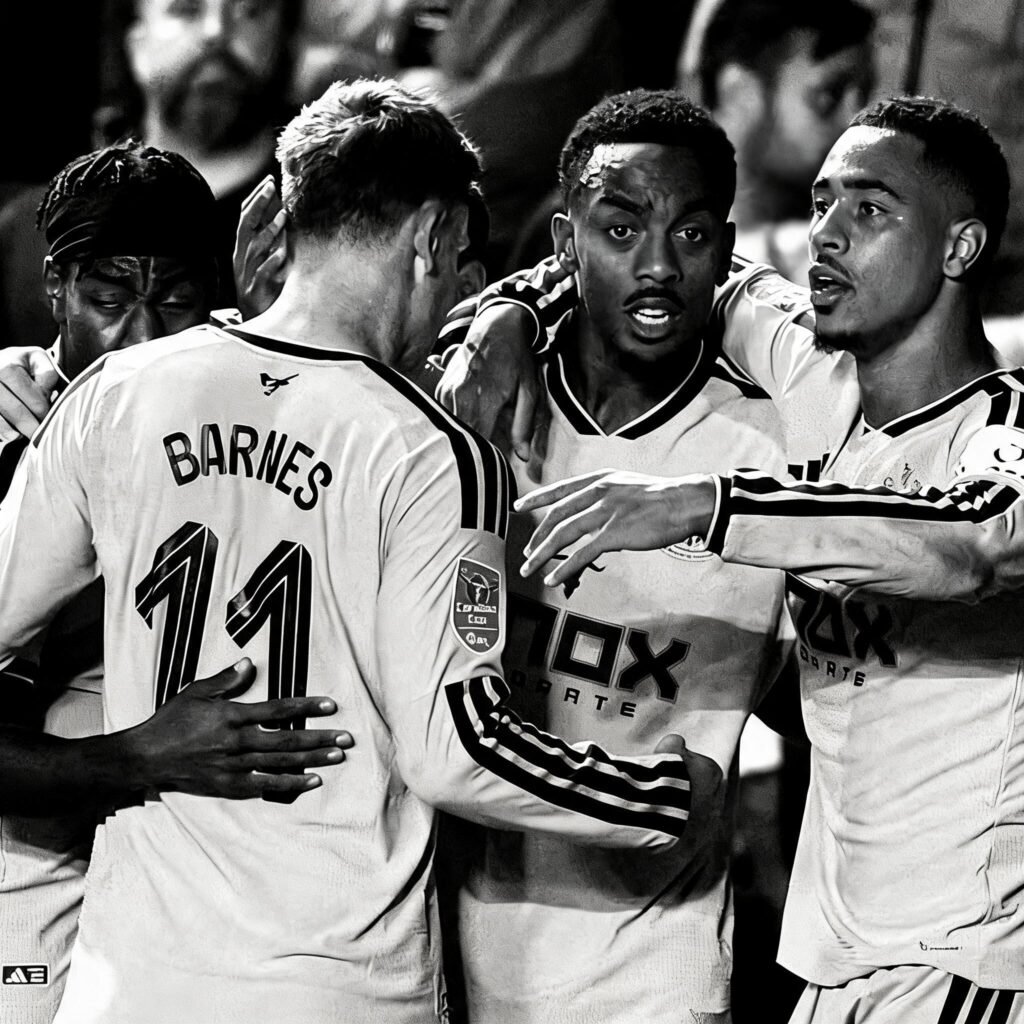
Millwall nearly made Newcastle pay for it. Nine minutes before the winner, substitute Tairyk Arconte turned Tino Livramento — only recently back from a long injury lay-off — and dragged a shot back off the near post with Lukas Horníček well beaten. Had that gone in, a near-full-strength Newcastle side would have been staring at a genuine upset rather than a mid-round formality, and the story of the selection would have written itself very differently. Instead, Jaissle’s bench did what his starters hadn’t: Elanga and deadline-day arrival Matías Fernández-Pardo had been on since the 66th minute to force the issue, and fifteen minutes later Hall’s low ball across the six-yard box found Willock at the back post for the finish that separated the sides.
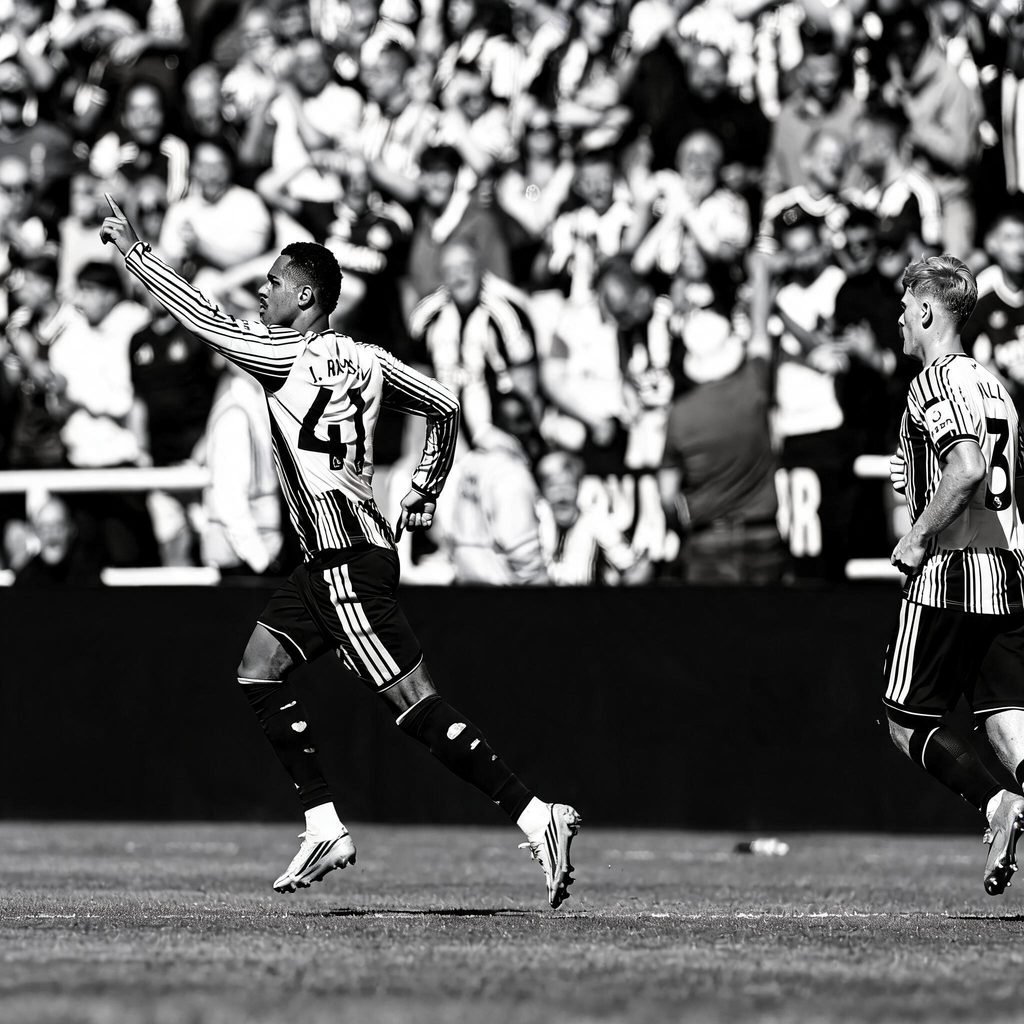
Celebrating a clever finish into the corner
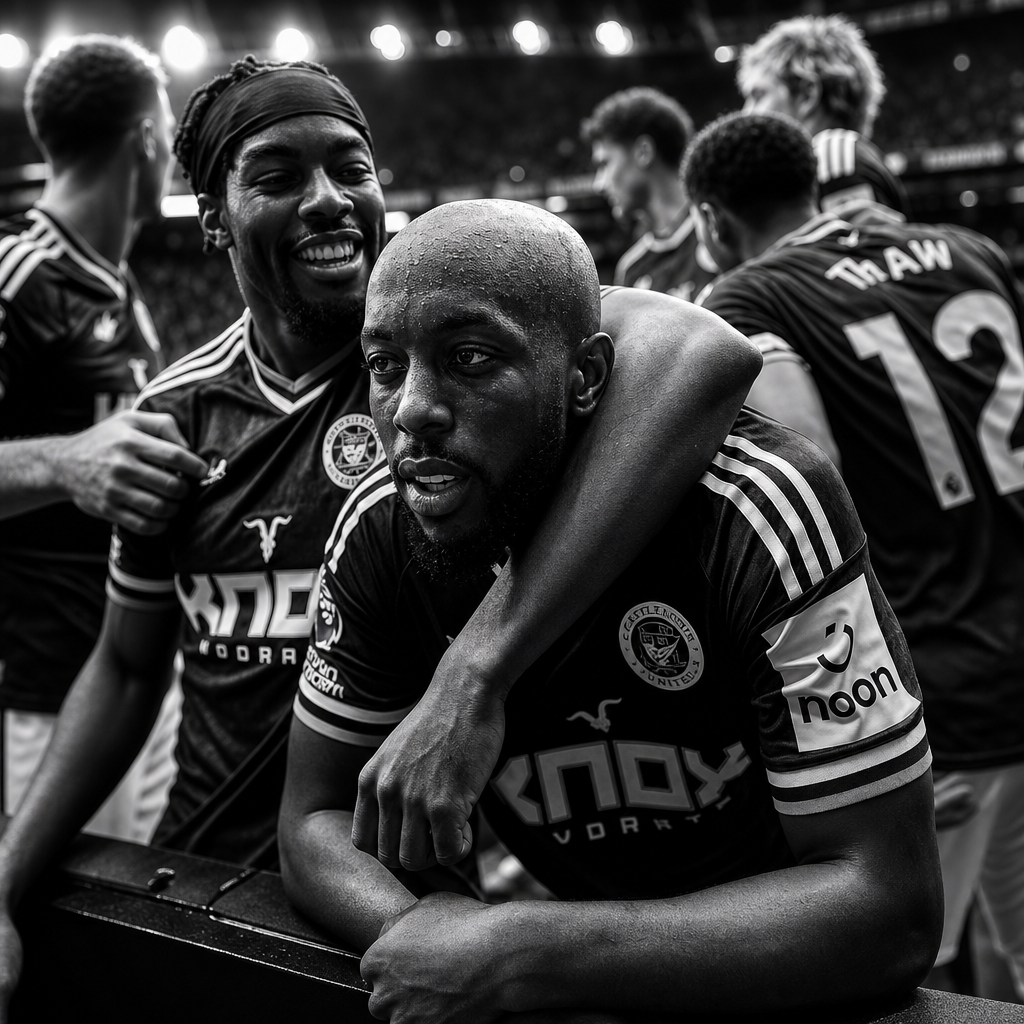
If one player made that selection look assured rather than merely bold, it was Hall. Tuesday continued a run of form that’s hard to argue with: an 8.6 in the win at Tottenham, a 7.8 with the assist in the Bournemouth draw, and now an 8.8 — his best of the three — built on the low ball across the six-yard box that Willock turned in. The pattern in the numbers matches the pattern on the pitch: solid without much incident defensively for an hour, then increasingly the outlet Newcastle turned to as Millwall’s low block held firm everywhere else, finishing with four chances created and more touches of the ball, 85, than anyone else on the pitch in either shirt. Speaking to Sky Sports afterwards, Hall credited the change in mood at the club since Jaissle’s arrival, saying the new coaching staff have “been top” and that the way they’re playing is one the whole squad is enjoying. On this evidence the feeling is mutual: he played every one of the ninety minutes on offer.
Willock is harder to write about cleanly, because the version of him that shows up changes depending on which ninety minutes are on. Nobody covered more ground trying to get into a scoring position than he did on Tuesday — ten duels won, more than any other player on the pitch, five shots, three of them on target, both the most of anyone in a Newcastle shirt — and it was that same appetite for the eighteen-yard box that put him on the end of Hall’s ball nine minutes from time, a finish rated a mere 0.28 expected goals that still finished with an on-target probability of 0.93 once it left his boot: not a gift, a finish. But the instinct that gets him into those positions so reliably is the same one that, watched over a longer run of matches, just as often produces the rushed shot or the wrong final pass when a simpler option is on: Newcastle’s profligacy in the first eighty minutes at The Den wasn’t confined to Murphy’s off night on the other flank. It’s what makes Willock simultaneously one of the easier players in this squad to get frustrated with and one of the hardest to leave out — a midfielder capable of long stretches of anonymity in the final third who has also, down the years, popped up with matchwinners. Tuesday’s ledger settled in his favour, emphatically. It won’t always.
Read the selection and the performance together, and a picture emerges of a manager unwilling to gamble with a competition his club takes seriously, backed by a group that took nearly the full ninety to justify his faith in them. Newcastle move into the Carabao Cup fourth round with the intended trophy challenge intact and the spine of the side rested only where it needed to be — but the manner of it, an expected-goals gulf that size taking until nine minutes from time to show up on the scoreboard, is worth remembering the next time a Championship low block stands between this squad and where it wants to go.
Newcastle return to league business on Monday at Elland Road, sitting seventh after four matches without defeat, against a Leeds side with its own survival plan to protect. Whether Tuesday’s finishing edge travels with the group Jaissle trusted to find it, or whether Bermondsey’s near-miss was the more honest guide to where this Newcastle side currently stands under pressure, gets another real test inside a week.
Do you think it was a scrappy win? The sort of results that we need to be able to grind out if we’re going to have a good season ahead? Join the conversation on X @mytoonarmy #NUFC
Twelve yards out, eighty-eighth minute, Jacob Ramsey took one touch to settle a half-cleared ball and side-footed it low past Djordje Petrovic. St James’ Park did not so much roar as exhale — fifty-two thousand people releasing eighty-eight minutes of accumulated grievance in one go.
It was Newcastle’s second shot on target all afternoon. Their second. Against a side who had managed five.
That single statistic tells you almost everything about the shape of Saturday lunchtime, and almost nothing about what actually mattered. Because the question posed in this column on Friday was never whether Newcastle would out-pass or out-create Bournemouth. It was whether this team, carrying the sudden and uncomfortable weight of expectation, could handle a fixture they were supposed to win against opposition they cannot beat. The answer arrived in two parts, and the second part was more revealing than the first.
The First Half That Proved the Warning and Missed the Point
Friday’s preview flagged the number that should have frightened everyone: no side in the Premier League had faced more shots than Newcastle across the opening two rounds. Jaissle’s system creates through aggression and concedes through it, and Bournemouth — pacey, direct, built to punish an open midfield — looked like precisely the wrong opponent to test it against.
Forty-five minutes later that warning looked prophetic. Thirteen Bournemouth shots to Newcastle’s three. An expected goals reading of 1.29 to 0.14. Marco Rose’s side did not merely start brightly; they arrived at St James’ Park with the clarity of a team who had watched the Liverpool and Tottenham tapes and decided that Newcastle’s high line was an invitation.
But the mechanism was not the one predicted. Both goals traced back to the same right boot, and it belonged to Newcastle’s own right-back.
The ninth minute: Alex Scott’s shot deflected off a Newcastle body and spun loose at the back post, and Amar Dedić stood watching it as though the phase of play had ended when the shot was struck. Marcus Tavernier did not stand watching. He arrived, and he finished, and Newcastle’s players surrounded referee Rob Jones insisting Anthony Elanga had been fouled in the build-up. VAR looked. VAR declined. Former PGMOL chief Keith Hackett has since backed the non-intervention as a legitimate refereeing judgement, and on the replays it is hard to argue otherwise — but the mood of the afternoon was set in that opening exchange, and it never fully recovered.
The thirty-fifth was worse, and it was worse because it was structural rather than accidental. Dedić lost the ball high up the pitch, in the advanced position his attacking instincts keep dragging him towards. Tavernier skipped past Nico González in the space that Dedić had vacated. Justin Kluivert’s shot smashed against the post and rebounded off Lukáš Horníček’s back; Scott collected the loose ball on a desperately tight angle and clipped a low cross that ricocheted off Malick Thiaw and looped over his own goalkeeper.
Call it misfortune if you like. The scoresheet does — Thiaw’s name sits there with the letters OG beside it, and he will not enjoy seeing them. But the dominoes fell in a very particular order, and the first one was pushed by a twenty-four-year-old full-back who has been outstanding going forward and repeatedly caught out coming back.
Here is the complication, and it is the reason this is a character study rather than a hanging. Dedić’s delivery into the box is what led to the equaliser. He also curled a late free-kick high over the crossbar chasing a winner. Three of the four goals in this match had his fingerprints on them, in both directions. Ross Wilson signed a right-back whose attacking threat and defensive naivety are not two separate traits but the same trait, pointed in opposite directions. That is a coaching problem, not a recruitment error — but it is a problem, and Leeds away is not the place you want it unresolved.
The Boy Newcastle Let Go
There is a small, sour piece of poetry buried in the identity of Bournemouth’s scorer.
Bane of Newcastle, Marcus Tavenier
Marcus Tavernier grew up in Newcastle’s academy. He was released as a boy, picked up by Middlesbrough at under-14 level a fortnight later, and has spent the years since building a career that keeps intersecting with the club that decided he was not good enough. Saturday’s opener was, by the Press Association’s count, his fourth goal in five appearances against Newcastle United.
Which brings us to the harder question this column promised to answer: why can’t we beat them?
The lazy explanation is that Bournemouth are a bogey side and bogey sides defy analysis. The better explanation is that the Cherries possess a specific structural weapon that has now survived a complete change of managerial philosophy. Andoni Iraola built a team around fast, direct wide players who attack space behind a committed defensive line. Marco Rose — Leipzig, Dortmund, Mönchengladbach — coaches a different game in most respects, but he inherited Kluivert, Tavernier and Rayan, and he did not have to be taught what they were for.
Nine Premier League matches without a Newcastle win, stretching back to July 2020. Two Bournemouth managers, four Newcastle ones. The dugouts keep changing. The puzzle piece that unlocks us does not.
What Bournemouth Actually Are
And here we should be honest about the opposition, because “mid-table side Newcastle should beat” undersells them badly.
The summer of 2026 was, on paper, the summer Bournemouth were supposed to be dismantled. Alex Scott — twenty-three, England-capped, refusing a new contract — was chased by Manchester United, Chelsea, Arsenal and Liverpool, with a late Chelsea bid rejected outright. Rayan, the Brazilian teenager they paid Vasco da Gama £30m for in January, drew Real Madrid’s attention. Eli Junior Kroupi, thirteen Premier League goals in his first full season, was watched by Arsenal and Paris Saint-Germain.
None of them left.
For a finance-literate readership this is the detail worth sitting with. Bournemouth did not merely wish their players would stay; they had built the contractual architecture to make refusal credible — long deals, release clauses set at levels (£87m for Rayan, roughly £86.5m for Kroupi) that price out opportunism rather than invite it. They sold Marcos Senesi, a defender approaching the end of his deal, and reinvested. António Silva, the man who replaced him, won nine duels on Saturday and eight of eleven in the air, more than any player on the pitch in either shirt.
Alex Scott, masterclass
That is not a plucky small club. That is a properly run one, refusing to accept the role of feeder club that the league’s economics keep pressing on everybody outside the top six. Newcastle, of all clubs, should recognise the achievement — we spent the summer watching Bruno Guimarães and Sandro Tonali walk out of the door.
Twenty Yards, Two Minutes, One Moment
Newcastle were drowning. And then Harvey Barnes decided they weren’t.
Harvey Barnes, wondergoal 1-2
Less than two minutes after Thiaw’s own goal, Lewis Hall slid the ball down the left channel, Barnes collected it, cut inside onto his right foot and curled a shot into the far top corner from the edge of the box. The underlying numbers rate the chance at 0.11 expected goals. The execution rated 0.83 on target. In plain English: nobody scores that shot, and he scored it.
Football is not usually decided by moments of individual defiance. It just is often enough that teams keep believing in them. Had that ball gone two feet wider, Newcastle go in three down or two down and dead, Jaissle’s substitutions become damage limitation rather than intervention, and this article is about a very different afternoon.
The Referee, and a Problem the League Has Not Solved
The second half is where the argument starts.
Newcastle came out quicker, sharper and with a settled idea of where the game was to be won. They did not get the chance to build any rhythm — and that was by design, though not solely Bournemouth’s.
Thirty-five fouls were awarded across ninety minutes. Rob Jones’s own season average coming into this fixture ran at 22.7 fouls per game, itself flagged as above the Premier League norm. This match ran hotter and choppier than his usual, and it ran that way at exactly the moment Newcastle needed continuity. Bournemouth’s players, comfortably ahead, discovered a succession of ailments requiring attention. Physios came on in rotation. Every restart took a beat longer than it needed to.
One passage captures it precisely. Shortly after coming on, Matias Fernandez-Pardo won a free-kick thirty-four yards from goal — the sort of set-piece that keeps a siege alive. The whistle went again for something else, and the moment evaporated. Jaissle, whose reading of the situation was entirely correct, collected the first booking of his Premier League managerial career in the seventy-first minute for saying so. Six minutes were added at the end.
Let us be precise about the complaint, because it is not the tired one. Bournemouth were entitled to manage the game; every side ahead in the eighty-second minute does the same, and Newcastle would have done it too. The issue is that the Premier League spent years introducing stopwatch timekeeping specifically to make this behaviour unprofitable — precise added time for treatment, substitutions, celebrations, delay. Howard Webb promised the clampdown was not a matter of “days and weeks.” Three seasons on, a visiting side slowed a match to a crawl at St James’ Park and it worked, right up until it didn’t.
The pre-season assessment of the 2026-27 officiating pool framed the coming year’s real test not as new technology or fresh guidance, but as whether the same foul, the same holding offence, the same threshold for stopping play is judged identically in August and in May. Saturday was a data point. It will not be the last, and it will not only ever fall against us.
Jaissle’s Hour
Now the part that should genuinely encourage you.
At sixty-three minutes, still 1-2 down, still creating little, Jaissle removed Joe Willock and Lewis Miley and sent on Fernandez-Pardo and Ramsey together. Not a late throw of the dice — a considered intervention with nearly half an hour left, from a manager who had watched the first half and concluded that the problem was not effort but structure.
The numbers either side of that change are stark. Bournemouth outshot Newcastle 13-3 before the break; after it, Newcastle edged the shot count 5-4 and the expected goals 0.57 to 0.08. The Cherries, who looked genuinely unplayable for half an hour, simply stopped being able to reach Newcastle’s box. Possession shifted, but more importantly the shape of possession shifted — quicker, straighter, forward.
Twenty-five minutes after arriving, Ramsey scored.
Jacob Ramsey, 2-2
And the crowd, it must be said, did as much of the work as the tactics board. Fifty-two thousand six hundred and forty-three inside a full house, and by the closing quarter they had turned St James’ Park into something Bournemouth visibly did not want to be standing in. Speaking to Match of the Day afterwards, Jaissle said: “I have mixed feelings. But after that start, you should be happy. But if we could have performed at the best level over 90 minutes, we could have had all three points. We couldn’t match Bournemouth’s intensity in the first half and conceded twice.”
That is the correct read. This was not a good performance. It was, however, evidence of a thing this club has conspicuously lacked. Last season Newcastle led the division in points thrown away from winning positions. On Saturday they were the ones doing the clawing.
The Best Player Was Not the One Who Scored
Harvey Barnes produced the moment. Lewis Hall produced the performance.
Both were rated 7.8, but the composition differs entirely. Hall supplied the assist for Barnes’s goal, made thirteen ball recoveries — more than any player on the pitch, in either shirt — completed 87 per cent of his passes and played nine line-breaking passes from left-back. When Newcastle were being overrun, he was the one repeatedly winning the ball back and pointing it forward. When they were chasing, he was the platform underneath the chase.
Yoane Wissa ran ten kilometres and hit 33.7 km/h without registering a single shot, which is its own kind of thankless. Nico González played more line-breaking passes than anyone on the pitch — twelve — while also conceding six fouls and being dribbled past three times, a rookie’s afternoon in an English midfield.
But Hall is the answer. Barnes won the highlights reel; Hall won the hour.
Twenty-Seven Minutes of a £51m Question
Friday’s preview predicted Jaissle would introduce Fernandez-Pardo gradually, from the bench, rather than disturb a functioning front line. That is precisely what happened, and the Belgian’s afternoon lasted twenty-seven minutes.
He did not score, did not assist, and was thoroughly upstaged by the man who came on alongside him. What he did do was cover 875 metres at running pace and register nine sprints in under half an hour, take three touches inside the Bournemouth box, and beat his man the one time he tried. He also won the free-kick that the referee’s whistle promptly buried.
Flashes, then. Nothing more, and nothing to worry about. Jaissle called it “a lot of quality” and stressed the need to manage a young player carefully. Judgement deferred, which is exactly where it should sit.
Toon Army Malaysia, MV #NEWBOUGringo’s TTDI, thanks for hosting us!
What’s Next
Newcastle travel to Millwall on Tuesday for a Carabao Cup third-round tie that will hand minutes to the players who did not get them here — and Tino Livramento, who Friday’s preview said would not be risked, has already returned for a stoppage-time cameo. Then Leeds away on Monday the fourteenth, and Hull City at St James’ Park the following Saturday. Five points from three games with a trip to Elland Road next is a perfectly respectable platform; it is also a schedule with no more free passes in it.
Bournemouth host Lincoln City on Tuesday and Brentford next Saturday, and Rose’s problem is now a matter of public record. His side became the first team in Premier League history to score first in each of their opening three fixtures and win none of them. They have dropped seven points from winning positions already this season and twenty-nine since the start of the last — a figure they share, with some irony, with Newcastle. Four of the five goals they have conceded this term arrived after the eightieth minute. “If we can’t finish the games,” Rose said afterwards, “we need to defend our goal like it’s the last game of our lives.”
The hoodoo stands at nine. We still cannot beat them.
But for the first time in a long while, the story on the way back down Barrack Road was not about what Newcastle let slip. It was about what they refused to. Friday’s column asked whether this team could handle the sudden, uncomfortable presence of expectation. They failed the first half of that examination badly, and then they answered it in the only currency that has ever mattered on Tyneside.
They did not give in.
What do you think about the fightback from 2 goals down? Shall Pardo start the next league game against Leeds? Join the conversation on X @mytoonarmy #NUFC
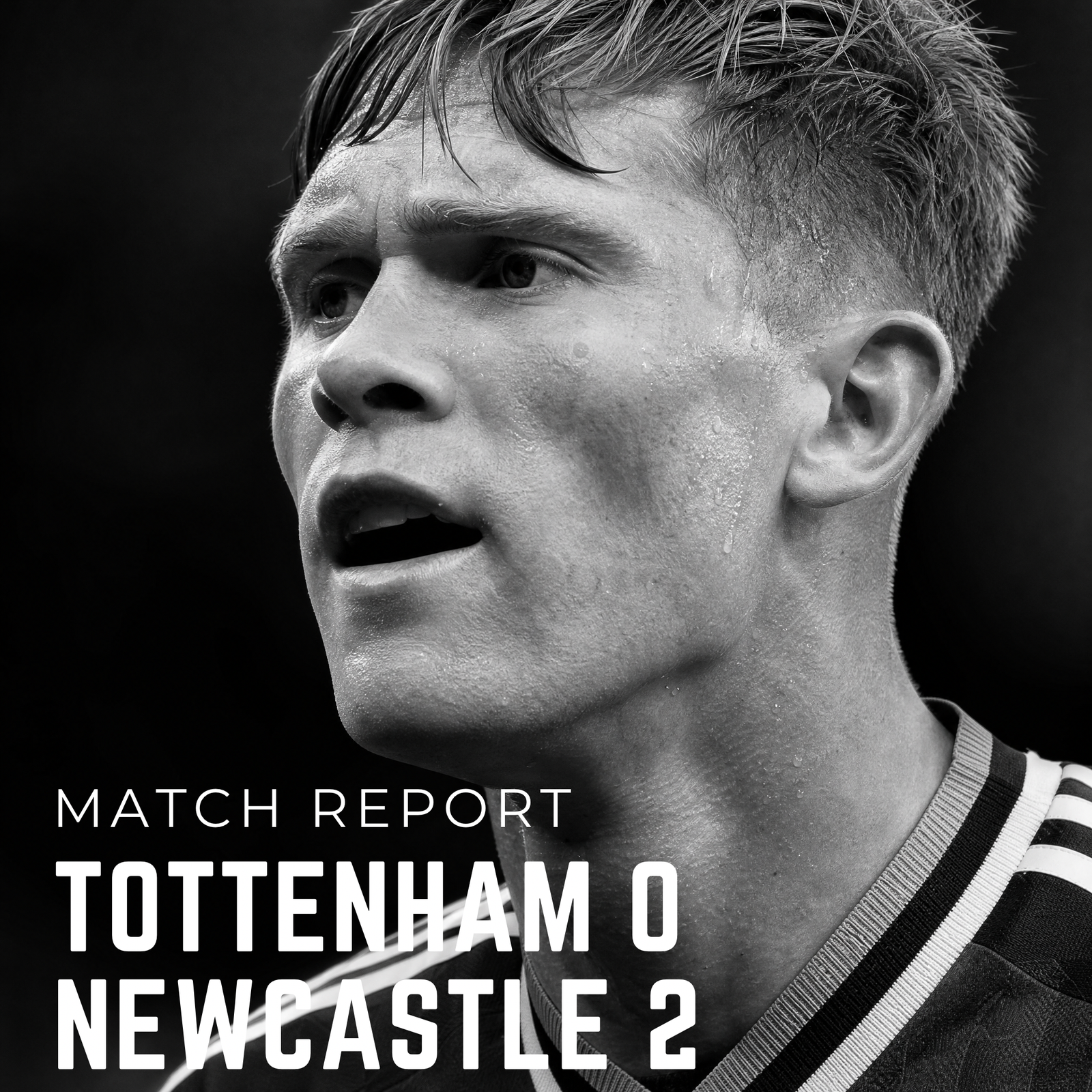
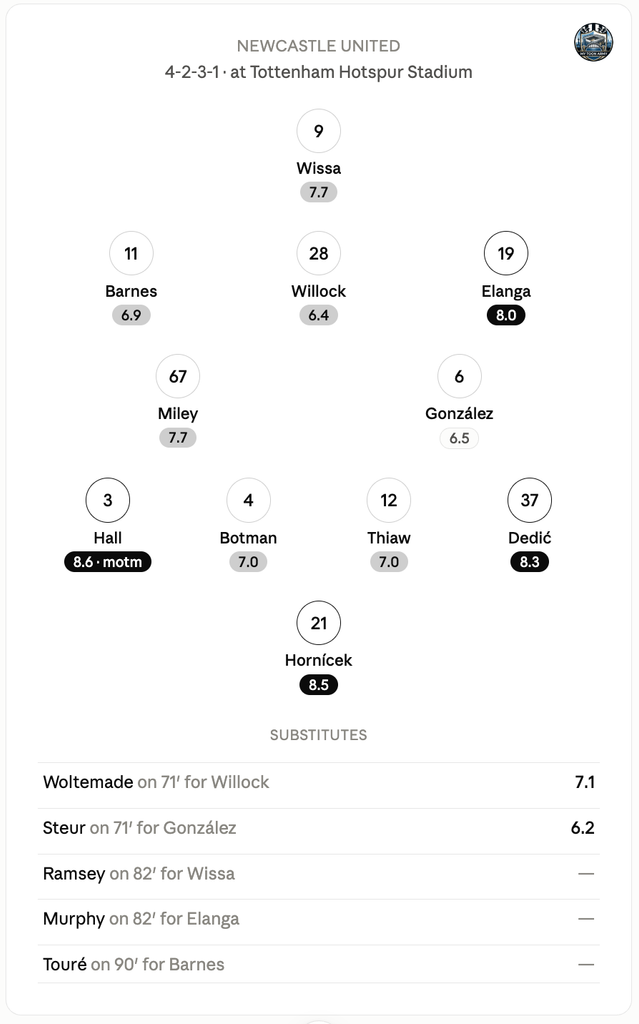
Sandro Tonali spent Saturday afternoon in a shirt that wasn’t black and white, and by the time Roberto De Zerbi withdrew him on 75 minutes, his old club had already put the game beyond Tottenham’s reach. There was something almost cruel about how it played out — the player Newcastle sold for up to £100 million this summer, watching from the touchline as two of the young unknowns his old club bought to replace him finished off a performance built on exactly the qualities his sale was meant to fund: patience, discipline, control of the moments that actually matter. Final score: Tottenham 0, Newcastle 2. But the story of this afternoon had been written months earlier, in a transfer window that pulled these two clubs in opposite directions.
Tottenham arrived at this fixture as a club trying to buy its way back to relevance. A year ago they were fighting relegation, sacking Thomas Frank in February and watching interim Igor Tudor lose all seven games of a doomed 44-day spell before Roberto De Zerbi walked into a dressing room sitting one point above the bottom three. He kept them up. This summer, handed total control over football operations and a five-year contract, he spent — heavily, and headline-grabbingly, none more so than the fee that brought Tonali south from Tyneside. It was meant to announce Tottenham’s return to the conversation about the top of the table.
Starting line-up and match ratings
Newcastle’s summer told the opposite story, and a stranger one. Eddie Howe, the manager who’d taken the club from Saudi-backed ambition to genuine Champions League contention across four seasons, walked away partly in protest at the decision to cash in on the spine of his side — Anthony Gordon to Barcelona, Bruno Guimarães eventually to Arsenal, and Tonali, the one Howe fought hardest to keep, sold to the very club Newcastle were about to play. Something in the region of £236 million came in. Curiously, most of it had already gone back out before Howe left the building — a goalkeeper from Sporting Braga, a winger from Hoffenheim, midfielders from Ajax and Monaco, none of them arriving with any reputation to speak of, and none of them, by most accounts, resembling the kind of player Howe had built a career recruiting. Matthias Jaissle only arrived afterwards, to manage a squad that had largely already been assembled without him.
There’s a theory doing the rounds at St James’ Park — unconfirmed, but persistent — that the recruitment had Jaissle’s profile in mind well before his appointment was ever made official, and that the identity of those signings said more about where the club was heading than anything said publicly at the time.
Which is what made Saturday feel like more than three points.
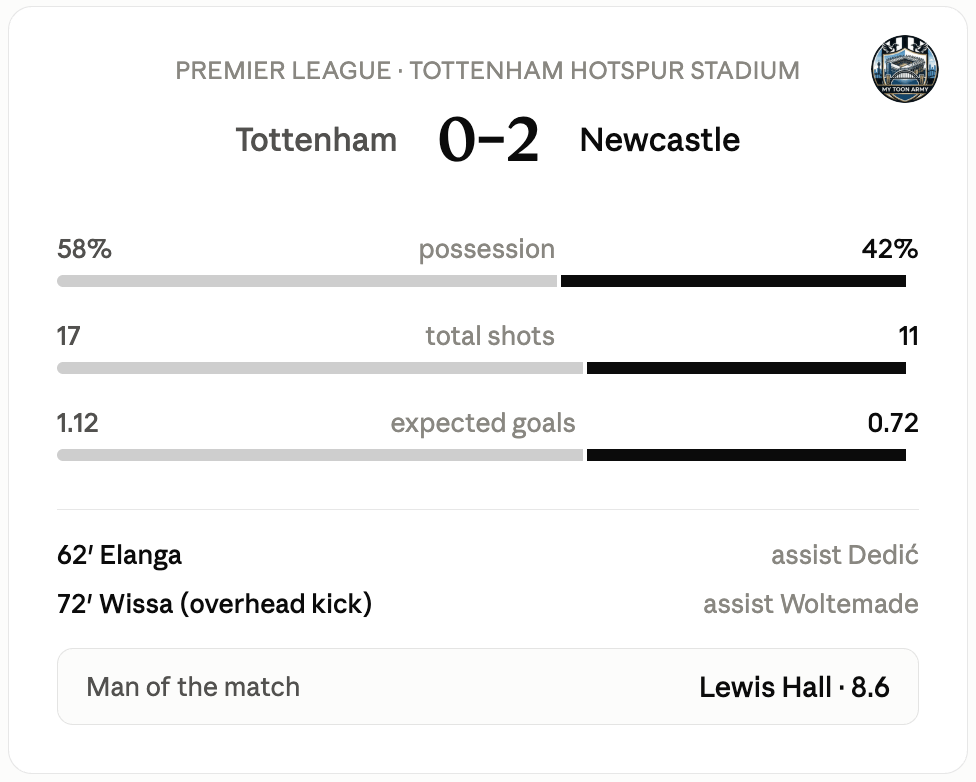
Tottenham had the players anyone would recognise, and for long stretches, the better of the football — more of the ball, more shots, more of the pressure that comes naturally to a side built around a £100 million midfielder rather than a teenager still finding his feet. What they didn’t have was control of the moments that decided the match. Newcastle gave up little clean space in front of their own goal, and on the couple of occasions Tottenham did carve out a real opening, Lukáš Horníček — another of those unheralded summer arrivals — was equal to it. When Newcastle’s own chances finally came, they were taken with a composure that made the scoreline look inevitable rather than fortunate.
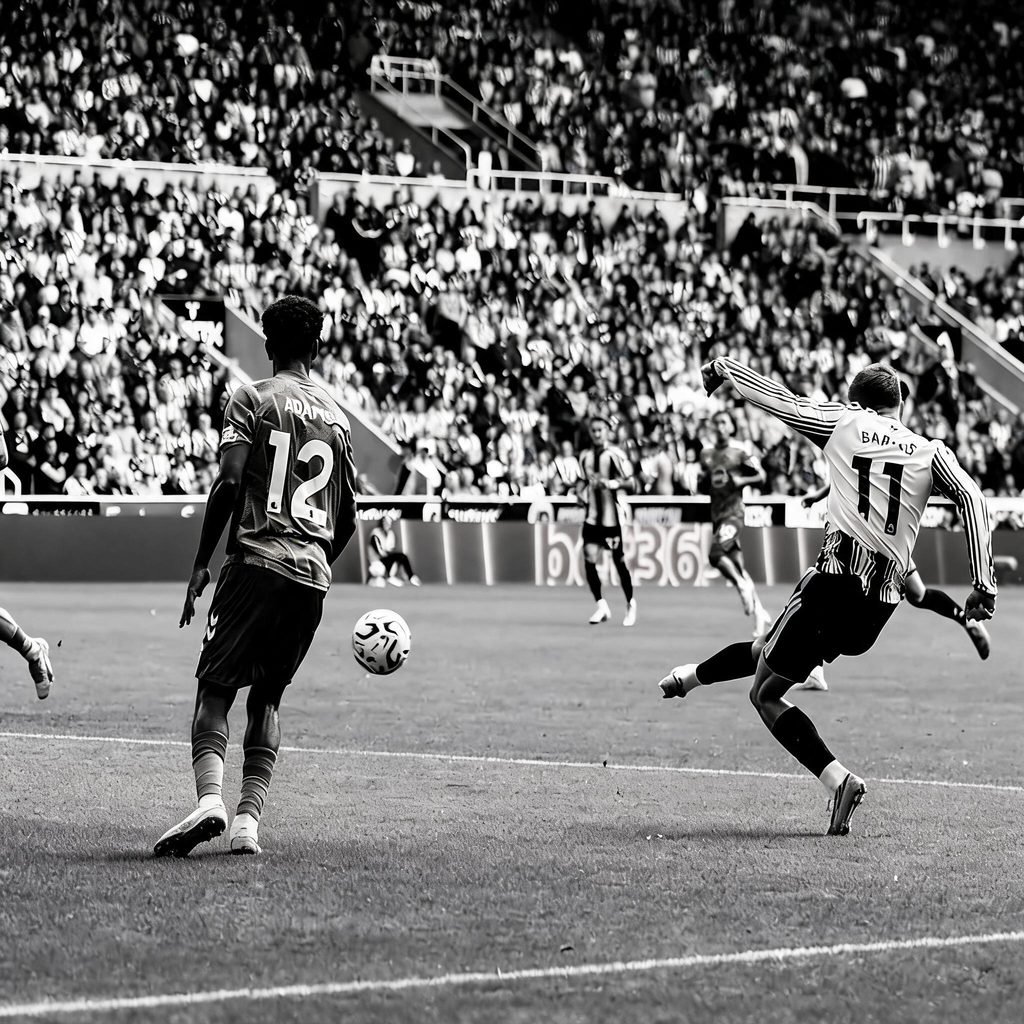
Anthony Elanga gave them the lead just after the hour, teed up by Amar Dedić’s overlapping run down the right — the kind of combination Jaissle’s side had been quietly building all afternoon while Tottenham huffed and puffed in front of them. Spurs searched for a way back in, making three substitutions in one go to change the picture. Newcastle responded by bringing on reinforcements as well: Nick Woltemade had barely found his bearings on the pitch before heading down a ball from a corner that Yoane Wissa met with an overhead kick, the finish of a team playing with more conviction than its transfer-market value suggested it had any right to.
2-0 Newcastle
Man of the Match: Lewis Hall
There was a personal story running through the game too. Lewis Hall had conceded two penalties in his previous two outings, the sort of run that follows a young full-back around and invites doubt about his temperament in the biggest moments. Against a Tottenham side that looked intent on targeting him early, he produced the best performance on the pitch — winning more duels, making more defensive contributions than anyone else out there, and doing it while still finding the energy to get forward and create.
A debut to remember
And a few yards inside from him, in the same central-midfield zone Tonali and Guimarães used to patrol, Nico González made his full debut. It wasn’t chance-free — the physical battles mostly went against him, and Jaissle withdrew him after 71 minutes to preserve his fitness. But he barely misplaced a pass all afternoon (the long diagonal to Dedić to setup the assist for the goal a particular highlight) , the kind of technical composure that may well make him the central piece in the summer rebuild of Newcastle 2.0.
Both clubs go again on 5 September — Tottenham away at Nottingham Forest, still searching for a first point and already facing questions about whether spending can substitute for cohesion; Newcastle at home to Bournemouth, with the growing belief of a squad discovering itself in real time. It’s one result, early in a long season, and nobody at St James’ Park will mistake it for anything more than that. But for a club that spent the summer being told what it had lost, beating the team that bought its best player, at his own stadium, with the players bought to replace him — that’s a start worth having.
Will Spurs struggle again this season despite the massive summer spending? Has Newcastle found a formula under Jaissle that works? Join the conversation on X @mytoonarmy #NUFC
Nineteen minutes gone at St James’ Park and Isaac Price, on his debut, has just bent a free-kick round a static wall and beyond a flat-footed Ewen Jaouen. The away end erupts. Somewhere in the directors’ box, Nico González watched on, unveiled to the Gallowgate before kick-off to great applause and reception. Down on the pitch, Newcastle’s kids are getting a lesson in the brutal unsentimentality of knockout football from a Championship side who mean business.
By 10.12pm BST, none of that mattered. Harvey Barnes, forty-five minutes into his night’s work, had scored twice from the bench, Amar Dedić had carved the game open from right-back with the composure of a man twice his experience, and Newcastle were through to round three of the Carabao Cup, 3-2, in a tie that swung four times before Matthias Jaissle could exhale.
The Numbers Behind a Ragged, Absorbing Night
Strip away the theatre and the underlying picture is one of a Newcastle side still assembling its identity under Jaissle — fluent going forward in bursts, alarmingly loose without the ball, and reliant on individual quality to bail out structural uncertainty.
Where Newcastle were strong:
Transition speed down the right. The axis of Dedić and Murphy (and later, Elanga) repeatedly turned West Brom’s back four before they’d set. The move for the 81st-minute winner — Elanga surging beyond his full-back, teeing up Dedić, whose low centre Barnes turned home first time — was a carbon copy of the pattern Newcastle had been probing for the better part of twenty minutes.
Set-piece opportunism. Barnes’ first goal, the 48th-minute equaliser-turned-lead-changer, came from a corner that West Brom’s back line failed to clear cleanly; Barnes’ low drive from the edge of the box wasn’t even meant to be the final act, and he arrived to finish his own rebound.
Goal-productivity from midfield architecture. Sean Steur’s driving run and incisive pass — after he’d been the one to concede the free-kick for West Brom’s opener, a detail Jaissle will have clocked — was the platform for the leveller on 38 minutes, worked wide to Dedić, whose whipped delivery Bazoumana Touré forced in under pressure from Chris Mepham.
Where the cracks showed:
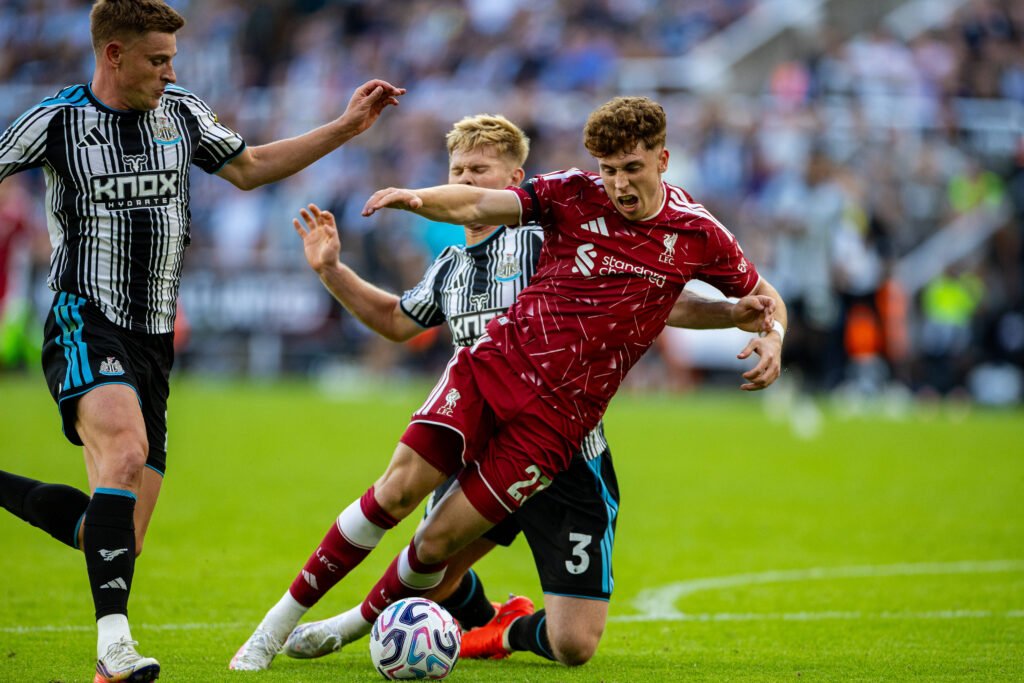
Two penalties conceded, both through Lewis Hall. A repeat offender inside four days — having given away a spot-kick against Liverpool on the Sunday — Hall’s second penalty of the week, on 76 minutes, allowed Price to draw West Brom level from twelve yards and expose a Newcastle back line that, shorn of Dan Burn and Tino Livramento to injury, is still finding its shape.
A two-man midfield stretched thin. With Steur and Jacob Ramsey the only bodies shielding the back four for large spells, West Brom’s front two — Barney Stewart and Jimmy-Jay Morgan — found pockets of space between the lines that a Championship side ought not to have found against a Premier League defence. It is, as more than one voice inside St James’ Park noted afterwards, still early days for Jaissle’s system, but the vulnerability was structural rather than incidental.
Goalkeeping uncertainty. Jaouen, stepping in for first-choice Lukáš Hornícek in a summer that has seen Nick Pope pushed down to third in the pecking order behind the two new arrivals, got a hand to Price’s free-kick for the opener and will feel he should have done better; competition for the gloves at St James’ Park is fierce enough now that even a rare off-night carries consequences.
Dedić: Two Assists, Ninety Minutes, and the Discipline That Wins a Manager’s Trust
If Barnes takes the headline for his brace, the man pulling the game’s strings from right-back was Amar Dedić, and the case for his man-of-the-match award is not close to marginal.
Start with the end product: two assists in ninety minutes, delivered from two different phases of play and two different sides of the pitch. The first — a fizzed, first-time cross into the six-yard box for Touré’s equaliser — required Dedić to receive Steur’s pass under pressure and produce a delivery with pace and precision inside a single touch. The second, for Barnes’ winner, was a lower-tempo, patient centre picked out after Elanga’s overlap had dragged West Brom’s shape apart; different circumstances, same clean execution.
End product alone tells only half the story. With Hall conceding two penalties in four days and Newcastle’s midfield often outnumbered by West Brom’s front two, the defensive burden on the opposite flank fell disproportionately on Dedić, tracking runners and closing lanes while still offering the outlet going forward that both goals required. A full-back doing a full-back’s unglamorous defensive job and a creator’s job simultaneously, for the full ninety minutes, against a well-organised Championship side, is precisely the profile of performance that shows up nowhere on a highlights reel but everywhere on a coach’s notes.
Compare that to the alternative candidates. Steur was excellent in the moments that mattered — his surge and pass built the equaliser, and Newcastle fans inside the ground were already murmuring his name for the individual honours — but he was culpable for the foul that led to Price’s opening free-kick, and was withdrawn before full time, replaced by Charlie McArthur Miley, meaning his influence on the closing stages, when Hall’s second penalty and Barnes’ winner both arrived, was zero. Barnes scored twice, which is precisely what a substitute introduced at half-time is asked to do, and Jaissle’s post-match praise for him was pointed and specific — more on that below — but a forty-five-minute cameo, however clinical, does not carry the same weight as ninety minutes of two-way defensive and creative work from right-back. Dedić’s case rests on volume as much as quality: he did more, for longer, in more phases of the game, than anyone else in a black-and-white shirt.
Man of the Match: Amar Dedić
Steur’s Statement and Barnes’ Instant Impact
None of which should diminish Steur’s night. At eighteen, deployed in the deeper of Newcastle’s two central midfield roles, he looked entirely unbothered by the step up — his passing range under pressure, particularly the ball that released Dedić for the first goal, suggested a footballing intelligence well beyond his conditions, and it was that combination of press-resistance and vision that had supporters and pundits alike pencilling him in for the individual award before West Brom’s second penalty complicated the picture. Jaissle’s decision to withdraw him rather than risk fatigue or a second yellow, with Miley a like-for-like swap, spoke to a coaching staff already trusting the teenager with genuine tactical responsibility.
And then there was Barnes. Introduced at the interval for the debutant Touré, he needed three minutes of the second half to make his mark and forty-five to complete the job: a driven shot from the edge of the area that West Brom couldn’t clear, followed by the simplest of finishes to the loose ball; then, on 81 minutes, the coolest of first-time turns onto Dedić’s low cross to restore a lead that had been surrendered moments earlier. Two goals from two genuinely different types of chance — the scrambled rebound and the clinical first-time strike — is the kind of instant-impact substitute cameo that reshapes a manager’s thinking about a matchday squad.
Asked specifically about Barnes afterwards, Jaissle was unambiguous that the value went beyond the scoreline. “It’s not only goals,” he said. “As we saw also against Liverpool he was doing a really great job, not only in possession, also out of possession. He is disciplined, especially also with the combination with Lewis Hall. We’re really pleased, I thanked him after the match, it was important that he scored.” It is a rare thing for a head coach to volunteer a defensive compliment about a winger who has just scored twice, and it points to exactly the kind of two-way team ethic Jaissle is trying to instil across his rebuilt squad.
Next Up: The Den Awaits
The reward for seeing off West Brom arrived within hours of the final whistle. Newcastle have been drawn away to Millwall in the Carabao Cup third round, a trip to The Den that will offer an altogether different examination of Jaissle’s young side to the one West Brom posed under the Gallowgate floodlights. With Round Three fixtures scheduled across the weeks commencing 7 and 14 September to accommodate the nine clubs still competing in Europe, and Newcastle among the sides not required to juggle a continental commitment that week, the tie is expected to fall in the earlier of the two windows — though the EFL is yet to confirm the precise date and kick-off time.
It is, on paper, a tie stripped of the glamour of a Manchester City or a Liverpool, but anyone who has made the journey to South Bermondsey knows The Den carries its own particular menace: a tight, hostile arena where Championship promotion-chasers have made life uncomfortable for bigger names than this Newcastle side in recent seasons. For a Jaissle project still finding its balance between the calm authority of Steur and the defensive uncertainty exposed by Hall’s fortnight of penalty concessions, it promises to be a useful, unglamorous test before the serious business of the Premier League campaign resumes.
The Broader Picture
Newcastle move into the third-round draw having survived rather than dominated, against opposition managed by James Morrison that Jaissle, in his post-match conversation with his opposite number, rated highly enough to suggest West Brom “will play a great role” in this season’s Championship. For a Newcastle side still stitching together a new-look XI in the opening weeks of Jaissle’s tenure — light on senior central midfield cover, still bedding in summer arrivals like Dedić, Steur and Touré, and managing without Burn, Joelinton and Livramento — a scrappy cup win with two goals from the bench and a captain’s-innings performance at right-back is, on balance, exactly the kind of result a rebuilding project needs: uncomfortable enough to expose the gaps, convincing enough to bank the points and the confidence.
What did you think of the victory against West Brom? Will Newcastle progress deep into the Carabao Cup competition? Join the conversation on X @mytoonarmy #NUFC
Under the towering lights, Newcastle United delivered ninety minutes of breathless, high-octane tactical poetry only to be denied a statement victory by the cruelest of stoppage-time penalties.
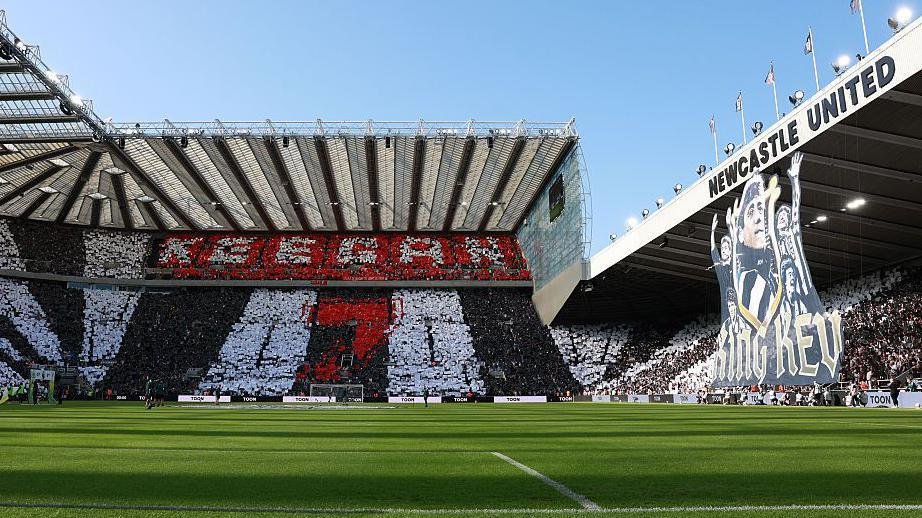
Before a ball was even kicked on a sweltering Tyneside afternoon, the emotional temperature inside the stadium was already at boiling point. A deeply moving, pre-match tribute to Kevin Keegan—marked by a huge display across the stadium in his honour. One banner read:
“I want people to dream about their football club. They should. We should all be dreamers at heart.” – King Kev
That thunderous nostalgic pride immediately shifted into pure, unadulterated hostility the moment Alexander Isak took the kick-off in Liverpool red. The Swede was subjected to a ferocious cacophony of jeers and whistles with every touch, a psychological cauldron that visibly unsettled the striker. He finished the night with just 10 completed passes, and just 2 shots on target.
Riding that wave of emotional fervor, Matthias Jaissle’s new-look Newcastle delivered a masterclass in suffocating structural intensity and devastating directness. The dividend arrived after just four minutes via a lightning-fast counter-attack. Pouncing quickly an attack that broke down, William Osula threaded a razor-sharp through ball into the open channel for Anthony Elanga.
Clocking a blisteringly fast top speed of 36.4 km/h, Elanga left Milos Kerkez completely in his wake before entering the penalty box and calmly slotting a precise finish low past Alisson into the bottom corner. Those first 20 minutes, Liverpool was treated to a suffocating spell of Tyneside football that encapsulated everything Jaissle wants his side to represent.
Liverpool adjusted their build-up shape after the interval, squeezing the space through central channels and clawing back an equalizer in the fifty-fourth minute when Cody Gakpo launched a precise daisy cutter to beat the keeper after some tentative defending; the team had begun to tire and foolishly stood off Gakpo. You simply cannot give a player of his quality time and space.
The equalizer could have deflated the team, but what followed was another stroke of transitional genius that sent St. James’ Park into absolute ecstasy. Barely sixty seconds after Gakpo’s strike, Jaissle made a decisive double change, introducing Joe Willock for Osula to alter the midfield dynamic, and Newcastle responded immediately with another devastating break.
Picking up possession in his own half, Yoane Wissa ignited the attack with a mesmerizing piece of ball-carrying, expertly weaving through the middle of the park and gliding past a clutch of red shirts under heavy pressure. Spotting Willock advancing in support, Wissa slipped a perfectly weighted lateral pass to the midfielder, who took one touch to set himself before curling a gorgeous, sweeping strike beyond Alisson’s reach from just outside the penalty area. The goal came a mere sixty seconds after Willock stepped onto the pitch, marking one of the fastest substitute strikes in recent Premier League history.
What should have been a triumphant victory march, however, devolved into heartbreak deep into added time. In the ninety-fifth minute, with Newcastle defending resiliently inside their own box, Lewis Hall clumsily clattering into Victor Muñoz who was trying to glide past him resulted in a referee’s whistle. It was a bitterly soft call to concede—the exact kind of physical coming together that another referee on a different afternoon would have waved on without a second thought. But the referee pointed to the spot, allowing Dominik Szoboszlai to step up in the ninety-eighth minute and smash the ball emphatically into the top corner, leaving the Newcastle goalkeeper with absolutely zero chance despite diving the right way to salvage a 2-2 draw for the visitors.
While the emotional toll of two dropped points in the dying seconds is heavy, the structural foundation Jaissle is building offers immense encouragement. The immediate focus now shifts to a relentless early-season schedule where momentum must be preserved. Newcastle return to St. James’ Park on Wednesday, August 26 at 20:45 BST to take on West Bromwich Albion in the League Cup, a fixture that represents an essential opportunity for squad rotation and deep-cup progress—a vital component for the club’s broader financial and squad-building objectives under SCR frameworks.
Following mid-week cup duties, the Magpies face a stern Premier League test on Saturday, August 29 at 17:30 BST when they travel to North London to face Roberto De Zerbi’s Tottenham Hotspur. That trip to the capital will serve as an early barometer of Newcastle’s aspirations this season, pitting Jaissle’s high-intensity pressing system against De Zerbi’s fluid possession mechanics in a match that could dictate the early trajectory of Newcastle’s European push.
Was it a penalty? Should Wissa have put the game beyond reach when clean through on goal? Join the conversation on X @mytoonarmy #NUFC