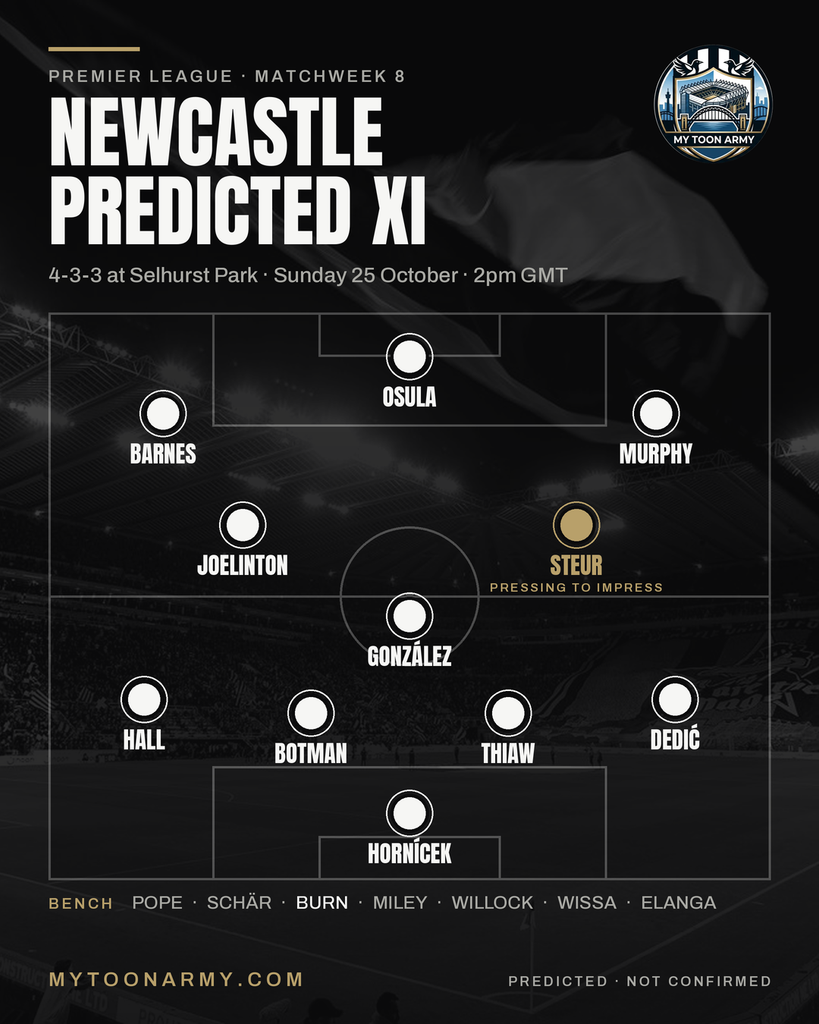
Two managers in their first Premier League seasons need a result at Selhurst Park on Sunday, and one of them has reportedly been given a deadline.
Crystal Palace v Newcastle United, Selhurst Park, Sunday 25 October, 2pm GMT.
Six minutes of stoppage time were left at St James’ Park last Saturday night when Dan Burn, all 6ft 7in of him, was sent up front as an emergency striker.
Newcastle were a goal down. Johan Manzambi, the Villa midfielder who had agreed to join the Magpies in the summer until Villa swooped, had headed in the winner in the 36th minute, and Newcastle’s only shot on target all evening had come from centre-half Sven Botman. The boos at half-time were saved for the final whistle. Matthias Jaissle pushed Yoane Wissa back into midfield and sent on Burn, the club captain, who had returned from injury at Coventry a few days earlier.
Villa held on.
Which manager is under more pressure?
Sunday arrives with both dugouts short of time. Pierre Sage has the clearer deadline: Sky Sports News reported this week that chairman Steve Parish has given him Thursday’s game in Istanbul and this one to improve results, particularly at the back, and that a change is likely if he doesn’t get it. A defeat would be Palace’s fifth in eight league games.
Jaissle’s position is quieter and harder to read. Reports on Tyneside say the board, led by chief executive David Hopkinson, still backs him, and he told his press conference that coaching Newcastle is “a privilege” and that he would use another word than pressure. The crowd at St James’ Park chose a different word on Saturday night. A defeat at Selhurst Park would be Newcastle’s fourth in five league games, and the table is tight enough to make the stakes plain: going into the weekend they were 11th on eight points, with Palace 14th on seven.
The two men have never faced each other, as far as the record shows, and each followed a hard act. Oliver Glasner won Palace’s first major trophy, the FA Cup, and Eddie Howe took Newcastle into the Champions League twice.
We haven’t won at Selhurst Park since 2020
Newcastle’s last visit to Selhurst Park ended in a late defeat. On 12 April, striker Will Osula, who is back in contention after injury, put Newcastle ahead in the 43rd minute. They led until the 80th, when substitute Jean-Philippe Mateta headed in an equaliser. In the fourth minute of stoppage time, after a long throw, Botman pulled the shirt of Palace midfielder Jefferson Lerma, and Mateta scored the penalty. The 2-1 defeat piled more pressure on Howe, who left in the summer.
Newcastle have not won at Selhurst Park since November 2020.
Sean Steur, the forgotten talent?
Sean Steur is 18, a Dutch playmaker signed from Ajax in the summer. He was man of the match in the 2-1 win over Hull before the international break, and Jaissle described his display as one you would expect from “a really experienced, mature, old player.” Then Nico González came back from concussion, and Steur dropped to the bench at Coventry and stayed there against Villa. Two defeats, no minutes. He is arguably the club’s best player this season, and the home supporters were bewildered when he stayed seated while Burn went up top. Jaissle says Steur is “knocking on the door” but needs time, and some predicted line-ups for Sunday have him starting.
Older heads, back from injury
It sits awkwardly beside the case Jaissle has been making for experience. The team behind that last-minute gamble was young: Lukáš Horníček 24, Lewis Miley 20, Malick Thiaw 25, Botman 26 and Lewis Hall 21, an average of just over 23. Burn, Fabian Schär and Nick Pope, all 34, began on the bench. Much of the experience left in the summer, with Bruno Guimarães going to Arsenal, Sandro Tonali to Tottenham and Anthony Gordon to Barcelona, and Jaissle told reporters on Friday that the older players now returning from injury have to fill that gap.
Joelinton, 30, is already back and wore the armband against Villa. Burn could start on Sunday. Anthony Elanga has trained all week but Jaissle says he cannot yet manage 90 minutes, and Jacob Ramsey, who hurt his thigh in the warm-up at Leeds, is only just back on the grass.
Players in unfamiliar places
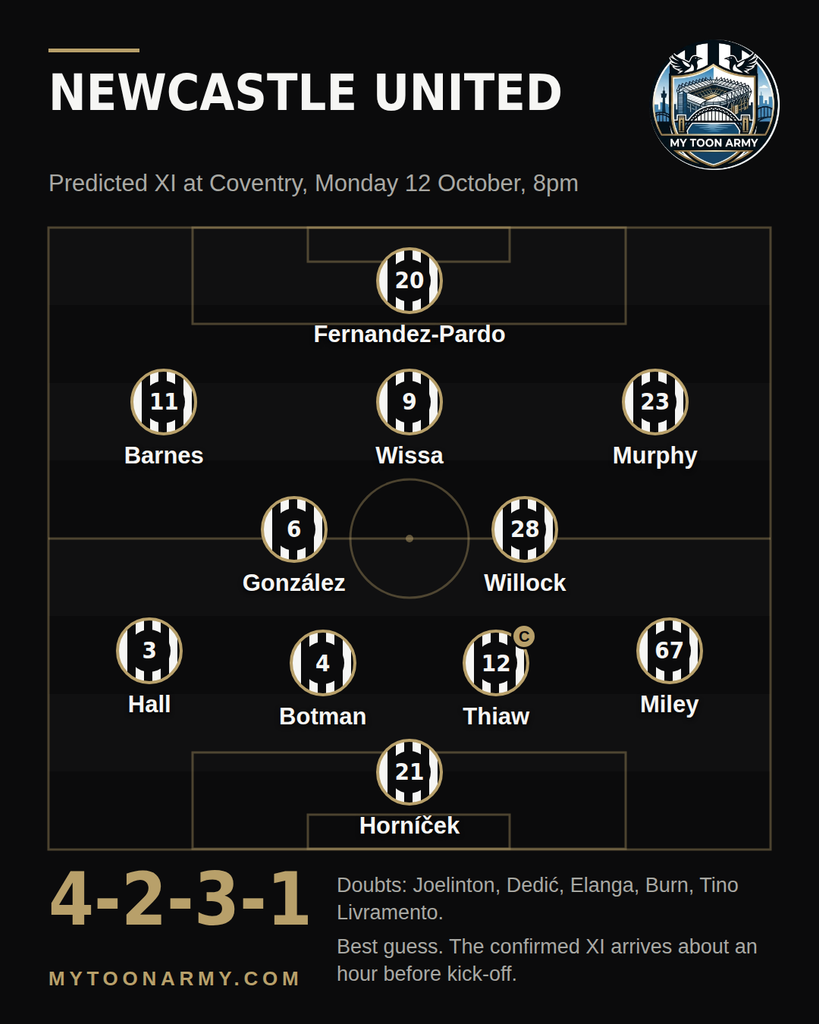
How Jaissle arranges them will draw as much attention as who he picks. In recent games Wissa has been used at No 10 (as he was at Coventry), Joe Willock deeper as a six and Matias Fernandez-Pardo mostly at No 9, which critics say puts all three out of position. Miley is a midfielder who can cover at right-back when the situation demands it, and he has been filling in there with Tino Livramento out and Amar Dedić only recently fit. Dedić’s return gives Jaissle a natural alternative on that side.
A rough week for Sage
Sage’s own week has been rough. Palace were three goals down inside ten minutes at Brighton and lost 5-0, and he apologised to the fans. Thursday in Istanbul went better, up to a point: they scored twice in four minutes through Yéremy Pino and Mateta, and Besiktas equalised in the 73rd minute from their second shot on target. Next, Sage said, “we need to win against Newcastle.”
What the numbers say
The defending is where the questions sit. Palace have let in 17 league goals in seven matches, the most in the division, and five came inside the first 15 minutes. Newcastle have let in 14, level with Sunderland, and have gone 16 home matches without a clean sheet, a club record. Goals are another matter. Newcastle have scored ten, though Squawka’s expected-goals model rates their chances at 7.5, and they have not scored more than twice in a league game this season. Palace’s goals come in bursts, three against Fulham and three against Forest, with blanks at Everton, Leeds and Brighton. Forward Jørgen Strand Larsen is out with a knock, and Sage said Mateta looked tired by the end in Istanbul.
Score Prediction: 2-2
Over 2.5 goals has landed in five of seven league games for both clubs, so goals are a safe bet. Three for Newcastle is a bigger ask, since they have not managed it in the league all season. The prediction here is 2-2, and a draw would do little for either man. Palace have conceded first in each of their last four games in all competitions, which makes an early Newcastle goal the likeliest route to a first win at Selhurst Park in almost six years.
A win would take Newcastle to 11 points before Everton visit St James’ Park on Monday 2 November. Jaissle names his side about an hour before kick-off, and the two names to look for are Burn and Steur.
Newcastle’s reply to Coventry meets Unai Emery’s tired legs at St James’ Park
Newcastle United v Aston Villa | Premier League | St James’ Park | Saturday 17 October, 5.30pm (UK)
Seconds before Coventry’s third goal on Monday night, Joelinton collects the ball inside his own penalty area and tries to dribble out of trouble.
He has been on the pitch for barely twenty minutes. It is his first appearance of the season after injury. Brandon Thomas-Asante closes him down, the ball breaks to Ellis Simms, and a shot that takes a deflection off Malick Thiaw makes it 3-1.
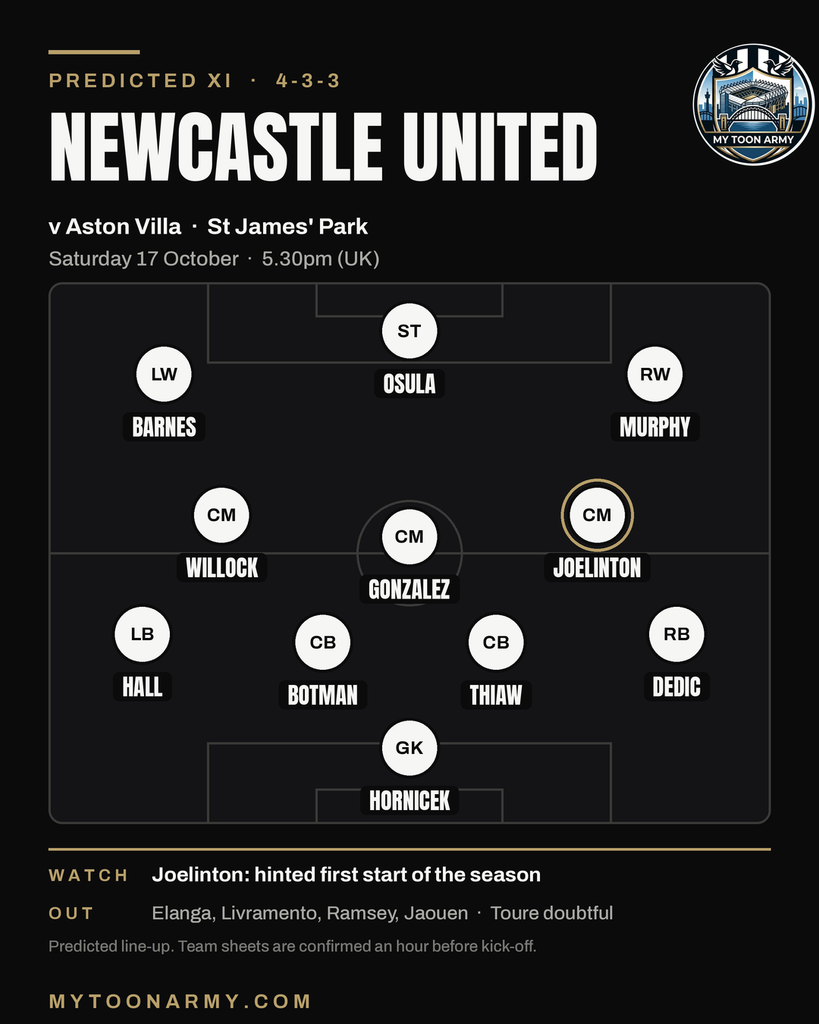
Five days later, Matthias Jaissle is hinting that the same man could start against Aston Villa. Dan Burn, the club captain, will most likely be too soon, the head coach said; Joelinton’s case, he implied, is different. Behind the hint sits a simple admission: “We missed them so much.”
That one passage of play says a lot about Monday, and about this fixture. Newcastle had 67 per cent of the ball that night, 19 shots to Coventry’s nine, and six on target, exactly as many as the hosts. They still lost 4-1. Goalkeeper Lukas Hornicek’s spill handed over a sixth-minute penalty. Thiaw’s header only half-cleared the throw that dropped to Sidiki Cherif for the second. Then came the dribble. Jaissle called it “too many individual mistakes”, and the numbers back him: Newcastle ran the game for long spells and gave it away in a handful of seconds.
The steel question
“Steel” is football shorthand for resilience: how a side reacts after a heavy defeat, and whether it can hold its shape and its concentration when a game turns against it. After Coventry, that is the question hanging over Jaissle’s players.
St James’ Park is where Newcastle get to answer, and the home record gives them something to hold. They are unbeaten in five there (three wins, two draws), the latest a 2-1 win over Hull City before the international break.
One thing keeps recurring, though. Newcastle have gone 12 Premier League home games without a clean sheet. A thirteenth would equal the club record, set between December 1998 and August 1999 under Ruud Gullit. They have conceded 13 goals in six league games, joint-most in the division, and their one shutout came in a 2-0 win at Tottenham at the end of August.
Newcastle have also scored in every league game this season, ten goals in six. Anthony Elanga, Tino Livramento and Jacob Ramsey remain out. Burn has trained only a couple of times since his return. Jaissle has said openly that he is building as the season runs. There will be ups and downs, he said this week, and he expects “one of those seasons”.
The question on Saturday is narrow. Can eleven players go ninety minutes without handing over a goal? Jaissle leans on the crowd for the answer. At home, he said, “we can hurt every opponent”.
The Wednesday Villa
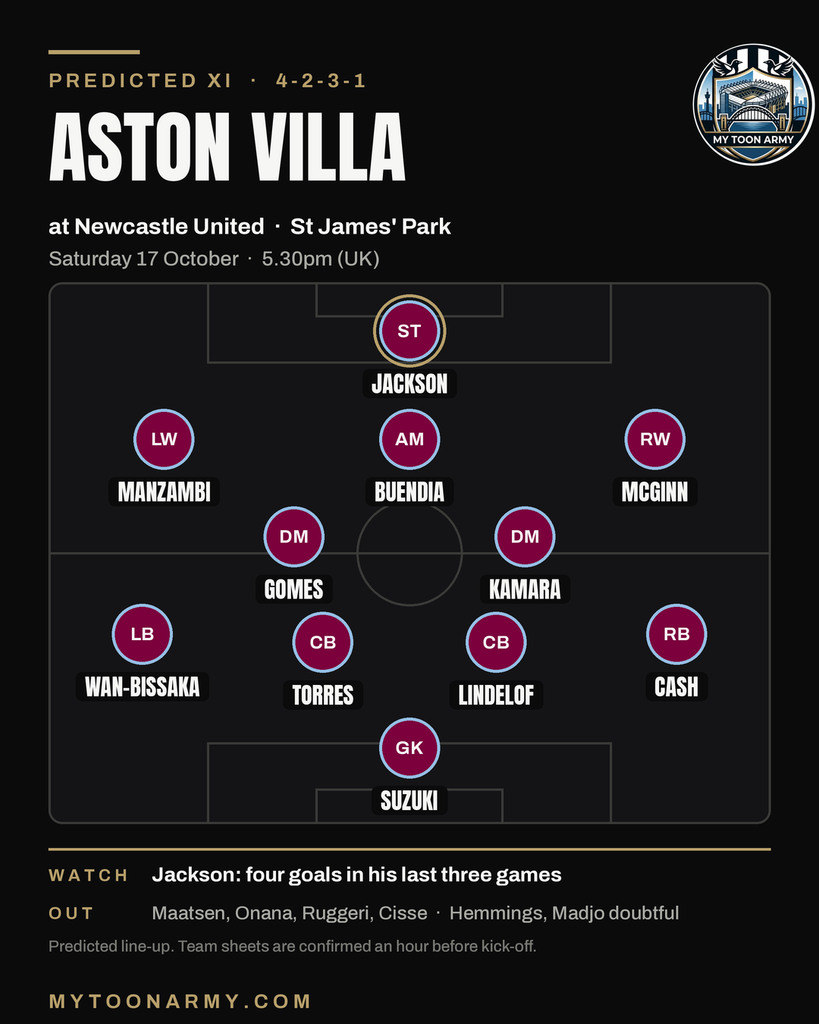
Villa arrive from a record night. The 6-0 win over Fenerbahce was their biggest European win and the biggest victory in any competition under Emery. Nicolas Jackson, the Senegalese striker, and Ross Barkley, the midfielder, scored two apiece. Jackson has four goals in his last three appearances.
Jaissle knows what that does to a dressing room. It gives them “a huge boost”, he said, before pointing out that Villa have problems of their own in the league.
They do. Villa sit 16th with five points from six matches, five points behind the top four, where they finished last season. They have lost 4-0 at Brighton, and at home to both Arsenal and Nottingham Forest. Wednesday was their first home win of the season in any competition, and Emery’s own words afterwards drew a line between two worlds: the Champions League, he said, is “the competition where we can feel comfortable”.
So does momentum carry over? Only partly. The Wednesday Villa and the Saturday Villa have looked like different teams, and the Saturday version has been better away from Villa Park than at it. Since the opening-weekend defeat at Brighton, they have won three and drawn one of their last four away games in all competitions, including at Tottenham and Coventry. A trip north does not frighten them.
Three days against five
What might is the calendar. Newcastle have had nearly five days since Coventry. Villa have had roughly three since Wednesday night.
Emery addressed it on Friday. “Some players may be tired,” he said, adding that he meant soreness rather than injury. He said “the rotation is coming” when his players are ready for his demands, but he would not name his XI until after training, and he wants players at full capacity, not 80 per cent.
The clues sit in the predicted team. Leon Goretzka, the summer signing, made his first appearance on Wednesday as a substitute and may not yet be ready to start. Joao Gomes and Boubacar Kamara, both midfielders, could return to the middle, with Emiliano Buendia, the playmaker, in for the scoring Barkley. At left-back, with Ian Maatsen and Matteo Ruggeri both injured, Aaron Wan-Bissaka, a right-back by trade, may fill in again. Midfielder Amadou Onana is also out.
That would put him opposite Jacob Murphy, who appears on the right in the predicted Newcastle XI. It is a prediction, and Emery has until the team sheet to change it.
Emery spoke respectfully of the opposition. He noted that Bruno Guimaraes and Sandro Tonali had left, that Nico Gonzalez has the quality to replace them, and that Newcastle have had more injuries than usual. Then he described what he expects at St James’ Park: pressing, duels, a crowd pushing the home side on. He wants fresh legs on his bench.
Both managers are reshaping their squads. The Mag, the independent Newcastle publication, framed it as two clubs squeezed by financial rules and forced into selling key players and replacing them with younger, cheaper options. Emery’s version was gentler: he is building a team the way he has in previous seasons, but this time with new and young players trying to close the gap as quickly as possible.
What to watch
Start with Joelinton. If he plays, Jaissle gets experience in midfield, and the vice-captain, who would likely wear the armband with Burn not ready, gets an immediate chance to turn Monday’s memory into something better.
Matias Fernandez-Pardo, the young forward, is next. Jaissle says he is already creating chances and is a goal away from getting his confidence back. He and Joe Willock both missed clear chances at Coventry.
Then there is the opening quarter of an hour. At Coventry the penalty arrived in the sixth minute and Newcastle spent the rest of the night chasing. A calm start would tell Jaissle more than any statistic.
The verdict
History is mixed. Villa won 2-0 at St James’ Park in January and could now win there in consecutive top-flight visits for the first time. Newcastle won the FA Cup tie at Villa Park 3-1 a month later. Emery, meanwhile, is a win away from his 100th in the Premier League.
Villa’s tired legs should show, if they show at all, in the last half hour. Newcastle’s response ought to be visible in their effort and shape, though a clean sheet is a bigger ask. Whichever side makes fewer mistakes probably wins it, and both can score: Newcastle have found the net in every league game, and Villa have a striker in form.
Prediction: Newcastle 2-2 Aston Villa.
A draw like that would carry its own footnote: a thirteenth home game without a clean sheet, and Newcastle level with Gullit’s side.
Newcastle had 67% of the possession and 19 shots at the Coventry Building Society Arena. They also made four mistakes, and Coventry punished every one.
Lukas Hornicek has the ball. Then he doesn’t.
Six minutes into a Monday night in Coventry, with 30,811 inside the arena, a routine ball drops out of his hands and runs loose. Sidiki Cherif, the Coventry striker making his first Premier League start, goes down. The referee points to the spot. Jack Rudoni, their attacking midfielder, steps up and scores.
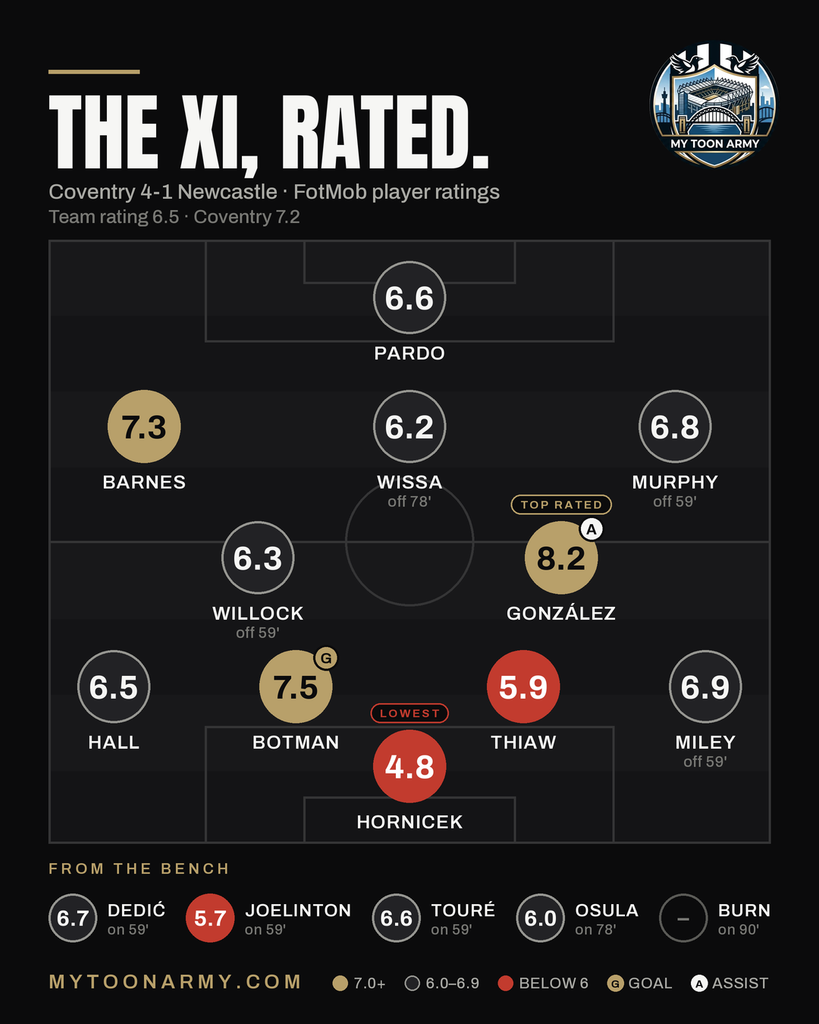
It is the kind of ball a Premier League goalkeeper collects without thinking. Hornicek should have held it the first time. FotMob’s rating for him, 4.8, was the lowest of anyone on the pitch.
Everything Newcastle do for the rest of the night is an answer to that moment. Most of the answers are wrong.
First half: all the ball, no goals
And yet the ball is theirs. Newcastle push Coventry back, and the home side survive on two clearances from Bobby Thomas, a centre-back who spends the half throwing himself into the way of things.
The first comes in front of an unguarded net, after Jacob Murphy knocks Harvey Barnes’ cross back into the danger area. The second is worse for Newcastle. Matias Fernandez-Pardo rounds Carl Rushworth, Coventry’s goalkeeper, with the goal in front of him, and Thomas gets back to clear that too.
Credit to Thomas. But the second one is Pardo’s to finish.
Pardo, all industry, no end result
Newcastle paid a reported £51.4m to Lille for him on 1 September, and six weeks later he is still waiting for his first goal for the club. The numbers say he was involved: FotMob gave him 0.70 in combined expected goals and assists, the highest of any Newcastle player. That is the point. Involvement is what a decent forward provides. A £51m forward is paid for goals, and on a night when others are making mistakes at the back, Newcastle need him to cover for them at the other end. He is 21 and still settling, and there is time. That chance, though, is the sort he is expected to take.
Newcastle go in a goal down.
48 minutes: the throw
Three minutes after the break, a long throw. Coventry have been firing them in all night.
The clearance does not clear. Cherif takes a touch on the edge of the D, turns, and drills the ball into the bottom-right corner. 2-0.
It is a lovely finish, and it is a goal Newcastle gift him. Yoane Wissa, the nearest man, is a beat slow to close him down. Joe Willock is off the pitch receiving treatment, which leaves Newcastle a man short as the throw comes in. That explains the shape of the defending. It does not excuse the reaction.
Minutes later Sven Botman botches a clearance of his own and Cherif, with a second goal there for the taking, slices it wide. Newcastle have not earned the reprieve.
Jack Rudoni, had an excellent game
59 and 70 minutes: the door opens
Matthias Jaissle reaches for his bench. Amar Dedić, Joelinton and Bazoumana Touré come on for Lewis Miley, Willock and Murphy, and the game tilts. Dedić looks sharper at right-back than Miley had before him.
Eleven minutes later Botman drives a 20-yard shot into the near corner, set up by Nico González. 2-1. The door is open.
Newcastle never get through it.
81 minutes: the touch
Joelinton is 22 minutes into his first appearance of the season, after an injury that had kept him out of the opening seven matches. He takes a touch on the edge of his own area, and the ball gets away from him.
Coventry pounce. Ellis Simms, a substitute striker who has been on the pitch for three minutes and 15 seconds, shoots, and it beats Hornicek. 3-1.
One loose touch on the edge of his own area, and Coventry turn it into a goal. The fault is Joelinton’s. Match fitness explains the touch; it does not soften it.
86 minutes: the glide
Five minutes later it is four.
Stephen Mfuni, a defender by trade on loan from Manchester City, has been on the pitch for three minutes and 31 seconds. He glides past Newcastle’s players and into the penalty area, then finishes in off the far post, beyond Hornicek’s reach. Jay Dasilva, Coventry’s left-back, gets the assist.
It is a fine piece of skill and Mfuni deserves the credit. But a substitute walking into the box that easily says more about where Newcastle’s heads are at 3-1 than it does about him.
Twice on a Monday
Leeds on 14 September. Coventry on 12 October. Two Monday-night away games, two 4-1 defeats. In between came a 2-1 win over Hull on 19 September and an international break that should have let the side carry that momentum forward. Once is a bad night. Twice, on the same night of the week and with the same ending, becomes a question.
Newcastle are 11th with eight points, and the 13 goals they have conceded are the joint-most in the league, level with Chelsea and Bournemouth.
What links Elland Road and Coventry
On the surface the two nights look identical: Monday, away from home, 4-1. Underneath they are different matches, and it matters which problem belongs to which.
Leeds was a beating on the pitch. Daniel Farke’s side had 14 shots to Newcastle’s seven and won the expected-goals count 1.99 to 0.88. Nico González had gone off inside 20 minutes as a concussion substitute, leaving 18-year-old Sean Steur and 20-year-old Lewis Miley as the midfield pair, and Miley’s deflection opened the scoring. Jaissle said afterwards that Newcastle could not match Leeds’ physicality in the first half. Coventry was the reverse. Newcastle were ahead on expected goals, faced only nine shots, and Coventry’s non-penalty xG was 0.64. At Leeds they were outplayed. At Coventry they beat themselves.
Three threads run through both.
The first is the long throw. Leeds’ fourth goal came in the 59th minute, when Newcastle failed to clear a long throw and Noah Okafor, a Leeds forward, volleyed in from the edge of the box. Coventry’s second, in the 48th, came from the same failure, with Cherif taking a touch on the edge of the D. It was not clear whether Newcastle were marking zonally or man for man. It was clear that nobody had Cherif. Whatever the scheme, the second ball dropped to a shooter on the edge of the area both times.
The second is what happens next. Leeds scored three times in 14 minutes, Coventry twice in five. Newcastle do not just concede; they concede in clusters.
The third is the personnel. Hornicek, Thiaw, Botman and Hall started both games, with Amar Dedić at right-back at Leeds and Miley at Coventry, and the unit has shipped eight goals in two away matches. That does not make them the whole problem. Botman made 17 defensive contributions at Leeds, more than anyone on the pitch, which says as much about the work the structure handed him as about him.
Is it Jaissle’s system? Partly. Going into Leeds, Newcastle had faced more shots than any side in the league, averaging 20.3 a game, which suggests the press, built to win the ball high up the pitch, was being bypassed too easily and leaving the back four exposed. At Leeds that cost them. At Coventry it did not. The problem there was execution, not structure.
Three adjustments suggest themselves. Put a body on the edge of the box for opposition long throws, so the second ball has an owner. Keep a midfielder deeper to cover behind the press when it is beaten; with González and Joelinton available again, Jaissle has the options. And when Newcastle are chasing a game, make sure a lost ball in midfield cannot become a shot on goal, because that is exactly how the 81st-minute goal arrived.
None of that requires tearing up a system that has shown it can win matches. It requires finishing the job at the edges of the box.
The good news is on the bench
At Coventry, Newcastle were not outplayed. They created enough to win and wasted it: three big chances, all missed, and six shots on target worth a combined 0.39 in expected goals on target, against 2.63 for Coventry’s six. That is a finishing and decision-making problem, not a talent one, and those are the problems a squad can fix.
And the squad is getting bigger. Newcastle’s bench at Coventry read Pope, Schär, Joelinton, Bamba, Osula, Steur, Touré, Burn and Dedić. Five of the nine players who missed the Hull win were back: González, back from concussion protocols, started, while Joelinton, Dedić, Will Osula and Dan Burn all came off the bench for minutes. Joelinton, mistake and all, brought the snap in the tackle that Newcastle’s midfield has been missing, and FotMob credited him with five defensive contributions in his 31 minutes.
Four are still out: Tino Livramento, Jacob Ramsey, Anthony Elanga and goalkeeper Ewen Jaouen. Jaissle is rebuilding after the summer departures of Anthony Gordon, Bruno Guimarães and Sandro Tonali, and he has described it as a period of huge transition. The depth that was missing in the opening weeks of the season is returning.
Saturday
Aston Villa arrive at St James’ Park on Saturday, kick-off 5.30pm, sitting 16th on five points to Newcastle’s eight. The returnees will have a few more days of training behind them, and Joelinton, Dedić, Osula and Burn now carry minutes into the week.
Coventry, on back-to-back league wins after their victory at Nottingham Forest before the break, travel to Tottenham, who have yet to win this season.
Newcastle had 67% of the ball on Monday night and could not hold on to the things that mattered. Hornicek had it in his hands in the sixth minute and let it go. Against Villa, the chance is to start holding on.
Carl Rushworth, Coventry City’s goalkeeper, hit it long. Jay Dasilva, their left wing-back, ran onto it and scored: the club’s first Premier League goal since the Morocco international Mustapha Hadji’s in May 2001.
The pass bypassed Nottingham Forest’s midfield altogether. It is the detail Matthias Jaissle will have circled this week, because making midfields uncomfortable is what his Newcastle United are built to do, and Coventry have just shown one way around it.
On Monday night, the two sides meet for the first time in the Premier League at the Coventry Building Society Arena. So do their managers.
Two coaches, one shared habit
Jaissle is 38 and a product of the Red Bull school. His pitch to Tyneside has been consistent since the summer: counter-press, attack vertically, win the ball high. “I want stress on the opponent as soon as possible,” he has said. He starts from a 4-2-3-1 but reshapes it by the state of the game, a flexibility he has said he developed at Al-Ahli, where the squad profile was very different from his Salzburg days.
Frank Lampard, the former Chelsea and England midfielder, is 48 and arrived at Coventry in November 2024 with the club hovering near the Championship relegation places. He took them up as champions, with 95 points and 97 league goals. He began with a back four, moved to a back three, and now sends out a back three with wing-backs, a 3-4-3 on the team sheet at Forest.
At Forest, injuries left him without his first-choice right wing-back, so he put the midfielder Caleb Yirenkyi there and it worked. “My job is to be pretty practical,” Lampard said after promotion.
That is the contrast. Jaissle arrives with a method and a squad built by someone else. Lampard is adjusting a promotion-winning group to a harder league one week at a time. Neither is dogmatic, which makes the shape of the game hard to call.
Where Coventry’s goals went
Ninety-seven league goals last season. One in five Premier League games this season.
Haji Wright, the striker who scored 17 league goals last season, is out until November at best with what Lampard calls an awkward injury. Striker Taiwo Awoniyi, signed from Forest in August, was sent off for violent conduct in the 5-0 home defeat by Brighton. He served the first match of his ban in the Carabao Cup loss to Aston Villa and missed the trip to his old club. Monday is the last of the three.
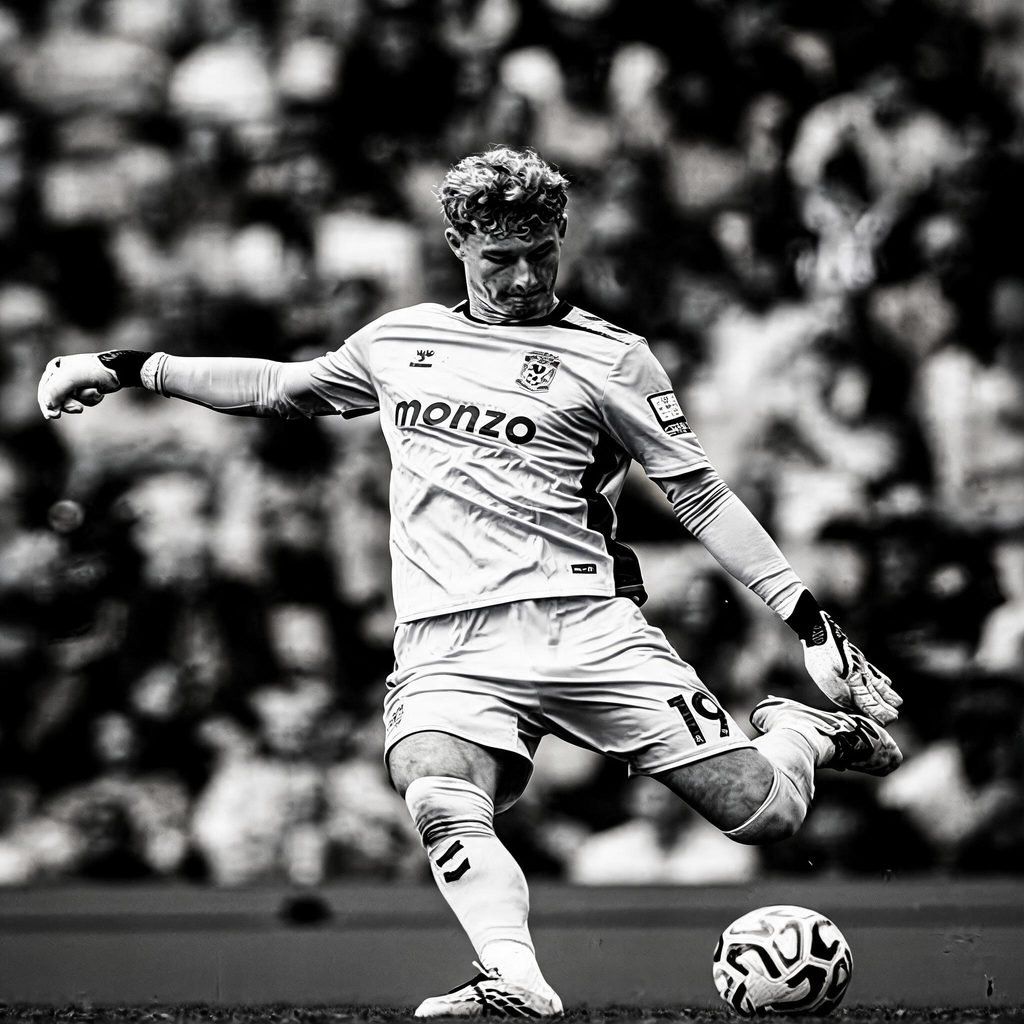
Carl Rushworth can really kick the ball
So forward Brandon Thomas-Asante leads the line again, a selection that raised eyebrows at Forest and then worked. Coventry have not scored at home yet, but they now know what a Premier League win feels like, and that changes a dressing room.
What Newcastle can lean on
Pace, first of all. The 2-0 win at Tottenham came from second-half goals by Anthony Elanga and Yoane Wissa. Against Hull, Joe Willock and Lewis Hall had Newcastle two up inside seven minutes. Jaissle’s side start games on the front foot, and the deadline-day arrival of Matias Fernandez-Pardo from Lille gives him a forward he describes as quick, strong and versatile.
Wissa back in action?
Then there is what Coventry lack. A side that has scored once, with its two main strikers unavailable, is easier to defend against than the 97-goal team of last season, and Newcastle’s wide players, Harvey Barnes in particular, will test a right-hand side that Lampard is still patching.
And there are the returners. Nico González and Joelinton are back in contention after missing the Hull win. Neither is a confirmed starter, or even a confirmed matchday squad member, but if Jaissle can use them, their legs in front of the back four are the most direct answer to the problem that follows.
The numbers Newcastle cannot ignore
Eight points from five games reads well. The underlying figures read less comfortably.
Going into the Hull game, Newcastle had faced more shots than any other side in the division. Fantasy Football Scout’s analysis has them losing the expected-goals battle in all five league matches. Hull outshot them 22 to 12 on Saturday 19 September and had 36 touches in the Newcastle box to their 15. At Leeds, the fourth goal came from a long throw-in that Newcastle failed to deal with properly.
All of that matters on Monday because a direct, physical, set-piece-minded opponent is what Coventry can be when they want to be. This is a rebuild under a new head coach, and for the Hull game he was without nine players. It is not a verdict. But Coventry’s route to goal runs through exactly the territory where Newcastle have been exposed.
What Coventry bring, and what they lack
They defend with their bodies. Forest had 62 per cent of the ball and 24 shots to Coventry’s 10, yet Coventry kept a clean sheet, helped by centre-back Bobby Thomas clearing a chip off the line and a late Forest goal ruled out by VAR for a foul on Yirenkyi. The back three of Ethan Pinnock, Thomas and Stephen Mfuni, who is on loan from Manchester City, is built for that kind of afternoon.
They also have a goalkeeper who can start attacks, which is rarer than it sounds: Rushworth’s long ball set up the Dasilva goal at Forest.
The weaknesses are plain. They conceded ten goals in their first four games, several of them described locally as awful. Centre-back Aurèle Amenda is out for up to three months, two more squad players, Josh Eccles and Luke Woolfenden, are still working back, and Milan van Ewijk, the first-choice right wing-back, has only just returned to training, as has his understudy Kaine Kesler-Hayden. Many of Lampard’s players are making their Premier League debuts, and he has already spoken of how ruthless the league feels.
Best-guess line-ups
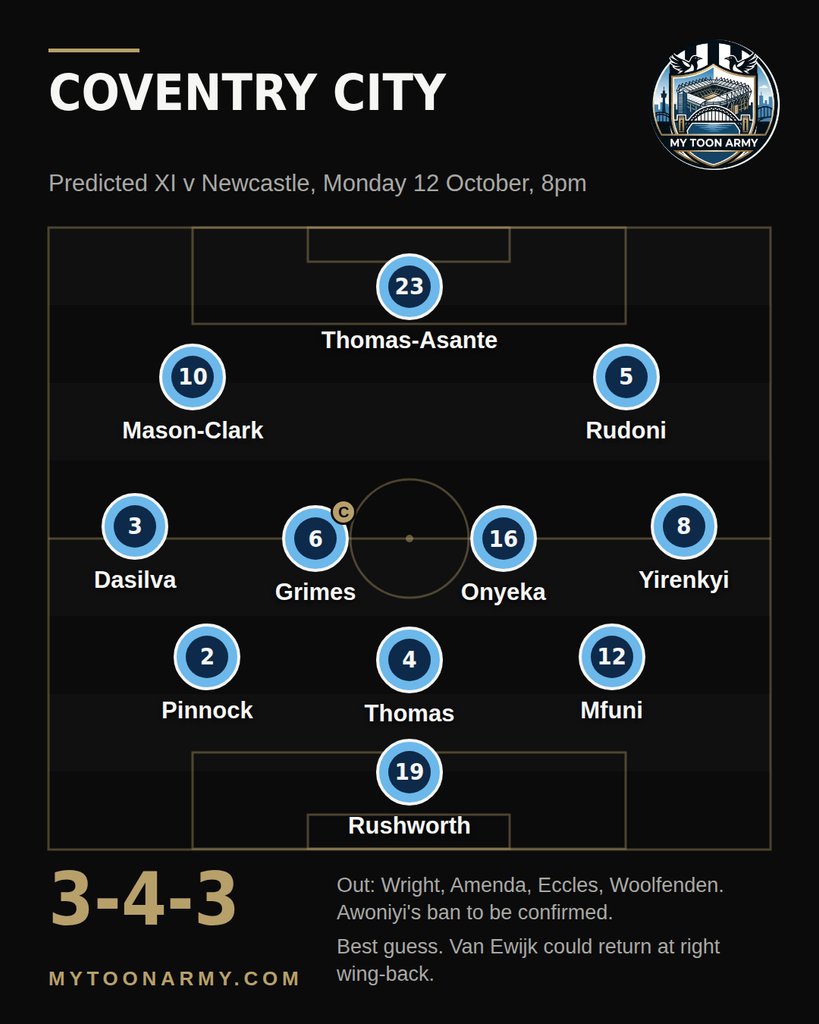
Coventry City (3-4-3): goalkeeper Rushworth; centre-backs Mfuni, Thomas and Pinnock; midfield Yirenkyi (right wing-back), Grimes (captain), Onyeka and Dasilva (left wing-back); attack Rudoni, Thomas-Asante and Mason-Clark.
Van Ewijk could return at right wing-back if he comes through training, which would move Yirenkyi inside.
Joelinton, Elanga and Steur are the likeliest to be eased in from the bench, depending on who is cleared. Amar Dedić would challenge Miley at right-back if fit, Burn is the closest to a return among the defenders, and Tino Livramento is doubtful.
Prediction
Coventry 1-2 Newcastle.
Newcastle have more quality and more attacking options, and Coventry have no first-choice striker and no home goals yet. But the xG numbers say this will be closer than the scoreline suggests, and a long ball or a set-piece is exactly how Coventry could get a goal.
What comes next
Kick-off is 8pm on Monday, live on Sky Sports. Whatever happens, neither side leaves with their story settled.
Newcastle are due at home to Aston Villa on 17 October, where a fuller squad should give a clearer view of where Jaissle’s rebuild stands. Coventry travel to Tottenham a week later, with Awoniyi available again and Wright’s return pencilled in for November, the date that may matter more to their season than any single Monday night.
What’s your score prediction? Will Newcastle see some of their best players back in action from injury? Join the conversation on X @mytoonarmy #NUFC
On the day PIF bought the club, one of its new co-owners asked supporters to be patient. Five years later, patience looks less like a plea and more like a strategy.
Newcastle lost 2–1 at Wolves on 2 October 2021. Five days later, nobody on Tyneside was talking about it.
On 7 October, the Premier League confirmed that the club had been sold to a consortium led by Saudi Arabia’s Public Investment Fund (PIF), the state’s sovereign wealth fund. Mike Ashley’s 14-year ownership was over. The reported price was about £305m, roughly twice what the club earned in a year.
Supporters celebrated. A Newcastle United Supporters’ Trust survey days earlier had found 93.8% in favour.
Hours after the deal, Amanda Staveley, then a co-owner, promised investment at every level. She also asked for patience.
It was a strange request to make of a fanbase that had waited since 1955 for a domestic trophy. It turned out to be the whole story.
A club left to rot
Patience was needed because of what the new owners had bought.
Ashley took over in 2007 and spent much of the next 14 years trying, on and off, to sell. Relegations came in 2009 and 2016. Turnover was £129.7m in 2014-15. By 2021 it had reached only about £140m.
The training ground at Benton told the story in bricks. It opened in 2002, and Sir Bobby Robson described it with pride as state-of-the-art. Under Ashley it received little more than a coat of paint. After the takeover, the club’s own planning application admitted its facilities fell “significantly below the Premier League and perhaps even Championship standards”. Staveley later called the place a joke.
St James’ Park carried Sports Direct advertising. The trophy drought ran back to 1955. The Champions League was a distant memory.
So the mood on 7 October was less triumph than relief. For 14 years, supporters had wondered whether anyone at the top was trying. Now somebody was, and with resources no Newcastle owner had ever had.
Hope arrived with a shopping list.
Steve Bruce left on 20 October. Eddie Howe arrived on 8 November. In January 2022 came Bruno Guimarães, Kieran Trippier and Dan Burn, with Matt Targett on loan. Across 2022, Newcastle collected 38 points, a total that only three teams in the division bettered.
They finished 11th. It was survival with a future.
The door closes
Then reality arrived, and it arrived quickly.
Money was the new owners’ obvious advantage. The Premier League moved to limit one of the ways it could be used. At an emergency meeting in October 2021, clubs voted for a temporary ban on deals between Newcastle and companies linked to its owners.
The ban lasted two months. On 14 December, it was replaced by a permanent rule.
The rule has an acronym: APT, for associated party transactions. These are commercial deals between a club and companies connected to its owners. Under the new regime, they must reflect fair market value (FMV), meaning the price an unconnected sponsor would pay. The league checks each deal against a database of comparable contracts and can call in independent assessors. Sponsorship deals above £1m had to be submitted for review, going back to 2016.
The fear behind the rule was simple. A club owned by a state-backed fund could sign sponsors from the same state at prices the open market would never pay. That income would lift revenue, and revenue sets how much a club can spend.
Newcastle and Manchester City were understood to be the only two clubs that voted against.
The pivot
Nobody outside the boardroom can say what the owners expected. But it is reasonable to suspect this was not the plan. A project built on fast, owner-funded growth had run into a rulebook rewritten in direct response to it.
The first bill arrived in the accounts. Newcastle lost roughly £73m in each of 2022 and 2023.
The Premier League’s Profit and Sustainability Rules (PSR) cap a club’s permitted losses at £105m over three seasons, before allowable adjustments. By January 2024, the club was acknowledging that it might have to sell one of its best players to stay compliant.
That left two choices: argue with the rulebook, or build inside it.
Newcastle built. The pivot had three parts. (1) Grow revenue in ways that would survive scrutiny. (2) Trade players deliberately. (3) And lean on the owners for patient capital rather than unlimited spending.
Growing inside the lines
Fair market value made the commercial department one of the most closely watched parts of the club.
In June 2023, Newcastle announced a multi-year front-of-shirt deal with Sela, a Saudi events company backed by PIF, reported at about £25m a year. The club’s chief executive, Darren Eales, said it followed a highly competitive commercial process. As a PIF-linked company, Sela’s deal had to be deemed fair market value.
The results show how much of the work happened elsewhere.
In 2023-24, commercial income rose 90%, from £43.9m to £83.6m. New partners included Adidas, Fenwick and the Saudi companies Sela and Noon, and an Amazon Prime documentary helped. Matchday income rose 32% to £50.1m, with three Champions League nights at St James’ Park. The competition added nearly £30m in distributions.
Even in 2024-25, with no European football, commercial income rose another 44%, helped by a new in-house retail operation and the St James’ STACK fan zone.
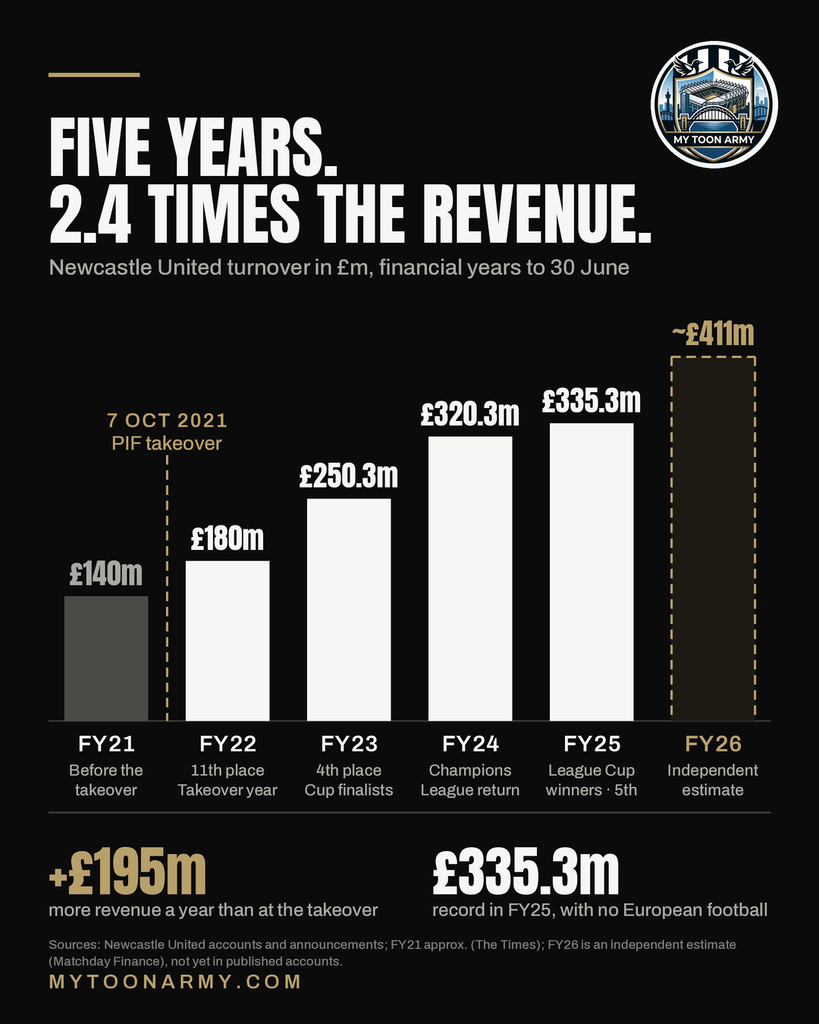
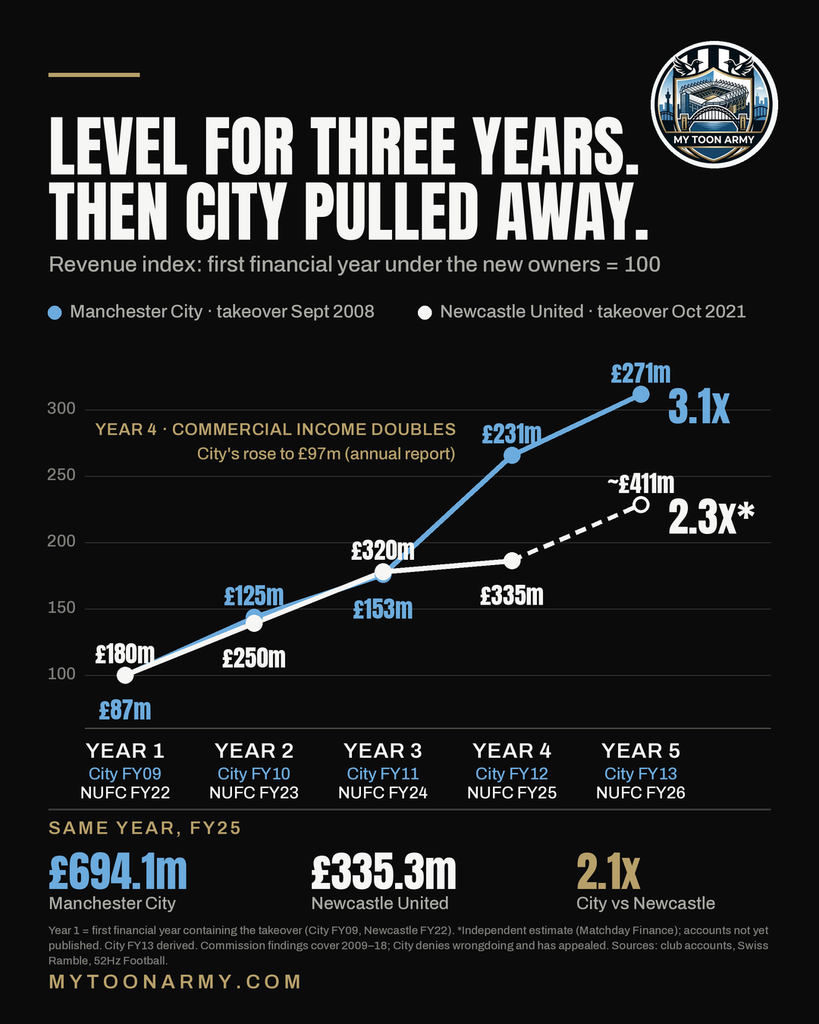
Turnover tells the story at a glance. It was about £140m in 2021. It reached £180m in 2022, £250.3m in 2023 and £320.3m in 2024. In the year to June 2025, it edged up to a record £335.3m.
Newcastle United’s turnover since the takeover. FY26 is an independent estimate. Sources: club accounts and announcements; Matchday Finance.
Losses fell with it, to £11.1m in 2024. The 2025 accounts show a profit after tax of £34.7m.
The footnotes add detail. That profit includes a £133.2m gain on selling the leasehold improvements at St James’ Park, and a project company, to PZ Holdings, another subsidiary of the club’s parent group. In plain terms, one part of the group sold an asset to another. The league tested it under the same FMV process, and the club says that process has concluded.
It is disclosed, audited and tested. It also means two numbers sit side by side: a £34.7m headline profit, and an operating loss that PSRwatch puts at roughly £109m.
Player trading became part of the model. Allan Saint-Maximin and Chris Wood were sold in 2023-24 for £23m and £15m. The owners kept their side of the bargain too. In September 2025, the parent group put in £106.5m of fresh equity. In July 2025, the club refinanced with a £50m term loan and a £50m revolving credit facility, a flexible borrowing line. Both run to July 2028 and are secured on Premier League central funds and ticket revenues.
The going-concern note in the same accounts is the most revealing line. Auditors need a reason to believe a company can keep trading for twelve months. Here, it is a letter from the parent company saying its present policy will see the club receive the funds it needs through June 2027. The letter describes a policy, not a promise.
That is not a warning. It is patient capital, described precisely.
What it bought
Everything above was a means. Here is the end.
Hard to beat
The first Champions League place came from the back.
In 2021-22, Newcastle conceded 62 goals. In 2022-23, they conceded 33, level with Manchester City for the fewest in the league. They lost five games, again level with City.
The recruitment behind it was precise. Nick Pope arrived from relegated Burnley for £10m and kept 14 clean sheets in his first season. Sven Botman cost £35m, and Newcastle beat AC Milan to him. Trippier and Burn gave Howe experience and an edge. Alexander Isak, signed for a club-record £63m, supplied the goals.
Fourth place came with 19 wins, 14 draws and five defeats, and a positive goal difference for the first time since 2011-12. There was a 6–1 against Tottenham in April. A goalless draw with Leicester in the last home game sealed the return to Europe’s top table after two decades.
The cost came the next year. In 2023-24, Newcastle beat Paris Saint-Germain 4–1 at St James’ Park, but won only one of their six group games and finished seventh. Managing Europe and the league together proved harder than reaching Europe.
Value for money
The more telling number is the wage bill.
Newcastle’s 2024-25 wage bill was £243.5m, the eighth highest in England, according to The Athletic’s reading of the accounts. By that measure, they finished above their wage ranking in each of Howe’s three full seasons.
Isak is the clearest case. Signed for £63m, he scored in the cup final. In September 2025, he left for Liverpool for a British record £125m, and one independent estimate puts the accounting profit at around £83m.
A club under PSR cannot spend its way out of mistakes. It has to buy right the first time. The numbers suggest it did, more often than not.
Wembley
Then, on 16 March 2025, the wait ended.
Over 32,000 Geordies made the trip to Wembley. Newcastle’s road had gone through Chelsea at St James’ Park, and a 3–1 quarter-final in which Sandro Tonali scored twice.
Just before half-time, Burn, a boyhood Newcastle supporter, rose to meet a corner and headed the opener. Isak scored early in the second half. Federico Chiesa pulled one back for Liverpool deep into stoppage time, but there was too little time left.
Bruno Guimarães and Trippier lifted the trophy. It was Newcastle’s first domestic trophy since the 1955 FA Cup, a gap of 70 years.
Howe said afterwards that he was emotional, and that the players had been desperate to end the years of hurt.
Fifth, on goal difference
The league season closed on a narrower margin.
Despite a slip at home to Everton on the final day, Newcastle finished fifth with 66 points, level with Aston Villa and ahead on goal difference. That put them back in the Champions League for 2025-26.
So why did it work twice?
Three things stand out. First, a head coach given time to build a settled identity. Second, recruitment aimed at fit and value rather than headlines. Third, a commercial and financial machine that kept the money coming without testing the rulebook’s patience.
None of it was quick. All of it was inside the lines.
The other road
A Gulf-backed club took a different road.
City’s rise began with Sheikh Mansour’s Abu Dhabi takeover in 2008. Between 2009 and 2018, they won the Premier League three times, plus one FA Cup and three League Cups. It is the same period a Premier League commission has just examined.
On Tuesday 29 September, the league published its findings. The commission found City guilty of all charges relating to serious breaches of the financial rules over nine seasons, and most of the charges relating to failing to co-operate with the investigation. Reports put the total at 114 of the 115 charges. The league’s chief executive, Richard Masters, said the club had systematically broken the rules for nearly a decade.
City says it is innocent and lodged an appeal on 1 October. The hearing is due by Christmas Eve, and sanctions will be decided separately, with options ranging from a reprimand to expulsion. Nothing is final.
The contrast is worth drawing carefully.
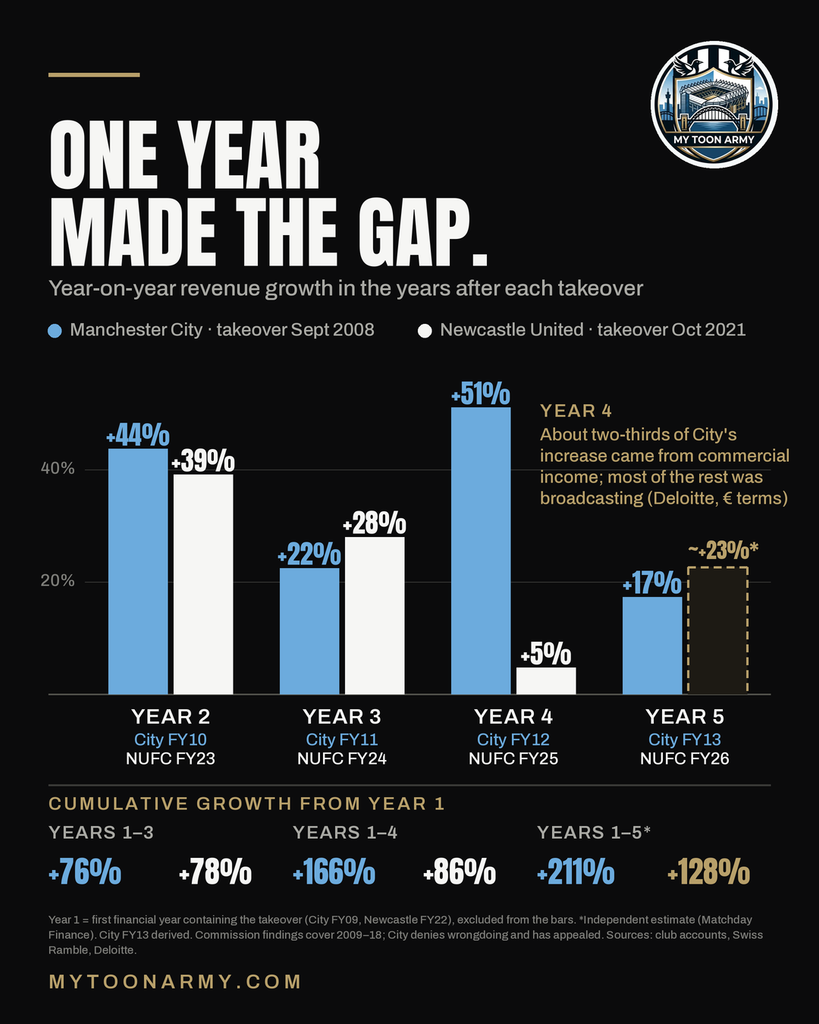
Start with the revenue lines. For the first three years after each takeover, the two clubs grew at almost the same pace: City’s revenue was up 76% on Year 1 by Year 3, Newcastle’s 78%. Then City’s revenue jumped 51% in a single year, while Newcastle’s, in a season without European football, rose 5%.
Year-on-year revenue growth after each takeover. Year 1 is the first financial year containing the takeover. Sources: club accounts, Swiss Ramble, Deloitte; Newcastle Year 5 is an estimate.
Newcastle’s first trophy took three years and five months. They reached it under rules built in response to their own arrival, so the patience was partly imposed. City challenged those same rules in a legal fight, then settled in September 2025, accepting them as valid and binding.
Newcastle’s route was slower, and visible in the books. Every deal passed through a test the club did not choose. The verdict against City is not a finding about Newcastle, and the ownership question, with a state fund at the top, is not settled by one case. Masters told MPs in 2023 that he could not say whether the league was re-examining its assurances.
But the difference is clear enough. One club’s story is now in the hands of an appeal board. The other is still being written in the accounts.
Year six
Newcastle return from the international break on 12 October under a new head coach. Matthias Jaissle told supporters in a Q&A on 3 October that his staff joined late in the summer window, with little time to work with the squad.
The build continues. The 2025 accounts describe the group as exploring an expansion of St James’ Park or a new stadium. From the start, the training-ground plan was an upgrade to Benton first and a new site later, and the 2025 accounts say work continues on the way forward.
On the first day, the co-owner asked for patience. The surprise is not that the club had to learn it. It is that, five years on, patience is what has set Newcastle apart.
What are your best memories of the PIF era? Can bring PIF bring Newcastle to the pinnacle of the Premier League? Join the conversation on X @mytoonarmy #NUFC