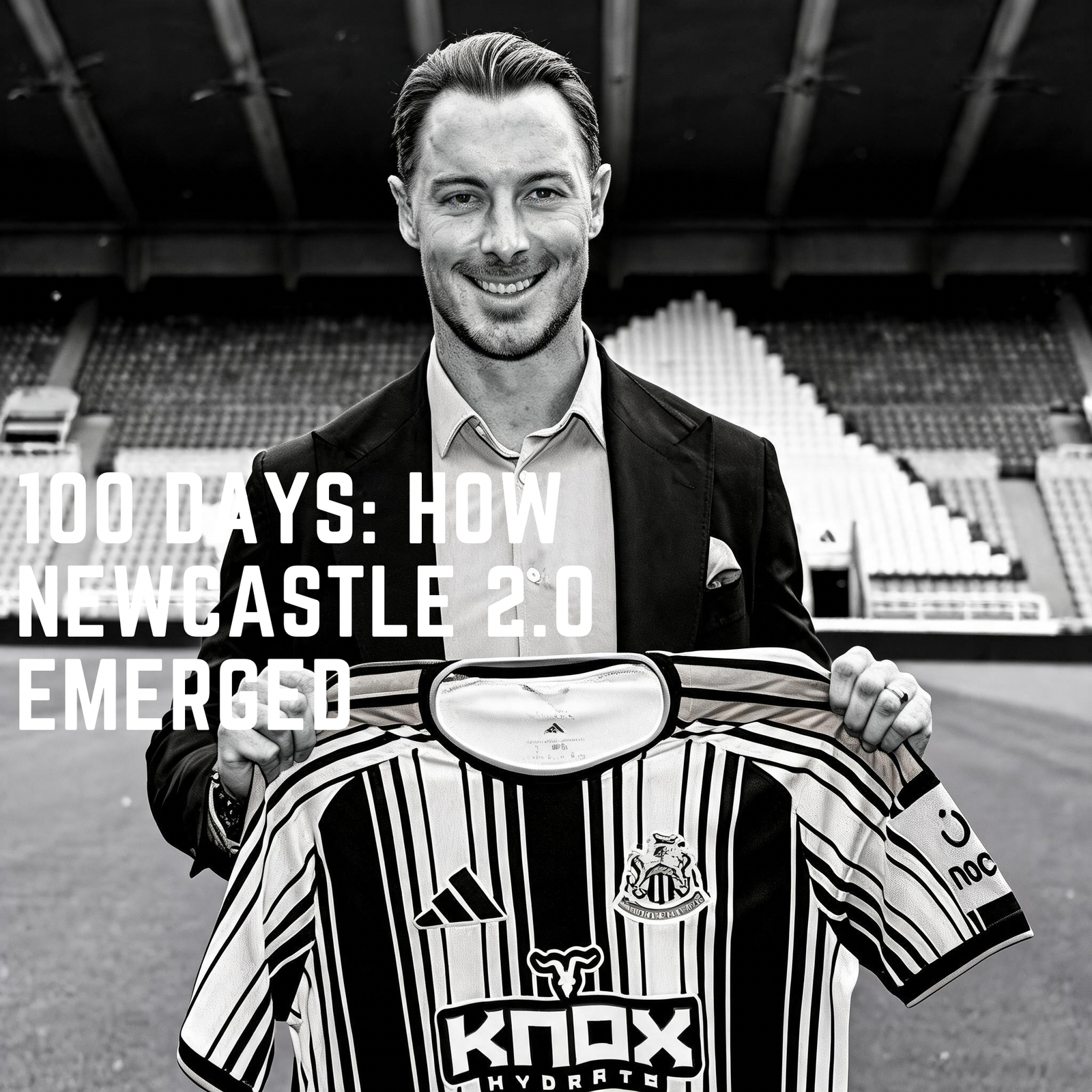

Ross Wilson, take a bow.
Eleven o’clock on Tuesday night, and the ledger finally closes: £266.4m spent, £236m banked, three full internationals sold inside nine weeks. By any measure that is one of the more violent squad turnovers English football has seen in a single window. That it happened without the finances buckling, without a manager-less panic, and without a single deal that reads as desperate on Wednesday morning, tells you rather more about Ross Wilson than any individual signing does.
Start with the conditions he was working under, because they matter more than the transfer graphics ever will.
The inheritance
Paul Mitchell walked out of the sporting director’s office in June 2025, eleven months after arriving to succeed Dan Ashworth. Newcastle went into last summer’s window — the one that delivered Woltemade at a club-record fee and saw Anthony Gordon fill in as an emergency centre-forward — without anyone formally holding that brief. Wilson didn’t arrive from Nottingham Forest until 11 October, by which point the season was already drifting toward the mid-table finish that eventually arrived: twelfth, five points off Europe, undone at Camp Nou by a Barcelona side that put seven past them in the second leg of a last-sixteen tie. Sunderland finished seventh. The optics were not kind.
So Wilson had less than eleven months in the building — most of it spent doing due diligence on a squad he hadn’t built — before he was asked to sell three of its best players, replace a head coach who resigned on 31 July with three weeks to the season opener, and execute the heaviest rebuild of the PIF era, all while a new Squad Cost Ratio and Sustainability and Systemic Resilience framework replaced the old Profit and Sustainability Rules and started tethering wages and amortisation directly to football revenue. A Scot who cut his teeth at Huddersfield and Southampton before winning Rangers their first league title in a decade doesn’t scare easily, by all accounts. He needed not to.
What went out the door
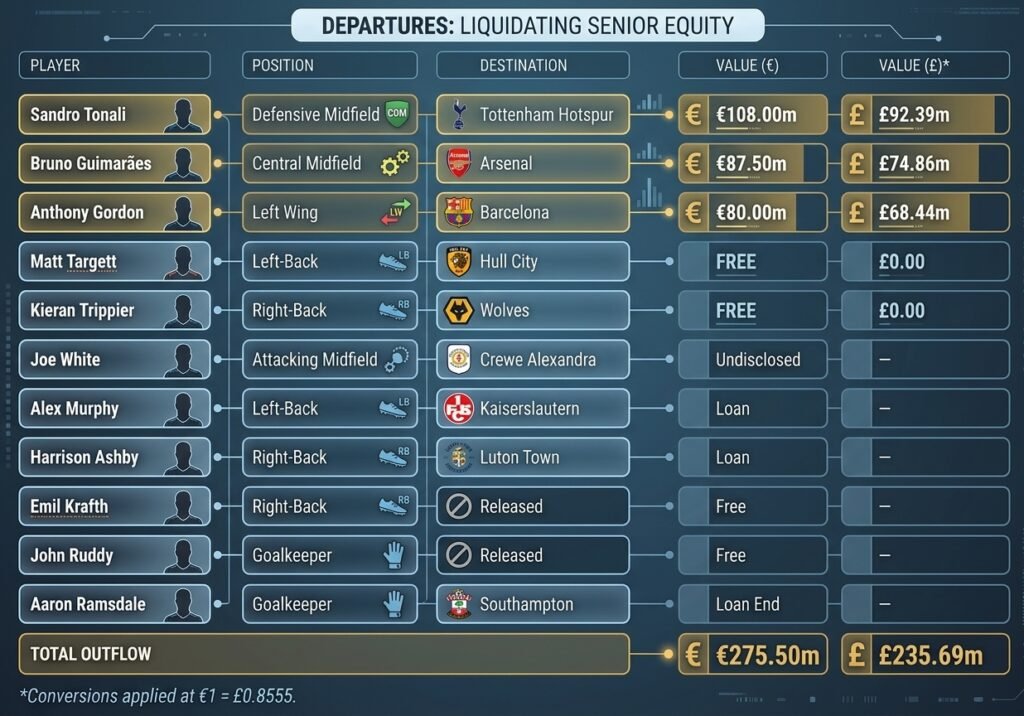
Sandro Tonali left for Tottenham at £92.5m, a fee that made him Spurs’ record signing on arrival. Bruno Guimarães — the armband, the goals, the player who kissed the badge on the way out — followed to Arsenal for £75m. Anthony Gordon, fresh off a World Cup with England, went to Barcelona for £68m. Kieran Trippier left for Wolves on a free transfer; Matt Targett and Emil Krafth were released outright. Add it up and roughly £236m came in across the summer, three of the dressing room’s most senior voices gone inside a fortnight in June and July.
For a fanbase that had spent four years being asked to trust a process, watching the removal van reverse up to St James’ Park stung. It was meant to. Selling three peak-value, fully amortised assets in the same window a club-record striker was already struggling for form is not a sequence any sporting director enjoys explaining to supporters. What it is, in the coldest accounting terms, is textbook: crystallise the profit on mature registrations before it depreciates, and do it while three separate buyers were prepared to pay top of market for proven Premier League and Champions League output. Newcastle’s FY25 accounts show intangible assets — the book value of the squad — falling from £350.0m to £281.2m across the year to 30 June 2025, even as net assets climbed from £248.3m to £333.0m and retained losses narrowed from £221.1m to £186.4m. That is a club that had already begun trading down its playing assets before this window opened. The summer just finished the sentence.
What came back in
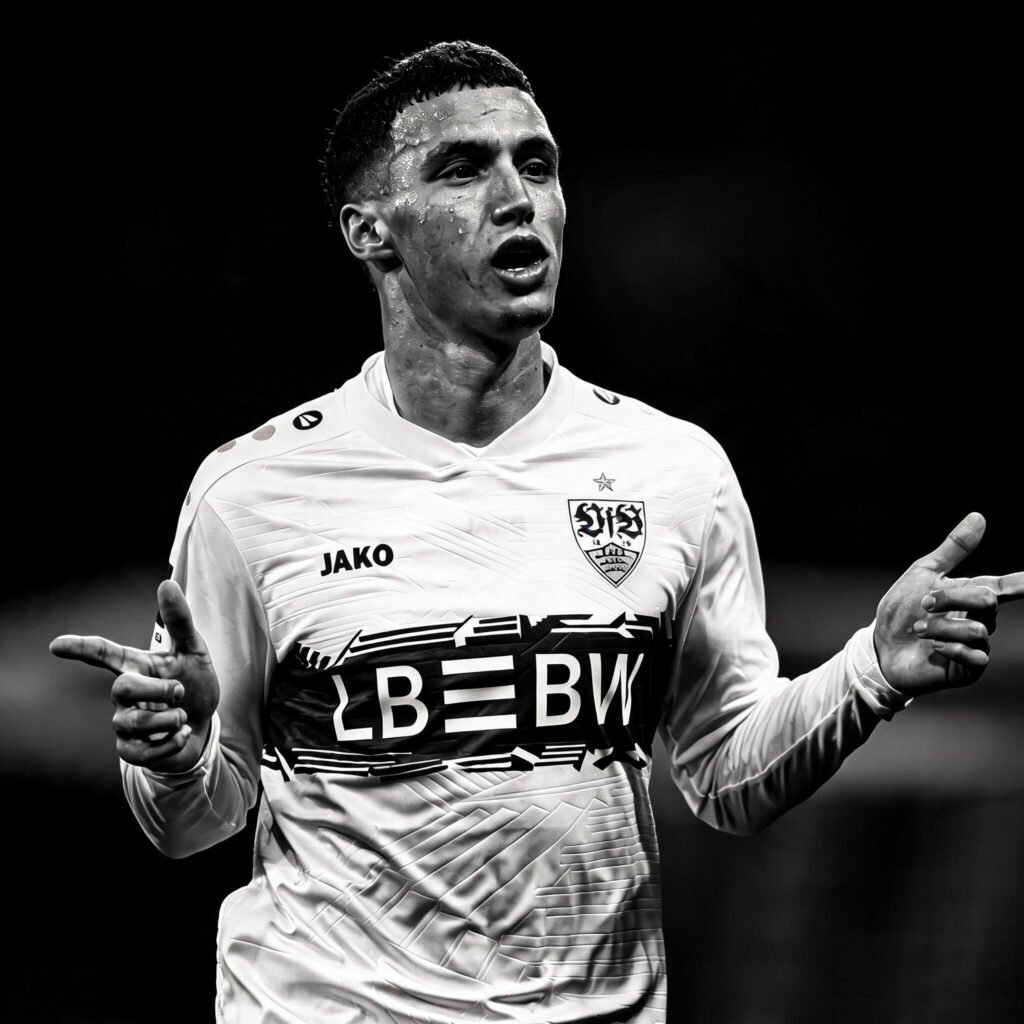
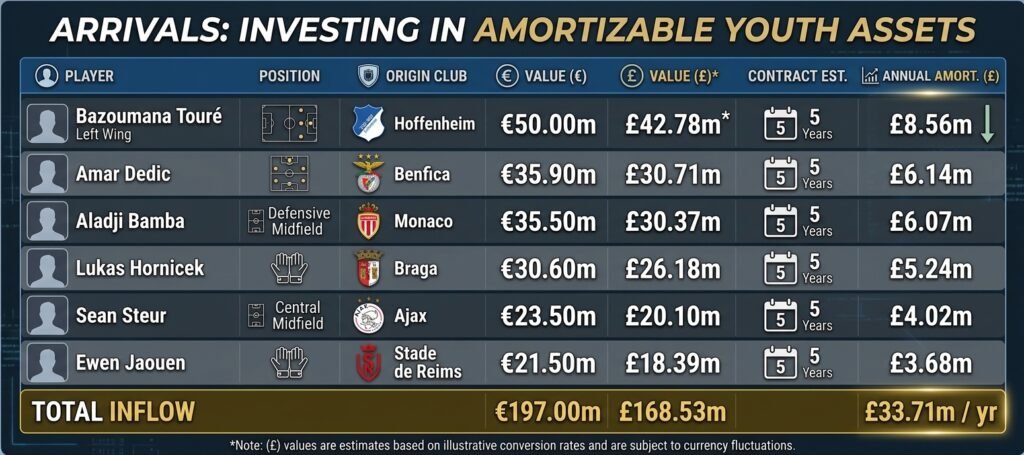
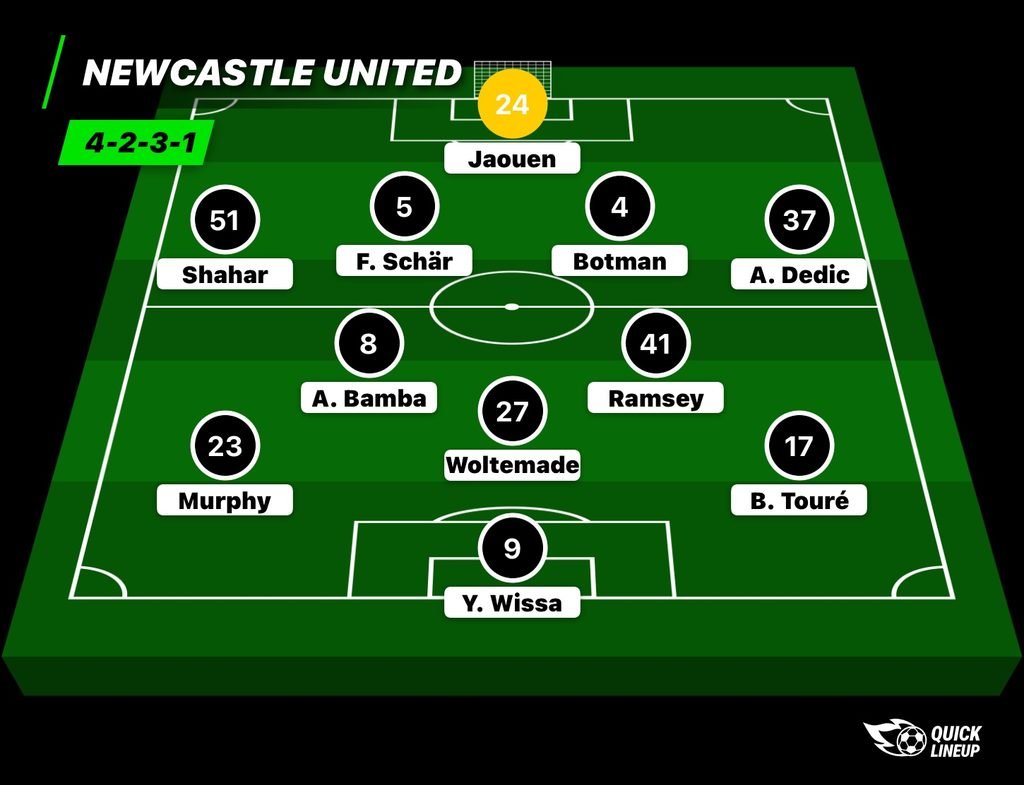
Roughly £215m went straight back out across seven signings before deadline day, and the profile discipline is the tell. Nico González arrived from Manchester City for £48m as the one ready-made starter of the intake, an experienced midfield anchor who was, by most accounts, the best player on the pitch in the 2-0 win at Tottenham. Around him: Bazoumana Touré from Hoffenheim (£43m), Amar Dedić from Benfica (£30m) — a full-back who played under incoming head coach Matthias Jaissle at Red Bull Salzburg — Aladji Bamba from Monaco (£30m), goalkeeper Lukáš Horníček from Braga (£26m), Sean Steur from Ajax (£20m) and a second young goalkeeper, Ewen Jaouen, from Reims (£18m). Bamba and Jaouen are twenty. Steur is eighteen.

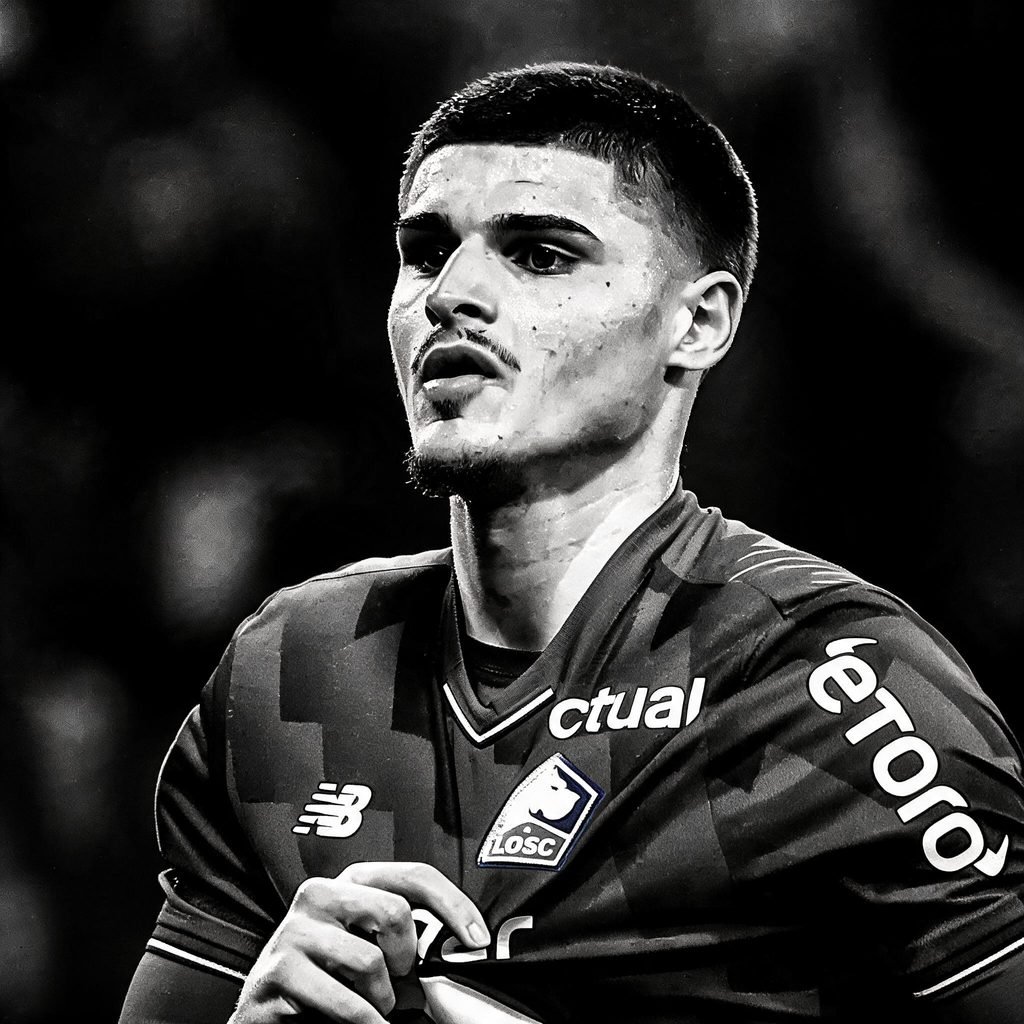
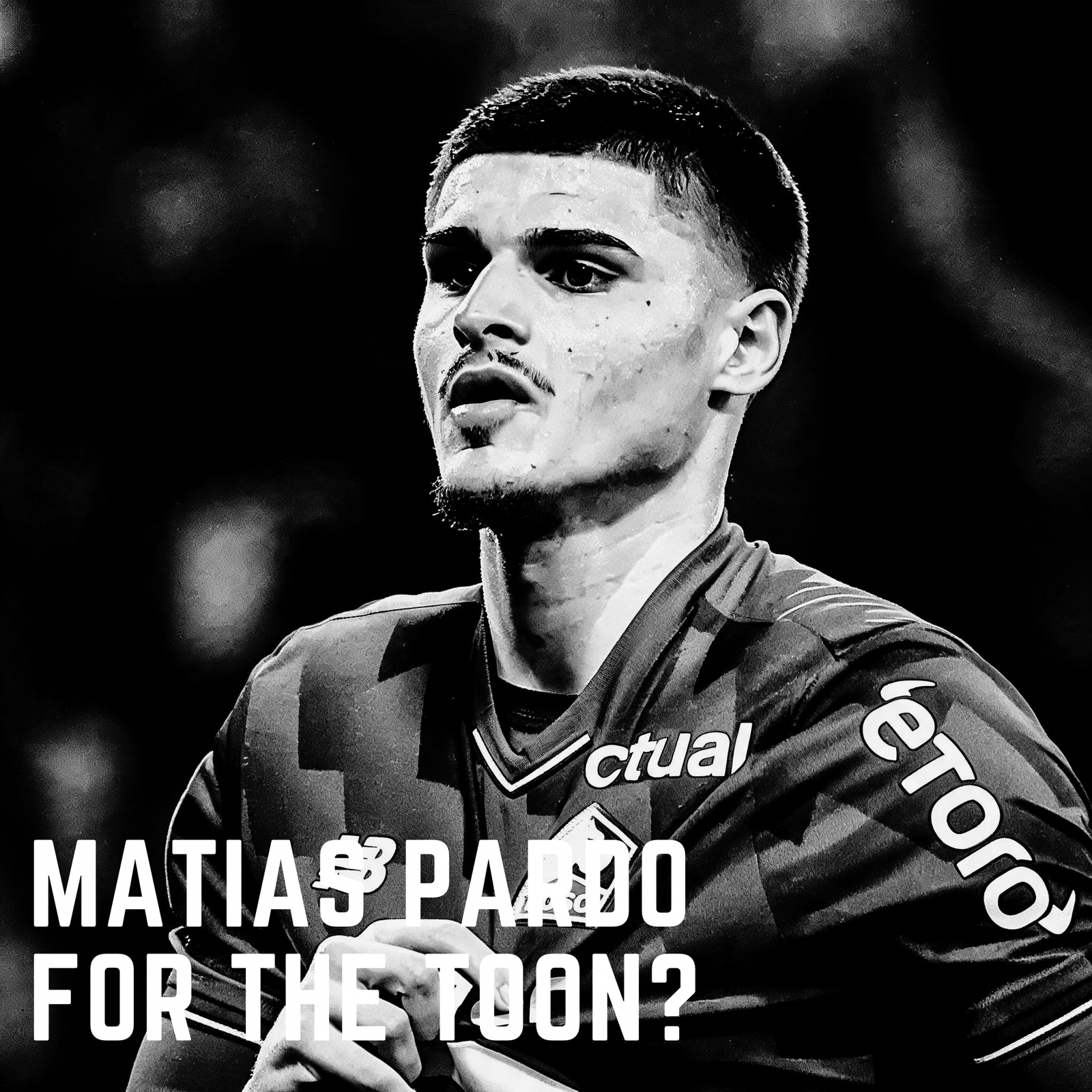
Then, on deadline day itself, the domino that made sense of everything else fell: Matias Fernandez-Pardo, twenty-one, from Lille for £51.4m on a five-year deal, taking the summer’s total spend to £266.4m. This was not a panic buy dressed up as ambition. Lille had frozen him out of training for the better part of a week rather than risk their asset before a deal closed; Newcastle’s opening bid near €40m in early August was returned unopened, and it took a final offer around €60m plus add-ons — with the player’s own resolve softening on his earlier insistence on Champions League football — to get it over the line. A Belgian international who plays off either flank or through the middle, comfortable receiving and carrying into the box, he is the closest thing this squad has to Gordon’s departed creativity, bought a full year younger and on a fee that will amortise gently across five seasons rather than sit as a single painful line in next year’s accounts.
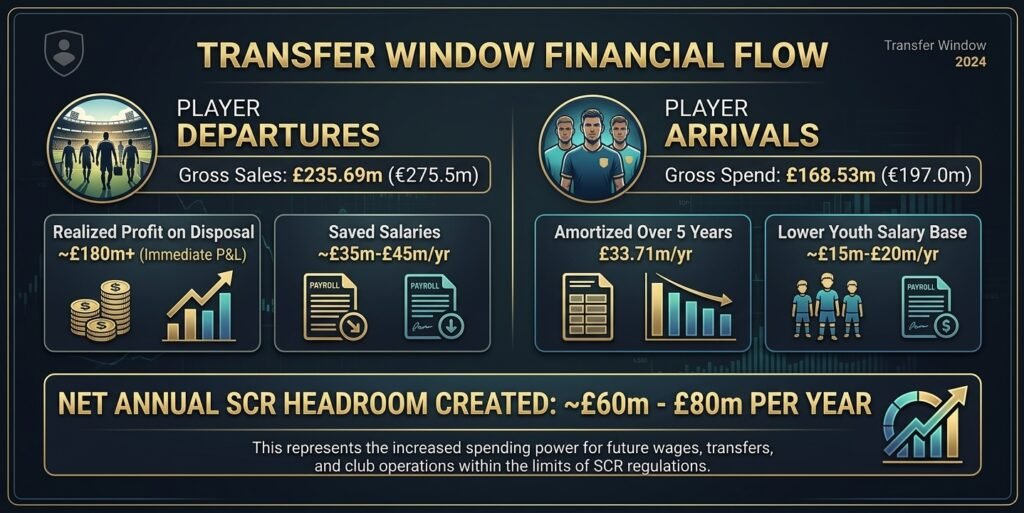
Net spend across the whole window: a little over £30m. Compare that with the £141m net cost of transfers Newcastle contracted for in the twelve months to last summer, against £20m the year before that, and the shape of Wilson’s discipline becomes obvious. This was the heaviest squad overhaul of the PIF era, and it was very nearly self-funding.
The deadline-day edges
The signing explains only half of a good window; what a sporting director declines to do explains the other half. Nottingham Forest had a £10m bid for Jacob Murphy rejected over the weekend, returned with £15m on deadline day, and were rejected again — twice, in the space of a day, for a thirty-one-year-old entering the final year of his contract. Social media did not love the decision. But Jaissle had already spoken of a leadership “vacuum” in a dressing room that lost Bruno, Trippier and Tonali inside one summer, and Murphy is the club’s longest-serving player, 267 appearances deep since arriving from Norwich in 2017. Selling your most experienced pro for late-window cash, with no replacement lined up and a right-hand side already carrying Livramento and Dedić as each other’s only cover, is the kind of “good business” that reads well in a spreadsheet and terribly in a February relegation six-pointer. Wilson and Jaissle judged the football risk correctly, even if it leaves a contract question to resolve before next summer.
Nick Woltemade’s exit tells the same story from the other direction. Newcastle’s club-record signing a year ago at an initial £65m, he had fallen behind Osula, Wissa and Willock in the pecking order under the new head coach and was heading for a loan for weeks — but the move was made contingent on Fernandez-Pardo’s arrival first. Nobody leaves until somebody arrives, was the internal line, and it held: the Belgian’s signature cleared the way for Woltemade to fly to Turin hours later, joining Luciano Spalletti’s Juventus on a season-long loan worth £3.5m to Newcastle, with no obligation to buy. That is asset preservation, not a fire sale — Newcastle get a struggling striker’s wages off the books for a season and retain full control of his valuation heading into next summer, rather than accepting a discounted permanent fee under deadline pressure. Sean Neave, nineteen, was also cleared to find senior football elsewhere on loan, the kind of minor squad-tidying that barely registers against nine-figure fees but matters to a development pathway.
The balance sheet underneath it all
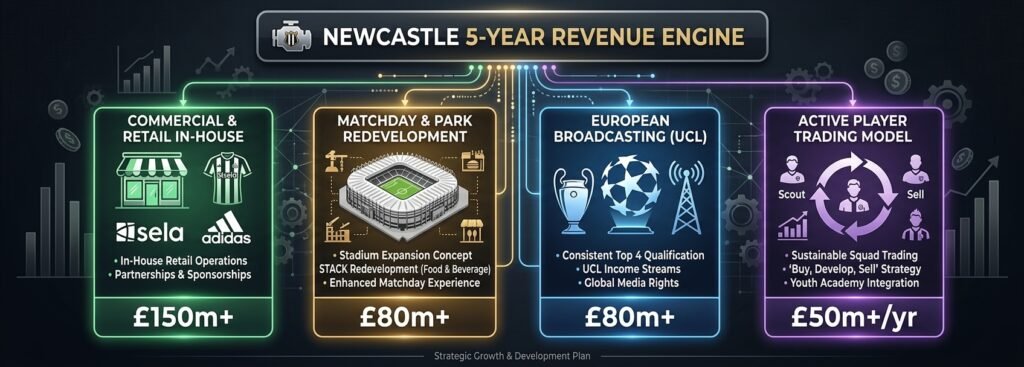
None of this happened in isolation from the boardroom. The club refinanced in July 2025 into a £50m term loan and a £50m revolving credit facility at SONIA plus 2.15 and 2.1 per cent respectively, secured against Premier League central funds and St James’ Park ticket revenue, running to 2028. A further £106.5m of equity funding arrived from PZ Newco in September 2025, on top of £50m raised through the share premium account during the financial year. Record commercial revenue — up 44 per cent to £120.1m, contributing to £335.3m in total turnover — is beginning to look like the off-field engine this ownership always promised rather than a line in an ambition deck. Put simply: Wilson wasn’t just managing a football rebuild this summer. He was managing it inside a financing structure that had just been rebuilt underneath him, against a regulatory framework that changed its rules on the same afternoon the season kicked off, for a chairman’s boardroom that is separately trying to work out how to fund a stadium project north of £1bn.
That he delivered a coherent, positionally sensible, five-years-younger squad within all of that — average age twenty-one among the new intake, a goalkeeping succession plan quietly assembled behind Nick Pope’s thirty-four-year-old frame, a genuine like-for-like creative replacement for Gordon bought at a discount to Lille’s opening valuation — is the kind of execution that doesn’t often get the credit it deserves, because it shows up as an absence of chaos rather than a highlight reel.
What still creaks
Credit isn’t the same as immunity from scrutiny, and a fair review owes the reader the cracks as well as the ceiling. The back four is the oldest part of an otherwise adolescent squad — Botman and Thiaw are asked to carry a season between them, with Schär and Burn both thirty-four behind them. Central midfield, rebuilt more aggressively than anywhere else, now leans on a twenty-year-old, an eighteen-year-old and a twenty-year-old alongside González, Ramsey and an ageing Joelinton with a recent surgical history. A squad cost ratio does not care about a five-year plan when three of your midfielders are teenagers in a February relegation scrap. And the Murphy contract situation — rejecting £15m for a player who could yet walk for nothing next summer — will need resolving with a new deal or a January sale, not left to drift.
The verdict
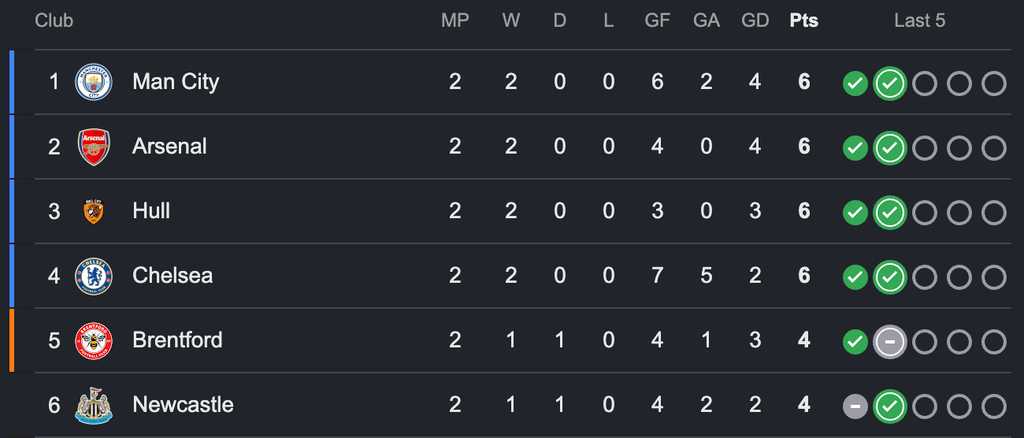
Three unbeaten league and cup performances to open the season — a battling 2-2 with Liverpool, a fightback past West Brom in the Carabao Cup, a proper away win at Tottenham — is a small sample, but it is not nothing for a head coach a month into the job with half his midfield still learning English pitches. The pieces Wilson assembled are, on the balance of the evidence so far, coherent rather than merely expensive.
Judge this window against what it actually was — not a transfer window in isolation, but a sporting director eleven months into the job, replacing a head coach mid-preparation, selling three internationals into a market that wanted them badly, buying eight replacements at a discipline of youth the club has rarely shown, and doing it all for a net outlay smaller than what Newcastle spent on Bruno Guimarães alone back in 2022 — and it stops looking like a chaotic summer. It looks like the first window since October 2021 in which the football department, the finance department and the head coach’s office were all reading from the same page. That it happened during the most turbulent hundred days this ownership has overseen is not a coincidence worth glossing over. It is, on the evidence in front of us, rather the point.
What do you think of the job Ross Wilson has done this summer? Are you satisfied with the recruits who have joined the cause? Join the conversation on X @mytoonarmy #NUFC