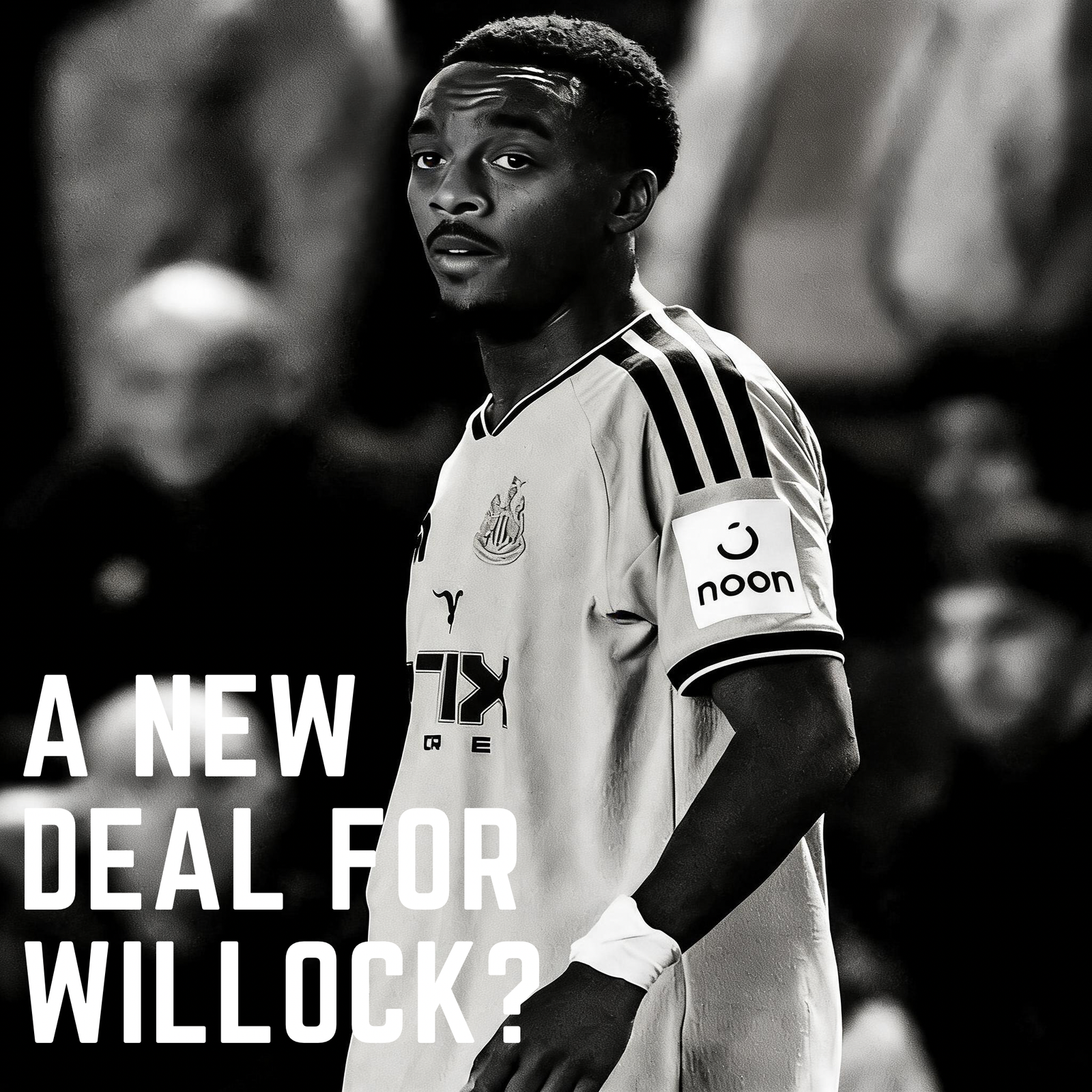
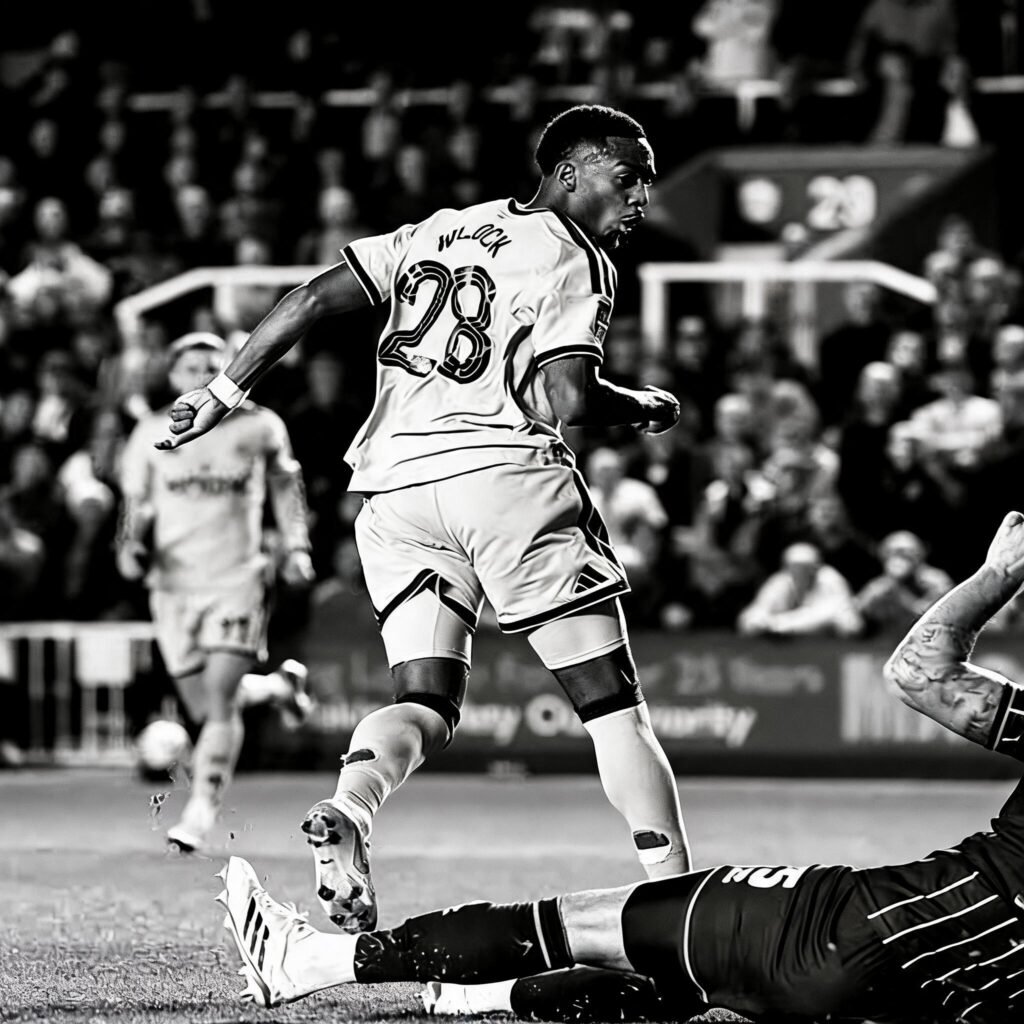
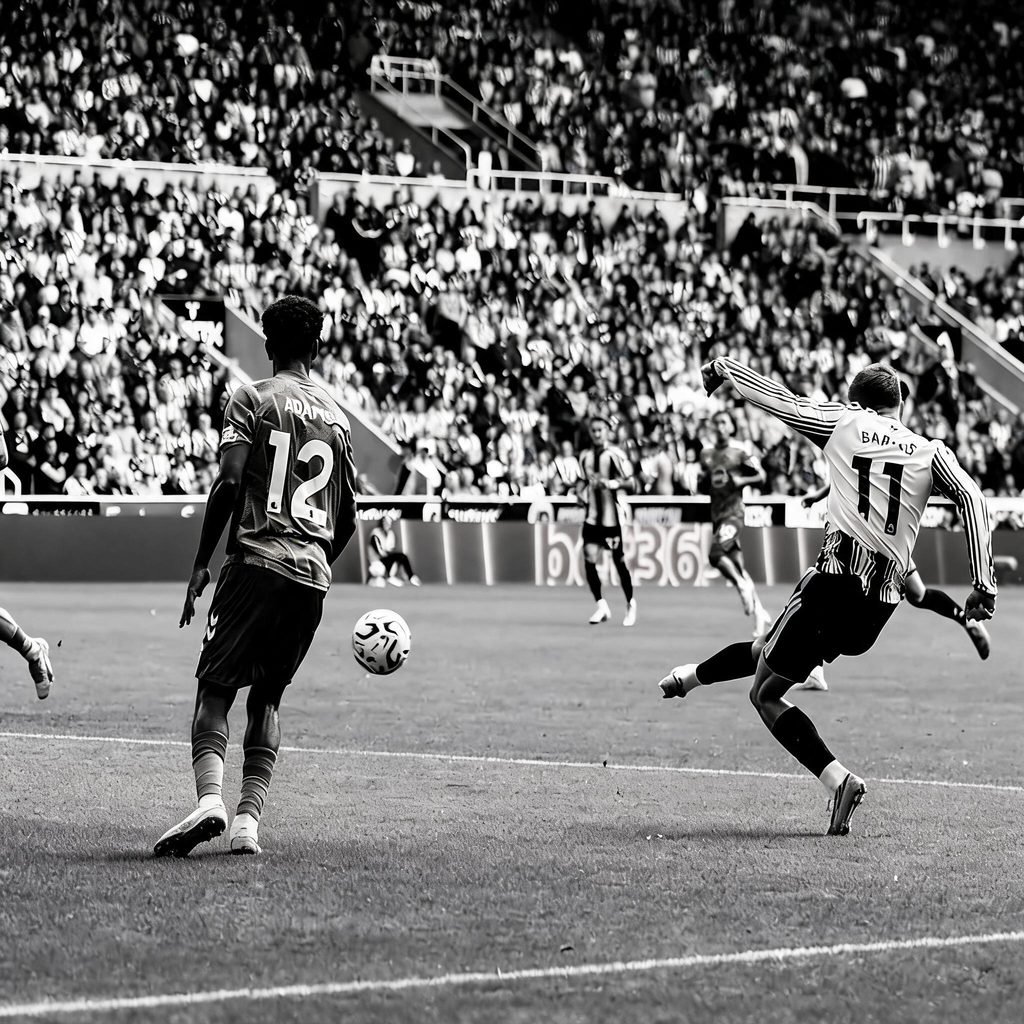
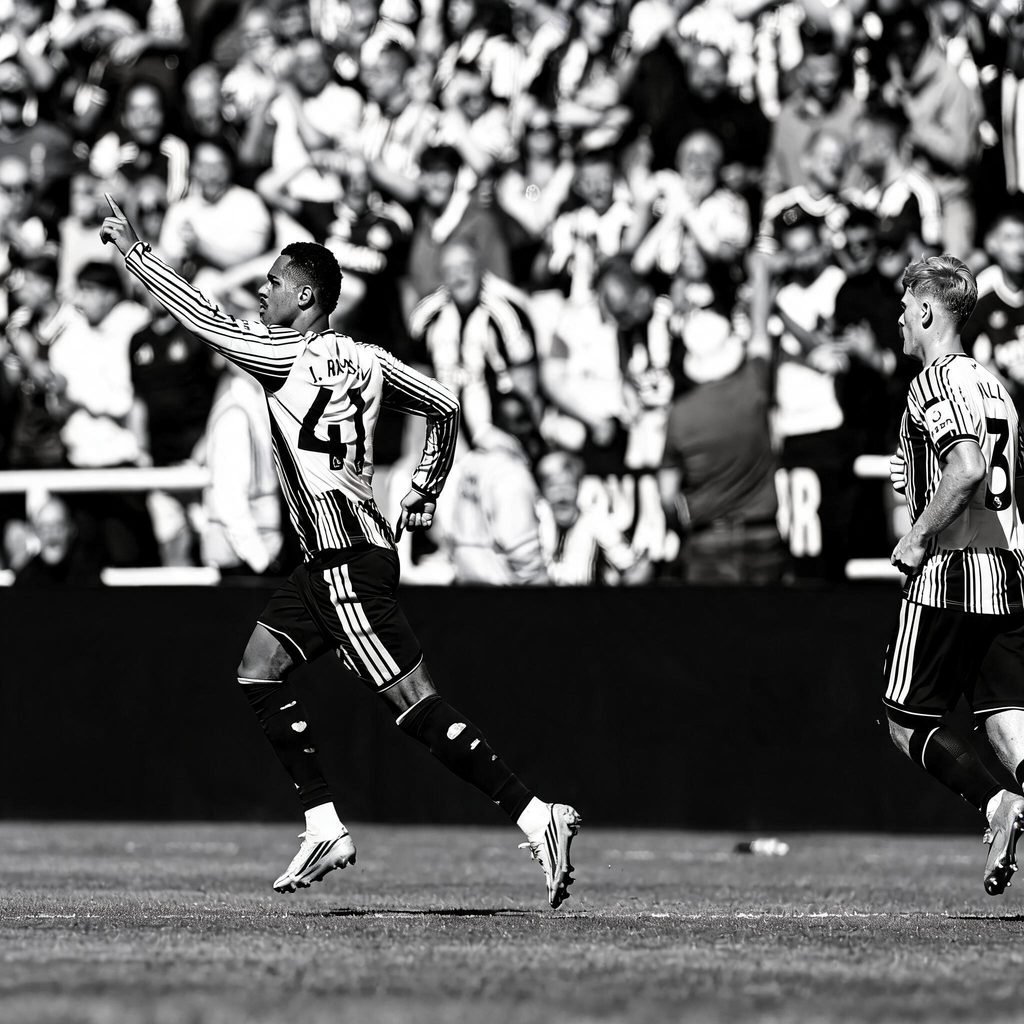
Fifty-seven minutes into his first involvement of the season, Joe Willock has been on the pitch for sixty seconds. Cody Gakpo has just cancelled out Anthony Elanga’s early strike, St James’ Park is still exhaling from that concession, and Lewis Hall’s ball has broken to Willock on the edge of the box. First touch. Ball in the net. The Gallowgate erupts, briefly forgetting that this was a player half of Tyneside had already said goodbye to.
That’s the trouble with writing off Joe Willock. He keeps not leaving.
By August, the exit had felt like a formality. Under twelve months left on his contract, shunted down the pecking order under Eddie Howe, and a move to Beşiktaş reportedly agreed in all but signature. Then Matthias Jaissle arrived, watched him train through pre-season, and decided he wasn’t for sale. Willock stayed. Three weeks later he was flicking home a matchwinner off a Lewis Hall cross away at Millwall — his second goal of a campaign that was never supposed to happen on Tyneside.
In between, the numbers back up what the eye is telling Gallowgate: this is not a favour being repaid. It’s form.
Start with the plainest of them. Since Jaissle took charge, Newcastle have played five competitive matches — three in the league, two in the Carabao Cup. Willock has featured in every single one. Not as a passenger carried by a new manager’s goodwill, but doing real, measurable work: an 85th-percentile rate of shot attempts among Premier League attacking midfielders despite barely more than a hundred minutes on the pitch in the league so far, a 6.92 average match rating, and — for what it’s worth as a curiosity rather than a headline — every one of his 28 attempted passes finding a Newcastle shirt. He isn’t just turning up. He’s the one generating the moments.
85th percentile, shots at goal
The Tottenham away trip on the last weekend of August told the fuller story, though, and it’s worth being honest about it. Handed the No.10 role in Jaissle’s 4-2-3-1 — a spot he shares with almost nobody else in the squad — Willock had the sort of afternoon that explains why this case needs stats rather than sentiment alone. He got clean through the Spurs defence and past the goalkeeper in the second half, only to lose his footing on the touch and watch the chance run away from him. Earlier in the game, a quick break down the right had fizzled out when his effort flew high and wide, out for a Tottenham throw-in. Newcastle won 2-0 anyway, Elanga and Wissa doing the scoring, and Willock was withdrawn with the game there to be killed off rather than started. The talent to be decisive was visible. So was the rawness in the moments that mattered most.
He’d say the same himself. After the Millwall winner, asked about his season so far, Willock talked about the goals still “missing” from his game — not as an excuse, but as a target. That’s not the sound of a player coasting on a new manager’s faith. It’s a 27-year-old who knows exactly what’s still to be added, and is naming it in public before anyone else does.
Which is, in its way, the whole argument. Nobody serious is claiming the finished article here. What Jaissle has found is a specialist: a player whose touches and defensive numbers sit in the bottom quarter of Premier League attacking midfielders, because his job isn’t volume — it’s the ten or fifteen touches a match that turn into shots and half-chances at a rate few others in his position can match. It’s a different kind of value to the one Newcastle built around Bruno Guimarães or Sandro Tonali. It’s the value of a player who, put in the right ninety-metre stretch of pitch, keeps finding the net or the pass that leads to it.
There is a version of this argument that stays entirely on the pitch. There’s a sharper one that doesn’t.
A clever flick to settle a game at Millwall
Willock signed permanently in August 2021 for a fee in the region of £25million, on the back of a loan spell so explosive — eight goals in fourteen games — that Newcastle simply couldn’t let him go back to Arsenal. His valuation peaked at €41.5million that October. It sits at €12.1million now. That fall isn’t a condemnation of the player; it’s what happens to transfer valuations for anyone who spends a season in and out of a matchday squad, which is exactly where Willock was twelve months ago. The point for Ross Wilson’s recruitment ledger is simpler than any of that: whatever’s left of the original fee on the books is now close enough to fully written down that a new contract is a wages decision, not a balance-sheet one. And his current deal runs out in June 2027 — which means from this coming January, he’s free to talk to clubs abroad about a pre-contract move, for nothing. Newcastle either commit now, on favourable terms while his stock has dipped, or they gamble on getting nothing at all for a player who has just proven, five matches out of five, that he’s worth something.
Willock, for what it’s worth, sounds like a man who wants to be asked. Reflecting this month on a fifth, maybe sixth, season at the club, he spoke about feeling valued and growing into a more senior role in the dressing room, crediting Jaissle with giving him what he called “a new lease of life.” Jaissle, for his part, needed one word when asked whether the Millwall winner justified keeping hold of him. “Yes.”
There’s a version of this story where Newcastle spend the next few months finding out the hard way what Willock is worth to somebody else. There’s a cheaper, simpler one where Newcastle just write down the numbers already sitting in front of them, and pay the man before somebody else does it for free.
Time to offer Willock a new contract to stay on longer? Is there room for him to get better still under a new manager? Join the conversation on X @mytoonarmy #NUFC
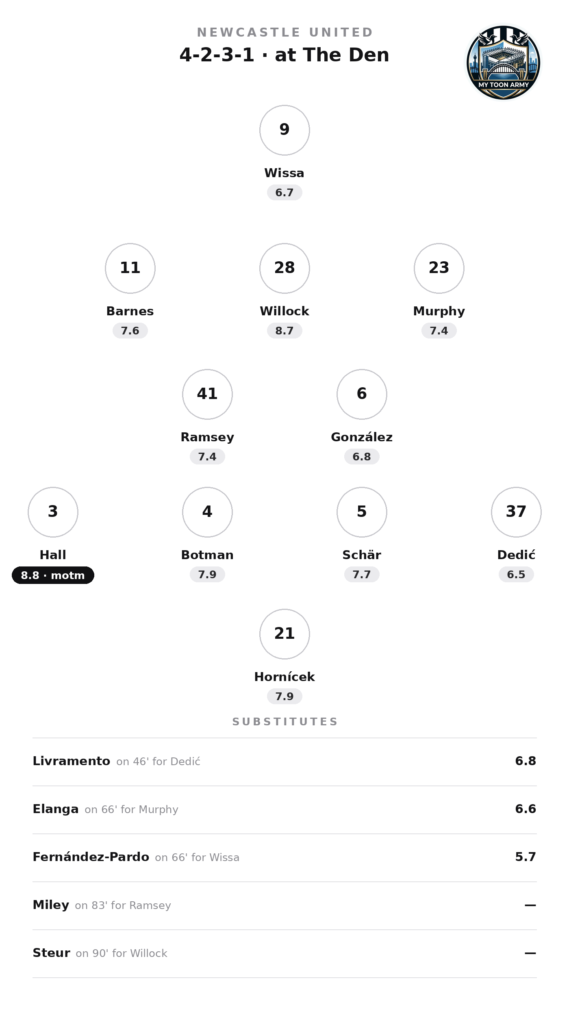
The teamsheet dropped at The Den forty minutes before kick-off and settled an argument before a ball had been struck: three changes, not the wholesale clearout that had seemed the safer bet for a Tuesday night in Bermondsey against Championship opposition. Sven Botman, Lewis Hall, Joe Willock, Harvey Barnes, Yoane Wissa and Amar Dedić all kept their places from Saturday’s draw with Bournemouth. Only Malick Thiaw, Lewis Miley and Anthony Elanga made way, for Fabián Schär, Jacob Ramsey and Jacob Murphy. For a manager five matches into the job, at a ground with a genuine history of humbling bigger clubs, that is a team sheet with intent written through it.
The reasoning isn’t hard to trace. Newcastle arrived at The Den as past winners of this competition and semi-finalists last season, and a young head coach fielding a second-string XI in round three away to a side sitting handily in the Championship risked exactly the kind of night this competition has previously punished sides for taking lightly. Millwall had won 4-0 three days earlier, had lost only one of three home league matches, and had never once hosted Newcastle at the current stadium in the thirty-three years since it opened — the sides hadn’t met at all, anywhere, since 1993. Alex Neil’s side had every reason to fancy their night, and Jaissle’s team selection reads as a direct answer to that threat rather than a nod to the calendar. With Leeds not arriving until Monday, there was no fixture-congestion argument forcing his hand toward heavy changes in the first place — the six-day gap gave him the freedom to rotate hard if he’d wanted to, and he chose largely not to take it.
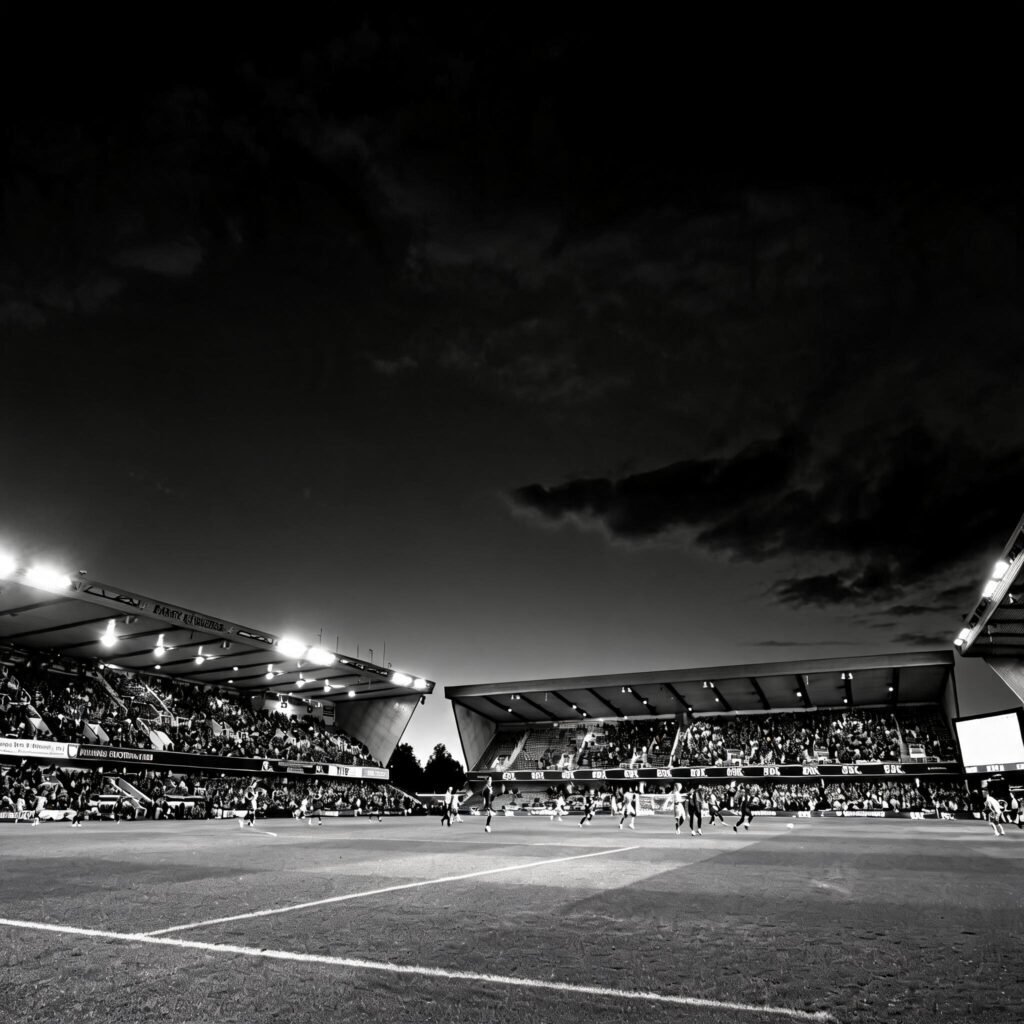
The Den, imposing by night
Look closer at who did sit out, too, and it reads less like a rotation policy than individual maintenance: Thiaw, Miley and Elanga rested on their own specific terms rather than as representatives of a fringe cohort given a run-out. That distinction matters. A coach still bedding in a high-press structure that depends on players reading one another’s triggers has good reason to protect continuity over giving minutes away — wholesale changes cost cohesion faster than they save legs this early into a new system, and Jaissle appears to have judged that trade-off wasn’t worth making against a Millwall side sitting deep and compact.
Which is what makes the eighty minutes that followed so instructive. This was, by most reasonable definitions, close to full strength — and it still took until the 81st minute to break Millwall down. Newcastle finished with 25 shots to Millwall’s nine, 15 corners to one, and an expected-goals reading of 1.77 against 0.50, yet spent long stretches of the first half unable to turn territory into anything alarming for Filip Marschall, handed his Millwall debut after a spell on loan at Gateshead. Of Newcastle’s 25 attempts, only one was rated a genuine big chance by the data — and they took it. Fourteen efforts before the break produced one shot on target, Willock’s low strike parried into the six-yard box rather than finished by the lurking Wissa. Murphy dragged an early sighter over. Jake Cooper and Caleb Taylor gave nothing away cheaply in the Millwall backline, and for a team picked specifically to win rather than to rest, the profligacy carried more weight than it would have against a weekend reserve XI — there was no fatigue or unfamiliarity to point to as mitigation.
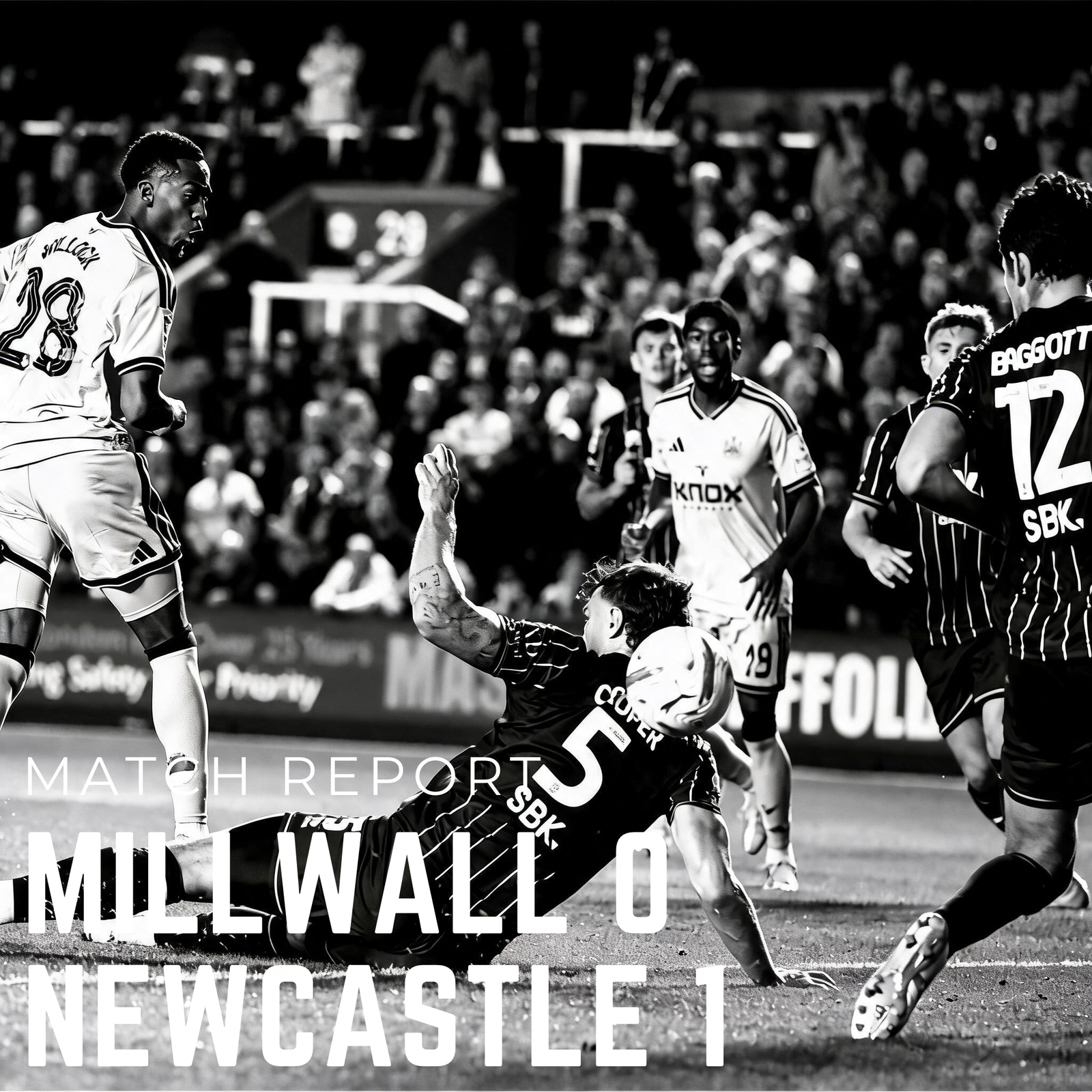
Millwall nearly made Newcastle pay for it. Nine minutes before the winner, substitute Tairyk Arconte turned Tino Livramento — only recently back from a long injury lay-off — and dragged a shot back off the near post with Lukas Horníček well beaten. Had that gone in, a near-full-strength Newcastle side would have been staring at a genuine upset rather than a mid-round formality, and the story of the selection would have written itself very differently. Instead, Jaissle’s bench did what his starters hadn’t: Elanga and deadline-day arrival Matías Fernández-Pardo had been on since the 66th minute to force the issue, and fifteen minutes later Hall’s low ball across the six-yard box found Willock at the back post for the finish that separated the sides.
Celebrating a clever finish into the corner
If one player made that selection look assured rather than merely bold, it was Hall. Tuesday continued a run of form that’s hard to argue with: an 8.6 in the win at Tottenham, a 7.8 with the assist in the Bournemouth draw, and now an 8.8 — his best of the three — built on the low ball across the six-yard box that Willock turned in. The pattern in the numbers matches the pattern on the pitch: solid without much incident defensively for an hour, then increasingly the outlet Newcastle turned to as Millwall’s low block held firm everywhere else, finishing with four chances created and more touches of the ball, 85, than anyone else on the pitch in either shirt. Speaking to Sky Sports afterwards, Hall credited the change in mood at the club since Jaissle’s arrival, saying the new coaching staff have “been top” and that the way they’re playing is one the whole squad is enjoying. On this evidence the feeling is mutual: he played every one of the ninety minutes on offer.
Willock is harder to write about cleanly, because the version of him that shows up changes depending on which ninety minutes are on. Nobody covered more ground trying to get into a scoring position than he did on Tuesday — ten duels won, more than any other player on the pitch, five shots, three of them on target, both the most of anyone in a Newcastle shirt — and it was that same appetite for the eighteen-yard box that put him on the end of Hall’s ball nine minutes from time, a finish rated a mere 0.28 expected goals that still finished with an on-target probability of 0.93 once it left his boot: not a gift, a finish. But the instinct that gets him into those positions so reliably is the same one that, watched over a longer run of matches, just as often produces the rushed shot or the wrong final pass when a simpler option is on: Newcastle’s profligacy in the first eighty minutes at The Den wasn’t confined to Murphy’s off night on the other flank. It’s what makes Willock simultaneously one of the easier players in this squad to get frustrated with and one of the hardest to leave out — a midfielder capable of long stretches of anonymity in the final third who has also, down the years, popped up with matchwinners. Tuesday’s ledger settled in his favour, emphatically. It won’t always.
Read the selection and the performance together, and a picture emerges of a manager unwilling to gamble with a competition his club takes seriously, backed by a group that took nearly the full ninety to justify his faith in them. Newcastle move into the Carabao Cup fourth round with the intended trophy challenge intact and the spine of the side rested only where it needed to be — but the manner of it, an expected-goals gulf that size taking until nine minutes from time to show up on the scoreboard, is worth remembering the next time a Championship low block stands between this squad and where it wants to go.
Newcastle return to league business on Monday at Elland Road, sitting seventh after four matches without defeat, against a Leeds side with its own survival plan to protect. Whether Tuesday’s finishing edge travels with the group Jaissle trusted to find it, or whether Bermondsey’s near-miss was the more honest guide to where this Newcastle side currently stands under pressure, gets another real test inside a week.
Do you think it was a scrappy win? The sort of results that we need to be able to grind out if we’re going to have a good season ahead? Join the conversation on X @mytoonarmy #NUFC
No Newcastle United shirt has ever crossed the touchline at The Den. Not in 133 years of the club’s history, not through 141 seasons of Millwall’s own. Tuesday night changes that — and it lands at an interesting moment for Matthias Jaissle, one month into the job, still building an identity in real time, and facing his first genuine selection puzzle rather than a straightforward team announcement.
The calculus, not the complication
Call it what it actually is: a rotation decision, and a healthy one at that. Whatever combination Jaissle sends out will still contain internationals, PIF-funded quality, and players capable of hurting a Championship side on their own terms. The question isn’t whether Newcastle can cope with missing faces — they can — it’s how far Jaissle rotates, and why.
Start with the calendar, because it explains more here than any team-sheet. Newcastle travel to Leeds United six days later, Monday 14 September at Elland Road, against a Whites side unbeaten through three league games and sitting ninth under Daniel Farke. Two away trips inside a week, the second a proper away-day rather than a formality, shapes selection more decisively than any single fitness concern. Whoever plays heavy minutes in Bermondsey has four or five days to recover before doing it again in Yorkshire, with only a home game against Hull the following weekend before the international break. This fortnight is the tightest squeeze of Newcastle’s autumn, and Millwall is where Jaissle has the most room to manage it.
Then there’s the question of continuity. Jaissle’s system is still being embedded — the pressing triggers, the relationships between midfield and front four — and four competitive matches unbeaten suggests those patterns are taking hold. A cup tie is a chance to change personnel while preserving the shape, not an invitation to tear it up. Expect the spine to shift — goalkeeper, a midfield voice — while the framework stays recognisable.
There’s also a squad-health dimension that has nothing to do with who’s fit and who isn’t. Several names have started every competitive game so far this season; part of what Jaissle will be weighing is workload distribution for that group specifically, with September about to compress hard and October offering little relief until the international break. At the other end of the squad, players like Lewis Miley, Nico González, Harvey Barnes, Anthony Elanga and Fabian Schär need competitive minutes to stay sharp and make their own case — a consideration about squad morale and depth as much as about Tuesday’s result.
None of which is to pretend the team sheet writes itself. Ewen Jaouen, first choice for cup exposure and the man who started the West Brom win, is now waiting on a specialist opinion after an ankle knock, handing the goalkeeping shirt to either Lukáš Hornicek or a recalled Nick Pope. Joelinton remains out with the thigh injury that has sidelined him all season, Dan Burn and William Osula are both unavailable, and Tino Livramento — back in training after summer calf surgery — won’t be risked from the start. Those absences narrow Jaissle’s options in specific positions; they don’t define the character of the side he picks.
Not a free hit
Whoever lines up for Newcastle shouldn’t expect an easy evening. Millwall arrive having just put four goals past Bolton Wanderers without reply — Caleb Taylor’s opener, a Lyndon Dykes brace, Camiel Neghli’s late fourth — a response to back-to-back beatings against Southampton and Wrexham that had threatened to sour Alex Neil’s start to the season. This is a side that finished third in the Championship last term and reached the play-offs; a mixed opening to this campaign undersells a squad with genuine top-half ambition and a manager who knows how to make a night at The Den uncomfortable for a bigger club.
The venue still carries its own reputation, even if it may not be fully tested on the night. The Den holds 20,146, capped at roughly 18,100 once away segregation is factored in, but cup football here rarely gets near that ceiling — the last Carabao Cup tie at this ground drew just 7,048, for Coventry’s visit last season. Newcastle’s own allocation is capped at 2,072, and reports out of Bermondsey suggest home sales have been sluggish too, with prices roughly double last year’s cup pricing landing awkwardly after back-to-back league defeats to Southampton and Wrexham. A sold-out first-ever NUFC visit would have made the better story; a stadium some way short of full wouldn’t be unusual for a midweek third-round tie, whatever the name on the away team sheet. Millwall’s own team news isn’t blemish-free — Josh Coburn, Casper De Norre, Tristan Crama, Ryan Leonard, Mihailo Ivanovic and Mathis Servais are all out, and Jenson Metcalfe serves a suspension — but the name worth knowing before kick-off is Lyndon Dykes.
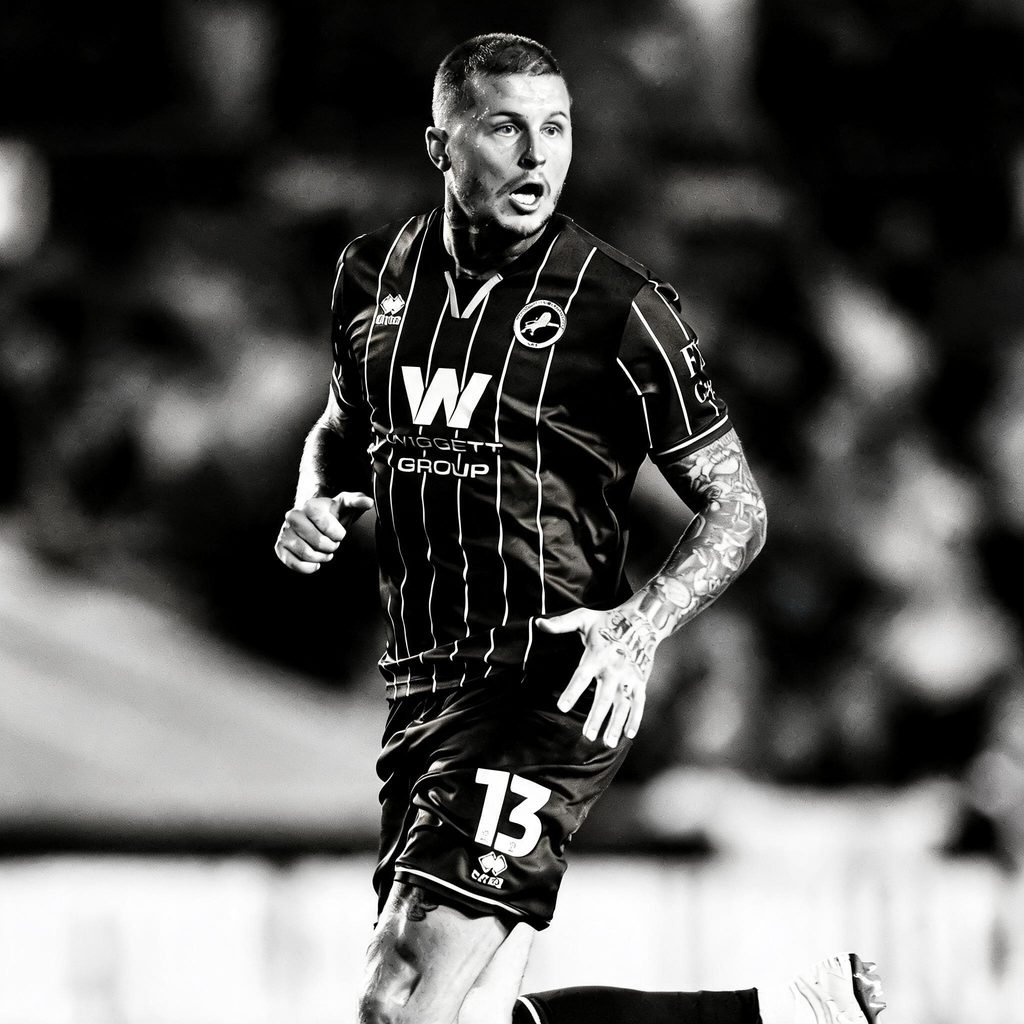
Lyndon Dykes, the main man of Millwall
The Scotland international arrived at The Den this summer via QPR, Birmingham City and Charlton, and took only five appearances to hit top form: two goals in that 4-0 demolition of Bolton, the best individual display by any Millwall player so far this season. At 6ft 2in he’s built to bully a defence in the air as much as run in behind it — exactly the kind of test an unfamiliar, rotated Newcastle back line should be wary of. Alex Neil has enough around him to set a direct, physical trap regardless: a double pivot screening the back four, width from Tairyk Arconte and Romain Esse, and Dykes the point of the spear.
A body of work worth trusting
Set against that is the case for calm. Jaissle’s four competitive matches in charge have returned two wins and two draws without defeat — a battling point at Liverpool, victory over West Brom in the last round of this competition, an assured 2-0 win at Tottenham, and Saturday’s fightback from two goals down to draw at Bournemouth. None of it has come through control for ninety minutes; this group has had to dig its way back into games rather than cruise through them, which is precisely the profile of evening Millwall are capable of engineering at The Den. That’s the real argument for trusting a rotated XI here: this group has already shown it can find a way when things aren’t straightforward.
Squad prediction
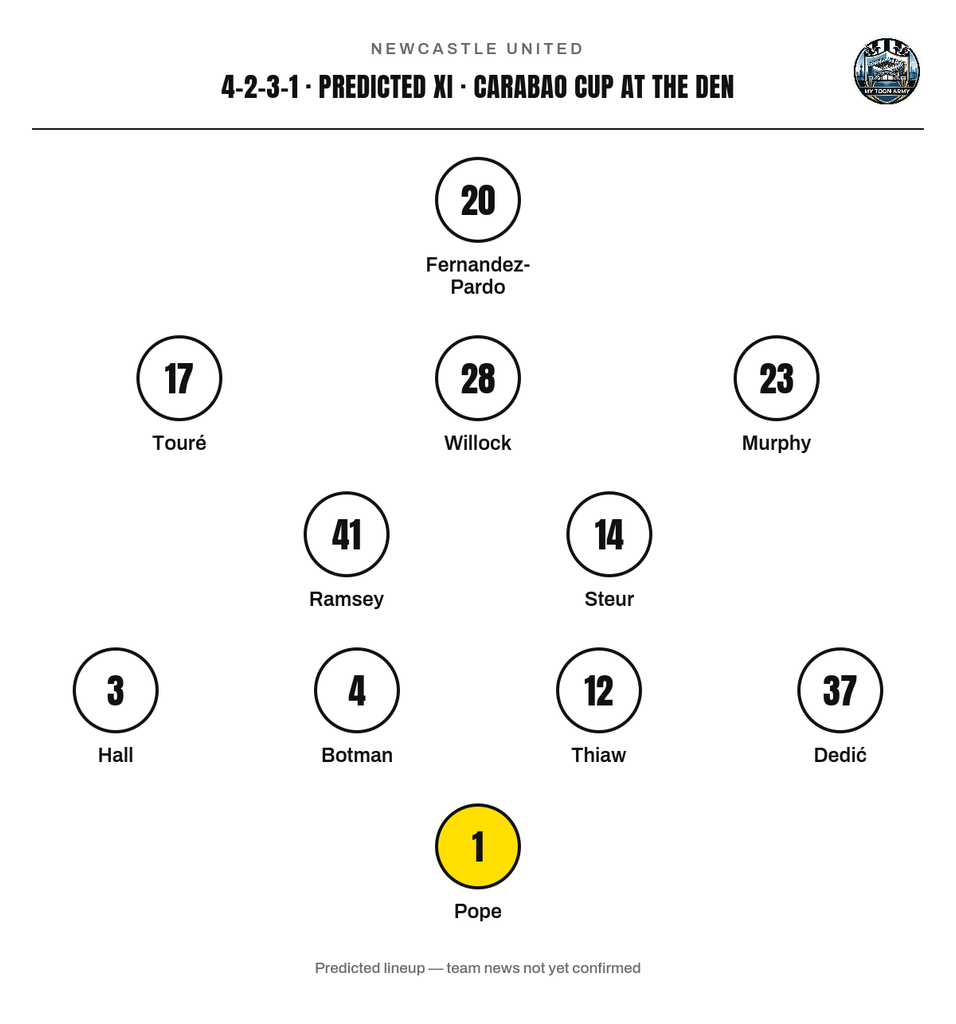
This is my own call rather than confirmed team news. Expect a 4-2-3-1: Pope given the nod in goal, the recall arriving through necessity rather than sentiment. Dedić at right-back, Botman and Thiaw retained as the centre-back pairing, Hall continuing at left-back with Livramento managed from the bench.
Ramsey to start against Millwall
Ramsey and Steur take the pivot on merit as much as fixture logic: Ramsey’s twenty-seven minutes off the bench against Bournemouth were enough to earn him the start on their own, sharper in the middle of the park than either man he replaced, while Steur’s thirteen-minute cameo was brief but composed enough to suggest Jaissle already trusts him on the ball. Miley and González drop no further than the bench — reminded that these places are contested weekly, not owned, which is exactly the competition a squad this size needs. Willock keeps his advanced role after an encouraging opening month, with Murphy and Touré offering width — rare pitch time for a £42m asset who needs it as much as the club does. Fernandez-Pardo leads the line, brought in on deadline day as Woltemade’s direct replacement — his own loan to Juventus went through the same afternoon — and a cup start is a sensible way to fast-track his introduction outside the league’s white heat. Wissa, Miley, González, Elanga, Barnes and Schär provide the bench options if Millwall’s physicality starts to tell.
Score prediction
Millwall will make this uncomfortable before Newcastle make it safe. I’ll go 3-1 to the Magpies — a nervy opening period in which the hosts ask real questions of an unfamiliar back line, a scare or an equaliser somewhere around the hour mark, and enough individual quality from the bench and front four to pull clear in the closing stages. Not the routine passage into round four the odds suggest, but a passage all the same — and one Jaissle will want wrapped up with legs still in the tank for Elland Road.
Does Millwall have what it takes after a rocky start to the season to stop a buoyant Newcastle? Will Ramsey and Steur step in for the first choice pairing of Miley and Gonzalez? Join the conversation on X @mytoonarmy #NUFC
Watch the split-second after Newcastle lose the ball in midfield and you are watching Matthias Jaissle’s entire football philosophy compressed into one freeze-frame: full-backs already stepping past the halfway line, a front four pushing into spaces that haven’t been vacated yet, a defensive line inching up before the ball has even changed hands. Nobody drops off. Nobody manages the game. The instruction, evidently, is to go and get it back higher than you lost it.
It is thrilling to watch. It is also why fifty-eight shots have been fired at Newcastle’s goal in Jaissle’s first three Premier League matches — an average of just over nineteen a game, against Liverpool, Tottenham and Bournemouth. One win and two draws have Newcastle unbeaten through those three games. The record reads fine. The process behind it has not.
The Brave Way, Tactically Speaking
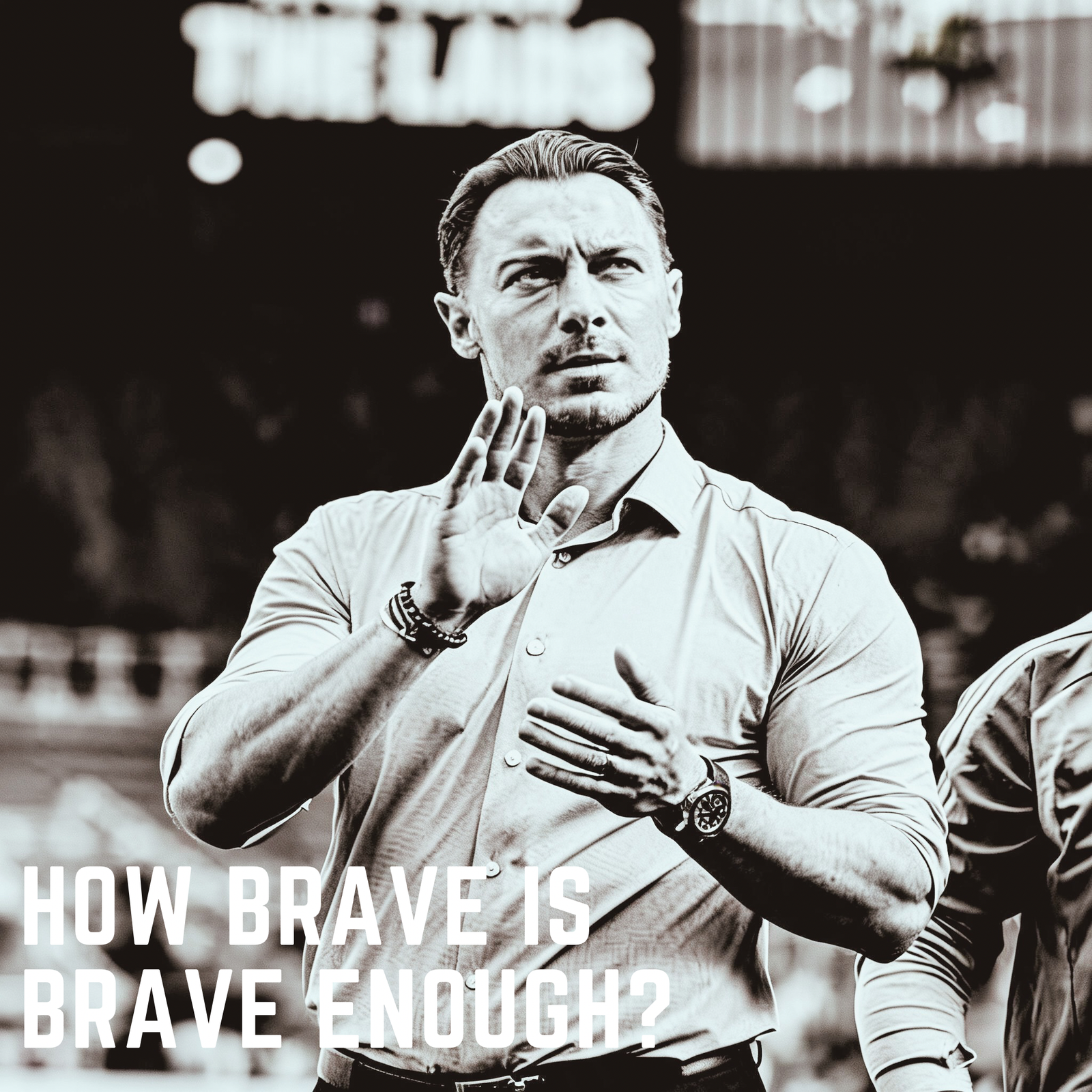
Jaissle has never pretended otherwise. Asked before the Bournemouth match whether he’d tighten up against a side built to counter, he said the approach stays “independent of the opponent, we have a clear way, clear identity.” That is not a throwaway line. It is a manager telling you, in advance, that he will not shape-shift to protect his defence no matter who’s coming the other way — the same conviction that has powered this summer’s recruitment strategy, which he has described, more than once, as simply “a brave way, but the way we want to go.”
Go back through his press conferences from the opening month and the phrase turns up again and again, attached to something different each time: rating a transfer window he wouldn’t score out of ten, defending a net spend he wouldn’t itemise, tempering Dan Burn’s talk of Europe against a squad he called one of the league’s youngest coming off a 12th-place finish, and pre-loading an excuse for Matias Fernandez-Pardo before the winger had kicked a competitive ball. Nick Woltemade, last year’s £69m club-record signing, left on loan to Juventus this window for a fee somewhere around a twentieth of what Newcastle paid for him thirteen months ago. That is what brave costs when you write it down on a balance sheet: patience, and faith that this summer’s twenty-one-year-old is a sounder long-run bet than last year’s.
The tactics are the same wager, run out on grass instead of a spreadsheet. Amar Dedić didn’t arrive as a blind punt — Jaissle brought him in from Benfica specifically because he already trusted the player’s game from their time together at Salzburg. Joe Willock and Jacob Murphy, both linked with exits all summer, were kept and immediately rewarded with bench impact against Liverpool. None of that sits apart from the shot count Newcastle are conceding; it’s the same operating principle expressed as a back four instead of a squad list. Commit to players you already trust, push bodies forward before the ball is fully won, accept that youth and unfamiliarity will produce ugly patches along the way, and bank on the upside outweighing them over a longer stretch than three games.
Same Coach, Different Numbers
The useful test is whether this shot count is simply what Jaissle’s football produces wherever he goes, or whether Newcastle are seeing something specific to this squad and this moment.
The early signs point to the latter, and the case is stronger than a hunch. A statistical comparison published before Jaissle’s first game, setting his final two seasons at Al-Ahli against Newcastle’s own recent defensive record, found the pressing identity translates almost exactly: near-identical shot counts generated directly from the high press, a defensive line sitting at a comparable height, the same volume of aggressive defensive actions. The one place the numbers diverged sharply was transition defending — Jaissle’s Al-Ahli conceded roughly 0.77 shots a game from counter-attacks, comfortably tighter than the 1.22 Newcastle had been shipping under their previous regime. By that measure, Jaissle arrived with a reputation for being harder to hit on the break, not easier.
Which makes nineteen shots a game — including twenty-five in a single afternoon against Liverpool — sit oddly against his own history. At Al-Ahli he averaged closer to ten shots conceded a match across two seasons while running practically the same press. At Salzburg, operating almost exclusively out of a 4-1-2-1-2 diamond that barely changed regardless of the scoreline, his sides won back-to-back titles and reached the Champions League knockout stage for the first time in the club’s history playing the same vertical, front-foot football — without bleeding shots at anything like this rate.
So this is not simply how Jaissle’s tactics work everywhere. Something about Newcastle right now is amplifying the risk beyond what his own managerial record would predict.
Why, Then?
A few explanations sit alongside each other rather than compete.
The obvious one is time. Jaissle walked into the building weeks before a ball was kicked, replacing a manager who had spent four years drilling a different structure into these exact players. He said as much himself before his first game, acknowledging the squad remains a work in progress and that building a new identity — after losing Bruno Guimarães, Sandro Tonali and Anthony Gordon in the same window — would take longer than one pre-season allows.
Amar Dedic, strong start to the season
The second is personnel, though the mechanism is sharper than “he plays too high.” Dedić’s own touch map this season argues against that reading — his heaviest zones sit deep, inside Newcastle’s own defensive and middle thirds, with barely a mark inside the final third. Nothing like the habitual overlap you’d see from a Diego Dalot or a Matty Cash. His baseline position is conservative, not advanced, which makes the two moments that undid Newcastle against Bournemouth more concerning, not less. They weren’t the recurring cost of a full-back who lives up the pitch finally getting caught out. They were isolated lapses inside an otherwise disciplined pattern, arriving at precisely the moments the game needed him switched on. A structural habit is something a manager coaches out by holding the line higher or lower. A specific lapse in concentration, twice in one afternoon, at the moments that decided the game, is a harder thing to promise will simply improve with time — trust from Salzburg or not.
There’s also a simpler fix sitting on the bench, worth flagging even with the caveats attached. Tino Livramento is Newcastle’s first-choice right-back when available, an England Under-21 European champion in two different tournaments, and a player whose reputation — concentration named specifically as a strength in his profile — is built on defensive solidity as much as attacking output. Set his final full season alongside Dedić’s opening three games and the gap turns up in exactly the places you’d expect: 1.25 xG conceded per 90 while on the pitch against Dedić’s 1.82, 0.95 goals conceded per 90 against 1.33, and a foul-committed rate of 0.47 per 90 against Dedić’s 2.00 — roughly four times fewer fouls, often the tell of a defender managing the game rather than recovering from having just been beaten by it.
None of that is a clean verdict. Three games is a small enough sample that one bad afternoon at Bournemouth can drag an average a long way on its own, and Livramento’s numbers come from an entirely different system under the previous manager, not from any minutes inside Jaissle’s actual structure. But directionally, it’s the same story the touch map told: the calmer, lower-event full-back profile is sitting on the bench, still working back from the calf injury and surgery that wiped out his entire pre-season. Nobody should rush him for the sake of a headline. Once he’s genuinely match-sharp rather than fresh off a comeback minute, though, he looks like the lowest-risk route back to solving this specific problem without touching the system at all.
The third is the level. Ten shots a game in the Saudi Pro League and a title-winning diamond in Austria are not the same test as Liverpool’s front four in August. Jaissle himself has drawn the distinction before, noting that his time working with a squad full of the established internationals at Al-Ahli forced him to think “much more game-to-game” than the fixed system Salzburg’s academy conveyor belt demanded of him. Newcastle currently ask something closer to the Salzburg version of him — one settled idea, applied without much in-game modification — against opposition that punishes fixed ideas fastest.
The Bill Comes Due, Eventually
Here is the part worth being honest about rather than papering over with good vibes from an unbeaten start.
Two German coaches, share the spoils #NEWBOU
Three games of quality finishing and a couple of slices of fortune — Barnes’ cannot-do-that-again strike, Ramsey scoring on his introduction, Liverpool’s leveller arriving from the penalty spot in stoppage time rather than a chance this back line actually conceded in open play — have made a shots-conceded column read fine on the league table. That is not a stable equilibrium across thirty-eight games. Defences that concede at close to nineteen shots a game across a full season, historically, are relegation-adjacent defences, not mid-table ones, unless the goalkeeper and finishing at both ends keep overperforming for nine months running. That basically never happens. The law of averages does not negotiate with good vibes, and it has a very long season to make its point.
None of which means the approach is wrong. It means it’s a wager, exactly like the summer’s transfer business was a wager, and wagers carry the possibility of losing as the explicit cost of the potential upside. The same afternoon that saw a teenager score Bournemouth’s equaliser off Dedić’s own delivery also saw two lapses from that same player gift Bournemouth a two-goal cushion inside thirty-five minutes. You do not get to keep one half of that trade and discard the other.
What happens next is the actual story of this season, more than any single result. If the counter-attack numbers tighten as Dedić’s concentration catches up with his positioning, as the back four settles, as Jaissle finds the flexibility at St James’ Park that he found in Saudi Arabia once he had time to build it — the brave way pays off, the way Ross Wilson’s transfer strategy is designed to pay off three years from now rather than three months. If it doesn’t, nineteen shots a game stops being a number Newcastle survive and starts being one that costs them points nobody can quality-finish their way back from.
Either way, watch the shots-conceded column more closely than the league table for the next ten games. It will tell you which version of brave this is going to be.
The brave way already showed us what this costs on a balance sheet. The shot count is showing us what it costs on the pitch.
What do you think of Jaissle after the first three league games? Will Newcastle be able to tighten up their leaky defence? Join the conversation on X @mytoonarmy #NUFC
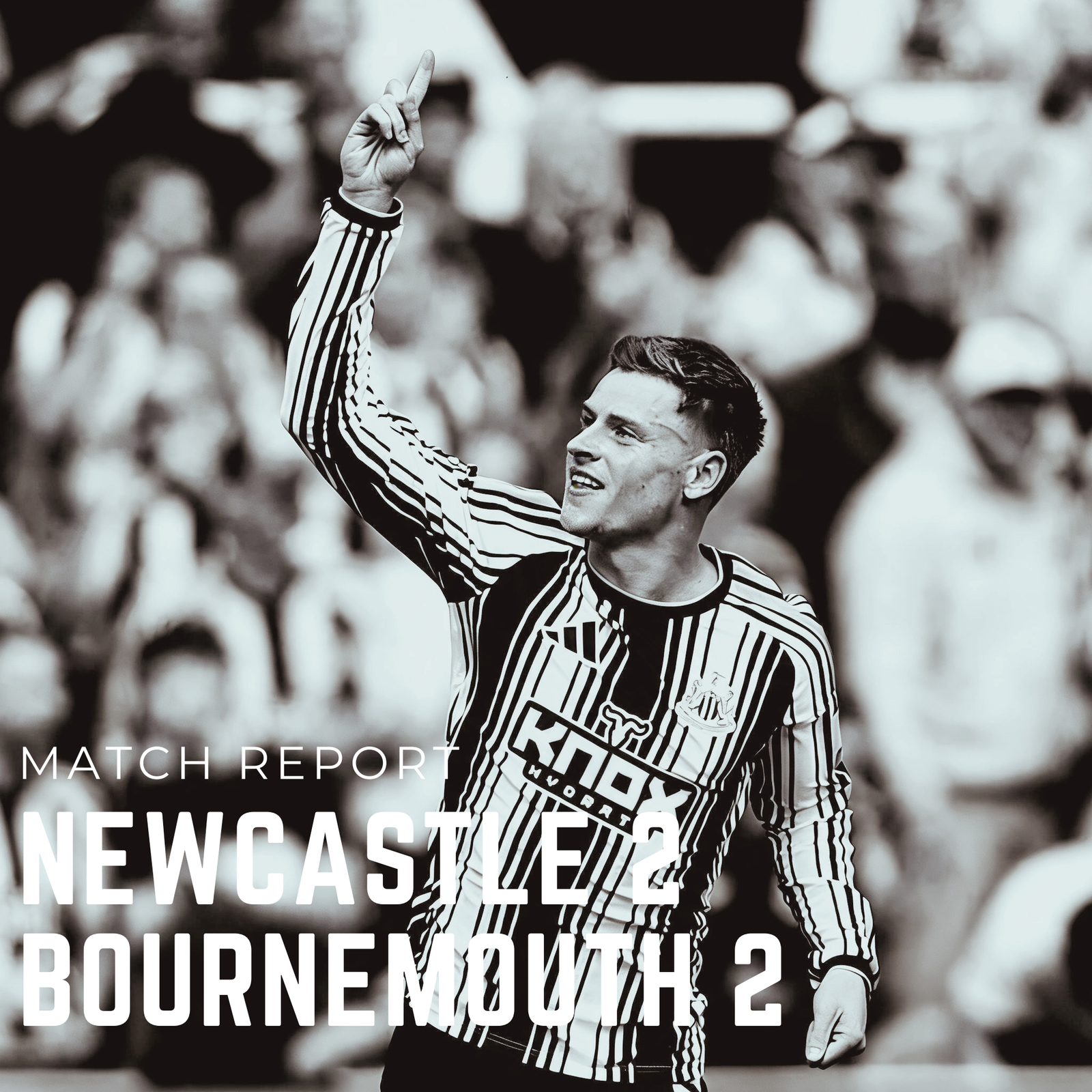
Twelve yards out, eighty-eighth minute, Jacob Ramsey took one touch to settle a half-cleared ball and side-footed it low past Djordje Petrovic. St James’ Park did not so much roar as exhale — fifty-two thousand people releasing eighty-eight minutes of accumulated grievance in one go.
It was Newcastle’s second shot on target all afternoon. Their second. Against a side who had managed five.
That single statistic tells you almost everything about the shape of Saturday lunchtime, and almost nothing about what actually mattered. Because the question posed in this column on Friday was never whether Newcastle would out-pass or out-create Bournemouth. It was whether this team, carrying the sudden and uncomfortable weight of expectation, could handle a fixture they were supposed to win against opposition they cannot beat. The answer arrived in two parts, and the second part was more revealing than the first.
The First Half That Proved the Warning and Missed the Point
Friday’s preview flagged the number that should have frightened everyone: no side in the Premier League had faced more shots than Newcastle across the opening two rounds. Jaissle’s system creates through aggression and concedes through it, and Bournemouth — pacey, direct, built to punish an open midfield — looked like precisely the wrong opponent to test it against.
Forty-five minutes later that warning looked prophetic. Thirteen Bournemouth shots to Newcastle’s three. An expected goals reading of 1.29 to 0.14. Marco Rose’s side did not merely start brightly; they arrived at St James’ Park with the clarity of a team who had watched the Liverpool and Tottenham tapes and decided that Newcastle’s high line was an invitation.
But the mechanism was not the one predicted. Both goals traced back to the same right boot, and it belonged to Newcastle’s own right-back.
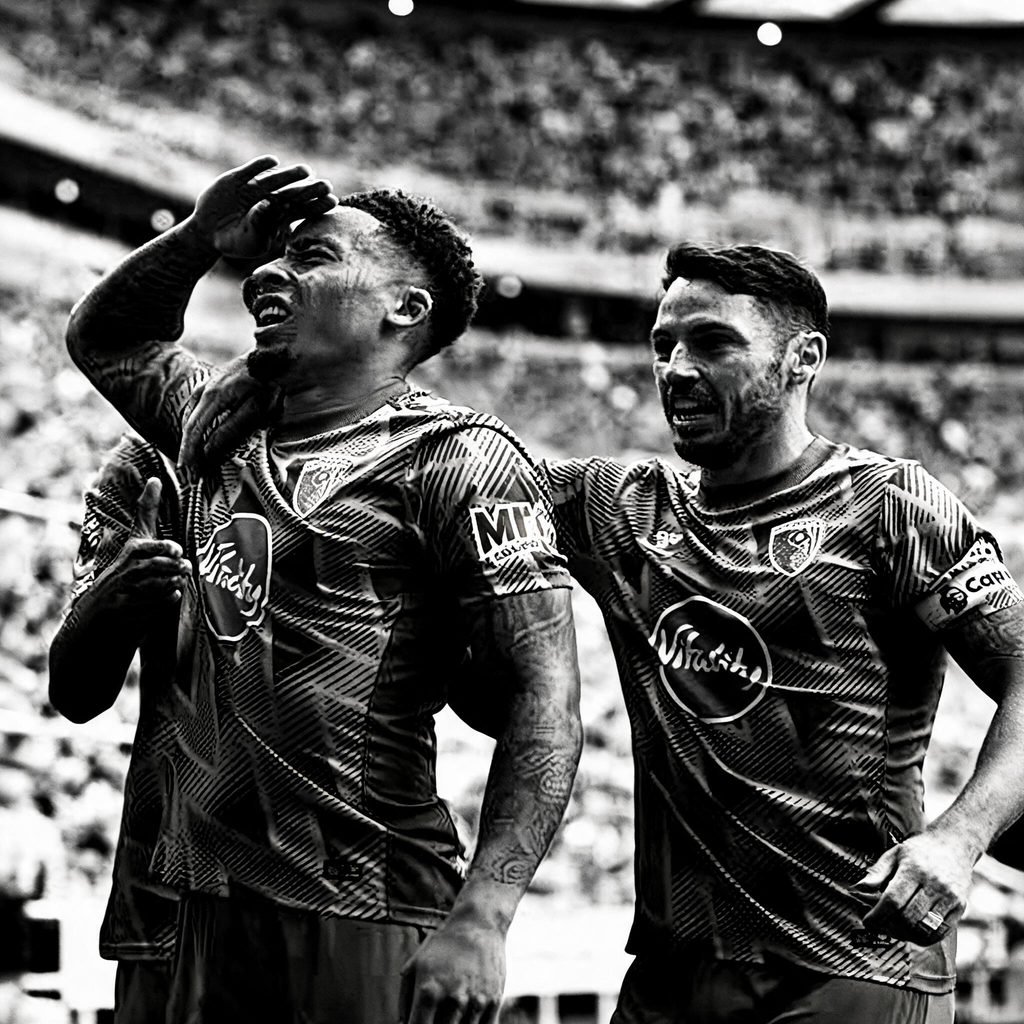
The ninth minute: Alex Scott’s shot deflected off a Newcastle body and spun loose at the back post, and Amar Dedić stood watching it as though the phase of play had ended when the shot was struck. Marcus Tavernier did not stand watching. He arrived, and he finished, and Newcastle’s players surrounded referee Rob Jones insisting Anthony Elanga had been fouled in the build-up. VAR looked. VAR declined. Former PGMOL chief Keith Hackett has since backed the non-intervention as a legitimate refereeing judgement, and on the replays it is hard to argue otherwise — but the mood of the afternoon was set in that opening exchange, and it never fully recovered.
The thirty-fifth was worse, and it was worse because it was structural rather than accidental. Dedić lost the ball high up the pitch, in the advanced position his attacking instincts keep dragging him towards. Tavernier skipped past Nico González in the space that Dedić had vacated. Justin Kluivert’s shot smashed against the post and rebounded off Lukáš Horníček’s back; Scott collected the loose ball on a desperately tight angle and clipped a low cross that ricocheted off Malick Thiaw and looped over his own goalkeeper.
Call it misfortune if you like. The scoresheet does — Thiaw’s name sits there with the letters OG beside it, and he will not enjoy seeing them. But the dominoes fell in a very particular order, and the first one was pushed by a twenty-four-year-old full-back who has been outstanding going forward and repeatedly caught out coming back.
Here is the complication, and it is the reason this is a character study rather than a hanging. Dedić’s delivery into the box is what led to the equaliser. He also curled a late free-kick high over the crossbar chasing a winner. Three of the four goals in this match had his fingerprints on them, in both directions. Ross Wilson signed a right-back whose attacking threat and defensive naivety are not two separate traits but the same trait, pointed in opposite directions. That is a coaching problem, not a recruitment error — but it is a problem, and Leeds away is not the place you want it unresolved.
The Boy Newcastle Let Go
There is a small, sour piece of poetry buried in the identity of Bournemouth’s scorer.
Bane of Newcastle, Marcus Tavenier
Marcus Tavernier grew up in Newcastle’s academy. He was released as a boy, picked up by Middlesbrough at under-14 level a fortnight later, and has spent the years since building a career that keeps intersecting with the club that decided he was not good enough. Saturday’s opener was, by the Press Association’s count, his fourth goal in five appearances against Newcastle United.
Which brings us to the harder question this column promised to answer: why can’t we beat them?
The lazy explanation is that Bournemouth are a bogey side and bogey sides defy analysis. The better explanation is that the Cherries possess a specific structural weapon that has now survived a complete change of managerial philosophy. Andoni Iraola built a team around fast, direct wide players who attack space behind a committed defensive line. Marco Rose — Leipzig, Dortmund, Mönchengladbach — coaches a different game in most respects, but he inherited Kluivert, Tavernier and Rayan, and he did not have to be taught what they were for.
Nine Premier League matches without a Newcastle win, stretching back to July 2020. Two Bournemouth managers, four Newcastle ones. The dugouts keep changing. The puzzle piece that unlocks us does not.
What Bournemouth Actually Are
And here we should be honest about the opposition, because “mid-table side Newcastle should beat” undersells them badly.
The summer of 2026 was, on paper, the summer Bournemouth were supposed to be dismantled. Alex Scott — twenty-three, England-capped, refusing a new contract — was chased by Manchester United, Chelsea, Arsenal and Liverpool, with a late Chelsea bid rejected outright. Rayan, the Brazilian teenager they paid Vasco da Gama £30m for in January, drew Real Madrid’s attention. Eli Junior Kroupi, thirteen Premier League goals in his first full season, was watched by Arsenal and Paris Saint-Germain.
None of them left.
For a finance-literate readership this is the detail worth sitting with. Bournemouth did not merely wish their players would stay; they had built the contractual architecture to make refusal credible — long deals, release clauses set at levels (£87m for Rayan, roughly £86.5m for Kroupi) that price out opportunism rather than invite it. They sold Marcos Senesi, a defender approaching the end of his deal, and reinvested. António Silva, the man who replaced him, won nine duels on Saturday and eight of eleven in the air, more than any player on the pitch in either shirt.
Alex Scott, masterclass
That is not a plucky small club. That is a properly run one, refusing to accept the role of feeder club that the league’s economics keep pressing on everybody outside the top six. Newcastle, of all clubs, should recognise the achievement — we spent the summer watching Bruno Guimarães and Sandro Tonali walk out of the door.
Twenty Yards, Two Minutes, One Moment
Newcastle were drowning. And then Harvey Barnes decided they weren’t.
Harvey Barnes, wondergoal 1-2
Less than two minutes after Thiaw’s own goal, Lewis Hall slid the ball down the left channel, Barnes collected it, cut inside onto his right foot and curled a shot into the far top corner from the edge of the box. The underlying numbers rate the chance at 0.11 expected goals. The execution rated 0.83 on target. In plain English: nobody scores that shot, and he scored it.
Football is not usually decided by moments of individual defiance. It just is often enough that teams keep believing in them. Had that ball gone two feet wider, Newcastle go in three down or two down and dead, Jaissle’s substitutions become damage limitation rather than intervention, and this article is about a very different afternoon.
The Referee, and a Problem the League Has Not Solved
The second half is where the argument starts.
Newcastle came out quicker, sharper and with a settled idea of where the game was to be won. They did not get the chance to build any rhythm — and that was by design, though not solely Bournemouth’s.
Thirty-five fouls were awarded across ninety minutes. Rob Jones’s own season average coming into this fixture ran at 22.7 fouls per game, itself flagged as above the Premier League norm. This match ran hotter and choppier than his usual, and it ran that way at exactly the moment Newcastle needed continuity. Bournemouth’s players, comfortably ahead, discovered a succession of ailments requiring attention. Physios came on in rotation. Every restart took a beat longer than it needed to.
One passage captures it precisely. Shortly after coming on, Matias Fernandez-Pardo won a free-kick thirty-four yards from goal — the sort of set-piece that keeps a siege alive. The whistle went again for something else, and the moment evaporated. Jaissle, whose reading of the situation was entirely correct, collected the first booking of his Premier League managerial career in the seventy-first minute for saying so. Six minutes were added at the end.
Let us be precise about the complaint, because it is not the tired one. Bournemouth were entitled to manage the game; every side ahead in the eighty-second minute does the same, and Newcastle would have done it too. The issue is that the Premier League spent years introducing stopwatch timekeeping specifically to make this behaviour unprofitable — precise added time for treatment, substitutions, celebrations, delay. Howard Webb promised the clampdown was not a matter of “days and weeks.” Three seasons on, a visiting side slowed a match to a crawl at St James’ Park and it worked, right up until it didn’t.
The pre-season assessment of the 2026-27 officiating pool framed the coming year’s real test not as new technology or fresh guidance, but as whether the same foul, the same holding offence, the same threshold for stopping play is judged identically in August and in May. Saturday was a data point. It will not be the last, and it will not only ever fall against us.
Jaissle’s Hour
Now the part that should genuinely encourage you.
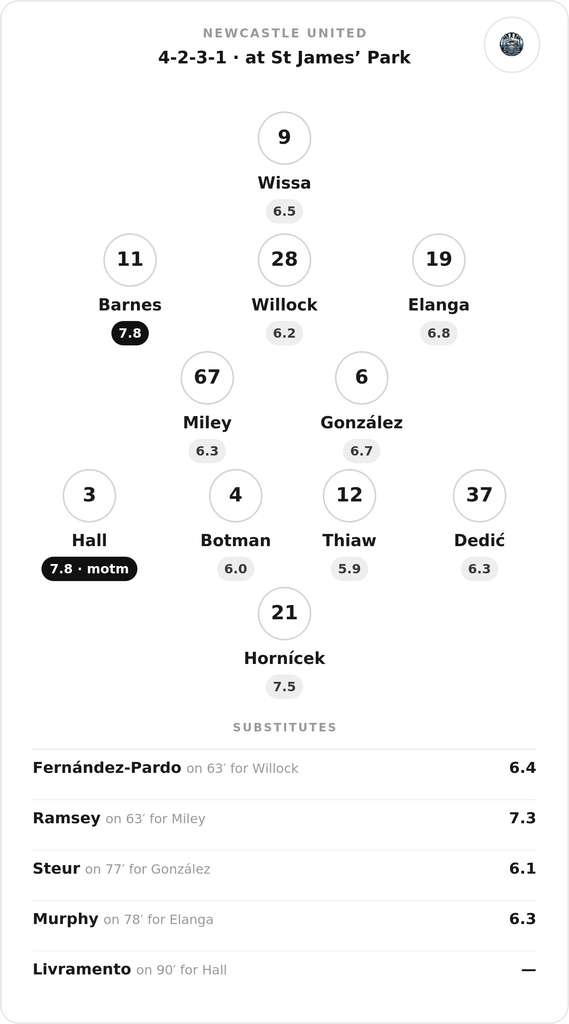
At sixty-three minutes, still 1-2 down, still creating little, Jaissle removed Joe Willock and Lewis Miley and sent on Fernandez-Pardo and Ramsey together. Not a late throw of the dice — a considered intervention with nearly half an hour left, from a manager who had watched the first half and concluded that the problem was not effort but structure.
The numbers either side of that change are stark. Bournemouth outshot Newcastle 13-3 before the break; after it, Newcastle edged the shot count 5-4 and the expected goals 0.57 to 0.08. The Cherries, who looked genuinely unplayable for half an hour, simply stopped being able to reach Newcastle’s box. Possession shifted, but more importantly the shape of possession shifted — quicker, straighter, forward.
Twenty-five minutes after arriving, Ramsey scored.
Jacob Ramsey, 2-2
And the crowd, it must be said, did as much of the work as the tactics board. Fifty-two thousand six hundred and forty-three inside a full house, and by the closing quarter they had turned St James’ Park into something Bournemouth visibly did not want to be standing in. Speaking to Match of the Day afterwards, Jaissle said: “I have mixed feelings. But after that start, you should be happy. But if we could have performed at the best level over 90 minutes, we could have had all three points. We couldn’t match Bournemouth’s intensity in the first half and conceded twice.”
That is the correct read. This was not a good performance. It was, however, evidence of a thing this club has conspicuously lacked. Last season Newcastle led the division in points thrown away from winning positions. On Saturday they were the ones doing the clawing.
The Best Player Was Not the One Who Scored
Harvey Barnes produced the moment. Lewis Hall produced the performance.
Both were rated 7.8, but the composition differs entirely. Hall supplied the assist for Barnes’s goal, made thirteen ball recoveries — more than any player on the pitch, in either shirt — completed 87 per cent of his passes and played nine line-breaking passes from left-back. When Newcastle were being overrun, he was the one repeatedly winning the ball back and pointing it forward. When they were chasing, he was the platform underneath the chase.
Yoane Wissa ran ten kilometres and hit 33.7 km/h without registering a single shot, which is its own kind of thankless. Nico González played more line-breaking passes than anyone on the pitch — twelve — while also conceding six fouls and being dribbled past three times, a rookie’s afternoon in an English midfield.
But Hall is the answer. Barnes won the highlights reel; Hall won the hour.
Twenty-Seven Minutes of a £51m Question
Friday’s preview predicted Jaissle would introduce Fernandez-Pardo gradually, from the bench, rather than disturb a functioning front line. That is precisely what happened, and the Belgian’s afternoon lasted twenty-seven minutes.
He did not score, did not assist, and was thoroughly upstaged by the man who came on alongside him. What he did do was cover 875 metres at running pace and register nine sprints in under half an hour, take three touches inside the Bournemouth box, and beat his man the one time he tried. He also won the free-kick that the referee’s whistle promptly buried.
Flashes, then. Nothing more, and nothing to worry about. Jaissle called it “a lot of quality” and stressed the need to manage a young player carefully. Judgement deferred, which is exactly where it should sit.
Toon Army Malaysia, MV #NEWBOUGringo’s TTDI, thanks for hosting us!
What’s Next
Newcastle travel to Millwall on Tuesday for a Carabao Cup third-round tie that will hand minutes to the players who did not get them here — and Tino Livramento, who Friday’s preview said would not be risked, has already returned for a stoppage-time cameo. Then Leeds away on Monday the fourteenth, and Hull City at St James’ Park the following Saturday. Five points from three games with a trip to Elland Road next is a perfectly respectable platform; it is also a schedule with no more free passes in it.
Bournemouth host Lincoln City on Tuesday and Brentford next Saturday, and Rose’s problem is now a matter of public record. His side became the first team in Premier League history to score first in each of their opening three fixtures and win none of them. They have dropped seven points from winning positions already this season and twenty-nine since the start of the last — a figure they share, with some irony, with Newcastle. Four of the five goals they have conceded this term arrived after the eightieth minute. “If we can’t finish the games,” Rose said afterwards, “we need to defend our goal like it’s the last game of our lives.”
The hoodoo stands at nine. We still cannot beat them.
But for the first time in a long while, the story on the way back down Barrack Road was not about what Newcastle let slip. It was about what they refused to. Friday’s column asked whether this team could handle the sudden, uncomfortable presence of expectation. They failed the first half of that examination badly, and then they answered it in the only currency that has ever mattered on Tyneside.
They did not give in.
What do you think about the fightback from 2 goals down? Shall Pardo start the next league game against Leeds? Join the conversation on X @mytoonarmy #NUFC